Raja Ratnam
- Festivals , Mythology
- October 5, 2026
- 28 views
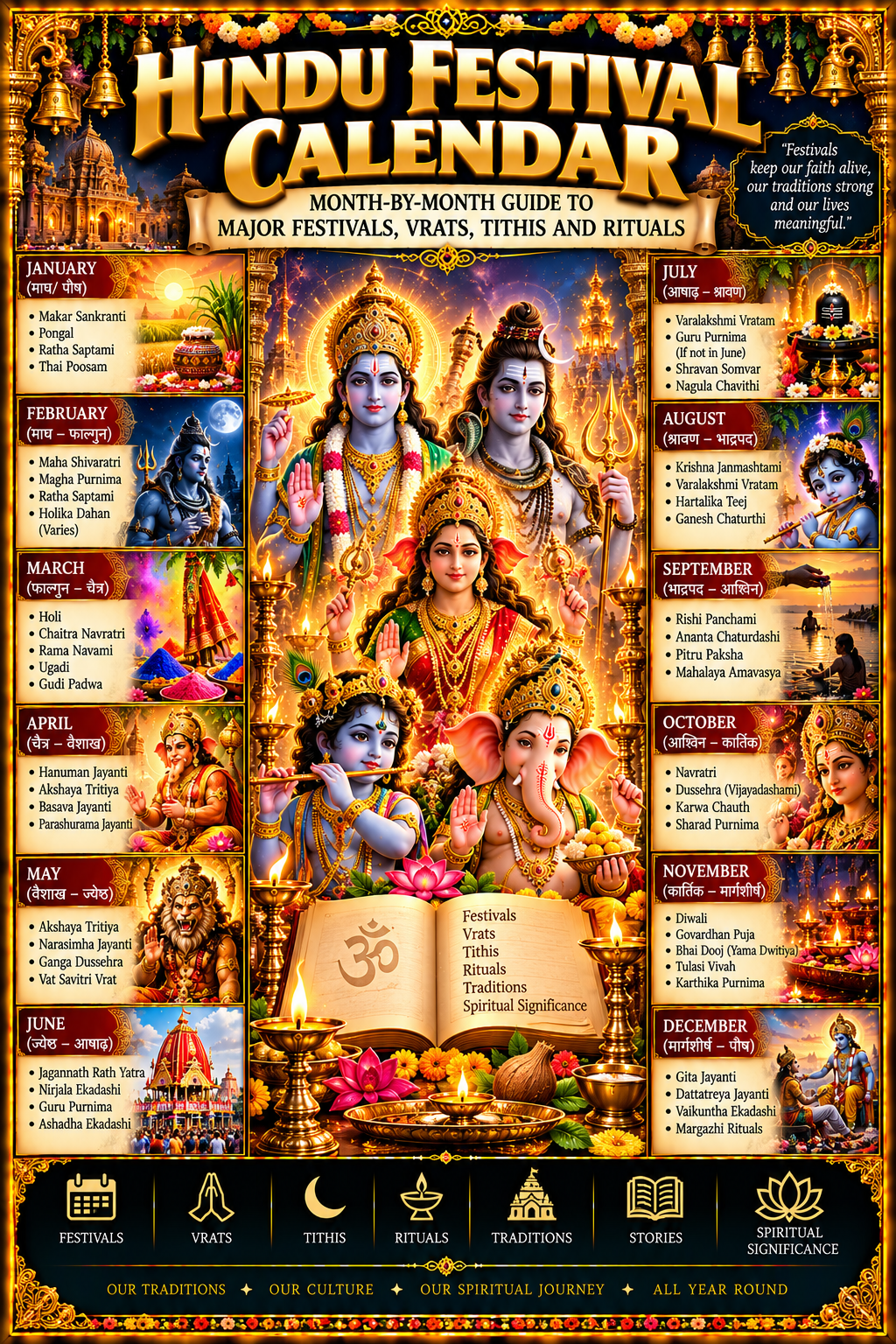
Hindu Festival Calendar: Month-by-Month Guide to Major Festivals, Vrats, Tithis and Rituals
The Hindu calendar (Panchangam) is one of humanity’s most sophisticated astronomical and spiritual systems. Rather than viewing time as a flat, linear ticking of clocks, Sanatana Dharma views time as a sacred cosmic dance governed by the movements of the Sun (Surya), Moon (Chandra), and constellations (Nakshatras). Every lunar month brings unique energetic frequencies, observed through sacred festivals (Utsavas) and disciplined penances (Vrats). Whether you are seeking auspicious dates for worship, fasting rules for sacred tithis like Ekadashi and Pradosham, or the spiritual symbolism behind celebrations like Diwali, Navratri, and Maha Shivaratri, this comprehensive month-by-month guide serves as the ultimate perennial reference for the Hindu liturgical year. Understanding the Hindu Calendar: Solar vs. Lunar and Amanta vs. Purnimanta Before exploring individual festivals, it is essential to understand how traditional Hindu dates are determined. The calendar incorporates both solar and lunar mechanics: Month-by-Month Hindu Festivals & Vrat Calendar Below is the complete cycle of the twelve sacred lunar months, their presiding planetary energies, and the foundational festivals celebrated across India: 1. Chaitra (March – April): The Dawn of the Cosmic Year Chaitra marks the beginning of the Hindu New Year in many traditions. It begins with the Shukla Pratipada following the…
- Mythology , Ramayanam
- October 5, 2026
- 11 views
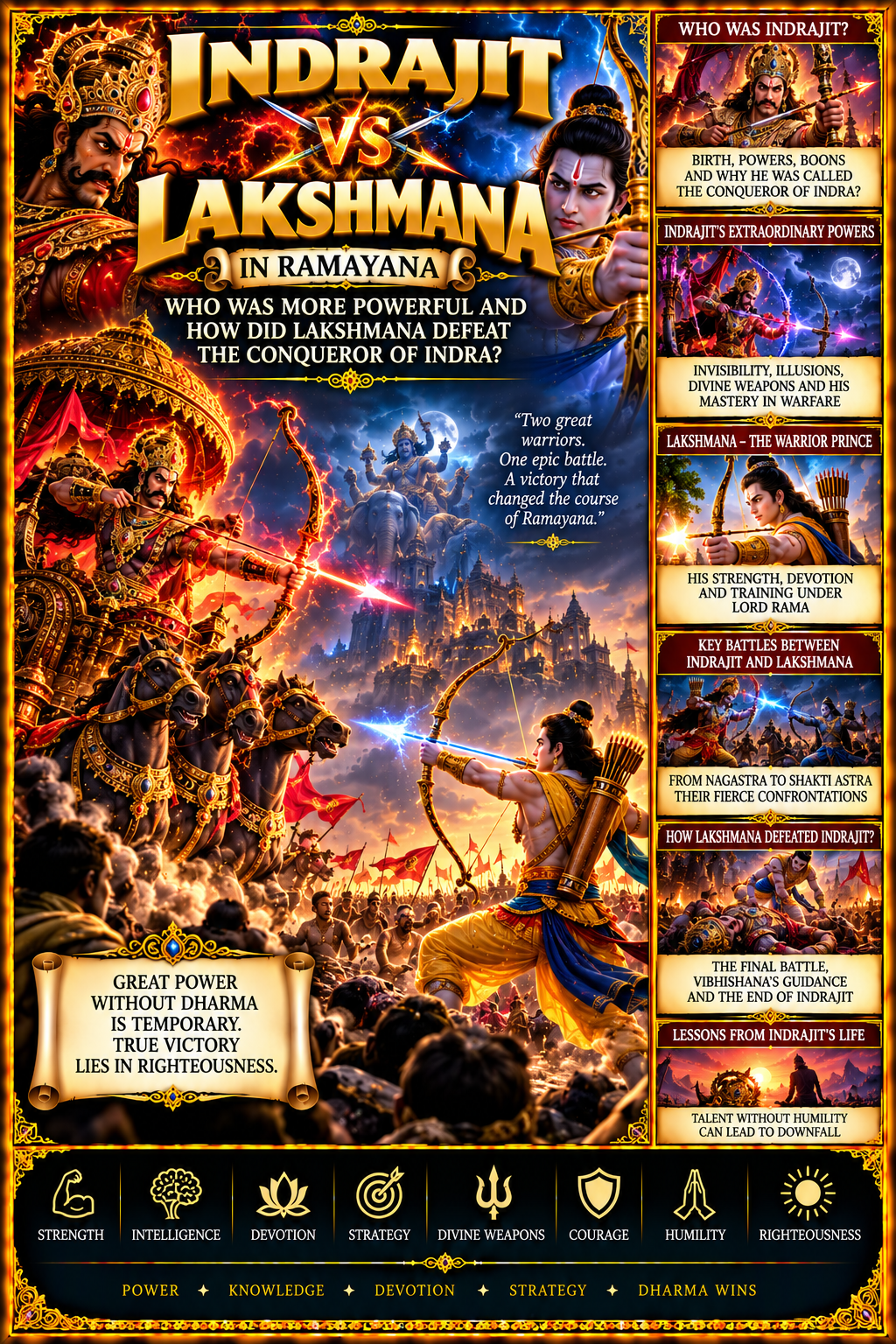
Indrajit vs Lakshmana in Ramayana: Who Was More Powerful and How Did Lakshmana Defeat the Conqueror of Indra?
In the grand canvas of the Valmiki Ramayana, while the ultimate philosophical showdown is fought between Lord Rama and Ravana, the most ferocious, technically terrifying martial confrontation unfolds between their respective champions: Meghnada (Indrajit), the crown prince of Lanka, and Lakshmana, the devoted younger brother of Rama and earthly avatar of Adi Shesha. This monumental duel has fascinated scholars, military tacticians, and spiritual seekers across millennia: between the master of celestial sorcery and the master of ascetic self-conquest, who was truly the superior warrior? To understand the depth of this war within a war, one must explore not just physical archery, but the metaphysical layers of destiny, divine boons, moral virtue, and the pivotal sacrifice of 14 sleepless years. For readers exploring our deep dives into Ravana in Ramayana: The Great Ruler of Lanka and the overarching epic of The Journey of Rama, Sita, and Lakshmana, this definitive comparison provides an authentic, scripture-backed analysis of the deadliest battle fought under the skies of Lanka. Who Was Meghnada? The Rise of Indrajit, the Supreme Mahamaharathi Meghnada was the eldest son of Ravana and Queen Mandodari. At the moment of his birth, his father forced the planetary deities (Navagrahas) into the eleventh…
- Mahabharatam , Mythology
- October 5, 2026
- 11 views
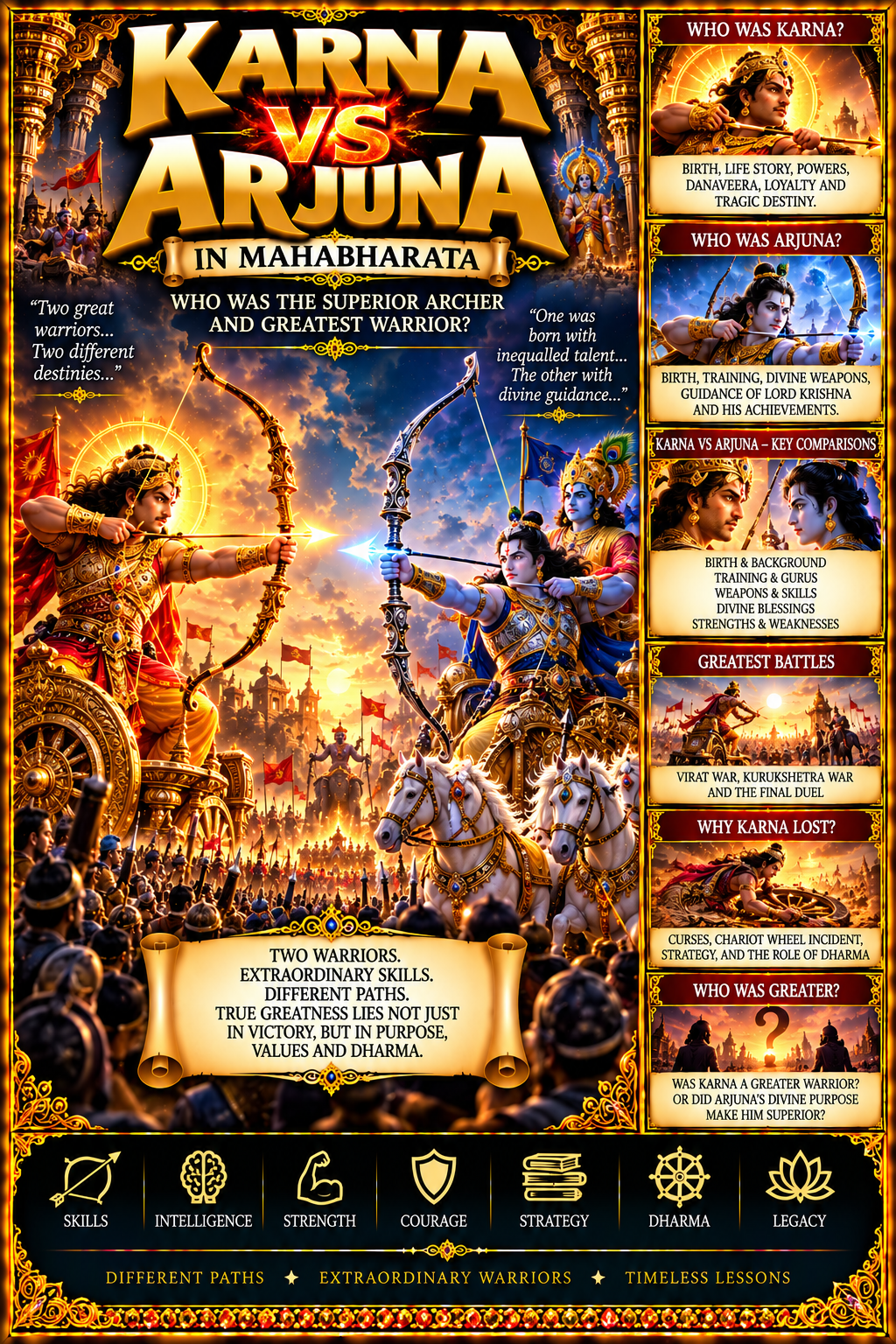
Karna vs Arjuna in Mahabharata: Who Was the Superior Archer and Greatest Warrior?
The rivalry between Karna and Arjuna in the epic Mahabharata stands as one of the most intense, passionate, and enduring debates in world literature. For thousands of years, scholars, devotees, and casual readers have passionately argued over a singular question: Who was truly the superior archer—Karna or Arjuna? Both warriors possessed divine parentage, peerless martial training, celestial weapons (Divyastras), and unwavering courage on the battlefield of Kurukshetra. Karna, the son of the Sun God Surya, is revered as Daanveer—a tragic hero whose loyalty, generosity, and resilience matched his fearsome archery. On the other side stood Arjuna, the son of Indra, the favorite disciple of Dronacharya, and the supreme warrior of Dharma guided by none other than Lord Krishna. To definitively understand the clash between Karna vs Arjuna, one must move past emotional retellings and analyze the authentic verses of the Vyasa Mahabharata. In this definitive guide, we compare their divine origins, gurus, celestial weapons, pre-war clashes, the climatic 17th day duel of Kurukshetra, a head-to-head comparison table, and 20 detailed frequently asked questions. 1. Divine Birth and Early Upbringing: Surya Putra vs. Indra Putra To understand the fundamental nature of their rivalry, one must first look at the divine forces…
- Mythology , Ramayanam
- October 4, 2026
- 13 views
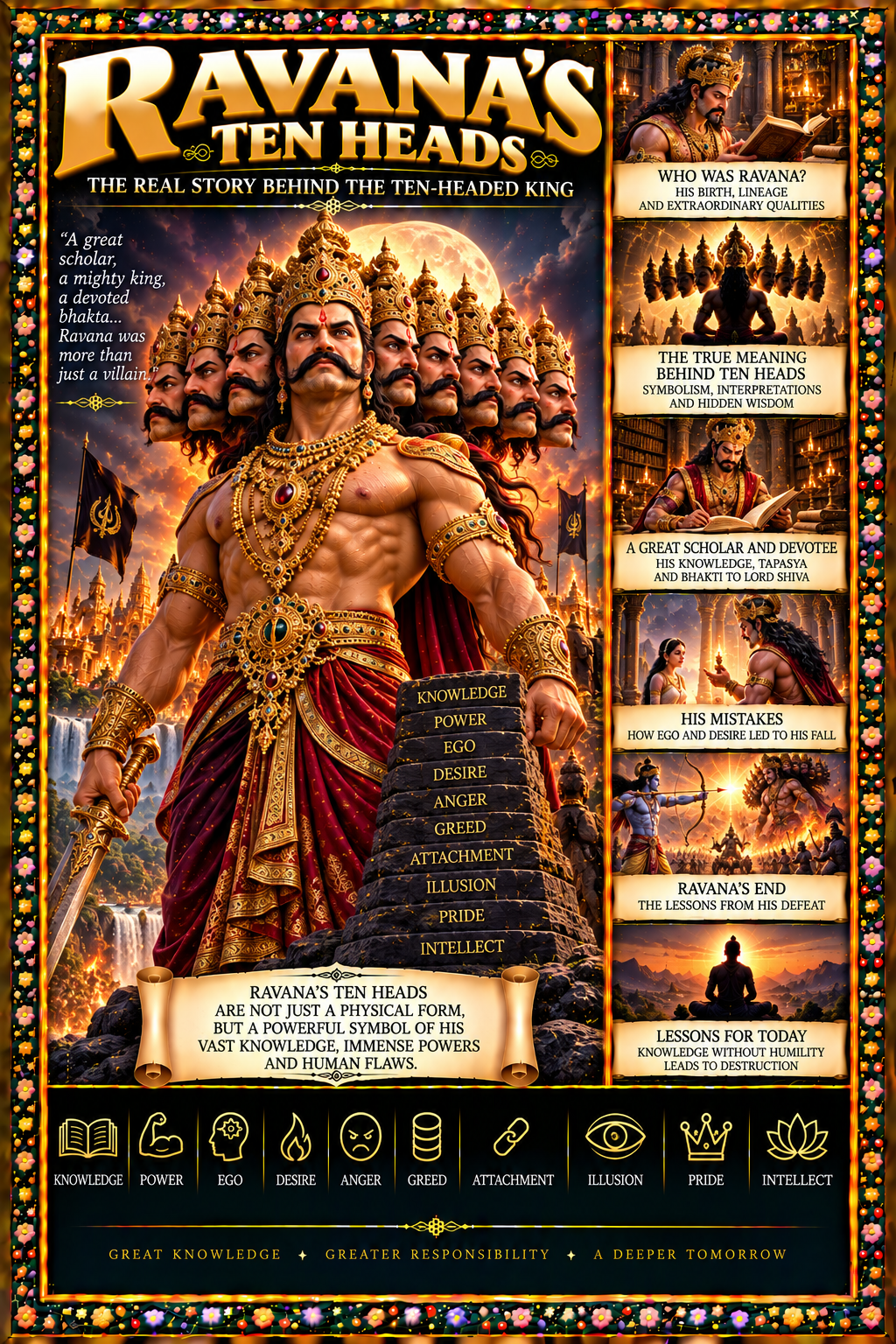
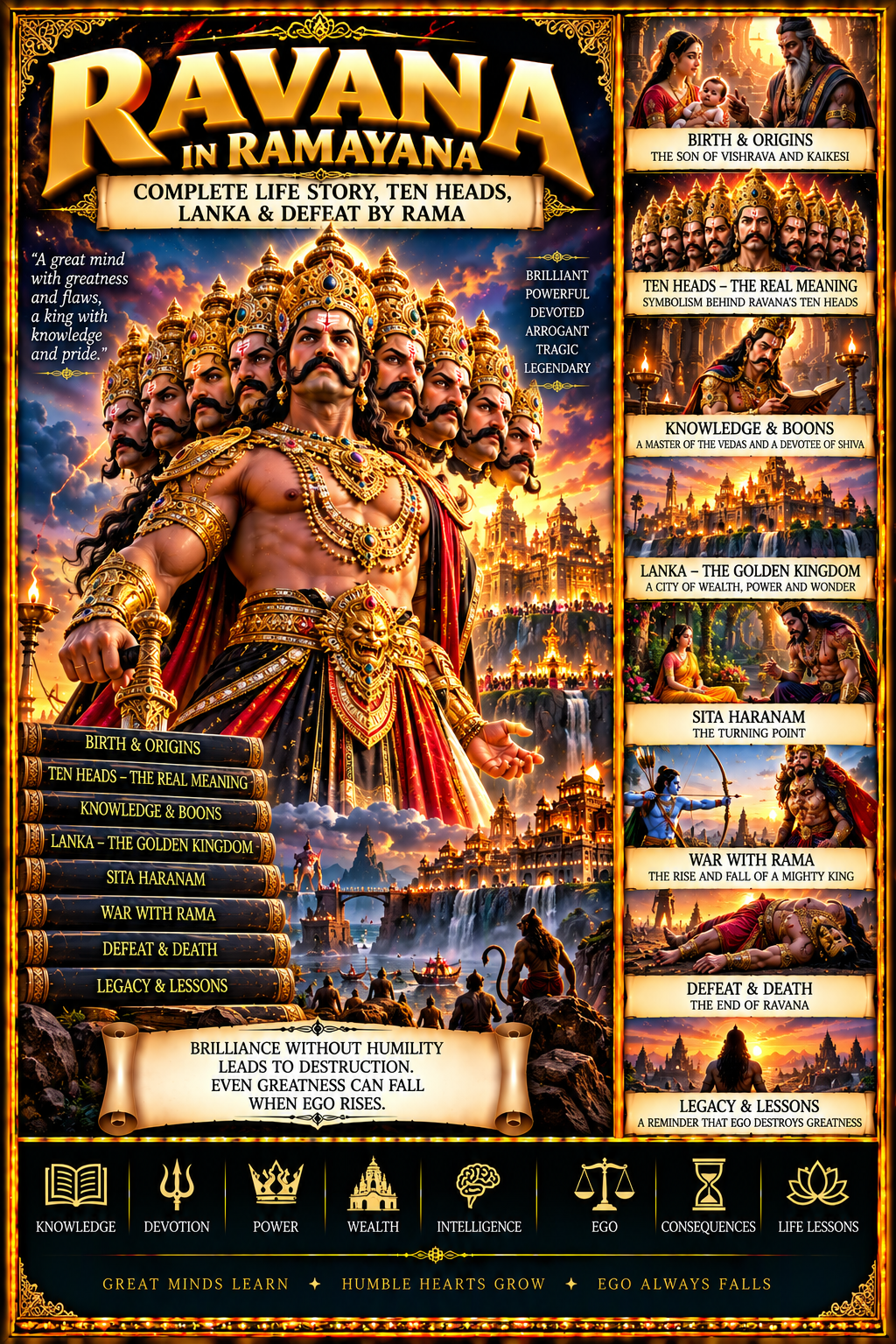
Ravana in Ramayana: Complete Biography, Shiva Bhakti, Golden Lanka & Downfall
The story of Ravana in Ramayana presents one of the most complex, formidable, and multi-dimensional figures in world mythology. Known as the King of Lanka, a devout worshipper of Lord Shiva, a master of the Veena, and a great scholar of the Vedas, Ravana possessed extraordinary intelligence, royal wealth, and cosmic power. Yet, despite his immense virtues, scholarship, and spiritual penance, Ravana allowed his uncontrollable ego, lust, and arrogance to govern his destiny. His unlawful abduction of Goddess Sita set into motion the final battle of Lanka and his ultimate defeat at the hands of Lord Rama. In this ultimate guide, explore the complete life story of Ravana in Ramayana, his divine birth, the secret of his ten heads (Dashanana), the golden empire of Lanka, his scholars’ achievements, the epic war, and 20 detailed frequently asked questions. The Birth, Ancestry, and Lineage of Ravana in Ramayana To understand the character of Ravana in Ramayana, one must trace his unique dual heritage. Half-Brahmin and Half-Rakshasa Lineage Ravana was the son of Sage Vishrava (a great Vedic Rishi and grandson of Lord Brahma) and Princess Kaikesi (an Asura princess). Because of his lineage, Ravana was half-Brahmin and half-Asura: Ravana grew up alongside…