Raja Ratnam
Jwala Toranam: Significance and Legend of the Karthika Pournami Fire Ritual
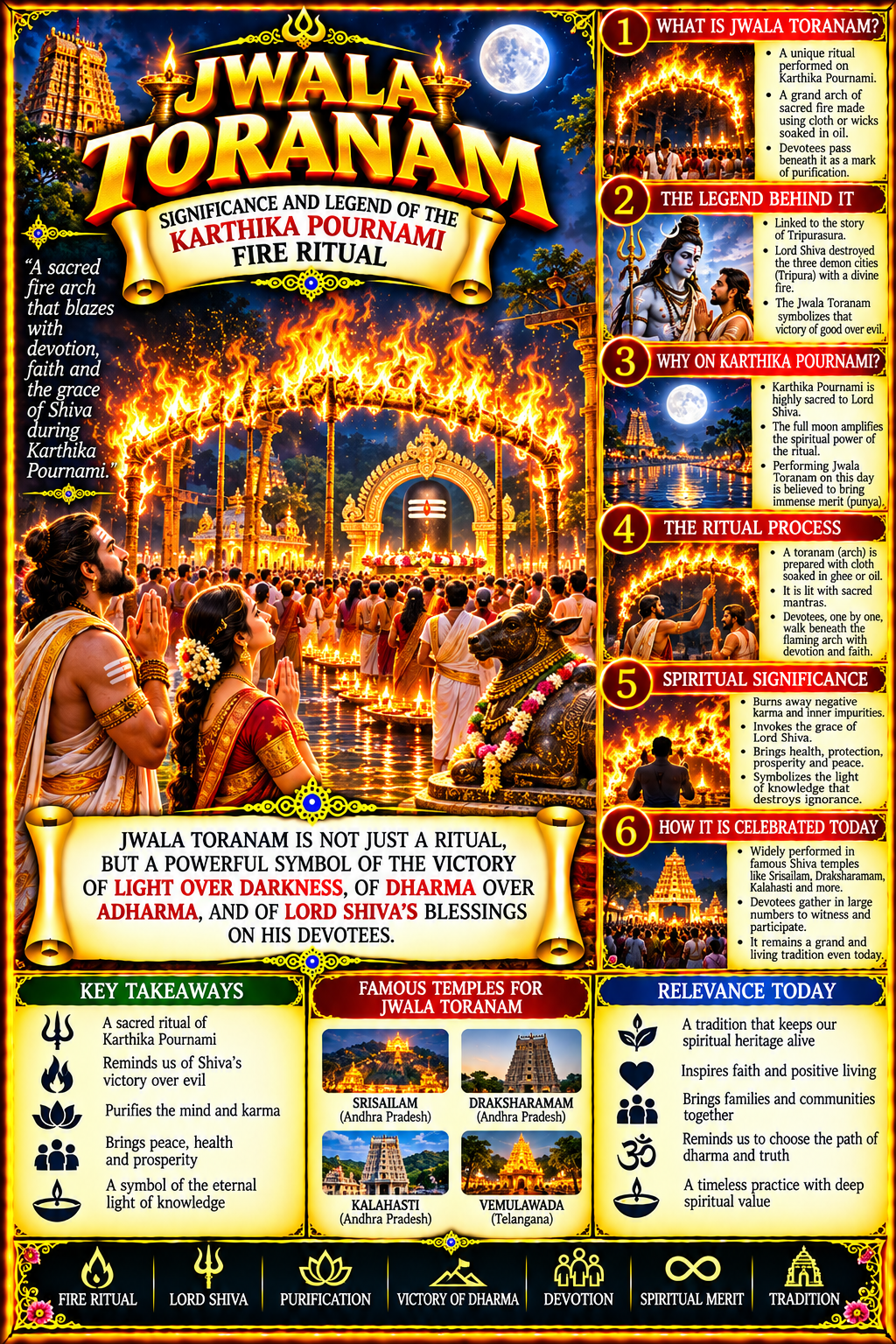
Every year on the sacred full moon night of Karthika Masam, temple courtyards illuminate with the spectacle of Jwala Toranam. In Sanatana Dharma, fire (Agni) represents the supreme cosmic purifier. Furthermore, ancient Vedic scriptures describe Agni as the mouth of the gods. Devotees construct an imposing ceremonial archway of dried grass and sacred straw before the temple sanctum. When evening twilight descends, the archway is set ablaze into a roaring canopy of holy golden flame.
As the divine palanquin carrying Lord Shiva and Goddess Parvati passes beneath the fire arch, thousands of devotees witness the cleansing spectacle. For liturgical calendar context, explore our foundational overview of the Hindu Festival Calendar guide on dates, vrats, and rituals. In addition, this ritual forms an essential climax to Karthika Poornima sacred rituals and the 365-wick deepam. Sacred narratives in the Skanda Purana text on Wisdom Library describe how this fire arch dissolves past sins. Thus, this comprehensive guide explores the timeless legends, ritual methods, and spiritual benefits of this awe-inspiring ceremony.
The Sacred Mythological Legend Behind Jwala Toranam
Several ancient puranic legends celebrate the origin of this fiery ritual. Primarily, the legend traces back to Lord Shiva’s cosmic victory over the demon king Tripurasura. Furthermore, the event symbolizes the revelation of Shiva as an infinite pillar of cosmic fire (Jyotirlinga).
According to the Shiva Purana, the three demon brothers known as the Tarakakshas constructed three invincible flying cities made of gold, silver, and iron. These celestial fortresses terrorized the three worlds for millennia. However, on Karthika Pournami, the three cities aligned in a straight line under the Krittika star constellation. Lord Shiva drew his cosmic Pinaka bow, releasing a single fiery arrow that reduced the three demonic fortresses to ashes. Therefore, temples commemorate this glorious triumph by igniting the flaming archway.
The Divine Manifestation of Lord Shiva as an Infinite Cosmic Pillar of Fire
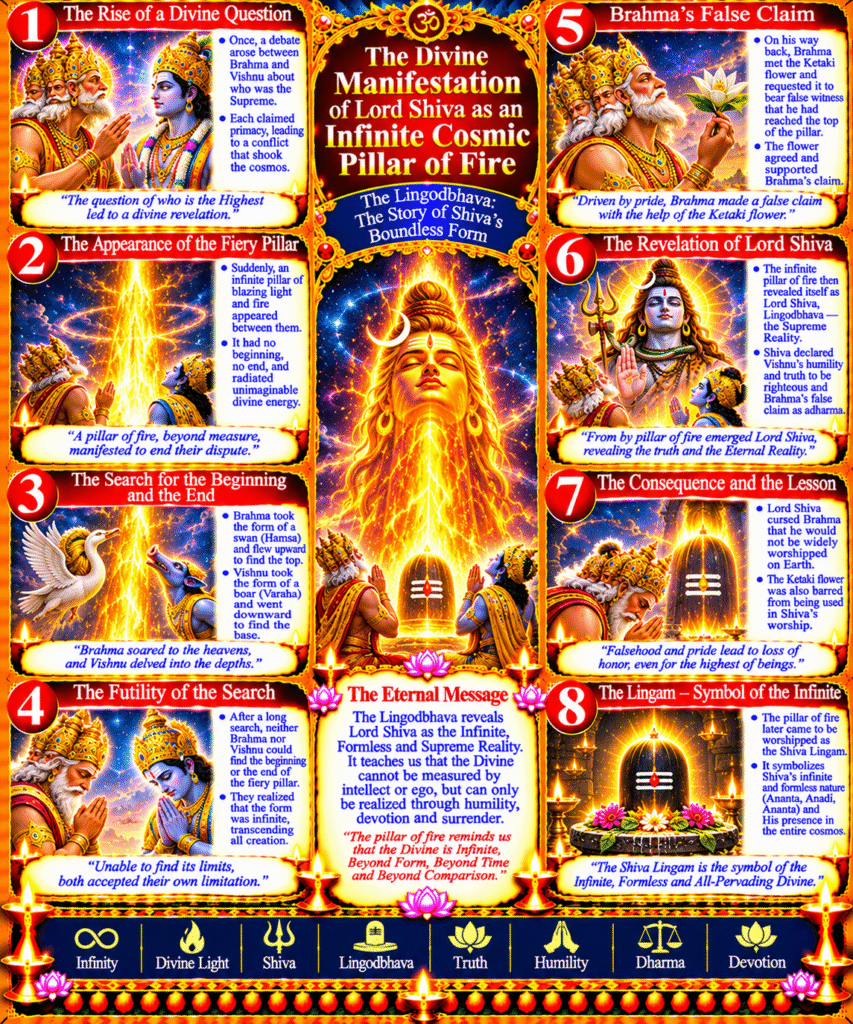
Another profound legend associates the ceremony with the cosmic dispute between Lord Brahma and Lord Vishnu regarding supremacy. Suddenly, an immeasurable column of blazing light manifested between them, piercing the highest heavens and deepest underworlds. Neither Brahma searching upward nor Vishnu diving downward could discover its limits.
Lord Shiva emerged from this infinite flame, revealing that supreme divinity transcends all physical forms. Similarly, classical scriptural codes in the Sacred Laws of the Aryas on Sacred Texts honor Agni as the ultimate cosmic witness. Consequently, the burning toranam reminds every seeker that mortal ego must burn away to perceive the eternal inner light.
The Spiritual Symbolism of the Flaming Archway (Agni Toranam)
Symbolically, the toranam represents the boundary separating mortal worldliness from divine consciousness. Passing underneath a blazing arch represents passing through the fire of spiritual wisdom (Jnanagni). Indeed, just as gold is purified in a furnace, human karmic blockages dissolve when facing the sacred fire. Learn how sacred fire conquers inner vices in our account of why Ravana is burned on Dasara. Thus, the fiery portal offers an annual rebirth for the devotee’s soul.
Sacred Preparation of the Dried Grass and Straw Consecration
Priests erect two sturdy wooden pillars measuring fifteen to twenty feet high before the temple entrance. Next, they tie horizontal ropes woven with dry paddy straw, coconut palm leaves, and wild grasses. In addition, temple priests chant purifying mantras and sprinkle sanctified Ganga water over the straw arch. Consequently, the physical materials transform into a consecrated altar ready to receive Agni Deva.
Scriptural Authority from the Kartika Mahatmya in the Skanda Purana
The Kartika Mahatmya explicitly promises that anyone who witnesses the Lord crossing under this flaming archway escapes the agonizing punishments of Yamaloka. Specifically, the text states that witnessing the ritual grants the merit of performing an imperial Ashvamedha Yajna. Hence, whole villages assemble to participate in this extraordinary annual blessing.
Step-by-Step Ritual Procedures of Jwala Toranam on Karthika Pournami
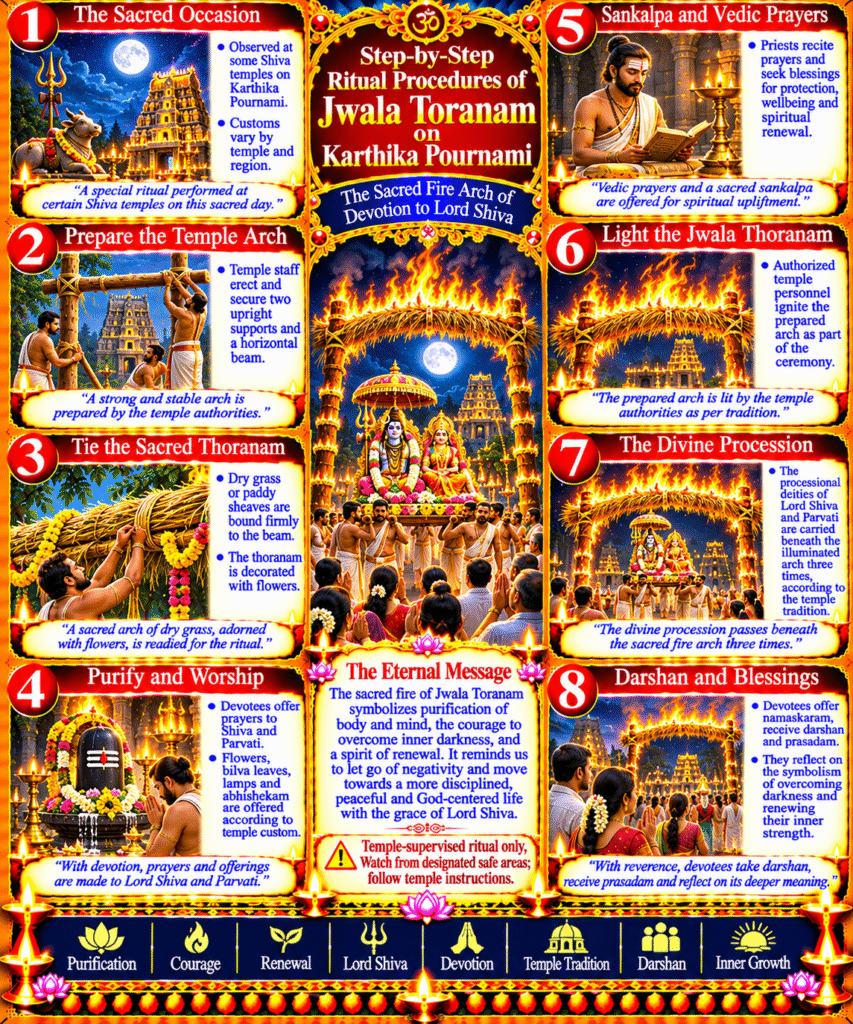
The ceremony unfolds through precise ritual stages established by ancient temple agamas. Moreover, each stage carries deep liturgical meaning for the community.
1. The Divine Palanquin Procession Beneath the Roaring Flame
Before igniting the toranam, priests perform elaborate Abhishekam and Shodashopachara puja for the utsava murthis. Next, they place Lord Shiva and Goddess Parvati (or Sri Rama and Sita) upon a lavishly decorated palanquin. Temple bearers lift the sacred palanquin amidst the thundering rhythm of drums, bells, and blowing conches.
Simultaneously, priests ignite the center of the straw toranam using camphor fire. Within seconds, a magnificent cascade of golden fire illuminates the night sky. With rapid, coordinated steps, the bearers rush the palanquin safely underneath the flaming arch three times. Indeed, the sight of the deities passing through the blazing portal evokes ecstatic devotional tears from the gathered crowd.
2. The Devotees’ Purification Walk (Agni Pradaksina)
Immediately after the divine palanquin clears the arch, the holy fire begins to recede into glowing embers. At this sacred juncture, thousands of devotees walk beneath the remaining toranam with folded hands. In particular, mothers carry newborn babies and elderly pilgrims cross under the archway with solemn reverence.
Devotees recite the Shiva Panchakshari mantra or Sri Rama Taraka mantra while walking. Discover how unshakeable faith in Lord Shiva grants triumph over the god of death in our history of Sage Markandeya conquering death through Shiva worship. Therefore, crossing beneath the embers shields the entire family from untimely demise and severe illnesses.
3. The Miraculous Protective Power of the Sacred Ash (Raksha Bhasma)
Once the straw arch burns completely, the fallen ashes are collected with supreme reverence. Temple priests distribute this consecrated ash, known as Raksha Bhasma or Torana Bhasma, to every devotee. Families carefully store this holy ash in copper boxes at their home altars throughout the year.
Applying a pinch of this sanctified ash on the forehead dispels nightmares, protects against evil eyes, and calms mental anxiety. Furthermore, rural farmers traditionally scatter a handful of this ash across agricultural fields to protect crops from pests. Thus, the sacred ash acts as a potent talisman carrying divine protective vibrations.
4. Astronomical Alignment with the Full Moon and Krittika Star
The ritual timing coincides with the exact moment when the Full Moon rises while the Sun sets on Karthika Pournami. Specifically, consult local planetary coordinates on the Drik Panchang Vedic calendar and ephemeris database for precise local twilight calculations. Review our detailed guide on Vijayadashami dates, puja times and traditions to understand how seasonal transitions align with sacred celebrations. Consequently, participating at the exact astronomical twilight multiplies the spiritual merits manifold.
Master Comparison Table: Jwala Toranam Traditions Across Major Temples
| Temple / Region | Presiding Deity | Unique Toranam Custom | Special Blessing Received |
|---|---|---|---|
| Srisailam Mallikarjuna Swamy | Lord Shiva & Bhramaramba | Grand toranam before Nandi Mandapam with thousands of chenchu devotees | Freedom from chronic illnesses and attainment of Moksha |
| Vemulawada Raja Rajeshwara | Lord Shiva (Sri Raja Rajeshwara) | Code-word prayers during palanquin dash, followed by Dharma Gundam bath | Neutralization of Graha doshas and ancestral peace |
| Draksharamam Bhimeswara | Lord Bhimeswara Swamy | Toranam erected near the Sapta Godavari sacred tank with Panchamrita snanam | Abundance of agricultural wealth and family longevity |
| Tirupati Sri Govindaraja Swamy | Lord Sri Govindaraja (Vishnu) | Vaishnavite observance where Lord Vishnu passes under the flaming archway | Eradication of poverty and reception of Lakshmi’s grace |
| Kaleshwaram Mukteswara | Twin Shiva Lingas (Shiva & Yama) | Unique joint darshan beneath the flame at the confluence of Godavari and Pranahita | Total liberation from fear of death and Yamaloka tortures |
| Local Village Shrines | Village Grama Devatas & Shiva | Community straw gathering where every home contributes bundles of dry grass | Communal harmony, village protection, and timely monsoon rains |
Spiritual and Metaphysical Benefits of Participating in Jwala Toranam
Participating in this annual fire ceremony produces profound transformations across physical, psychological, and karmic levels. Indeed, ancient rishis designed this ceremony to awaken higher cosmic awareness in ordinary householders.
First, the radiant heat and herbal smoke of burning camphor, neem, and straw cleanse environmental pollutants. Second, walking under the blazing archway dissolves subconscious fears, anxiety, and depression. Third, the ritual fosters extraordinary social equality, as kings and commoners walk shoulder to shoulder beneath the same sacred flame. Finally, the ceremony reinforces devotion to the supreme reality, reminding seekers that all worldly attachments must dissolve into pure spiritual light.
Frequently Asked Questions About Jwala Toranam
1. What is Jwala Toranam?
Jwala Toranam is a sacred fire arch ritual celebrated in Shiva and Vishnu temples on Karthika Pournami night.
2. On which day is Jwala Toranam celebrated?
It is celebrated annually on the evening of Karthika Pournami, the full moon day of the holy Karthika month.
3. What materials are used to construct the toranam arch?
Priests construct the arch using two wooden pillars, horizontal ropes, dry paddy straw, coconut palm leaves, and wild grasses.
4. What is the main legend behind Jwala Toranam?
The main legend commemorates Lord Shiva incinerating the three demonic cities of Tripurasura with a single fiery arrow on Karthika Pournami.
5. Why does the deity’s palanquin pass under the fire?
Passing the deities beneath the blazing arch symbolizes Lord Shiva purifying creation and illuminating the cosmos with his divine presence.
6. Why do devotees walk beneath the burnt toranam?
Walking under the consecrated embers is believed to erase past life sins, cure illnesses, and grant protection from untimely death.
7. What is Torana Bhasma?
Torana Bhasma is the sacred ash collected after the straw arch burns down, distributed to devotees as a divine protective talisman.
8. How should families use the sacred ash at home?
Devotees keep the ash at their home altar and apply a pinch to the forehead to ward off negative energies and bad dreams.
9. Can Jwala Toranam be celebrated in Vaishnava temples?
Yes, many South Indian Vishnu temples perform Jwala Toranam to honor the divine synthesis and mutual harmony of Hari and Hara.
10. What is the scriptural significance of Agni in this ritual?
Agni is the supreme purifier (Pavaka) that receives offerings and cleanses mortal karmic impurities through spiritual wisdom.
11. What mantra should devotees chant while walking under the arch?
Devotees chant the Shiva Panchakshari mantra (Om Namah Shivaya) or the sacred Mahamrityunjaya mantra during the ritual walk.
12. Is Jwala Toranam celebrated throughout India?
It is celebrated most elaborately in Andhra Pradesh, Telangana, Karnataka, and Tamil Nadu, and in major pilgrimage centers like Srisailam.
13. What merit does the Skanda Purana promise for witnessing this ritual?
The Skanda Purana states that witnessing the ritual grants the spiritual merit of an Ashvamedha Yajna and liberates ancestors from Yamaloka.
14. Why is the ritual performed specifically at dusk (Pradosha)?
Dusk on the full moon marks the auspicious convergence of day and night, amplifying spiritual energies for fire rituals.
15. Can young children and women walk under the toranam?
Yes, people of all ages, including children and elderly devotees, walk under the embers to receive divine health and longevity blessings.
16. How does Jwala Toranam relate to Karthika Deepam?
Both rituals honor the manifestation of Shiva as a cosmic pillar of light, celebrated through fire on the same sacred night.
17. Why do farmers sprinkle the toranam ash in their fields?
Farmers scatter the consecrated ash across their crops to ward off agricultural pests and invoke divine blessings for abundant harvest.
18. What should devotees wear during the ceremony?
Devotees wear traditional Indian attire, typically clean cotton garments in white, yellow, or saffron, symbolizing purity and devotion.
19. Does fasting accompany the Jwala Toranam celebration?
Yes, devotees observe a full-day fast on Karthika Pournami, consuming satvic food only after witnessing the Jwala Toranam and moonrise.
20. Where can readers find authentic information on Vedic rituals and legends?
Ratnam Strategy provides comprehensive, scripture-backed analyses of Indian temple rituals, puranic legends, and Vedic philosophical heritage.