Admin
- Mahabharatam , Women Characters
- August 16, 2026
- 42 views
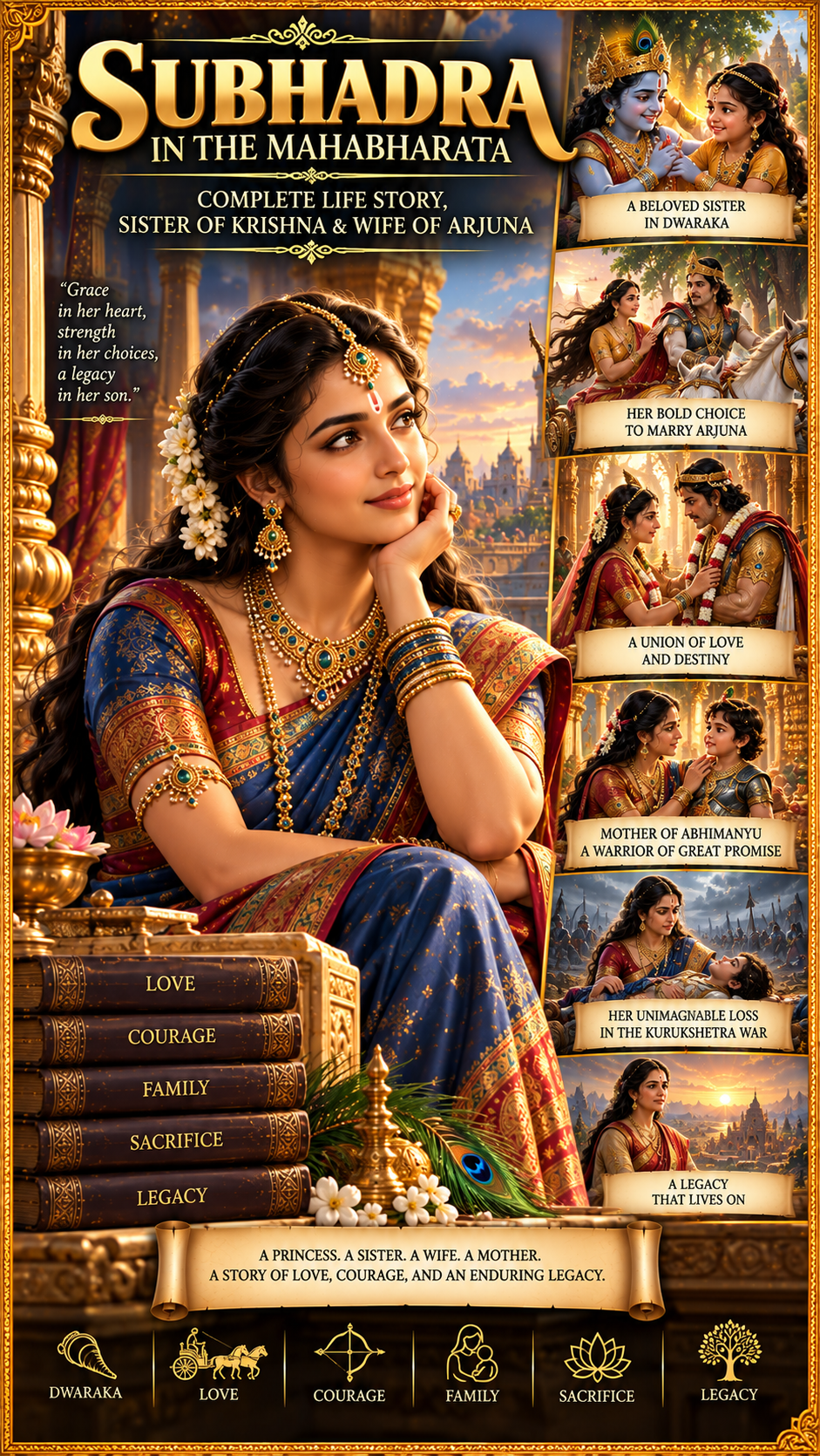
Subhadra in the Mahabharata: Complete Life Story, Sister of Krishna & Wife of Arjuna
The Mahabharata is a grand canvas of epic battles, political maneuvers, and moral dilemmas. Among the key women who shape the narrative of the Kuru dynasty, Subhadra in the Mahabharata occupies a central and highly revered position. Known as the sister of Lord Krishna and Balarama, the beloved wife of the Pandava warrior Arjuna, and the mother of the tragic hero Abhimanyu, Subhadra is a key figure whose presence bridges the powerful Vrishni clan of Dwaraka with the Pandavas of Indraprastha. Her story is one of royal grace, romantic choice, quiet strength, immense maternal sacrifice, and structural legacy. While characters like Draupadi are associated with public humiliation, vengeance, and the fiery initiation of war, Subhadra in the Mahabharata represents a different dimension of strength: the unifying thread of the family, a mother who instilled legendary courage in her son, and the woman whose direct descendant (Parikshit) saved the Pandava lineage from extinction. The Lineage and Childhood of Subhadra in the Mahabharata Subhadra was born into the Yadava clan (specifically the Vrishni branch) as the daughter of Vasudeva and Rohini. She was the younger sister of Balarama and Lord Krishna. Born in Dwaraka, a magnificent coastal city renowned for its wealth,…

- Mahabharatam , Women Characters
- August 9, 2026
- 66 views
Hidimbi in the Mahabharata: Complete Life Story, Marriage to Bhima, and Legacy
The Mahabharata is a monument of classical literature, exploring the depths of righteousness, duty, and human emotion. Among the many women characters who leave a permanent mark on the epic, the story of Hidimbi in the Mahabharata is one of the most unique, touching, and spiritually significant. Unlike other royal queens who came from established dynasties, Hidimbi belonged to the Rakshasa clan—the forest-dwelling tribes of ancient India. Yet, her transformation from a forest dweller to the devoted wife of the Pandava prince Bhima, and the mother of the legendary warrior Ghatotkacha, stands as a testament to her noble character, high intelligence, and profound sacrifices. To truly understand Hidimbi in the Mahabharata, one must look past the superficial labels of “demoness” or “rakshasi” and analyze her choices, her devotion, and the critical role she played in helping the Pandavas survive their early trials. Her story teaches us that nobility is not defined by birth or lineage, but by actions, love, and adherence to Dharma. The Lineage and Identity of Hidimbi in the Mahabharata Hidimbi lived with her brother Hidimba in the dense, dark forests located in the northern region of ancient India (believed to be parts of modern-day Himachal Pradesh, where…
- Mahabharatam , Women Characters
- August 2, 2026
- 70 views
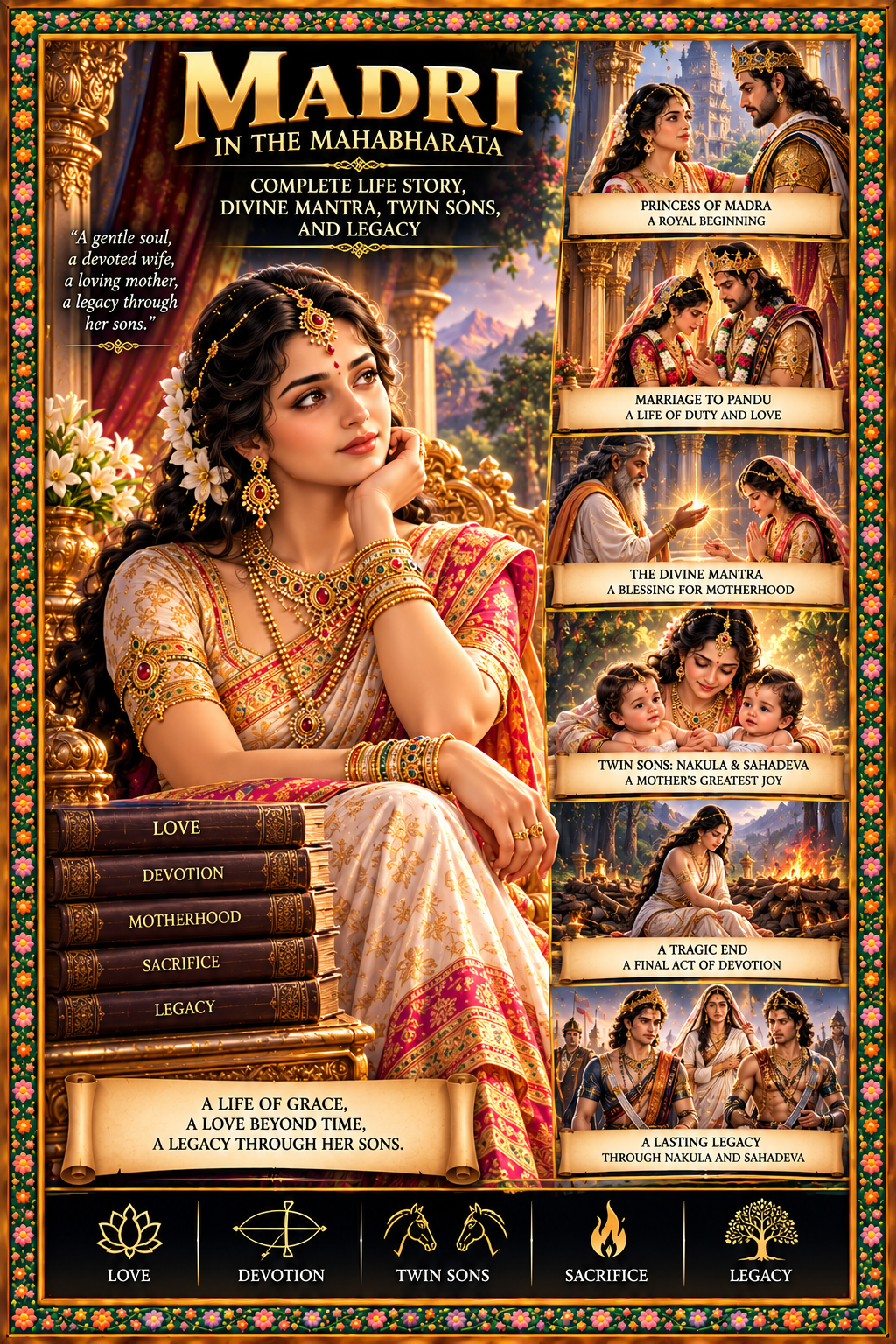
Madri in the Mahabharata: Complete Life Story, Divine Mantra, Twin Sons, and Legacy
The Mahabharata is a grand tapestry of duty, sacrifice, complex choices, and cosmic destiny. While much of the spotlight in the Kuru dynasty falls on key figures like Kunti, Draupadi, and Gandhari, the life and legacy of Madri in the Mahabharata is equally profound, tragic, and central to the epic’s unfolding. As the second wife of King Pandu, the Princess of Madra, and the mother of the twin Pandavas—Nakula and Sahadeva—Madri’s actions shaped the destiny of the entire lineage. Her story is one of beauty, rivalry, spiritual transformation, maternal love, and ultimate self-sacrifice. Understanding the character of Madri in the Mahabharata requires looking beyond the popular perception of her as simply the “second queen.” She represents a complex human journey: a princess who had to live in the shadow of a senior queen, a wife who shared her husband’s exile, a mother who brought divine children into the world, and a woman whose final decision changed the course of Hastinapur’s history. The Lineage of Madri in the Mahabharata: The Princess of Madra Madri was the princess of the Madra kingdom, a prosperous region located in the north-western part of ancient India (corresponding to modern-day Punjab and parts of Pakistan). She…
- Women Characters
- July 27, 2026
- 147 views
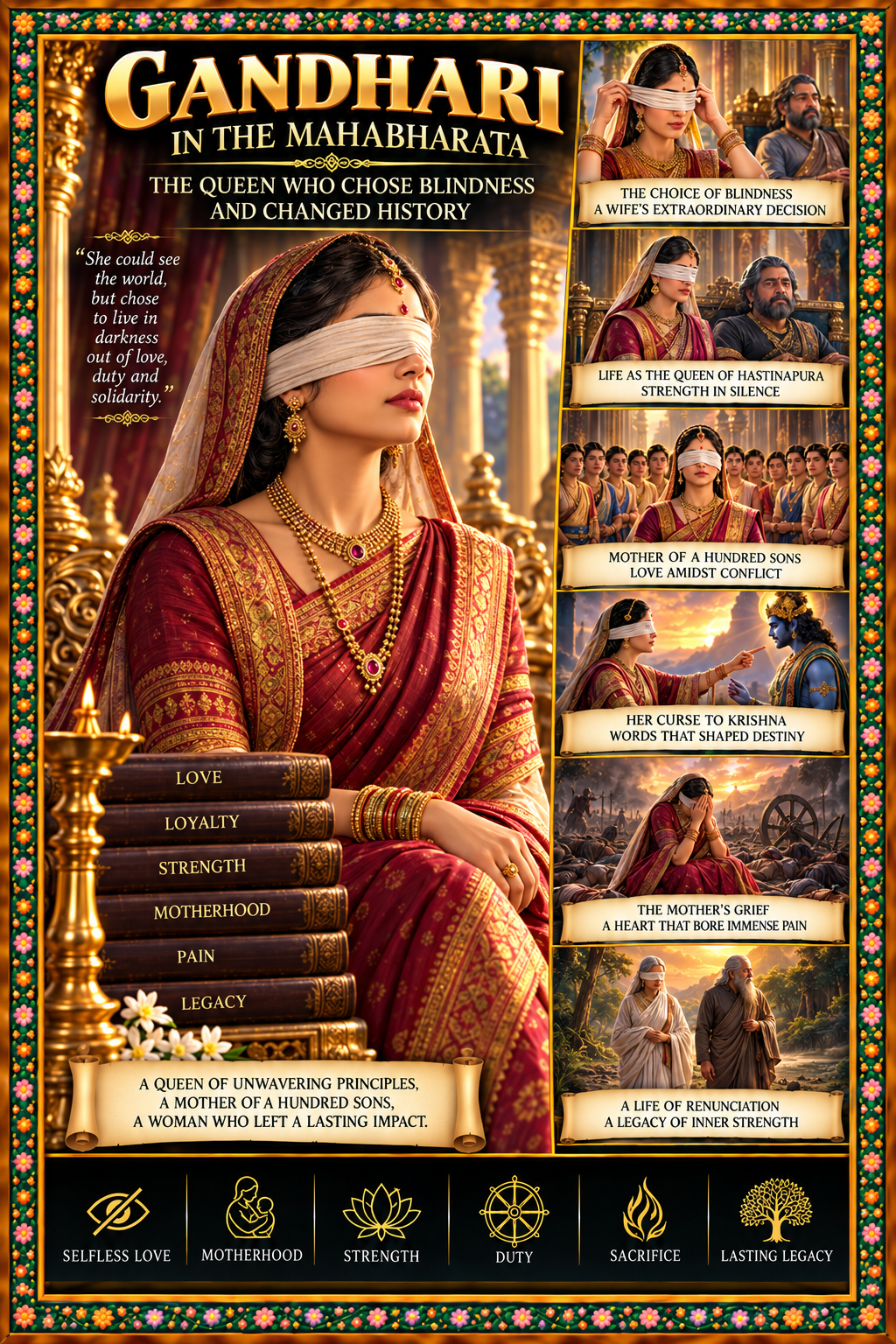
Gandhari in the Mahabharata: The Queen Who Chose Blindness and Changed History
The Mahabharata is filled with extraordinary characters whose decisions shaped one of the greatest epics ever written. Among them, Gandhari in the Mahabharata stands as one of the most respected and misunderstood women. She is remembered for voluntarily blindfolding herself for life, being the mother of the hundred Kauravas, and cursing Lord Krishna after the devastating Kurukshetra War. The story of Gandhari in the Mahabharata is not merely about sacrifice—it is about duty, motherhood, pain, and destiny. Gandhari’s life demonstrates how personal choices can influence generations and alter the course of history. Her unwavering devotion to her husband, her deep love for her children, and her commitment to Dharma make Gandhari in the Mahabharata one of the most inspiring and complex female characters in Indian mythology. This detailed guide explores the complete life of Gandhari in the Mahabharata, including her marriage to Dhritarashtra, the reason behind her blindfold, her role during the Kurukshetra War, her famous curse on Lord Krishna, and the timeless lessons her life continues to offer. Who Was Gandhari? Gandhari in the Mahabharata Gandhari was the princess of the Kingdom of Gandhara, ruled by King Subala. She was renowned for her beauty, wisdom, patience, and devotion to…
- Women Characters
- July 25, 2026
- 150 views
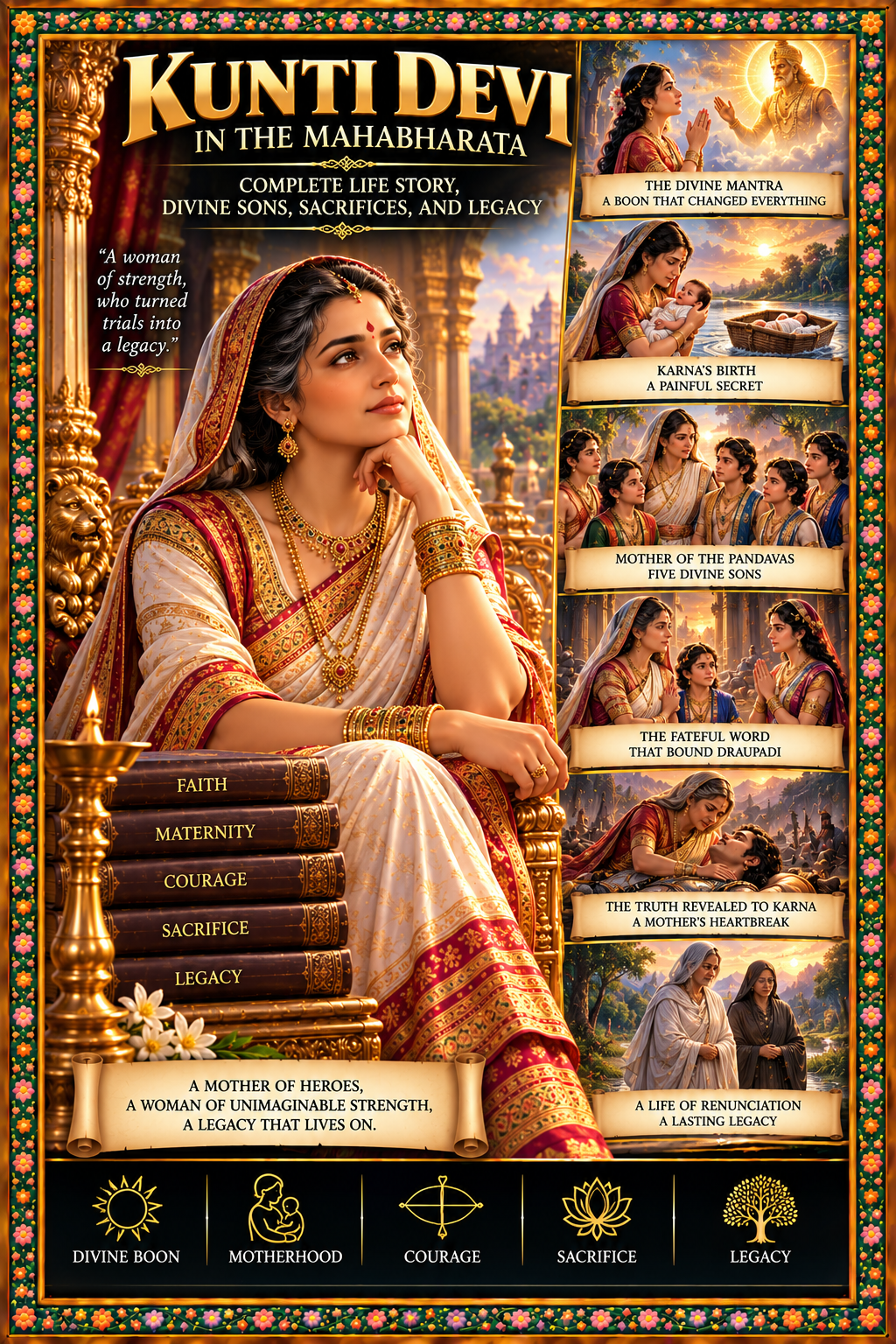
Kunti Devi in the Mahabharata: Complete Life Story, Divine Sons, Sacrifices, and Legacy
Introduction – Kunti Devi in Mahabharata Kunti Devi is one of the most respected and influential women in the Mahabharata. She was not only the mother of the Pandavas but also a symbol of strength, devotion, sacrifice, wisdom, and unwavering faith in dharma. Throughout her life, she endured countless hardships yet never abandoned righteousness. Her life teaches us that courage, patience, and faith can overcome even the greatest challenges. From receiving a divine boon in her youth to witnessing the Kurukshetra War, Kunti’s journey remains one of the most inspiring stories in Hindu mythology. In this comprehensive guide by Ratnam Strategy, you’ll discover Kunti Devi’s birth, childhood, marriage, divine sons, greatest sacrifices, role in the Mahabharata, and timeless lessons. Who Was Kunti Devi? Pritha Kunti Devi was born into the Yadava dynasty as Kunti Devi.She was the daughter of King Shurasena and was later adopted by King Kuntibhoja, from whom she received the name Kunti. She was known for her humility, compassion, intelligence, and devotion to sages and elders. Her life changed forever when she served Sage Durvasa with great dedication. Birth and Early Life of Kunti -Kunti Devi in Mahabharata Princess Pritha Kunti was born as Princess Pritha. Because…
- Women Characters
- July 4, 2026
- 123 views
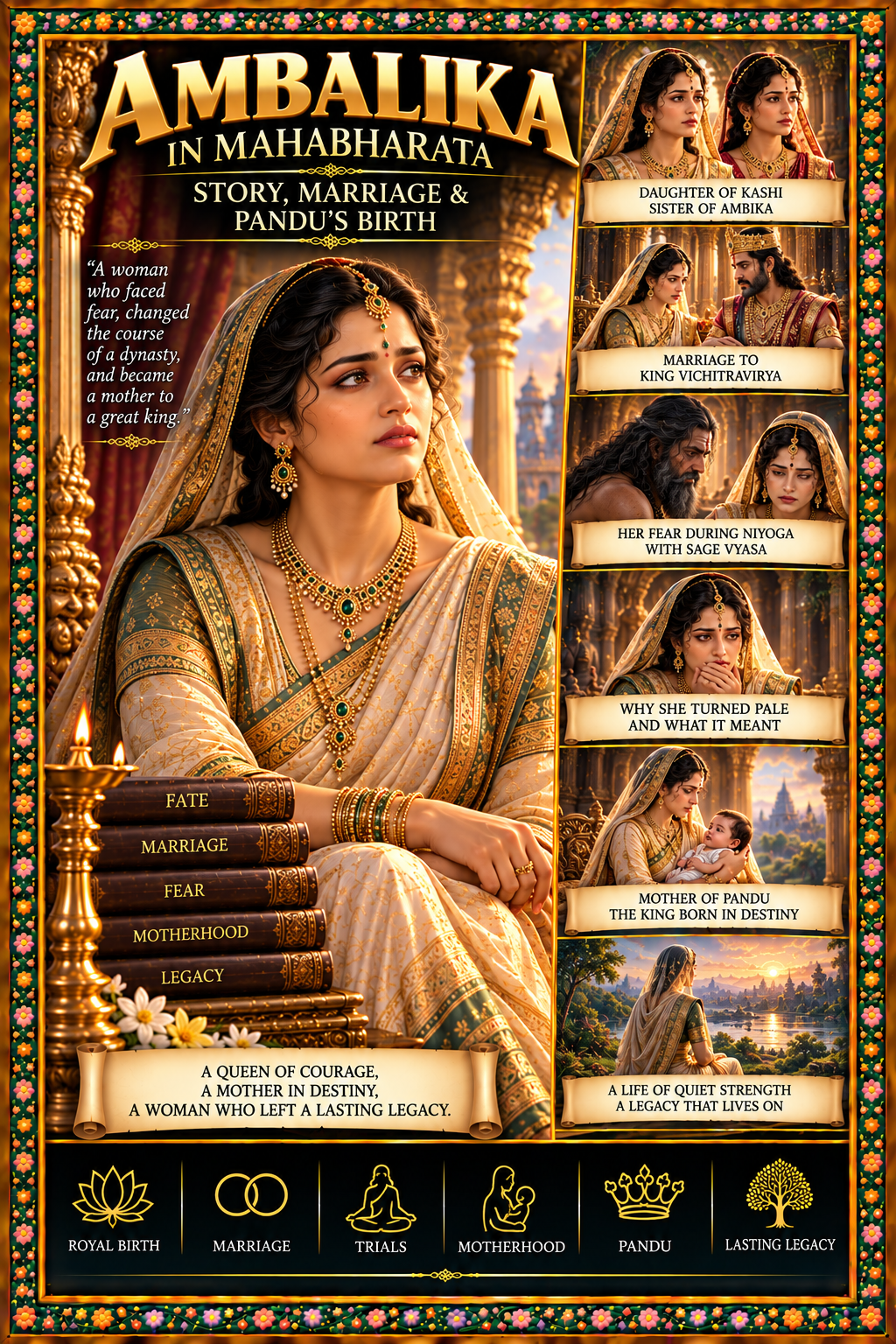
Ambalika in Mahabharata: Story, Marriage & Pandu’s Birth
Ambalika in the Mahabharata: The Queen Who Became the Mother of Pandu The story of Ambalika in the Mahabharata is one of sacrifice, destiny, and courage. While the Mahabharata is filled with legendary warriors like Bhishma, Arjuna, Karna, and Krishna, several women quietly shaped the destiny of the Kuru dynasty. Among them, Ambalika occupies a special place because she became the mother of King Pandu, whose sons later became the famous Pandavas. The tale of Ambalika in the Mahabharata is deeply connected with the continuation of the Kuru lineage. Her life reflects the difficult choices royal women had to make for the welfare of their kingdom. Though she rarely appears in battle scenes or political debates, her role influenced the greatest war in Indian history. In this article, we will explore the complete story of Ambalika in the Mahabharata, from her birth and marriage to her motherhood, spiritual life, and lasting legacy. Who Was Ambalika? Ambalika in the Mahabharata Ambalika was one of the three princesses of the Kingdom of Kashi. She was the younger sister of Ambika and the sister of Amba. The three princesses were renowned for their extraordinary beauty, intelligence, and royal upbringing. Their lives changed forever…
- Women Characters
- June 27, 2026
- 201 views
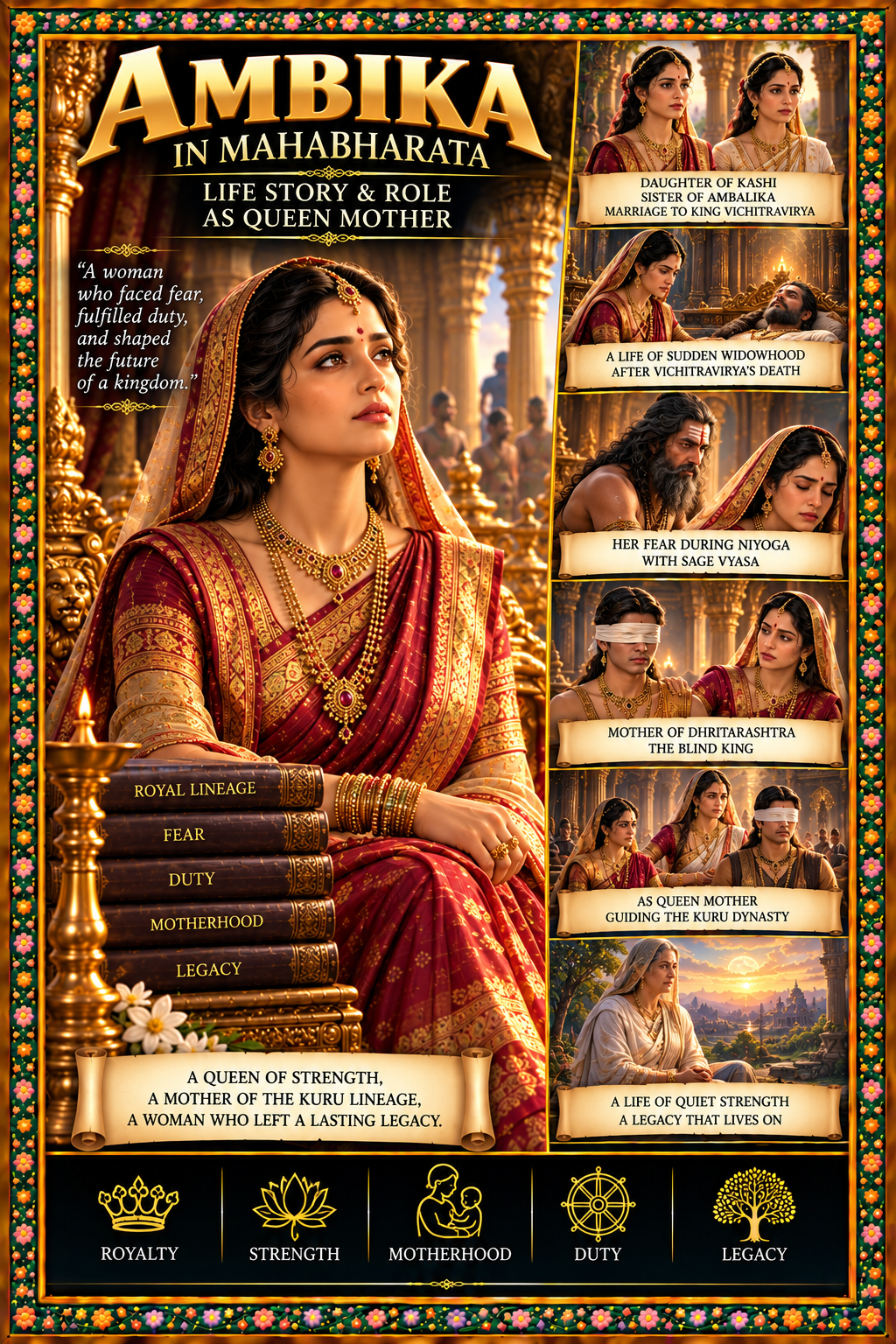
Ambika in Mahabharata: Life Story & Role as Queen Mother
Ambika in the Mahabharata Ambika in the Mahabharata. : The Mahabharata is one of the greatest epics in world literature, filled with heroic warriors, wise sages, powerful kings, and influential women. Among the many women who shaped the destiny of the Kuru dynasty, Ambika occupies a significant place. Though she is not as widely discussed as Kunti, Gandhari, or Draupadi, Ambika played a crucial role in ensuring the continuation of the Kuru lineage. As the wife of King Vichitravirya and the mother of Dhritarashtra, Ambika became an important link in the chain of events that ultimately led to the Kurukshetra War. Her life reflects the challenges faced by royal women in ancient India and highlights the importance of duty, sacrifice, and destiny. Who Was Ambika? – Ambika in the Mahabharata. Ambika was one of the princesses of the Kingdom of Kashi. She was the daughter of the King of Kashi and the sister of Ambalika and Amba. The three sisters became famous in the Mahabharata because of the dramatic events surrounding their marriage. Ambika later became the queen of Hastinapura after marrying King Vichitravirya, a member of the Kuru dynasty. She is primarily remembered as the mother of Dhritarashtra, the…
- Women Characters
- June 20, 2026
- 200 views
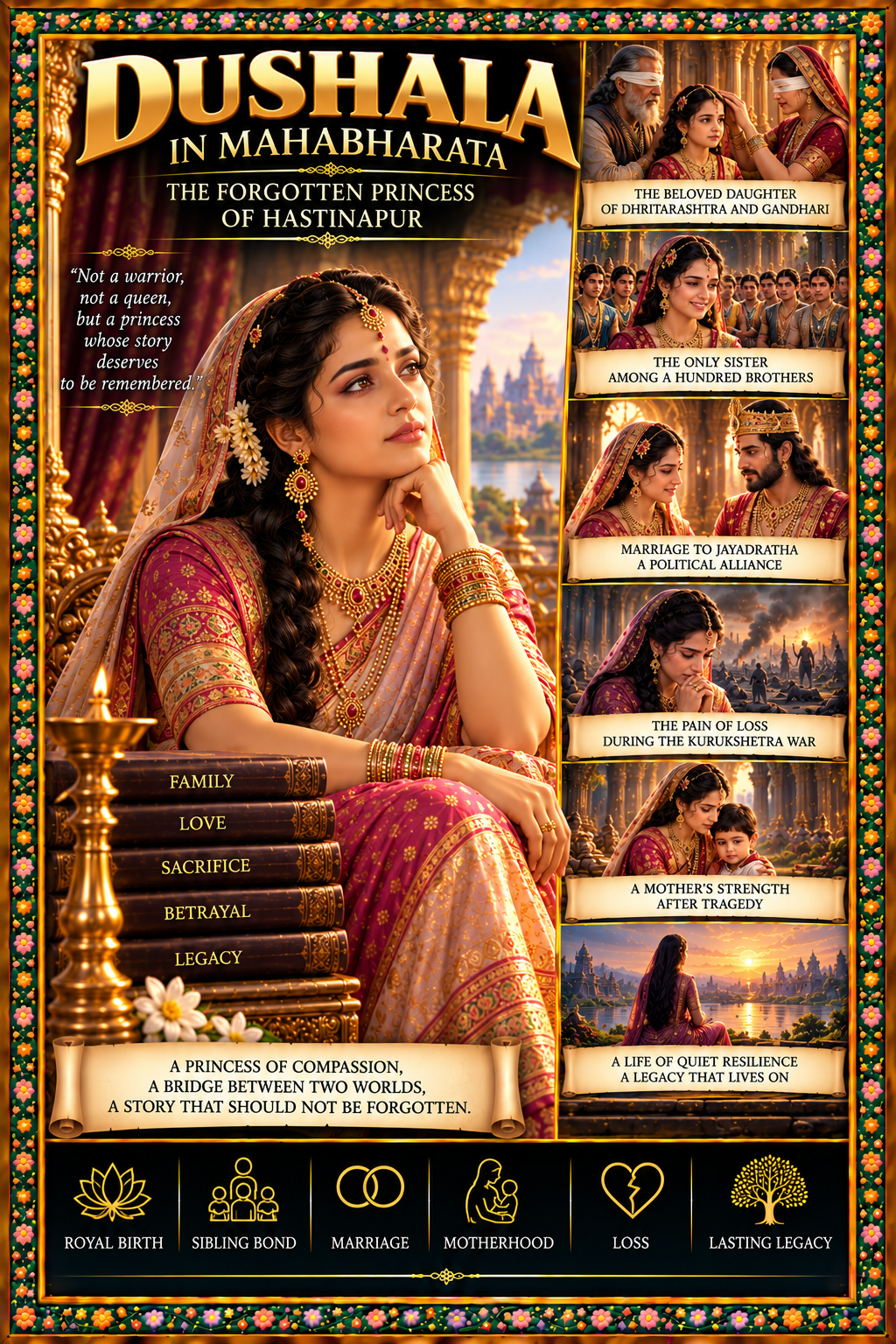
Dushala in Mahabharata: The Forgotten Princess of Hastinapur
Dushala in the Mahabharata: The Forgotten Princess of Hastinapur Dushala in the Mahabharata : The Mahabharata is filled with powerful kings, mighty warriors, wise sages, and remarkable women. While characters like Draupadi, Kunti, Gandhari, and Subhadra are frequently discussed, one important woman often remains overlooked—Dushala, the only daughter of Dhritarashtra and Gandhari. Dushala’s life reflects the emotional cost of the great war. Born into the royal family of Hastinapur, she witnessed both the glory and destruction of her lineage. Her story provides a unique perspective on family, politics, duty, and the tragic consequences of conflict. In this article, we explore Dushala’s life, marriage, role in the Mahabharata, and the lessons her story offers. Who Was Dushala?Dushala in the Mahabharata Birth and Family Background – Dushala in the Mahabharata Queen Gandhari and King Dhritarashtra had one daughter, Dushala. She was the sister of the hundred Kauravas, including Duryodhana and Dushasana. As the sole princess among one hundred brothers, Dushala was deeply loved and cherished by her family.Having grown up in Hastinapur’s royal palace, she enjoyed a rich, luxurious, and affectionate childhood. However, her life would eventually become intertwined with the political rivalries that led to the devastating Kurukshetra War. Dushala’s Place…
- Mahabharatam , Women Characters
- March 22, 2026
- 391 views
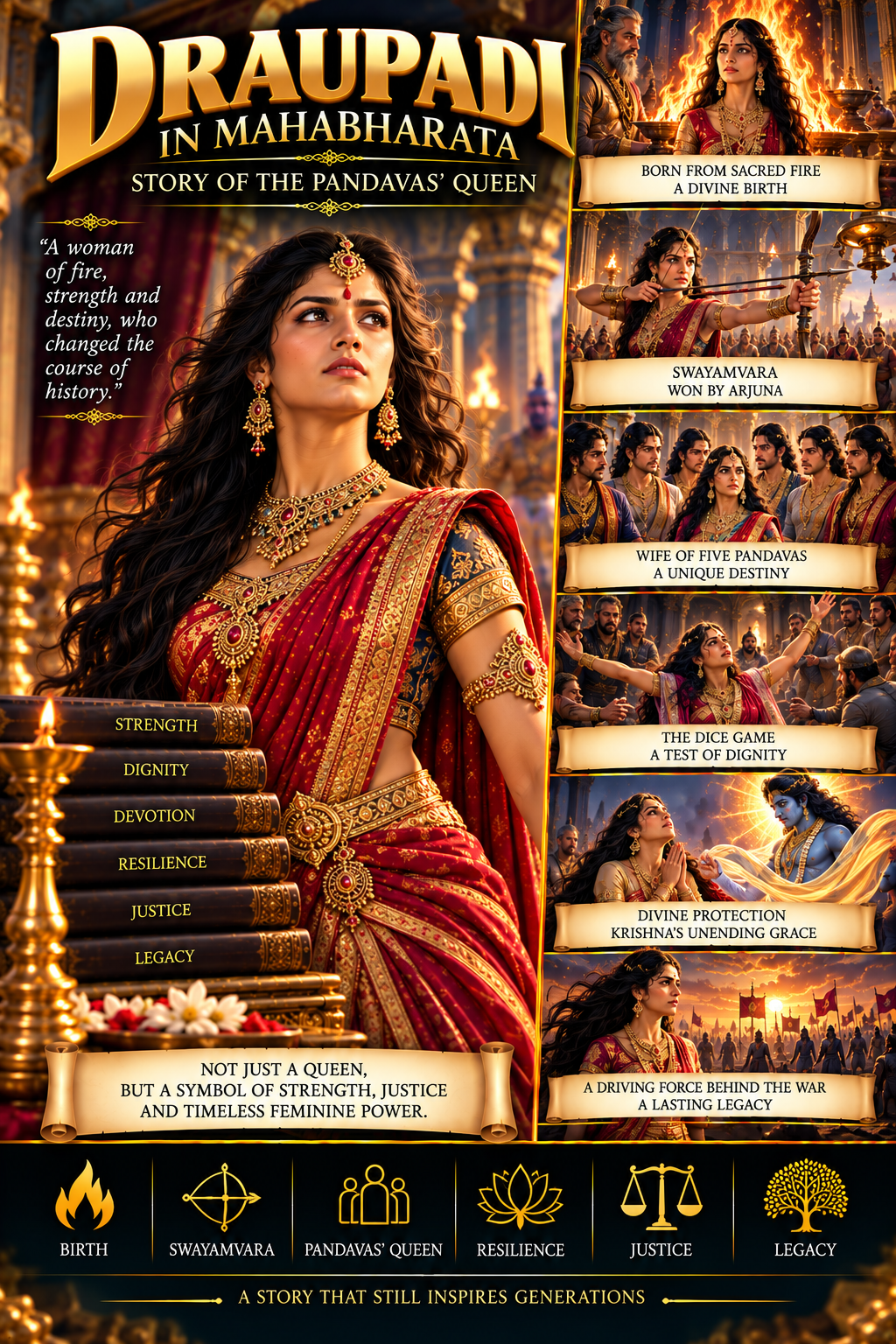
Draupadi in Mahabharata: Story of the Pandavas’ Queen
Introduction – Draupadi in Mahabharata Draupadi in Mahabharata : Draupadi is one of the most important and powerful characters in the Mahabharata. She was not only the wife of the five Pandavas but also a woman of great strength, courage, and dignity. Her life was full of struggles, sacrifices, and unforgettable moments that changed the course of the great epic. Many events in the Mahabharata happened because of the insult done to Draupadi. Her humiliation in the Kaurava court became one of the main reasons for the Kurukshetra war. Even though she suffered many hardships, she remained strong and never lost her self-respect. Draupadi’s story teaches us about courage, patience, devotion, and the power of dharma. Birth of Draupadi – Draupadi in Mahabharata Draupadi was not born like an ordinary child. She appeared from a sacred fire during a yajna performed by King Drupada, the ruler of Panchala. King Drupada wanted revenge against Drona, so he performed a powerful sacrifice to get a son who could defeat Drona. From the fire, two children appeared — a son named Dhrishtadyumna and a daughter named Draupadi. Because she was born from fire, Draupadi was also called Yajnaseni. She was known for her…

- Kuru Dynasty , Mahabharatam , Mythology , Women Characters
- January 6, 2026
- 513 views
Satyavati in Mahabharatam – The Woman Who Shaped Destiny
Introduction Satyavati in the Mahabharatam popularly known as Sathavai in regional traditions, is one of the most powerful and influential women in the Mahabharatam. Though she does not fight on the battlefield of Kurukshetra, her decisions, ambitions, and maternal instincts shape the destiny of the Kuru dynasty and ultimately lead to the great war itself. Her life is a remarkable journey—from a humble fisherwoman to the Queen of Hastinapura, from a young girl cursed with a foul smell to the revered Queen Mother of one of India’s greatest epics. Birth and Early Life of Satyavati She was born to Uparichara Vasu, the king of Chedi, and a celestial nymph (apsara). Due to circumstances, she was abandoned at birth and later adopted by a fisherman chief named Dasharaja. In her early years, she was known as Matsyagandha, meaning “one who smells of fish”, because of her association with the fishing community. Despite her humble upbringing, possessed: These traits would later transform her destiny. Meeting Sage Parashara and the Birth of Vyasa One of the most crucial events in the Mahabharatam occurs when Satyavati meets Sage Parashara while ferrying him across a river. The Divine Boons Parashara, impressed by her beauty and…