Raja Ratnam
- Navagraha's
- December 29, 2025
- 473 views
The 9 Navagrahas in Vedic Astrology: Names, Mantras, Planetary Effects & Remedies
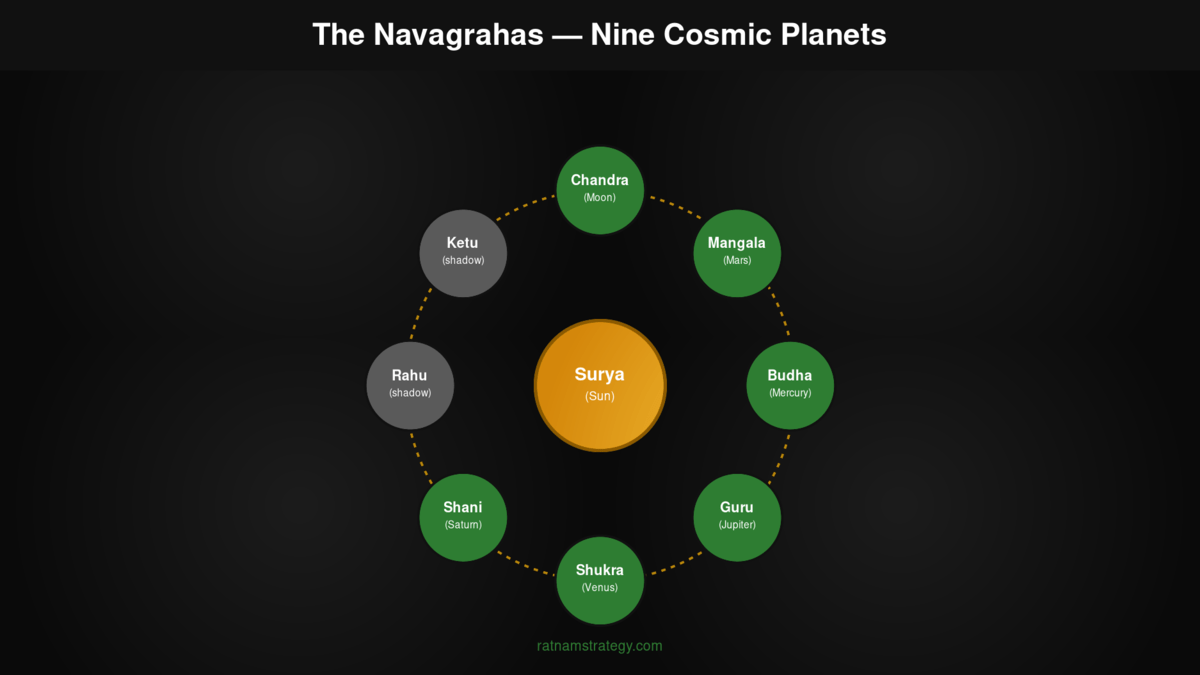
Introduction — More Than Planets, Eternal Teachers The Navagrahas are often misunderstood as mere planets that influence fate.In truth, they are cosmic teachers — divine forces that guide the soul through karma, experience, growth, and liberation. The purpose of each Graha is not to punish, but to teach.Transits are not accidents, but lessons timed by the universe. Together, the Navagrahas form a complete spiritual syllabus for human life —from birth and identity to desire, duty, wisdom, and finally moksha. Surya — Awakening the Soul (Atman) The source of life and consciousness is Surya Deva.He teaches: Surya awakens the Atman, reminding us to stand in our truth and shine without fear. Without Surya, there is no life.Without self-awareness, there is no growth. Chandra — Mastering the Mind Chandra governs the mind, emotions, and inner world.He teaches: The Moon reminds us that inner peace is more important than outer success.A calm mind reflects the divine clearly. Mangala — Right Action and Courage Mangala Deva represents energy, discipline, and righteous action.He teaches: Mangala is the inner warrior —fighting ignorance, laziness, and fear. Guru (Brihaspati) — Wisdom and Dharma Guru is the light of wisdom.He teaches: Without Guru, power becomes arrogance.With Guru, life becomes…

- Navagraha's
- December 28, 2025
- 479 views
Ketu Deva: The Planet of Moksha & Detachment, Astrological Effects & Remedies
Introduction — The Silent Force of Liberation Among the Navagrahas, Ketu is the most silent, mysterious, and spiritually potent graha.He does not create noise, fame, or desire — instead, he cuts attachments, dissolves ego, and pushes the soul toward liberation (Moksha). If Rahu binds the soul to illusion and desire,Ketu frees the soul through detachment and realization. Ketu represents: Ketu does not give pleasure —he gives truth. Mythological Origin of Ketu Deva The origin of Ketu is inseparable from Rahu and the great event of Samudra Manthan. When the Asura Svarbhanu disguised himself and drank Amrita,Lord Vishnu severed his body with the Sudarshana Chakra. Unlike Rahu, who retained desire and hunger,Ketu was left without a head — symbolizing ego-less existence. Thus, Ketu became: Scriptures describe Ketu as a flag without a pole —present, powerful, but unattached. Ketu Deva in Hindu Scriptures Ketu appears in: Ancient sages describe Ketu as: Unlike other planets, Ketu does not follow worldly dharma.He follows cosmic truth. For official cultural and historical archives, visit the Ministry of Culture, Government of India. Mythological Origin of Ketu Deva The origin of Ketu is inseparable from Rahu and the great event of Samudra Manthan. When the Asura Svarbhanu disguised…

- Navagraha's
- December 28, 2025
- 464 views
Rahu Deva: The Shadow Planet, Kaal Sarp Dosha, Illusions & Astrological Remedies
Introduction — Rahu Deva It is the invisible force that shapes destiny Among the Navagrahas, Rahu Deva is the most mysterious, feared, and misunderstood force.He has no physical body, no light of his own — yet his influence is powerful enough to alter destinies, create kings, destroy empires, and awaken souls. Rahu represents: If Surya gives clarity and Mangala gives action,Rahu tests the soul by blurring truth — forcing growth through confusion. Rahu is not evil.He is the teacher of hidden karma. Mythological Origin of Rahu Deva The origin of Rahu comes from the legendary Samudra Manthan (Churning of the Ocean of Milk). When the Devas and Asuras churned the ocean for Amrita (nectar of immortality), Lord Vishnu appeared as Mohini to distribute it only to the Devas. An Asura named Svarbhanu disguised himself as a Deva and secretly drank the Amrita.Before the nectar could reach his stomach, Surya (Sun) and Chandra (Moon) exposed him. In anger, Lord Vishnu beheaded him with the Sudarshana Chakra. But since he had already tasted Amrita: Rahu survived — immortal, bodiless, and eternally hungry. From that moment, Rahu swore revenge on the Sun and Moon —causing solar and lunar eclipses by swallowing them temporarily.…