Admin
Admin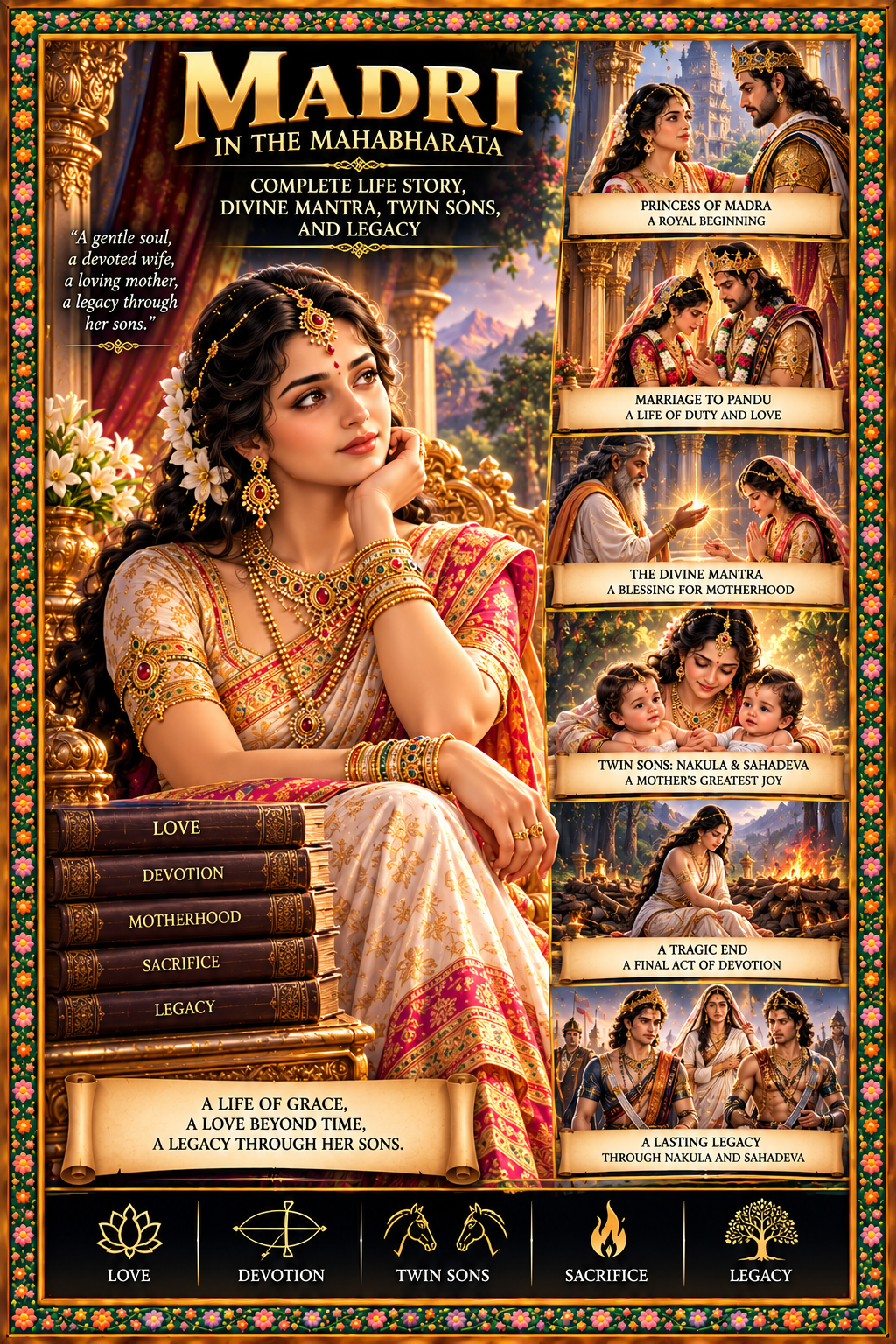
The Mahabharata is a grand tapestry of duty, sacrifice, complex choices, and cosmic destiny. While much of the spotlight in the Kuru dynasty falls on key figures like Kunti, Draupadi, and Gandhari, the life and legacy of Madri in the Mahabharata is equally profound, tragic, and central to the epic’s unfolding. As the second wife of King Pandu, the Princess of Madra, and the mother of the twin Pandavas—Nakula and Sahadeva—Madri’s actions shaped the destiny of the entire lineage. Her story is one of beauty, rivalry, spiritual transformation, maternal love, and ultimate self-sacrifice.
Understanding the character of Madri in the Mahabharata requires looking beyond the popular perception of her as simply the “second queen.” She represents a complex human journey: a princess who had to live in the shadow of a senior queen, a wife who shared her husband’s exile, a mother who brought divine children into the world, and a woman whose final decision changed the course of Hastinapur’s history.
The Lineage of Madri in the Mahabharata: The Princess of Madra
Madri was the princess of the Madra kingdom, a prosperous region located in the north-western part of ancient India (corresponding to modern-day Punjab and parts of Pakistan). She was the sister of Shalya, the powerful ruler of Madra who would later play a critical role in the Kurukshetra War as a chariot driver for Karna and the final commander of the Kaurava army.
From her birth, Madri was renowned across kingdoms for her extraordinary beauty, grace, and cultural education. The Madra dynasty was known for its fierce warriors and wealthy nobility, and Madri’s upbringing reflected the highest traditions of royal etiquette, music, and the arts. In the epic, her physical beauty is often described as radiant, resembling a celestial maiden (Apsara), which made her one of the most sought-after princesses of her era. Her name itself, “Madri,” is a patronymic meaning “the lady of Madra,” signifying her proud regional identity.
Marriage to King Pandu: Madri in the Mahabharata becomes the Second Queen
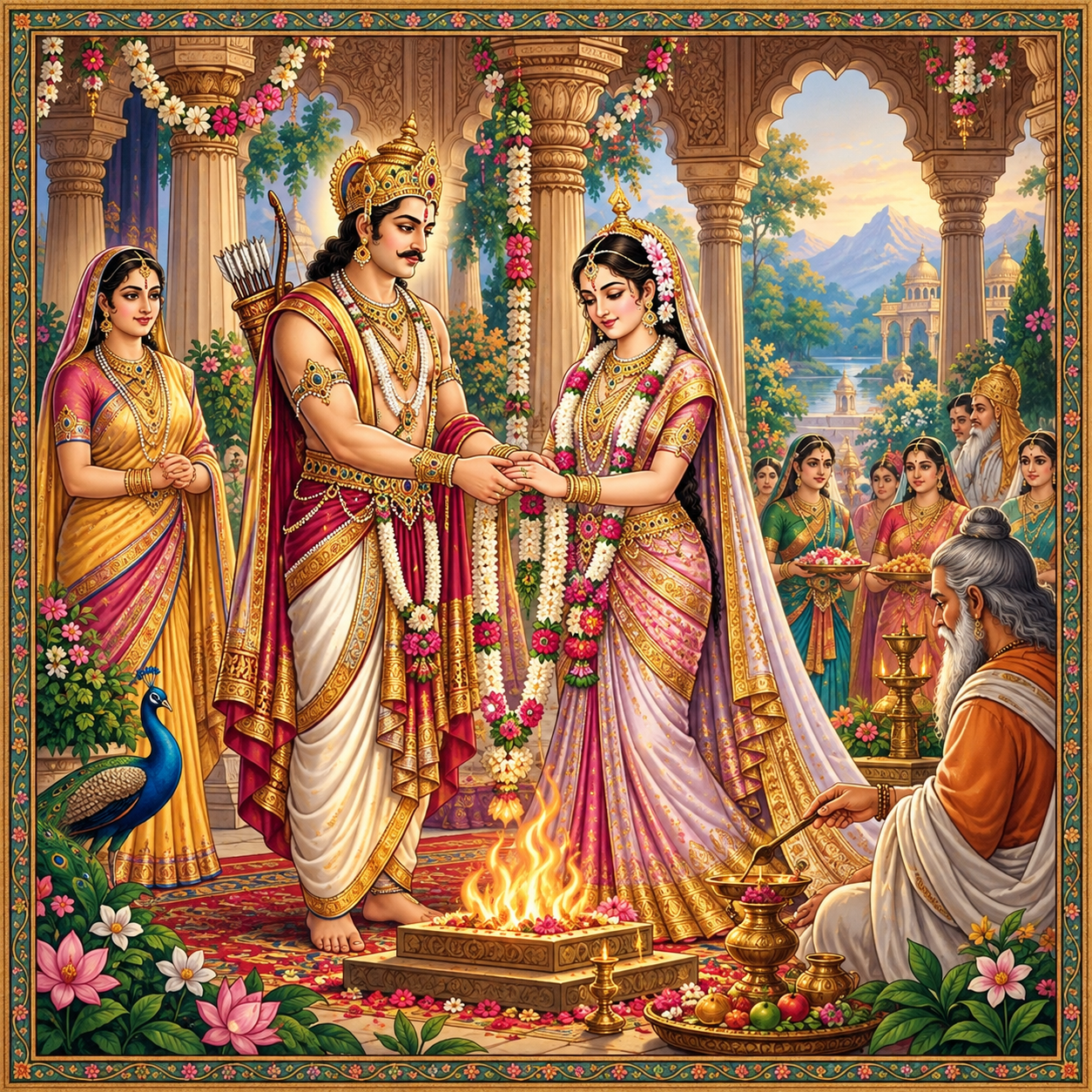
The marriage of Madri in the Mahabharata was a matter of high statecraft. King Pandu of Hastinapur had already married Kunti, the princess of the Yadava clan, securing a strong southern alliance. However, Bhishma, the patriarch and regent of the Kuru dynasty, wanted to strengthen Hastinapur’s ties with the northern kingdoms.
Hearing of Madri’s exceptional beauty and virtues, Bhishma traveled personally to the Madra kingdom with a massive entourage of soldiers, wealth, and royal gifts. Shalya, recognizing the prestige of an alliance with the Kuru dynasty, welcomed Bhishma. In accordance with the customs of the Madra kingdom, Bhishma offered a vast dowry of gold, gems, elephants, horses, and chariots to secure Madri’s hand for Pandu.
Upon her arrival in Hastinapur, Madri was married to King Pandu in a grand ceremony. Pandu was instantly captivated by her beauty and charm. As the second queen, Madri brought a youthful vitality to the royal palace. While Pandu respected Kunti for her wisdom and seniority, he was deeply attached to Madri. This created a subtle, unspoken rivalry between the two queens—a classic dynamic in royal households of the era—yet both women maintained a high degree of dignity and mutual respect.
The Curse of Sage Kindama and Madri in the Mahabharata
The golden era of Pandu’s reign was cut short by a tragic error. While hunting in the deep forests of the Himalayas, Pandu spotted a pair of deer mating. Swept by the thrill of the hunt, Pandu shot an arrow, mortally wounding the male deer.
To Pandu’s horror, the deer transformed back into their true forms: Sage Kindama and his wife, who had taken the guise of deer to enjoy the freedom of nature. Before dying, Sage Kindama cursed Pandu: just as Pandu had slain him during an act of passion, Pandu would die the moment he attempted to engage in physical union with either of his wives.
The curse shattered Pandu’s life. Realizing that he could never father children to carry on the Kuru dynasty through normal means, and filled with deep remorse for the sin of killing a sage, Pandu renounced his crown. He decided to lead a life of ascetism in the forest. Showing immense devotion, both Kunti and Madri in the Mahabharata refused to stay behind in the luxury of Hastinapur. They threw away their royal ornaments, donned simple barks of trees, and followed their husband into the wilderness.
Life in the Forest: The Journey of Madri in the Mahabharata
In the quiet forests of Satasringa, Pandu, Kunti, and Madri lived a life of severe penance. Despite their spiritual progress, Pandu remained deeply distressed by his lack of heirs. In ancient Indian tradition, a man without sons could not attain liberation (*Moksha*), nor could he repay his debt to his ancestors.
Pandu pleaded with Kunti to find a way to bear children. It was then that Kunti revealed a secret: during her youth, Sage Durvasa had granted her a divine mantra (*Atharvaveda* mantra) that allowed her to invoke any deity and bear a child possessing the deity’s attributes.
Using this mantra, Kunti conceived Yudhishthira from Dharma (the god of justice), Bhima from Vayu (the god of wind), and Arjuna from Indra (the king of gods). The birth of these three exceptionally powerful and virtuous sons brought immense joy to the forest hermitage. However, it also accentuated the silent grief and sense of inadequacy felt by Madri in the Mahabharata. She remained childless, watching Kunti’s sons grow, while she could not contribute to her husband’s lineage.
The Divine Mantra and the Sons of Madri in the Mahabharata
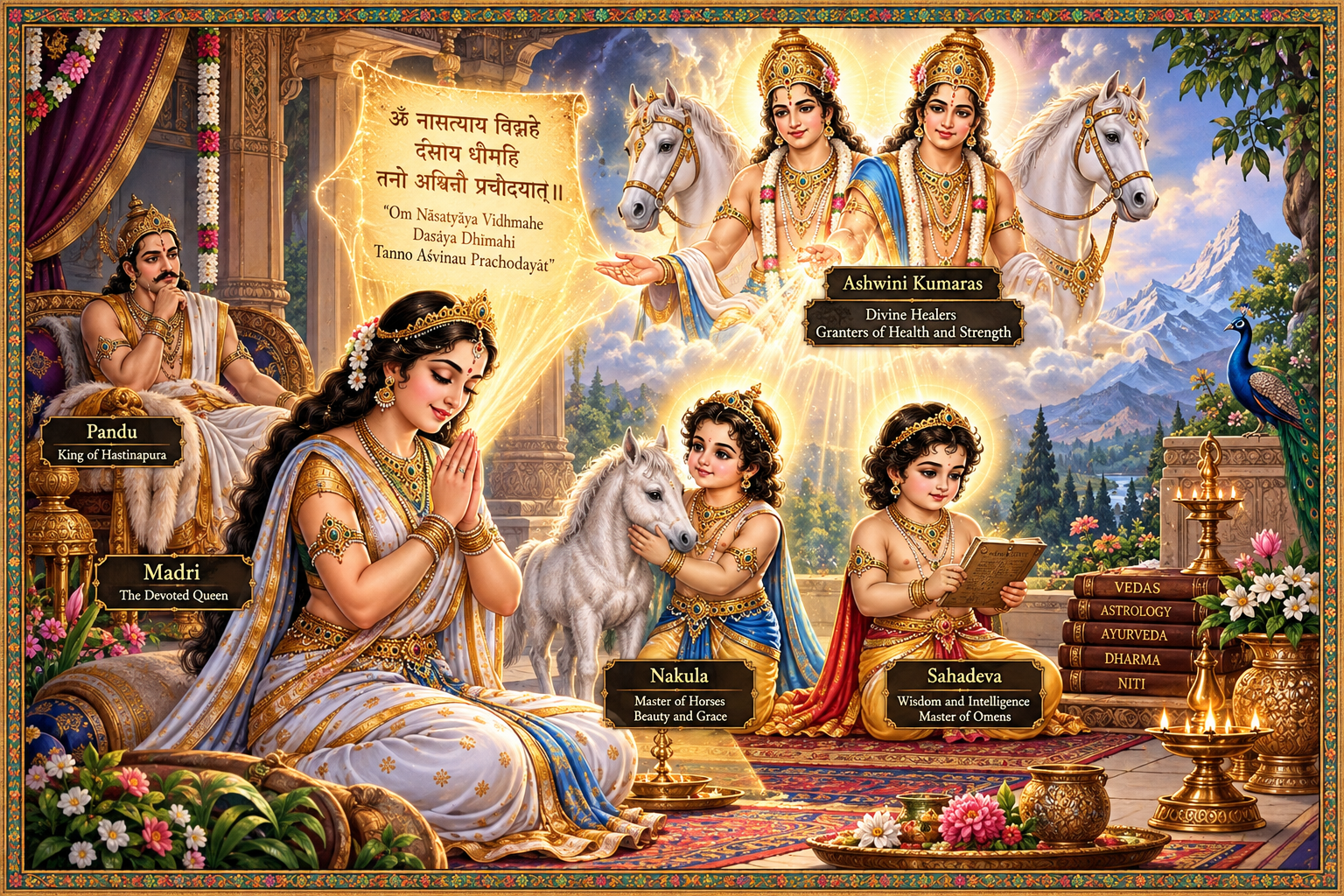
The Invocation of Ashwini Kumaras by Madri in the Mahabharata
Birth of Nakula: The First Twin of Madri in the Mahabharata
Birth of Sahadeva: The Second Twin of Madri in the Mahabharata
Pandu, sensing Madri’s sorrow and wishing to balance the happiness of both his wives, approached Kunti. He requested Kunti to share the divine mantra with Madri so that she, too, could experience the joy of motherhood.
Kunti, out of compassion and sisterly love, agreed. She taught the mantra to Madri once. Madri, possessing a sharp intellect and strategic mind, realized she only had one opportunity to use it. Instead of invoking a single deity, she decided to invoke the Ashwini Kumaras—the twin celestial physicians of the gods, who represented health, beauty, symmetry, and wisdom.
Because the Ashwini Kumaras were twins, Madri gave birth to twin sons: Nakula and Sahadeva.
- Nakula was blessed with unparalleled physical beauty, charm, and mastery over horses and combat.
- Sahadeva was blessed with immense wisdom, intelligence, foresight, and mastery over astronomy and cattle-rearing.
The birth of Nakula and Sahadeva completed the family of five brothers, who would collectively be known as the Pandavas. Madri’s clever use of the mantra to obtain twins from a single invocation earned her Pandu’s deep admiration and Kunti’s slight wariness, as Kunti declined to share the mantra a second time to prevent Madri from surpassing her in the number of sons.
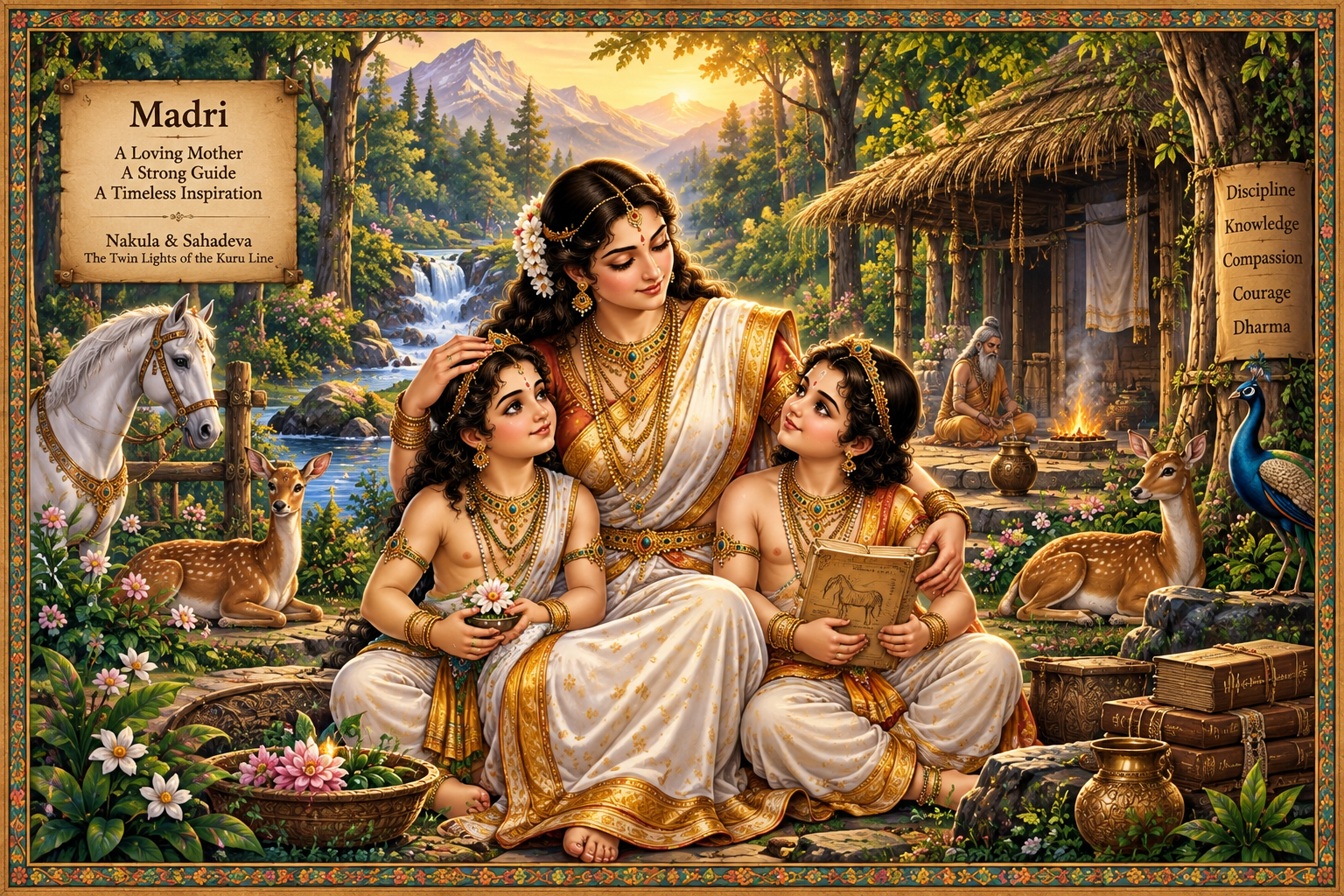
The Tragic Final Encounter of Madri in the Mahabharata
The family lived happily in the forest for several years, raising the five princes. However, fate had not finished its play.
One spring afternoon, when the forest was filled with the fragrance of blooming flowers and the singing of birds, Pandu was walking along the banks of a river. He encountered Madri, who was dressed in a simple yet elegant attire that accentuated her natural beauty. Overcome by the beauty of the spring season and a sudden, uncontrollable surge of passion, Pandu forgot the curse of Sage Kindama.
Despite Madri’s desperate pleas, warnings, and physical resistance, Pandu embraced her. The curse was instantly activated. Pandu collapsed and died in Madri’s arms.
Madri’s screams echoed through the silent forest, bringing Kunti and the five young princes running to the scene. Seeing the lifeless body of the king, the hermitage was plunged into deep mourning.
The Ultimate Sacrifice of Madri in the Mahabharata – The Satidaha
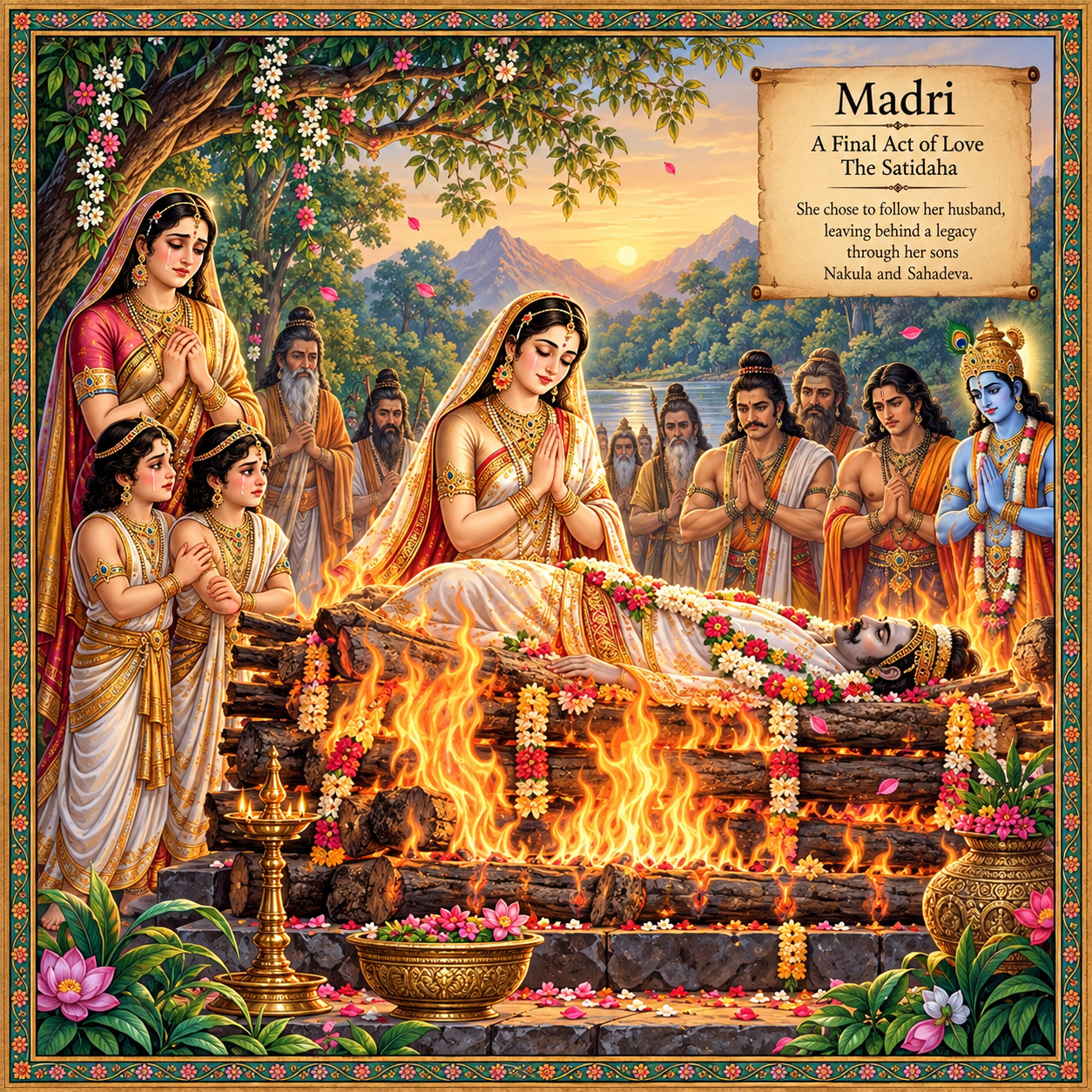
The Funeral Pyre and Ascension of Madri in the Mahabharata
Leaving Kunti and Children Behind: Madri in the Mahabharata’s Last Request
Spiritual Significance of the Satidaha Rite of Madri in the Mahabharata
Historical Reflections on the Sacrifice of Madri in the Mahabharata
The death of Pandu brought immense guilt and grief to Madri in the Mahabharata. She held herself solely responsible for his demise, believing that her presence and beauty had triggered the king’s fatal lapse in self-control.
When the sages and Kunti began preparing for Pandu’s funeral, a serious debate arose between Kunti and Madri. Kunti, as the senior queen, argued that she should ascend the funeral pyre (*Sati*) with her husband, leaving Madri to raise the five young children.
However, Madri made a compelling and heartbreaking counter-argument. She pleaded with Kunti, saying:
- She felt directly responsible for Pandu’s death and could not bear to live with the immense burden of guilt.
- She admitted that she might not be able to treat Kunti’s sons with the same absolute equality and love that Kunti was capable of showing. She feared that favoritism might slip into her heart, whereas she trusted Kunti completely to raise Nakula and Sahadeva as her own sons without any discrimination.
- She believed that Pandu, having died out of desire for her, would be wandering in the spirit realm, and she needed to accompany his soul to the next world to offer him companionship and peace.
Convinced by Madri’s sincerity and sorrow, the assembly of sages and Kunti consented. Madri voluntarily ascended the funeral pyre, embracing her husband’s body, committing the ultimate act of self-sacrifice (*Satidaha*).
The Legacy and Lessons of Madri in the Mahabharata
Madri’s sacrifice left a lasting impact on the epic.
- Kunti’s Exemplary Motherhood: Following Madri’s death, Kunti returned to Hastinapur with the five princes. True to Madri’s trust, Kunti raised Nakula and Sahadeva with the exact same love, care, and protection as her own three sons. Throughout their lives, Nakula and Sahadeva never felt the absence of a mother’s love, and they remained fiercely loyal to Kunti and their brothers.
- The Character of Nakula and Sahadeva: The twins grew up to be noble warriors. Sahadeva, inheriting his mother’s quiet intelligence, became the chief advisor to Yudhishthira, while Nakula’s charm and humility made him beloved by all.
- Modern Interpretation: Modern readers often debate Madri’s choice of Sati. While historically viewed as the highest act of conjugal devotion, contemporary analysis views it as a tragic consequence of systemic guilt and the intense pressure of royal expectations. Nonetheless, her decision to entrust her children to Kunti shows a high level of self-awareness and absolute trust.
Madri in the Mahabharata remains a symbol of beauty, intellect, and profound sacrifice. Her brief but vital role set the stage for the epic conflict of the Pandavas, ensuring that the lineage of Pandu survived through divine intervention to ultimately establish Dharma on earth.
Frequently Asked Questions (FAQs) About Madri in the Mahabharata
1. Who was Madri in the Mahabharata?
Madri was the princess of the Madra kingdom, the sister of King Shalya, and the second wife of King Pandu of Hastinapur. She was the mother of the twin Pandavas, Nakula and Sahadeva.
2. How did Madri marry King Pandu?
Bhishma traveled to the Madra kingdom to secure Madri’s hand for Pandu. In accordance with Madra custom, Bhishma offered a large amount of wealth, gold, and animals as a dowry to Shalya to seal the alliance.
3. Who was Madri’s brother?
Madri’s brother was Shalya, the king of the Madra kingdom. He was a mighty warrior who eventually fought on the side of the Kauravas in the Kurukshetra War.
4. Why did King Pandu and Madri go to the forest?
Pandu accidentally killed Sage Kindama and his wife while they were in the guise of deer. The sage cursed Pandu to die if he touched his wives. Filled with remorse, Pandu renounced his kingdom to live as an ascetic in the forest, and Madri and Kunti followed him.
5. How did Madri conceive her children despite Pandu’s curse?
Kunti shared a divine mantra given to her by Sage Durvasa with Madri. The mantra allowed Madri to invoke any deity to conceive a child.
6. Which deities did Madri invoke to have her sons?
Madri invoked the Ashwini Kumaras, the twin celestial physicians of the gods, who are associated with health, medicine, light, and beauty.
7. Who were Madri’s sons?
Madri’s sons were the twins Nakula and Sahadeva, the fourth and fifth Pandava brothers.
8. Why did Kunti refuse to give the mantra to Madri a second time?
Kunti feared that if Madri used the mantra again, she would invoke another set of twin deities and have more sons than Kunti, thereby gaining a higher status in the family.
9. What were the qualities of Nakula?
Nakula was renowned as the most handsome man in the world. He was an expert swordfighter, horse tamer, and possessed deep knowledge of equestrian medicine.
10. What were the qualities of Sahadeva?
Sahadeva was exceptionally intelligent, a master of scriptures, astrology, and cattle-rearing. He possessed the gift of foresight (knowing the future) but was cursed to die if he revealed it without being asked.
11. How did King Pandu die?
On a spring day in the forest, Pandu was overcome by desire for Madri. Despite her attempts to stop him, he embraced her, which activated Sage Kindama’s curse and caused his immediate death.
12. Why did Madri decide to commit Sati?
Madri felt directly responsible for Pandu’s death, believing her beauty led to his fatal loss of self-control. She also wanted to accompany his soul to the spirit world and believed Kunti would be a better mother to all five children.
13. Who raised Nakula and Sahadeva after Madri’s death?
Kunti raised Nakula and Sahadeva as her own sons alongside Yudhishthira, Bhima, and Arjuna, showing no discrimination between them.
14. What was the name of Madri’s father?
The name of Madri’s father is not explicitly highlighted in the main texts, but he was the previous King of Madra, and her brother Shalya succeeded him.
15. Where was the Madra kingdom located?
The Madra kingdom was located in north-western ancient India, corresponding to the modern-day Punjab region between India and Pakistan.
16. Did Madri ever return to Hastinapur after going to the forest?
No, Madri spent the rest of her life in the forest and died there. Only Kunti and the five young Pandavas returned to Hastinapur after Pandu’s death.
17. Was there rivalry between Kunti and Madri?
There was a natural, silent rivalry regarding their husband’s affection and the bearing of heirs. However, they maintained a high level of respect, and Kunti showed deep love by raising Madri’s sons with absolute equality.
18. Why are Nakula and Sahadeva called Madreyas?
They are called “Madreyas” because they are the sons of Madri, distinguishing them from the “Kaunteyas” (sons of Kunti).
19. Did Shalya support Madri’s sons in the Kurukshetra War?
Shalya intended to support the Pandavas (his nephews), but Duryodhana tricked him into fighting for the Kauravas by offering him lavish hospitality. However, Shalya secretly helped Nakula and Sahadeva during the war.
20. What is the spiritual significance of Madri’s story?
Madri’s story represents the dangers of uncontrolled desire, the power of self-sacrifice, and the divine intervention needed to maintain the righteousness of the Kuru lineage.