Raja Ratnam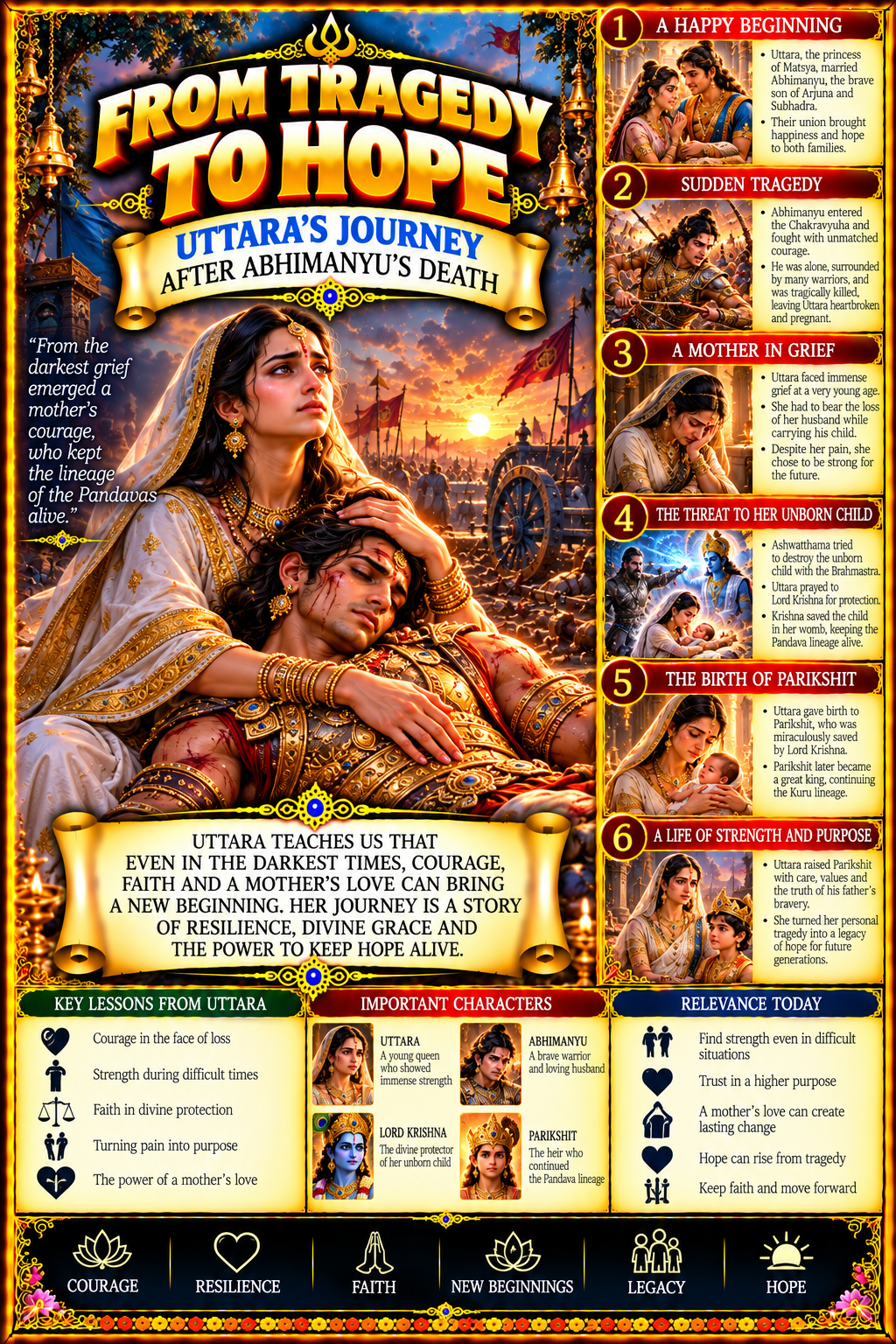
In the poignant aftermath of the Kurukshetra war, the heroic transformation chronicled in Uttara’s journey after Abhimanyu’s death represents one of the most heart-wrenching yet inspiring epics of classical Indian literature. While the grand epic of Vyasa frequently highlights the clash of celestial astras and the philosophical discourse of the Gita, the quiet fortitude of its women forms the true emotional bedrock of the tale. Amidst a desolation that claimed eighteen Akshauhinis of warriors, Princess Uttara was called upon to bear the crushing weight of personal tragedy while nurturing the singular, fragile spark of future civilization.
As explored in our comprehensive biography of Uttara in the Mahabharata, she was the tender princess of Matsya kingdom, trained in dance by Arjuna during the exile in disguise. Her blissful marriage to the sixteen-year-old warrior hero Abhimanyu in the Mahabharata was tragically cut short on the thirteenth day of the war inside the impenetrable Chakravyuha. Widowed in her youth while pregnant with an unborn child, Uttara stood at the threshold of absolute despair.
Yet, guided by the maternal embrace of Subhadra in the Mahabharata, the stoic solidarity of Queen Draupadi in the Mahabharata, and the divine intervention of Lord Krishna, Uttara rose above unimaginable grief. Even when the vengeful warrior Ashwatthama in the Mahabharata hurled the apocalyptic Brahmashira Astra directly into her womb, her unshakeable surrender (Sharanagati) allowed the cosmos to redeem hope from the ashes of destruction.
Archived in ancient Sanskrit texts including the poignant Stri Parva translated on scholarly archives like Wisdom Library, and the canonical narratives preserved in the Srimad Bhagavatam (Canto 1, Chapter 12), this treatise examines how Uttara’s maternal devotion safeguarded the lineage of Bharata and birthed Emperor Parikshit.
The Abyss of Grief and the Crucible of Hope: Uttara’s Journey After Abhimanyu’s Death
To understand the spiritual magnitude of Uttara’s journey after Abhimanyu’s death, one must reconstruct the harrowing night of Day 13 of the Kurukshetra war. When the sun dipped below the crimson horizon, the Pandava camp resounded not with the conches of victory, but with the inconsolable shrieks of Subhadra and Uttara. Abhimanyu, the radiant nephew of Krishna and crown jewel of the Chandra dynasty, had been brutally encircled and struck down by six seasoned Maharathis in blatant violation of the warrior code of honor (Kshatriya Dharma).
Rushing onto the corpse-strewn battlefield, young Uttara threw herself onto Abhimanyu’s mangled chest. As preserved in the Stri Parva of Vyasa’s Mahabharata, her lamentation brought tears even to the stoic eyes of Sage Vyasa and Lord Krishna. She wept bitterly, questioning how hands that had tenderly adorned her hair with forest jasmines were now clutching bloodstained dust, and how a prince destined for an imperial throne was sleeping upon the bare, arrow-pierced earth.
The Temptation of Sati and the Sacred Restraint of the Unborn Heir
Overwhelmed by blinding despair, the teenage princess resolved to enter the sacred funeral pyre with her fallen husband, seeking to unite with him in the celestial realm of Amaravati. However, Queen Mother Kunti, Subhadra, and Lord Krishna gently restrained her. Krishna placed His reassuring hand upon her trembling brow and spoke words of immense karmic gravity:
“Daughter Uttara, you do not belong merely to your own grief. Within your sanctified womb rests the seed of the Pandavas, the sole unbroken link of the Lunar Dynasty. If you surrender to fire today, you extinguish the future of Dharma. Live not for yourself, but as the fortress of hope for the world that will emerge from this carnage.”
Listening to the Lord, Uttara chose the far more challenging path: rather than embracing a swift death in the flames of grief, she chose the agonizing, patient asceticism of living for the sake of her unborn child.
The Nocturnal Massacre and the Apocalyptic Brahmashira Threat
On the eighteenth night of the war, after the mortal wounding of Duryodhana, the Pandavas believed the conflict was finally resolved. However, consumed by festering hatred, Ashwatthama, along with Kripacharya and Kritavarma, launched a catastrophic midnight ambush upon the sleeping Pandava encampment (Sauptika Parva). In cold blood, Ashwatthama murdered Dhrishtadyumna, Shikhandi, and all five young sons of Draupadi (the Upapandavas).
When Arjuna and Krishna tracked the fugitive Ashwatthama to the banks of the sacred Ganga, the desperate son of Drona invoked the Brahmashira Astra – a weapon of cosmic annihilation possessing four blazing faces like Lord Brahma. Arjuna discharged his own Brahmashira to neutralize the threat. Seeing the entire cosmos on the brink of incineration, Maharishi Vedavyasa and Sage Narada intervened, commanding both warriors to retract their celestial missiles.
“Apandavaya”: The Vengeful Weapon Directed into Uttara’s Womb
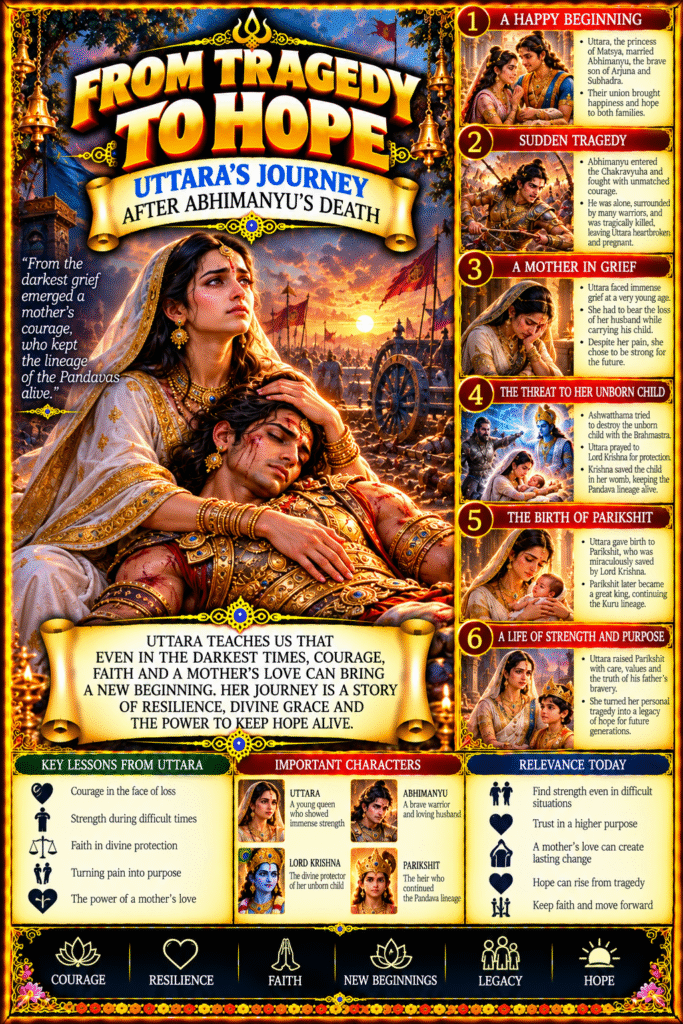
Arjuna, possessing immaculate ascetic discipline and lifelong truthfulness, smoothly recalled his Brahmashira Astra. But Ashwatthama lacked the spiritual purity to withdraw the weapon. Driven by unbridled malice, he declared: “Apandavaya!” (“Let there be no Pandava left in the universe!”). Rather than neutralizing the kinetic cosmic fire, he intentionally diverted the apocalyptic projectile directly into the wombs of the pregnant Pandava women, explicitly targeting Princess Uttara.
The Cry of Sharanagati: Uttara Flees to Lord Krishna
Within the royal tents of Hastinapur, Uttara felt an excruciating, searing heat tearing through her innermost being. The radioactive energy of the celestial missile began scorching the vital fluids protecting her fetus. Clasping her abdomen with blistering hands, Uttara did not run to mighty warriors or royal physicians; she ran straight toward Lord Krishna, crying out the eternal hymn of surrender immortalized in the Srimad Bhagavatam:
“PÄhi pÄhi mahÄ-yogin deva-deva jagat-pate | NÄnyaá¹ tvad abhayaá¹ paÅ›ye yatra má¹›tyuḥ parasparam”
(O Greatest of Mystics, God of Gods, Lord of the Universe! Save me, protect my child! In this mortal realm, I see no shelter other than You from this blazing circle of death!)
Uttara pleaded not for her own survival, but for the life of Abhimanyu’s unborn child. She cried: “Let this fiery arrow consume my mortal flesh if it must, O Madhava, but let not the seed of Abhimanyu be destroyed!” Her utter selflessness and absolute surrender dissolved all cosmic limitations.
The Miracle in the Womb: How Lord Krishna Rescued Unborn Parikshit
Witnessing Uttara’s pure devotion, Lord Krishna enacted a divine leela unprecedented in Vedic history. To counter a celestial weapon that was already destroying the physical fabric of the fetus, external barriers were useless. Krishna deployed His supreme mystic potency (Yoga-Maya).
1. The Thumb-Sized Form with the Sudarshana Chakra
Manifesting a microscopic, thumb-sized transcendental form (Angustha-matra), Lord Krishna entered the womb of Uttara. Clad in brilliant golden pitambara robes, holding His conch, club, lotus, and the incandescent Sudarshana Chakra, Krishna stationed Himself directly between the lethal radiation of the Brahmashira Astra and the developing child.
2. The Celestial Shield of Light
As the fiery tendrils of Ashwatthama’s weapon battered the womb, Krishna spun His Sudarshana Chakra at blinding velocity, creating an impenetrable ring of divine solar energy. The Sudarshana absorbed the atomic fury of the Brahmashira, dissipating its poison into cosmic ether. Inside the amniotic waters, the unborn infant looked upon this radiant four-armed savior, mesmerized by the divine vision that would forever define his consciousness.
The Stillborn Child and Krishna’s Sacred Oath of Absolute Truth (Satya Kriya)
When the full nine months were accomplished, Uttara entered labor in the quiet quarters of Hastinapur. However, when the baby emerged into the world, a heavy, suffocating silence gripped the delivery room. The infant was motionless, cold, and blackened by the lingering radioactive heat of the Brahmashira Astra. The child of Abhimanyu was born stillborn.
The sorrow that erupted in Hastinapur eclipsed even the horrors of the battlefield. Kunti wept bitterly; Draupadi collapsed to the floor; Subhadra struck her chest in agony. Young Uttara, pale and exhausted from childbirth, looked upon her lifeless child and wept with heart-rending desperation, asking why the Lord who had conquered three worlds had allowed death to triumph over Abhimanyu’s legacy.
The Satya Kriya: Invoking Untainted Truth
Hearing the cries of the grieving mothers, Lord Krishna stepped into the room. He washed His hands in sanctified water, gazed upon the lifeless body of the infant, and performed the ancient Vedic rite of Satya Kriya (the Act of Truth). Elevating His voice so that the heavens and earth bore witness, Krishna proclaimed:
“If I have never uttered an untruth even in jest; if righteousness (Dharma) has eternally been My breath and supreme guiding star; if I have vanquished all evil purely for the restoration of virtue; and if the vow of eternal truth resides unblemished within My heart – then by the virtue of that immaculate Satya, let this dead son of Abhimanyu arise and live!”
The moment the solemn oath resonated through the chamber, a blinding golden light illuminated the room. The charred skin of the baby turned fair and lustrous; the motionless chest heaved with life, and the infant let out a vigorous, resonant cry! The tears of despair turned instantaneously into tears of ecstatic gratitude. Uttara fell at the lotus feet of Krishna, her long ordeal of tragedy crowned with miraculous hope.
The Naming of Parikshit: The Examiner of the Divine
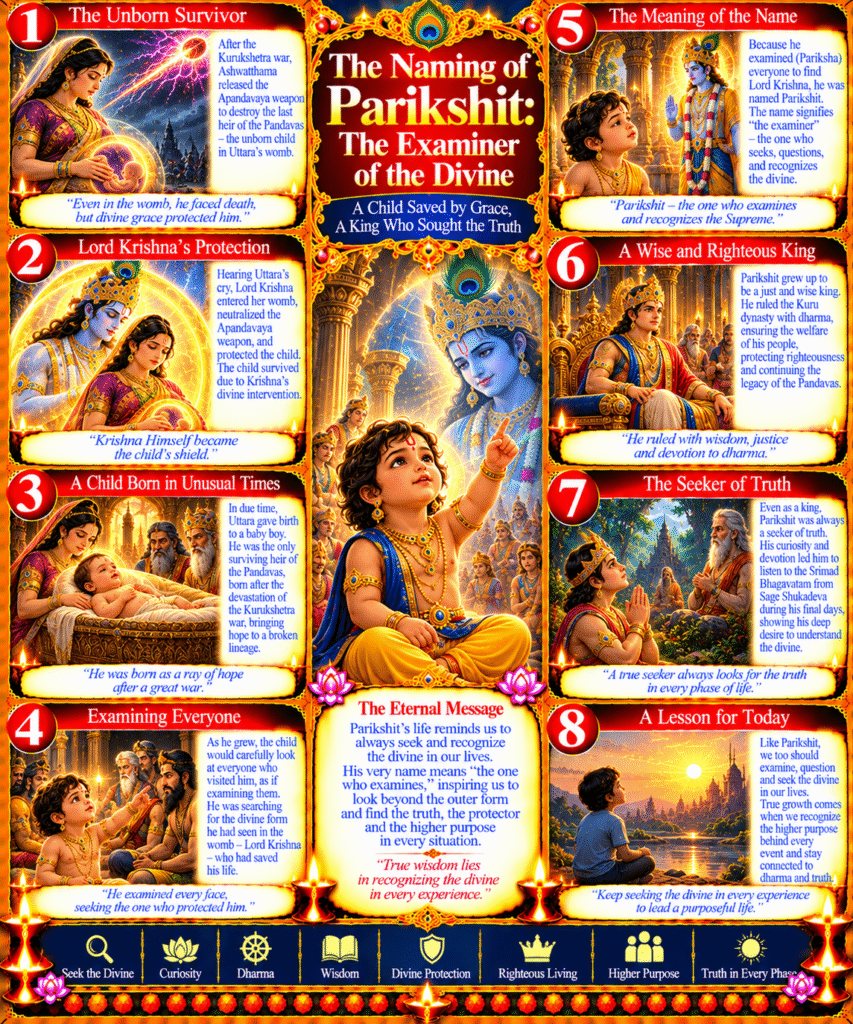
When the time arrived for the naming ceremony (Namakarana), the sages noticed an extraordinary behavior in the young infant. As visitors entered the royal court, the child looked intently into the eyes of every single human being, scanning their faces with keen, discerning curiosity.
Lord Krishna explained the profound metaphysical reason behind this search: while inside his mother’s womb, the baby had seen the radiant, four-armed form of Krishna protecting him from death. Now that he was born into the mortal world, he was constantly searching every human face to see if any mortal could match the peerless beauty and majesty of the Lord he had seen within the womb!
The Dual Names: Parikshit and Vishnurata
From Widowed Princess to Queen Mother: Uttara’s Living Legacy
Following the miraculous resurrection of her son, Uttara transitioned from a grieving young widow into the venerable Queen Mother of the Pandava empire. Under the tutelage of Yudhishthira, Arjuna, Kunti, and Draupadi, she raised Parikshit with peerless ethical foundations, instilling in him the courage of his father Abhimanyu and the spiritual wisdom of Krishna.
Three decades later, when the Pandava brothers and Draupadi renounced the kingdom to embark on their final journey to the Himalayas (Mahaprasthana), it was Uttara’s son, King Parikshit, who was crowned Emperor of Hastinapur. Parikshit’s reign is celebrated across ancient histories maintained by the Ministry of Culture, Government of India as a golden epoch of prosperity, peace, and righteous justice.
Furthermore, it was King Parikshit who, upon being cursed to die within seven days by a serpent bite, sat upon the banks of the sacred Ganga and listened to the entire Srimad Bhagavatam narrated by Sage Shukadeva. Thus, Uttara’s steadfast resilience in the face of tragedy did not merely preserve a mortal lineage; it became the direct catalyst for delivering the greatest theological text of devotion to all subsequent generations.
Comparative Matrix: The Trials, Divine Interventions, and Triumphs of Uttara
The following structured matrix summarizes the pivotal stages of Uttara’s life, illustrating how each catastrophe was transmuted into cosmic hope:
| Life Phase / Trial | Catastrophic Crisis | Spiritual Dilemma | Divine Intervention | Ultimate Triumph |
|---|---|---|---|---|
| Death of Abhimanyu (Day 13) | Widowed as a teenager; husband slain inside the Chakravyuha | Desire to enter the funeral pyre (Sati) in unbearable grief | Krishna, Kunti, and Subhadra counsel her to preserve the unborn seed | Overcame suicidal grief to become the guardian of the Pandava future |
| The Brahmashira Attack (Night 18) | Ashwatthama directs apocalyptic weapon into her womb | Blistering radioactive heat destroying the amniotic life of the fetus | Utter surrender (Sharanagati) as Uttara flees to Krishna | Krishna enters the womb with Sudarshana Chakra, neutralizing the missile |
| The Stillborn Birth of Parikshit | Baby born lifeless, charred black by lingering astra heat | Extinction of the Lunar Dynasty; despair of all Pandava elders | Krishna executes the sacred Satya Kriya (Act of Absolute Truth) | Child miraculously resurrects, breathes, and fills Hastinapur with joy |
| Raising the Sovereign Heir | Single mother in a post-war capital scarred by immense trauma | Nurturing a child capable of ruling a fractured subcontinent | Mentorship under Kunti, Subhadra, Draupadi, and Yudhishthira | Parikshit crowned Emperor, establishing an era of exemplary Dharma |
| Spiritual Fruition (Bhagavata) | Parikshit cursed to perish within seven days by Takshaka snake | Accepting mortality with transcendental detachment | Sage Shukadeva delivers the complete Srimad Bhagavatam | Parikshit attains supreme Moksha; cosmic wisdom gifted to humanity |
Philosophical Breakdown: Grief Transmuted into Duty (Swadharma)
In modern psychological and spiritual paradigms, Uttara exemplifies post-traumatic growth. Rather than remaining trapped in the paralysis of victimhood, she sublimated personal loss into selfless maternal service. Her life proves that true strength in Sanatana Dharma is not measured by the weapons one wields, but by the suffering one has the courage to endure for the welfare of others.
Spiritual Dimension: The Archetype of Unflinching Surrender (Prapatti)
Uttara’s prayer before Krishna is recognized in Vaishnava theology as the pure expression of Prapatti (unconditional surrender). When she cried “Pahi Pahi”, she abandoned reliance on worldly kings, celestial defenses, and personal ego, acknowledging that the Divine alone is both the means (Upaya) and the goal (Upeya) of salvation.
Ethical Dimension: The Triumph of Truth over Nuclear Malice
The resurrection of Parikshit illustrates that no weapon of mass destruction, however terrifying, possesses greater potency than absolute adherence to truth (Satya). Ashwatthama’s weapon represented the pinnacle of technological violence channeled through hate; Krishna’s Satya Kriya represented cosmic order channeled through selfless love.
Scriptural Citation: Mahabharata (Stri Parva, Sauptika Parva, Ashvamedhika Parva)
The detailed laments of Uttara and the revival of her child are documented across the Stri Parva (Chapters 20-21) and the Ashvamedhika Parva (Chapters 66-70) of the critical edition of the Mahabharata.
Philological Note: The Sanskrit Etymology of “Parikshit”
Scholars also interpret “Parikshit” from the Sanskrit term Pari-Kshin, signifying “one born when the entire family lineage was diminished or exhausted,” symbolizing hope blooming in the desert of annihilation.
Frequently Asked Questions About Uttara and Abhimanyu (20 Detailed FAQs)
1. Who was Uttara in the Mahabharata?
Uttara was the princess of the Matsya Kingdom, daughter of King Virata and Queen Sudeshna. She was married to the heroic Pandava prince Abhimanyu and became the mother of Emperor Parikshit.
2. How did Uttara meet Abhimanyu?
During the Pandavas’ final year of exile in disguise (Agyatvas) in Matsya, Arjuna lived as Brihannala, a dance teacher to Uttara. At the end of exile, King Virata offered Uttara’s hand in marriage; Arjuna declined for himself since he had been her teacher, and arranged her wedding with his son Abhimanyu instead.
3. On which day of the Kurukshetra war was Abhimanyu killed?
Abhimanyu was killed on the 13th day of the Kurukshetra war after bravely entering the Chakravyuha formation and being encircled by six Maharathis who broke all codes of warfare.
4. Was Uttara pregnant when Abhimanyu died?
Yes, Uttara was expecting Abhimanyu’s unborn child when he was killed in the war. This unborn child was the sole remaining heir of the entire Pandava dynasty.
5. Why didn’t Uttara perform Sati after Abhimanyu’s death?
Uttara desperately wished to enter the funeral pyre, but Queen Mother Kunti, Subhadra, and Lord Krishna restrained her, explaining that she carried the last surviving lineage of the Pandavas in her womb and had a sacred duty to protect the child.
6. Who attacked Uttara’s unborn baby and why?
Ashwatthama attacked Uttara’s unborn child using the deadly Brahmashira Astra. Unable to recall his weapon after confronting Arjuna, Ashwatthama redirected its destructive energy into Uttara’s womb out of sheer vengeance to wipe out the Pandava bloodline.
7. What did Uttara do when Ashwatthama’s weapon attacked her womb?
Feeling intense burning within her womb, Uttara ran directly to Lord Krishna and surrendered unconditionally (Sharanagati), pleading with Him to save the life of Abhimanyu’s child even if she had to lose her own life.
8. How did Lord Krishna protect the unborn baby inside Uttara’s womb?
Krishna assumed a microscopic, thumb-sized four-armed transcendental form and entered Uttara’s womb. Using His blazing Sudarshana Chakra, He intercepted and absorbed the lethal cosmic radiation of the Brahmashira Astra.
9. Was Parikshit born alive or dead?
Parikshit was born stillborn, charred black and breathless due to the intense radioactive heat of Ashwatthama’s weapon that had enveloped the womb.
10. How did Krishna revive the stillborn Parikshit?
Krishna performed the sacred Satya Kriya (Act of Truth). He proclaimed that if He had never spoken a lie and had lived strictly in accordance with Dharma and Brahmacharya, the child should breathe again. Instantly, the infant came back to life and cried.
11. What is the meaning of the name “Parikshit”?
Parikshit means “The Examiner” or “The Inquirer.” Having seen the divine four-armed form of Krishna within the womb, the newborn child searched and examined the eyes and face of every person he encountered to find that divine image again.
12. What was Parikshit’s other name and its meaning?
His other name was “Vishnurata,” which means “one who was protected and given life as a gift by Lord Vishnu (Krishna).”
13. Who raised Parikshit after the Kurukshetra war?
Parikshit was raised primarily by his devoted mother Uttara, with loving guidance from his grandmothers Subhadra, Draupadi, and Kunti, along with the five Pandava brothers.
14. What happened to Ashwatthama after he attacked Uttara’s womb?
Lord Krishna cursed Ashwatthama to roam the earth for 3,000 years in isolation, suffering from festering, incurable wounds, deprived of all human touch and hospitality. Krishna also removed the divine protective gem (Mani) from Ashwatthama’s forehead.
15. When did Parikshit become king of Hastinapur?
Parikshit was crowned King of Hastinapur 36 years after the Kurukshetra war, when the five Pandavas and Draupadi renounced the world to embark on their final journey to the Himalayas (Mahaprasthana).
16. What kind of king was Uttara’s son Parikshit?
Emperor Parikshit is celebrated as an exceptionally wise, just, and benevolent ruler who upheld Dharma, protected the downtrodden, and restrained the corrupting influences of the Kali Yuga during his reign.
17. How did Uttara react to her son’s accession to the throne?
Uttara witnessed her son’s coronation with immense humility and gratitude, realizing that her decades of patient sacrifice, grief, and faith in Lord Krishna had successfully preserved the light of righteousness for the world.
18. What is the connection between Parikshit and the Srimad Bhagavatam?
When cursed by a sage’s son to die of a snakebite within seven days, Parikshit renounced his throne and sat by the Ganges. Sage Shukadeva narrated the entire 18,000 verses of the Srimad Bhagavatam to him, granting him supreme liberation (Moksha).
19. Which book in the Mahabharata contains Uttara’s lamentations?
Uttara’s deeply moving laments over the body of Abhimanyu are preserved in the Stri Parva (Book of Women), while the attack on her womb is narrated in the Sauptika Parva and her child’s revival in the Ashvamedhika Parva.
20. What is the central moral lesson of Uttara’s life?
Uttara’s journey teaches humanity that even the most catastrophic personal tragedies can be transformed into lasting hope through moral endurance, self-sacrificing love, and absolute faith in divine grace.