Raja Ratnam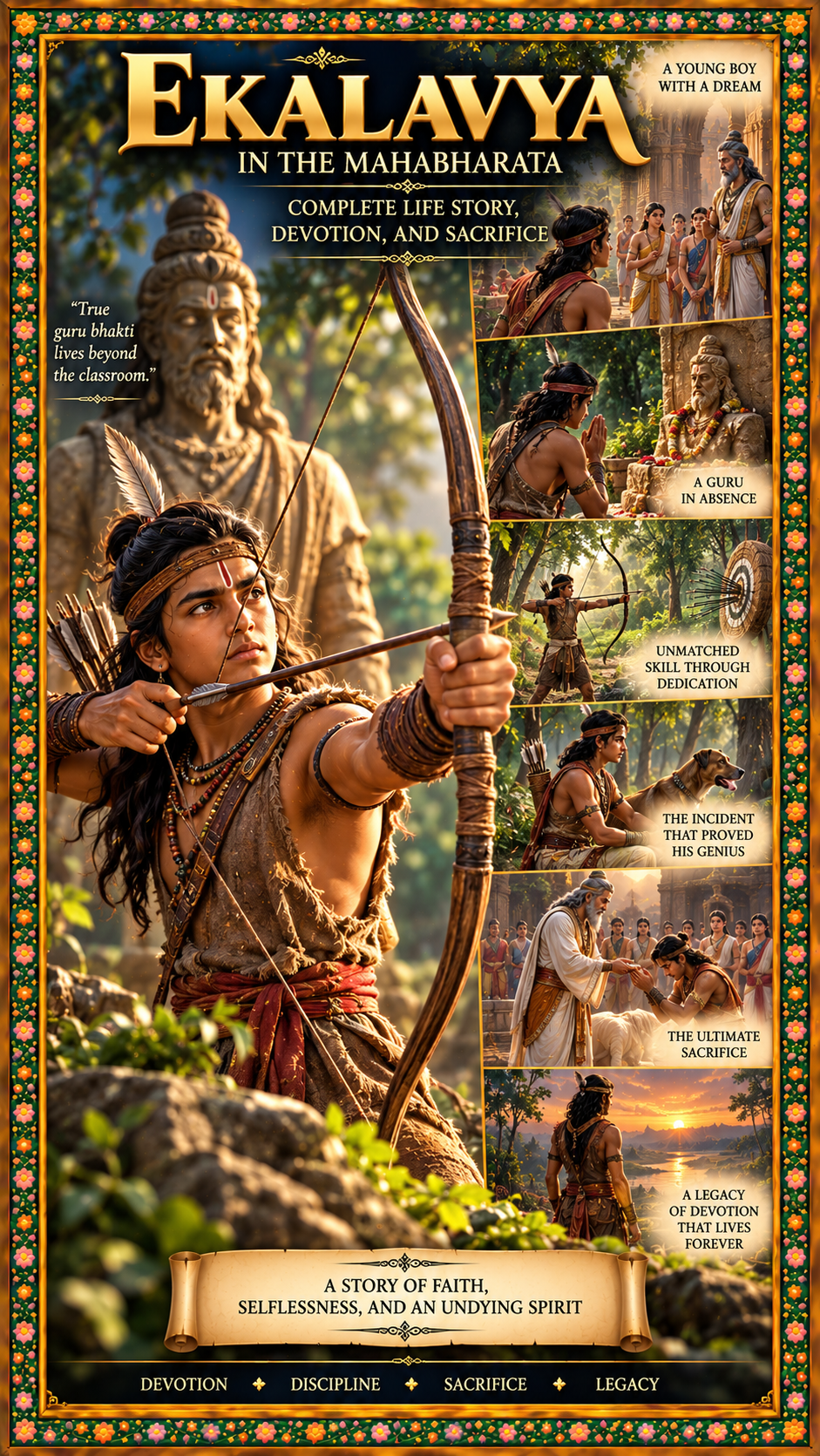
In the quiet shadows of the Hastinapur forest, far away from the royal archery grounds, a young Nishadha boy stood alone before a humble statue sculpted from clay. Without a master to correct his grip or praise his stance, Ekalavya practiced day and night with pure devotion, shooting arrows until his fingers bled. His extraordinary discipline made him one of the greatest archers of his generation, rivaling the royal prince Arjuna. Yet his story remains one of the most touching in the Mahabharata – a testament to what absolute dedication can achieve, and the heavy price an outsider paid to honor his silent teacher.
While most readers know about Ekalavya’s legendary sacrifice of his right thumb, there are many lesser-known aspects of his life, his hidden royal lineage, and his post-sacrifice career as a formidable warrior that are rarely discussed. Exploring the life of Ekalavya in the Mahabharata reveals a narrative that challenges the boundaries of traditional caste structures and explores the true nature of the teacher-student relationship (Guru-Shishya Parampara).
The Birth and Lineage of Ekalavya in the Mahabharata
Ekalavya is commonly described as a forest-dwelling tribal boy belonging to the Nishada community. His father, Hiranyadhanus, was the king of the Nishadas and a powerful military commander who protected the forest borders of the Magadha kingdom.
Growing up in the forest, Ekalavya developed a natural affinity for nature, wildlife, and the hunting arts, showing an early inclination toward archery.
The Royal Secret: Ekalavya in the Mahabharata as Krishna’s Cousin
One of the most fascinating and unknown facts about Ekalavya in the Mahabharata is his actual birth lineage. According to the Harivamsa (the appendix to the Mahabharata), Ekalavya was not born a tribal. He was actually born into the royal Yadava dynasty, making him a first cousin of Lord Krishna.
His biological father was Devashrava, the younger brother of Vasudeva (Krishna’s father). Due to astrological predictions or political circumstances, Devashrava abandoned the infant in the forest, where he was found and raised by King Hiranyadhanus of the Nishadas. This hidden lineage adds a layer of depth to his relationship with Krishna and his eventual role in the political conflicts of ancient India.
For official cultural and historical archives, visit the Ministry of Culture, Government of India.
The Rejection by Guru Dronacharya: Ekalavya in the Mahabharata’s Turning Point
As Ekalavya grew, his passion for archery intensified. Hearing of the legendary military preceptor Dronacharya, who had been appointed by Hastinapur to train the Kuru princes, Ekalavya travelled to the royal capital.
He approached Dronacharya and humbly requested to be accepted as his disciple.
Devotion and Mastery: Ekalavya in the Mahabharata and the Clay Statue
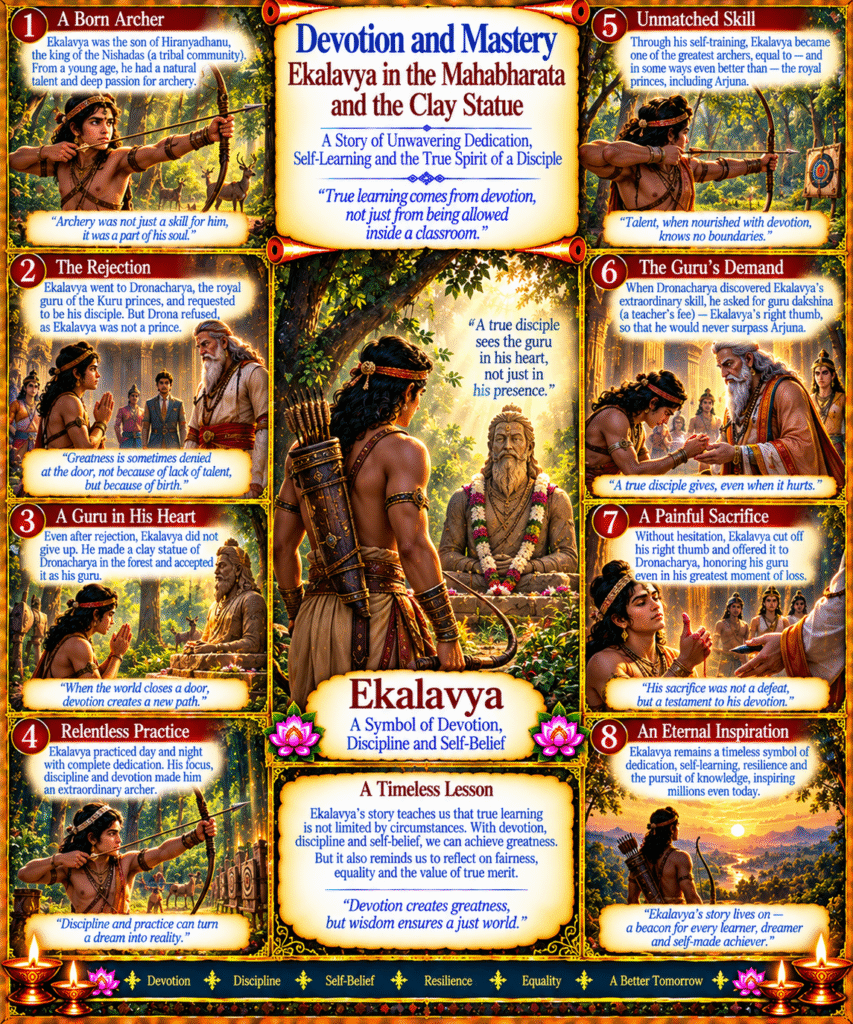
Dronacharya, however, refused to accept Ekalavya. Drona was bound by his contract with Hastinapur, which required him to train only Kuru royalty. Furthermore, Drona had promised Arjuna that he would make him the greatest archer in the world.
Accepting a tribal prince who could potentially challenge Hastinapur was politically impossible. Devastated but undeterred, Ekalavya bowed to Drona, gathered soil from under the Guru’s feet, and returned to the forest.
In a quiet clearing, he built a life-sized clay statue of Dronacharya under a large tree. Treating the statue as his physical Guru, Ekalavya began practicing archery with absolute discipline and faith. His devotion was so pure that his skills grew rapidly, and he eventually surpassed the royal princes in speed, accuracy, and concentration.
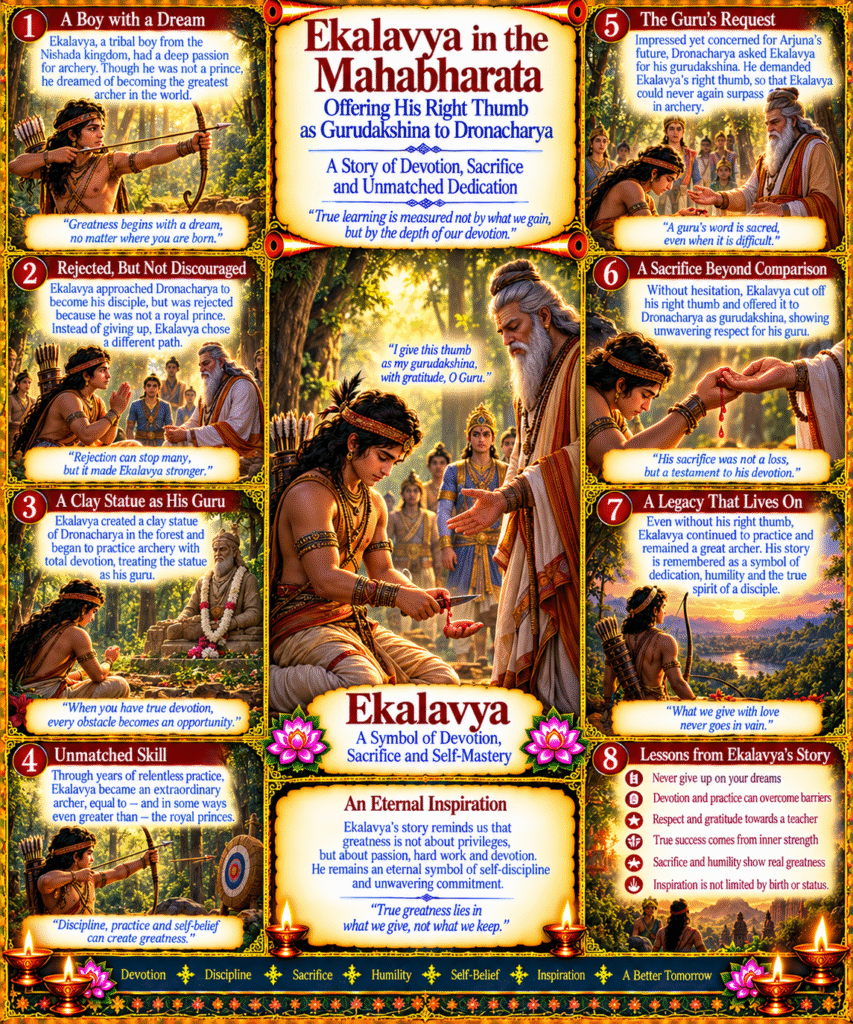
The Ultimate Sacrifice: Guru Dakshina of Ekalavya in the Mahabharata
The peace of Ekalavya’s forest sanctuary was shattered one day when the Kuru princes went hunting in the same forest.
The Barking Dog Incident: Proving Superior Archery Skills
During the hunt, the princes’ dog wandered near Ekalavya’s clearing and began barking loudly, disrupting his meditation. Without looking at the dog and without causing it any physical harm, Ekalavya shot seven arrows in rapid succession, sealing the dog’s mouth shut with a web of arrows.
When the dog returned to the Kuru princes, Arjuna was astonished by the sight. The skill required to perform such a feat without injuring the animal was beyond anything Arjuna had learned. Arjuna approached Dronacharya, reminding him of his promise to make him the greatest archer in the world. Drona, equally amazed, led the princes into the forest to find this mysterious archer.
The Right Thumb Demand: A Tragic and Controversial Request
They found Ekalavya practicing in front of the clay statue. When Dronacharya asked who his teacher was, Ekalavya bowed and pointed to the statue, saying, “You are my Guru, Acharya.”
Dronacharya immediately realized that Ekalavya’s skill was indeed superior to Arjuna’s. To preserve his promise to Arjuna and protect the political dominance of Hastinapur, Dronacharya demanded his Guru Dakshina (the teacher’s fee). He asked for Ekalavya’s right thumb.
In archery, the right thumb is critical for drawing the bowstring. Without hesitation, Ekalavya drew his knife, cut off his right thumb, and placed it at Dronacharya’s feet.
Ethical Questions Surrounding Dronacharya’s Decision
This incident remains one of the most controversial events in the Mahabharata. Critics argue that Dronacharya acted out of extreme favoritism, social prejudice, and cruelty.
By demanding the thumb, Drona effectively destroyed the career of a brilliant young archer who had shown nothing but respect and devotion.
Social and Political Context of Ekalavya in the Mahabharata’s Thumb Sacrifice
From a political standpoint, Dronacharya was an officer of Hastinapur. A tribal prince possessing superior military knowledge could easily lead a rebellion against the kingdom, especially since the Nishadas were allies of Hastinapur’s enemy, Magadha.
Dronacharya chose his duty to the state and his promise to Arjuna over moral fairness, cementing Ekalavya’s status as a tragic hero.
The Resilient Warrior: Ekalavya in the Mahabharata’s Later Life
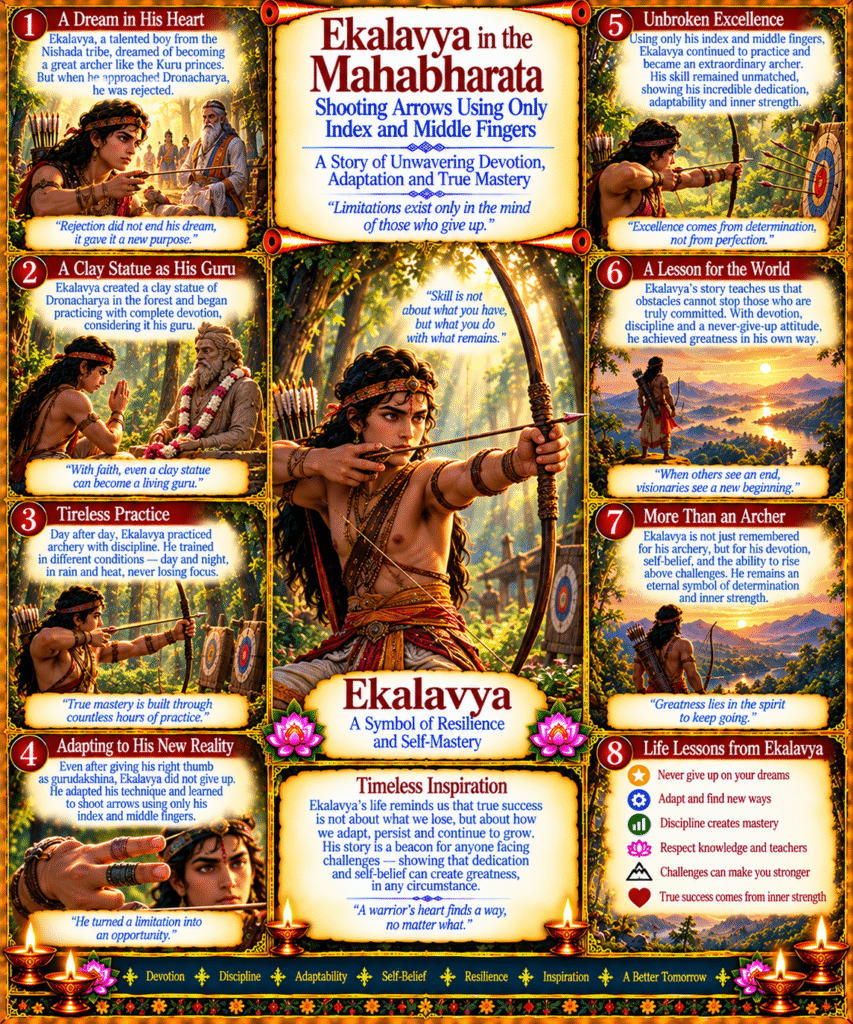
An interesting fact about Ekalavya in the Mahabharata is that losing his thumb did not end his career as a warrior. With immense determination, Ekalavya retrained himself to shoot arrows using only his index and middle fingers.
He developed a new style of rapid-fire archery that proved to be incredibly effective. Following his father’s death, Ekalavya became the King of the Nishadas.
He formed an alliance with King Jarasandha of Magadha and fought against the Yadavas of Dwaraka. During Jarasandha’s campaigns against Dwaraka, Ekalavya’s archery skills caused massive casualties among Krishna’s forces, proving that he remained one of the deadliest warriors in ancient India.
Unknown and Interesting Facts About Ekalavya in the Mahabharata
Aside from his cousinship with Lord Krishna, there are other remarkable facts about Ekalavya’s life:
* The Blessing of Reincarnation: When Ekalavya was eventually killed by Lord Krishna during a battle at Dwaraka, Krishna recognized his unmatched devotion and sacrifice. Krishna blessed Ekalavya, promising him that he would be reborn as Dhrishtadyumna (the prince of Panchala) in his next life, specifically to behead Dronacharya on the battlefield of Kurukshetra and avenge his thumb sacrifice.
* The Ekalavya Style of Archery: Ekalavya’s method of shooting without the thumb is studied by modern archers. In some tribal communities in India, archers still practice shooting with only the index and middle fingers in honor of Ekalavya.
* Symbol of Self-Made Success: Ekalavya is revered as the patron saint of self-taught individuals, demonstrating that true knowledge does not depend on elite institutions, but on individual dedication and focus.
The Death and Legacy: How Ekalavya in the Mahabharata Inspires Today
Ekalavya’s life ended in battle, but his legacy remains eternal. He represents the voice of the marginalized who, through sheer willpower, rise to match the elite.
His story serves as a reminder of the sacrifices demanded by social systems and the timeless value of unwavering dedication to one’s passion.
Frequently Asked Questions (FAQs) About Ekalavya in the Mahabharata
1. Who was Ekalavya in the Mahabharata?
Ekalavya was a young tribal prince of the Nishada community who became a master archer by practicing in front of a clay statue of Guru Dronacharya.
2. Was Ekalavya related to Lord Krishna?
Yes. Ekalavya was biologically the son of Devashrava (Krishna’s uncle), making him Krishna’s first cousin. He was adopted and raised by the Nishada king Hiranyadhanus.
3. Why did Dronacharya refuse to teach Ekalavya?
Dronacharya was bound by his contract to teach only Kuru princes and had promised Arjuna that he would make him the greatest archer in the world.
4. How did Ekalavya learn archery?
He built a clay statue of Dronacharya in the forest, treated it as his Guru, and practiced archery before it with absolute dedication.
5. What was the barking dog incident?
Ekalavya filled the mouth of a barking dog with seven arrows in rapid succession without injuring it, silencing it and demonstrating his superior skill.
6. What did Dronacharya ask from Ekalavya as Guru Dakshina?
Dronacharya asked for Ekalavya’s right thumb, knowing it would destroy his ability to shoot arrows with the same speed and accuracy.
7. Did Ekalavya hesitate to give his thumb?
No, Ekalavya immediately cut off his right thumb and placed it at Dronacharya’s feet without any hesitation or anger.
8. Did Ekalavya stop practicing archery after losing his thumb?
No, he retrained himself to shoot arrows using only his index and middle fingers, remaining a formidable warrior.
9. Which kingdom did Ekalavya rule?
He became the King of the Nishadas after his father’s death and allied with Magadha.
10. Who killed Ekalavya?
Ekalavya was killed by Lord Krishna during a battle near Dwaraka when Ekalavya attacked the city alongside Jarasandha.
11. Why did Krishna kill Ekalavya?
Krishna killed him because Ekalavya was fighting on the side of adharma (unrighteousness) with Jarasandha, and because Krishna wanted to grant him salvation and a future rebirth.
12. How was Ekalavya reincarnated?
Krishna blessed Ekalavya that he would be reincarnated as Dhrishtadyumna, the son of King Drupada, to kill Dronacharya and avenge his sacrifice.
13. What is the symbolic meaning of Ekalavya’s story?
His story represents the struggles of self-taught individuals, the tragedy of social discrimination, and ultimate student devotion.
14. Who was Ekalavya’s father?
His adoptive father was Hiranyadhanus, the king of the Nishadas, and his biological father was Devashrava.
15. Where did Ekalavya practice archery?
He practiced in the forests near modern-day Gurgaon (Haryana), where Dronacharya’s Gurukul was located.
16. Did Arjuna feel guilty about Ekalavya’s sacrifice?
The text suggests Arjuna was relieved to remain the top archer, but the sacrifice of Ekalavya remained a moral burden for both Arjuna and Dronacharya.
17. How did Ekalavya fight without a thumb?
He held the bowstring between his index and middle fingers, a technique that is still recognized as the “Ekalavya style” of archery.
18. Why did Jarasandha ally with Ekalavya?
Jarasandha valued Ekalavya’s military power and archery skills, utilizing the Nishada forces in his attacks against Dwaraka.
19. What is the moral lesson of Ekalavya’s sacrifice?
It teaches that while dedication can yield master skills, blind devotion to systems or individuals who do not respect you can lead to tragic exploitation.
20. Is Ekalavya worshipped today?
Yes, in several tribal regions of India, Ekalavya is worshipped as a deity of archery, focus, and student devotion.