Raja Ratnam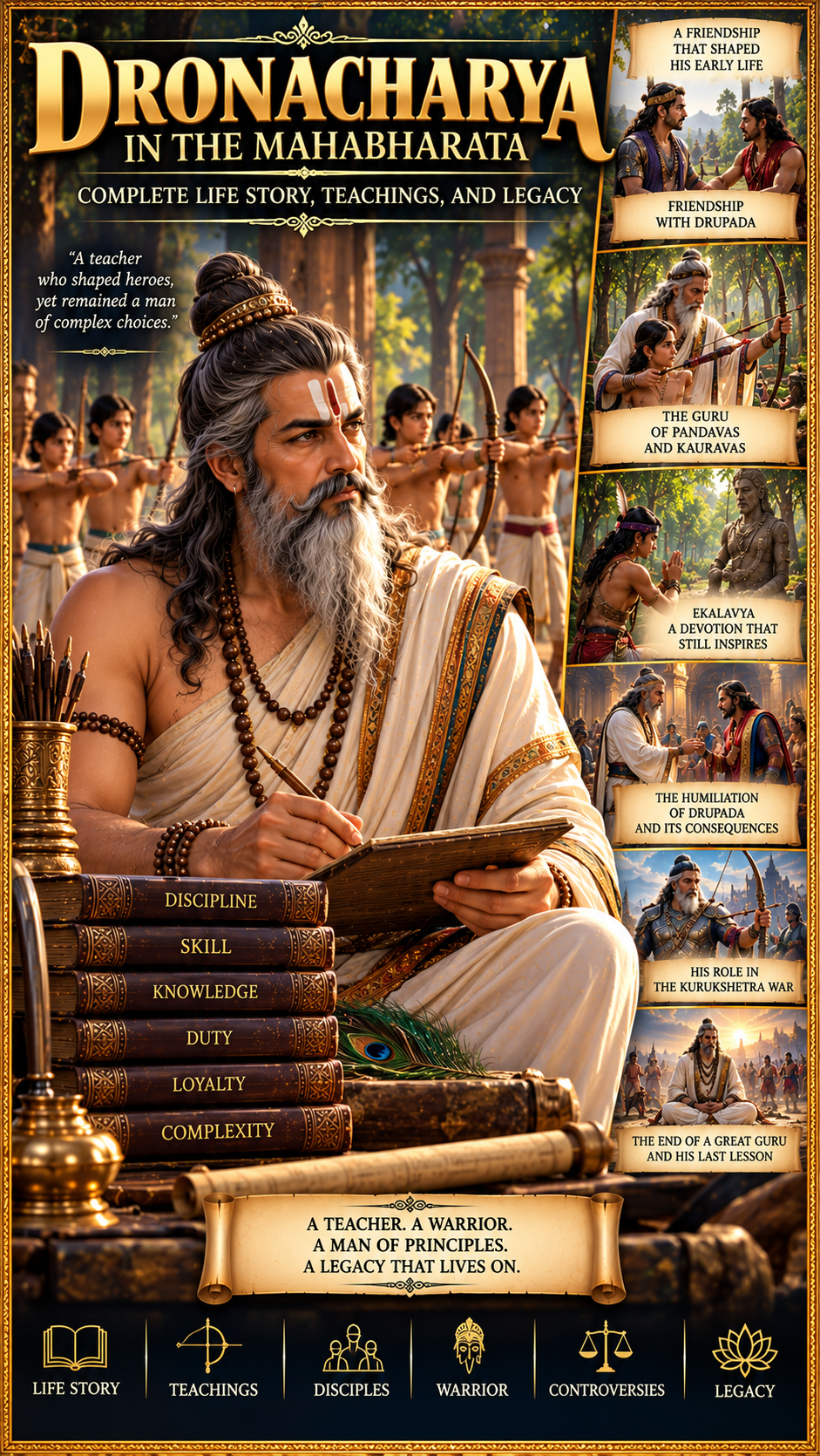
The Mahabharata is a monumental epic that serves as a profound guide to human behavior, politics, and duty (Dharma). Among its many central characters, Dronacharya in the Mahabharata stands as one of the most complex, revered, and controversial figures. As the royal preceptor (Guru) who trained both the Pandava and Kaurava princes in the military arts, he was a master of archery, advanced military formations, and divine weaponry. Yet, his life was a constant struggle between his duties as a teacher, his loyalty to the state of Hastinapur, and the heavy moral sacrifices he had to make.
To truly understand Dronacharya in the Mahabharata, one must explore past his reputation as a master archer and examine the deep conflicts of interest, the tragic demands of his career, and his final days on the battlefield of Kurukshetra. His journey represents the light of knowledge combined with the shadows of political compromise.
The Birth and Lineage of Dronacharya in the Mahabharata
Dronacharya was not born in a conventional royal family. He was the son of the revered sage Bharadwaja. The story of his birth is unique: he was generated from a vessel or pot (known in Sanskrit as a *Drona*), which is why he was named Drona.
Drona grew up in his father’s hermitage, living a life of simplicity, spiritual study, and intense focus. During his youth, he studied alongside Drupada, the prince of Panchala. The two became close friends, and Drupada promised Drona that once he became king, he would share half of his wealth and kingdom with him.
Drona married Kripi, the sister of Kripacharya, and had a son named Ashwatthama. Ashwatthama was born with a magical gem on his forehead, which protected him from hunger, thirst, and fatigue. Despite his vast knowledge of divine weapons, Drona lived in extreme poverty. Unable to even buy milk for his crying son, Drona decided to visit his childhood friend, King Drupada, to ask for a cow. However, Drupada, now a proud king, mocked Drona’s poverty and refused to acknowledge their childhood friendship, stating that friendship can only exist between equals. Devastated and humiliated, Drona vowed to gain a position of power and train disciples who would defeat Drupada.
The Introduction: Dronacharya in the Mahabharata and the Kuru Princes

Drona travelled to Hastinapur in search of a livelihood. One day, he saw the young Pandava and Kaurava princes surrounding a deep, dry stone well. Their rubber ball had fallen into the well, and they were unable to retrieve it.
Dronacharya approached the princes and offered to retrieve the ball. He shot a blade of grass into the well, which pierced the ball. He then shot another blade of grass, which connected to the first, creating a chain of grass blades. He pulled the ball out of the well using this chain, leaving the princes in absolute awe.
When the princes narrated this incident to Bhishma, the patriarch of Hastinapur, Bhishma instantly recognized that this was the work of a master archer. Bhishma invited Dronacharya to the palace and appointed him as the royal tutor (Guru) to train the Kuru princes in archery and military arts, promising him all the resources and respect he deserved.
The Royal Gurukul: Archery Teachings of Dronacharya in the Mahabharata
Dronacharya set up his academy (Gurukul) and began training the princes. He was a strict and demanding teacher, utilizing innovative techniques to develop their skills. He taught them the science of archery (Dhanurveda), physical combat, and the deployment of divine weapons (Astras).
Among all his disciples, Arjuna was the most dedicated, focused, and hardworking. Recognizing Arjuna‘s immense potential, Dronacharya promised him that he would make him the greatest archer in the world.
The Bird’s Eye Test: Extreme Focus by Arjuna under Dronacharya in the Mahabharata
To test his students’ concentration, Dronacharya placed a wooden bird on a branch of a distant tree. He called the princes one by one, telling them to aim at the bird’s eye. Before they released the arrow, he asked them what they could see.
Yudhishthira, Duryodhana, and the other princes replied that they could see the tree, the branch, the leaves, the sky, and the bird. Dronacharya told them to step down, saying they were not ready.
Finally, he called Arjuna. When asked what he saw, Arjuna replied, “I see only the eye of the bird.” Dronacharya asked if he saw anything else, and Arjuna repeated, “Nothing else, Guru. I see only the bird’s eye.” Dronacharya ordered him to shoot, and Arjuna’s arrow pierced the wooden bird’s eye perfectly. This test demonstrated the importance of absolute focus, which Dronacharya instilled in Arjuna.
The Guru Dakshina: Ekalavya and Dronacharya in the Mahabharata
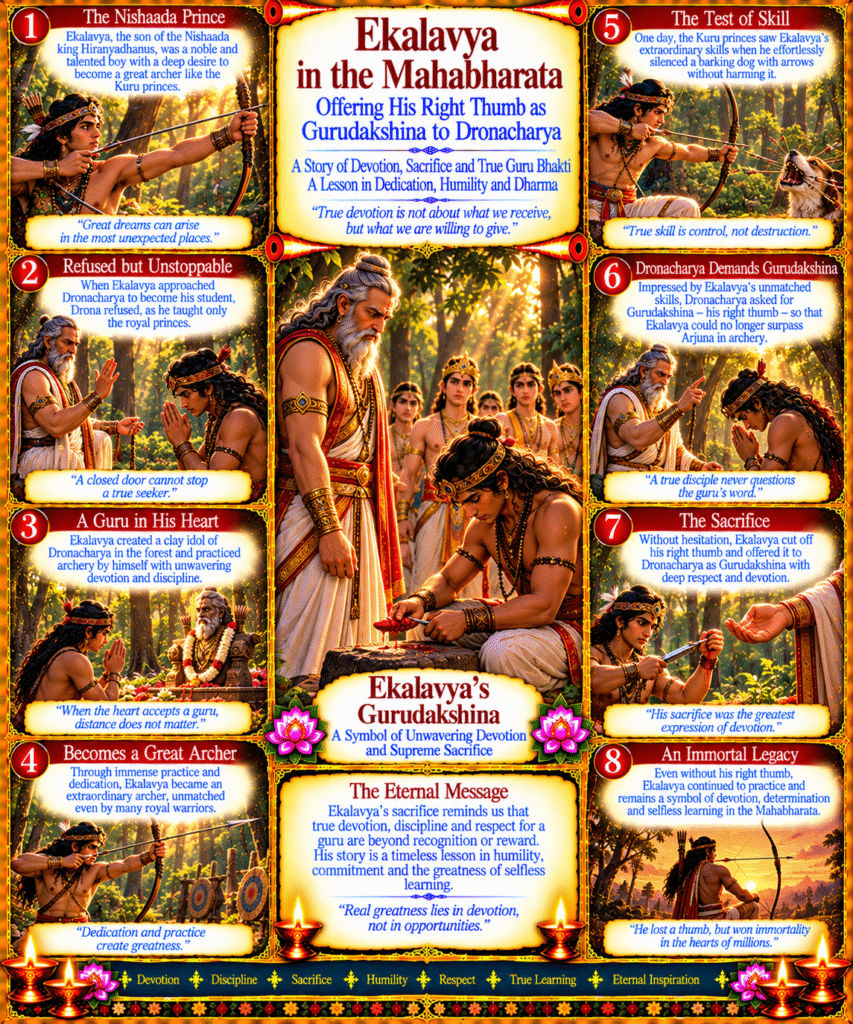
The story of Ekalavya is one of the most tragic and widely debated stories associated with Dronacharya in the Mahabharata, highlighting the rigid social structures and political compromises of the time.
The Tragic Sacrifice: The Story of the Right Thumb
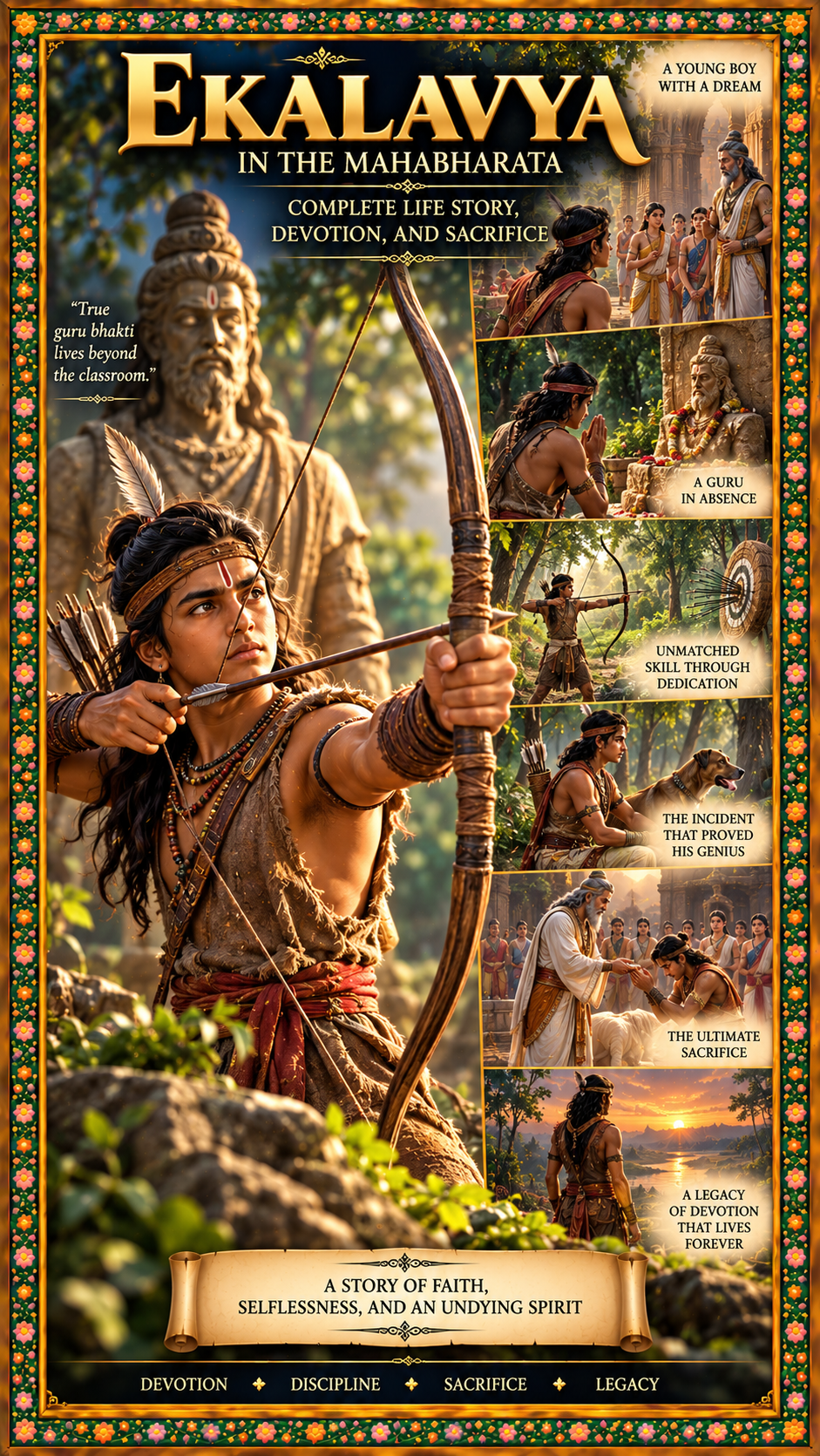
Ekalavya was a young tribal prince (belonging to the Nishada clan) who wished to learn archery under Dronacharya. However, Dronacharya refused to accept him, stating that his royal contract required him to train only Kuru princes, and that training a non-royal forest dweller would violate his loyalty to the throne.
Undeterred, Ekalavya returned to the forest. He constructed a clay statue of Dronacharya, treated it as his physical Guru, and began practicing archery in front of it with absolute devotion. Through his self-study and faith, Ekalavya developed skills that rivaled and perhaps even surpassed those of Arjuna.
One day, while the Kuru princes were hunting in the forest, their dog wandered near Ekalavya’s clearing and began barking. Without harming the dog, Ekalavya shot seven arrows into its mouth in rapid succession, silencing it. When Arjuna saw the dog, he was astonished by this masterclass in archery. Arjuna approached Dronacharya, reminding him of his promise to make him the greatest archer.
Dronacharya and the princes searched the forest and found Ekalavya. When asked who his teacher was, Ekalavya bowed before Dronacharya and pointed to the clay statue. Dronacharya, realizing that Ekalavya’s skill could threaten Arjuna’s position and create a powerful warrior outside Hastinapur’s control, demanded his Guru Dakshina (the teacher’s fee). He asked for Ekalavya’s right thumb. Without hesitation, Ekalavya cut off his right thumb and offered it to his Guru, destroying his ability to shoot arrows with the same speed and accuracy.
Deep Moral Questions of Dronacharya in the Mahabharata’s Decision
Dronacharya’s demand for Ekalavya’s thumb raises deep ethical questions. Critics argue that Dronacharya acted out of favoritism for Arjuna and social prejudice against the tribal community.
Historical and Social Perspectives on Ekalavya and Dronacharya in the Mahabharata
From a political perspective, Dronacharya was a state-employed teacher. If a tribal prince became a superior archer, it could threaten the security of Hastinapur, as the forest tribes often clashed with the royal capital. Dronacharya chose his loyalty to the throne and his promise to Arjuna over universal fairness.
Cultural Evolution of the Guru-Shishya Bond in Dronacharya in the Mahabharata
Despite the tragic demand, Ekalavya’s sacrifice made him a legendary symbol of devotion. Today, in Indian sports, the highest award given to sports coaches is named the Dronacharya Award, celebrating the legacy of coaching, while Ekalavya is remembered as the ultimate disciple.
The Battle of Kurukshetra: Dronacharya in the Mahabharata as Commander
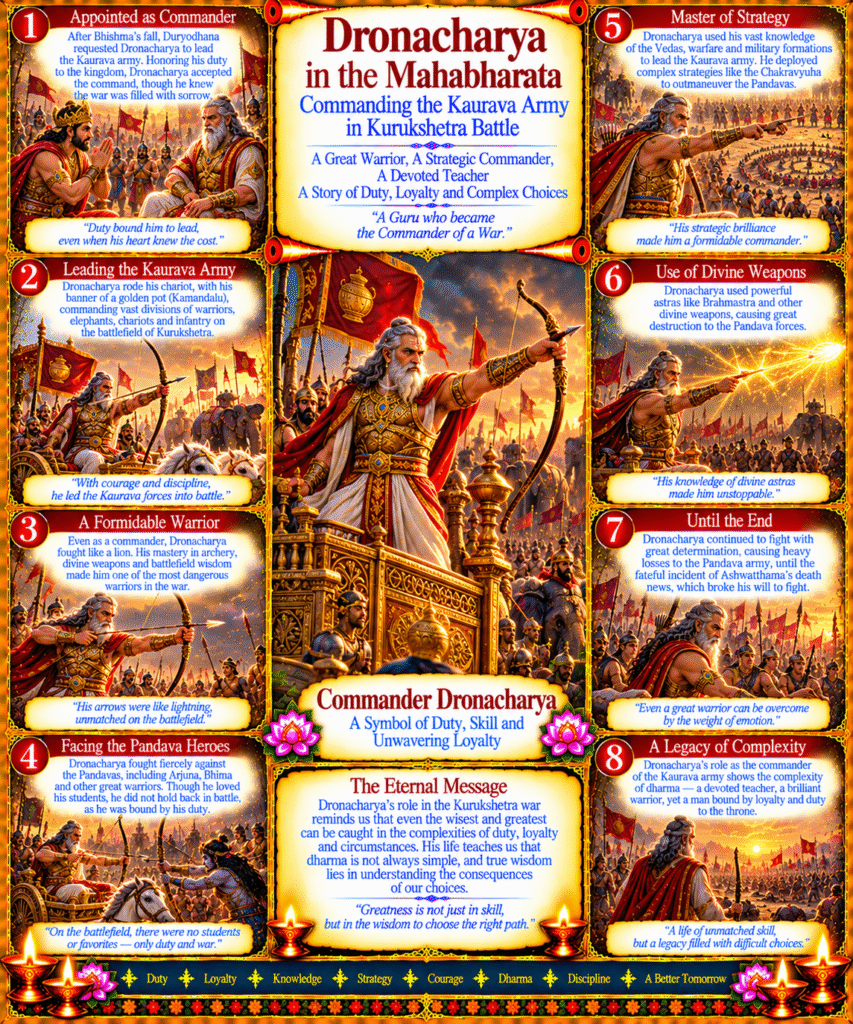
When the Kurukshetra War broke out, Dronacharya was bound by his oath of loyalty to fight for the Kauravas, despite his personal affection for the Pandavas, especially Arjuna.
After the fall of Bhishma on the tenth day of the war, Dronacharya was appointed as the Commander-in-Chief of the Kaurava army. He led the army with immense skill and ruthlessness, killing thousands of Pandava soldiers. On the thirteenth day of the war, Dronacharya deployed the Chakravyuh formation, knowing that only Arjuna knew how to enter and exit it. With Arjuna lured away to the southern front by the Samsaptaka warriors, the young Abhimanyu entered the formation. trapped inside, Abhimanyu was brutally killed by the Kaurava commanders—an act that violated the laws of war and left a permanent stain on Dronacharya’s honor.
The Tragic Demise of Dronacharya in the Mahabharata
On the fifteenth day of the war, Dronacharya was unstoppable, devastating the Pandava forces. Realizing that Dronacharya could not be defeated in physical combat as long as he held his weapons, Lord Krishna devised a psychological strategy.
Krishna knew that Dronacharya’s only weakness was his deep love for his son Ashwatthama. Krishna suggested spreading a rumor that Ashwatthama was dead. Yudhishthira, known for his absolute honesty, was asked to confirm the news. Bhima killed an elephant named Ashwatthama and shouted that Ashwatthama was dead.
Dronacharya, hearing this, approached Yudhishthira and asked if the news was true. Yudhishthira replied: “Ashwatthama is dead,” and muttered in a low voice: “the elephant, not the man.” Krishna blew his conch shell (*Panchajanya*) at that exact moment, drowning out the second part of Yudhishthira’s statement.
Believing his beloved son was dead, Dronacharya lost all interest in life. He threw down his bow, sat in his chariot, and entered a state of deep meditation (Samadhi) to search for his son’s soul. Seizing this opportunity, Dhrishtadyumna (the son of King Drupada, born specifically to kill Drona) ran toward the chariot and beheaded the defenseless Guru, ending the life of the great preceptor.
Legacy of the Royal Guru: Dronacharya in the Mahabharata
Dronacharya’s life is a profound study of the conflict between personal ethics and professional duty. He was a brilliant teacher who brought the science of weaponry to its peak, yet he was bound by his dependence on the royal palace of Hastinapur. His legacy remains a mixture of respect for his unmatched teachings and reflection on his decisions regarding Ekalavya and Abhimanyu.
Frequently Asked Questions (FAQs) About Dronacharya in the Mahabharata
1. Who was Dronacharya in the Mahabharata?
Dronacharya was the royal preceptor (Guru) who trained both the Pandava and Kaurava princes in military arts, archery, and divine weaponry.
2. How was Dronacharya born?
He was born to the sage Bharadwaja and was generated from a vessel or pot (known as a *Drona*), which is why he was named Drona.
3. Who was Dronacharya’s wife, and who was his son?
His wife was Kripi (the sister of Kripacharya), and his son was Ashwatthama, a powerful warrior born with a protective gem on his forehead.
4. Why did Dronacharya become the teacher of the Kuru princes?
After retrieving a ball from a well using a chain of grass blades, Bhishma recognized Dronacharya’s genius and appointed him to train the royal princes.
5. Why did Dronacharya hate King Drupada?
King Drupada was his childhood friend who had promised to share his wealth, but later mocked Drona’s poverty, leading Drona to seek revenge by training students to defeat him.
6. What was the bird’s eye test conducted by Dronacharya?
It was a concentration test where he asked the princes to aim at a wooden bird’s eye. Only Arjuna passed because he saw nothing but the eye, demonstrating absolute focus.
7. Who was Ekalavya, and why did Dronacharya refuse to teach him?
Ekalavya was a tribal prince who wanted to learn archery. Dronacharya refused because his royal contract bound him to teach only Kuru royalty.
8. Why did Dronacharya ask for Ekalavya’s thumb?
To protect Arjuna’s position as the greatest archer and to prevent a non-royal warrior from possessing superior military skills that could threaten Hastinapur.
9. What is the Dronacharya Award in India?
It is India’s highest sports coaching honor, presented annually to outstanding sports coaches.
10. Which side did Dronacharya fight for in the Kurukshetra War?
He fought for the Kauravas due to his oath of loyalty to the throne of Hastinapur.
11. When did Dronacharya become the Commander-in-Chief of the Kaurava army?
He became the Commander-in-Chief on the eleventh day of the war, after the fall of Bhishma.
12. What was Dronacharya’s role in the death of Abhimanyu?
Dronacharya deployed the Chakravyuh formation, which trapped the young Abhimanyu, leading to his brutal death by multiple Kaurava commanders.
13. How did Lord Krishna plan Dronacharya’s defeat?
Krishna suggested spreading a rumor that Dronacharya’s son Ashwatthama was dead, which caused Dronacharya to lay down his weapons in grief.
14. What lie did Yudhishthira tell Dronacharya?
Yudhishthira said “Ashwatthama is dead,” referring to an elephant Bhima had killed, but Krishna drowned out the words “the elephant” by blowing his conch.
15. Who killed Dronacharya in the war?
He was beheaded by Dhrishtadyumna, the prince of Panchala, while Dronacharya was sitting unarmed in deep meditation.
16. What weapons did Dronacharya possess?
He possessed advanced divine weapons, including the Brahmastra, Brahmashira Astra, Pasupatastra, and Narayanastra.
17. Who was Dronacharya’s favorite student?
Arjuna was his favorite and most dedicated student.
18. Where was Dronacharya’s Gurukul located?
It is believed to have been located in Gurgaon (modern Gurugram), Haryana, which translates to “the village of the Guru.”
19. Did Dronacharya defeat Drupada?
Yes, after their training, Dronacharya asked the Pandavas to capture Drupada as their Guru Dakshina. Arjuna successfully captured Drupada and presented him to Dronacharya.
20. What is the main moral lesson of Dronacharya’s story?
His story teaches that even the greatest knowledge can be compromised if one binds themselves to corrupt political systems and fails to protect universal justice (Dharma).