Raja Ratnam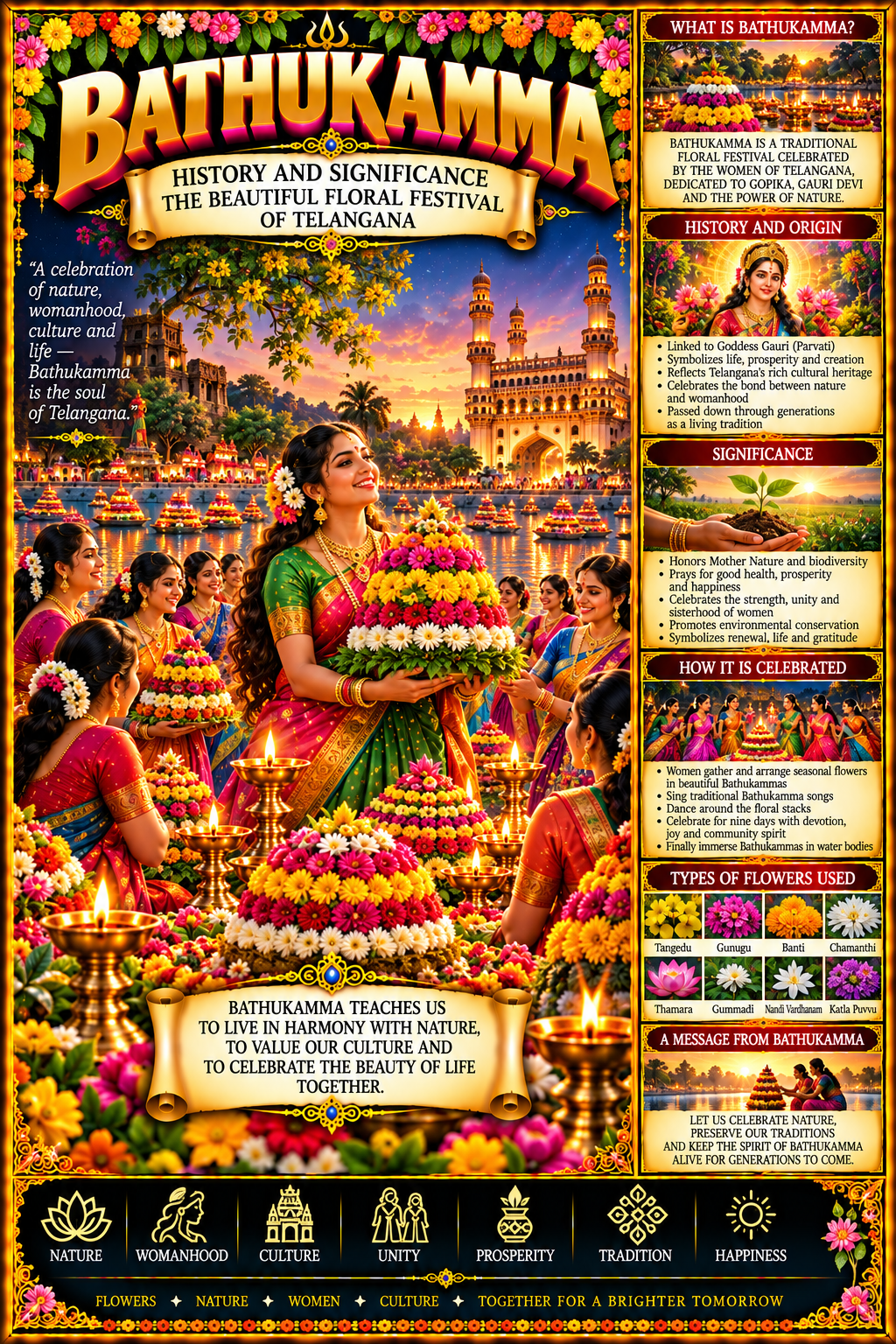
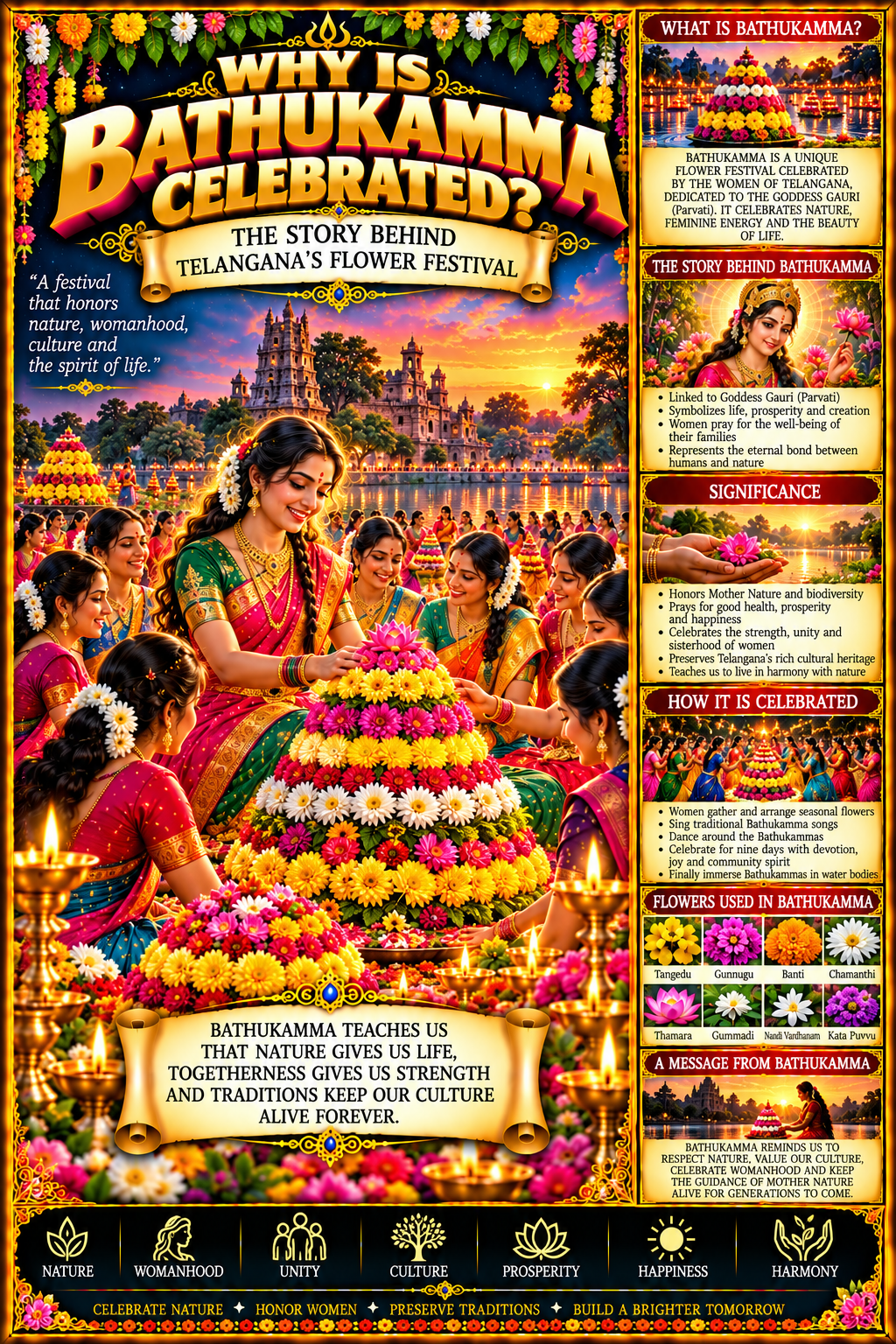
Celebrated with boundless devotion, poetic music, and vibrant colors across the Deccan plateau, understanding Bathukamma History and Significance reveals one of humanity’s most magnificent tributes to feminine divinity, seasonal ecology, and collective sisterhood. Revered as the official state festival of Telangana, Bathukamma stands apart in the cultural tapestry of Sanatana Dharma. While most Indian festivals celebrate deities sculpted from clay, stone, or metal, Bathukamma honors the Supreme Mother Goddess through living, concentric pyramids of freshly gathered seasonal wild flowers.
Observed over nine glorious days during the autumn season, the festival commences on Mahalaya Amavasya (known in Telangana as Engili Pula Bathukamma) and culminates on Ashwayuja Ashtami (popularly celebrated as Saddula Bathukamma), precisely coinciding with the sacred period of Sharad Navratri detailed in our Hindu festival calendar guide. The word Bathukamma literally translates in Telugu to “Mother Goddess, Come Alive!” or “Mother, Grant Us Life” (Bathuku = Life, Amma = Mother), expressing a profound collective prayer for health, agricultural prosperity, and spiritual vitality.
According to the official cultural heritage portal of Telangana Tourism, Bathukamma represents the enduring pride of Telangana’s civilization, celebrated universally across towns and villages by women of all communities who gather at village squares and temple tanks with unmatched festive fervor.
Bathukamma History and Significance: Ancient Legends and Cultural Roots
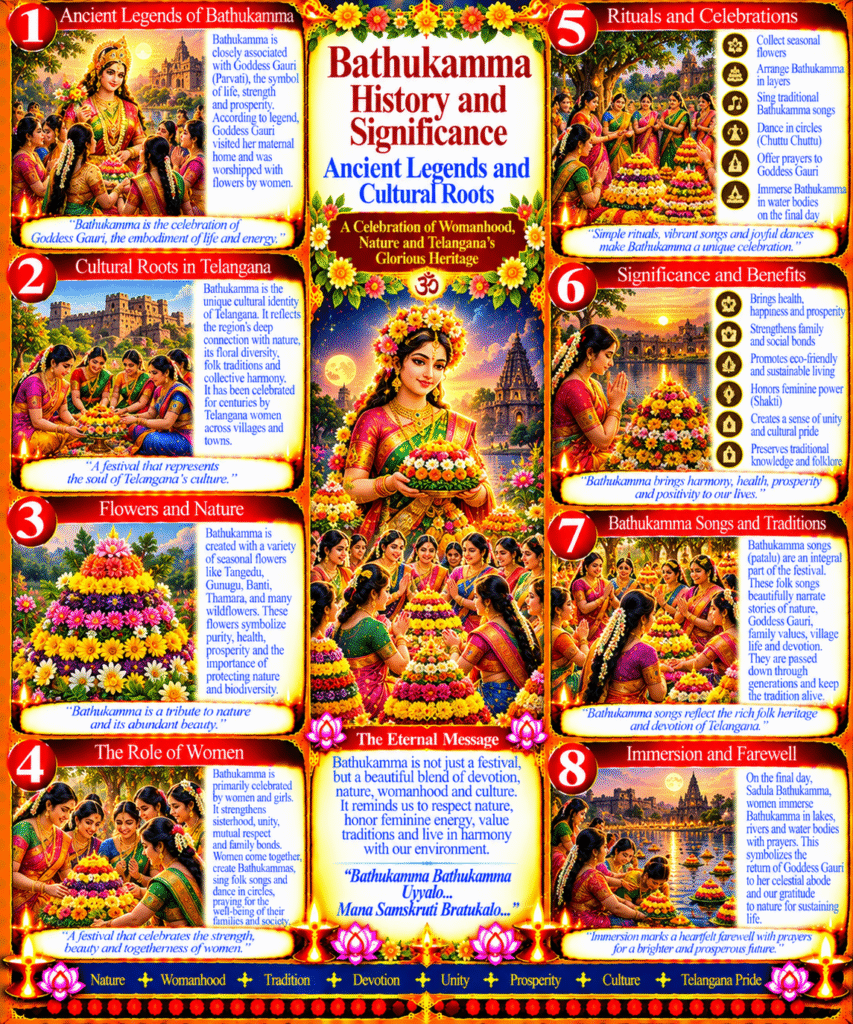
To truly grasp the timeless depth of Bathukamma History and Significance, one must explore the canonical Puranic lores and folklore narratives passed down through generations of oral storytelling in Telangana.
1. The Legend of King Dharmangada and Princess Bathukamma
The most widely celebrated legend originates from the sacred realm of the Chola Dynasty. King Dharmangada and his queen Satyavathi were righteous monarchs who suffered immense personal agony after losing their one hundred valorous sons on battlefields. Yearning for a noble lineage and divine solace, the royal couple performed severe penance (Tapasya) invoking Goddess Mahalakshmi.
Pleasured by their unwavering devotion, the Mother Goddess took birth in their palace as a radiant baby girl. Numerous enlightened sages and Munis arrived at the kingdom to bless the newborn child. Recognizing her supreme cosmic potency and praying that she should transcend all mortal vulnerabilities, the sages blessed her in unison: “Bathukamma” — meaning “May you live forever, Divine Mother!”. Ever since, women have fashioned conical floral representations of Goddess Gauri, invoking her eternal blessings for the longevity, marital harmony, and well-being of their households.
2. The Awakening of Goddess Durga after Slaying Mahishasura
Another deeply revered Puranic episode connects Bathukamma directly with the cosmic battle of Goddess Durga against the demon king Mahishasura. After an intense nine-day combat, the Divine Mother annihilated the demon, restoring cosmic Dharma and righteousness to the three worlds.
Overcome by profound exhaustion from the colossal clash, Goddess Durga collapsed into a deep, meditative slumber on Ashwayuja Ashtami (Durgashtami). Greatly concerned for her revival, women from all realms assembled rare medicinal wild flowers possessing rejuvenating fragrances and arranged them in artistic circular towers. Singing heartfelt melodious songs and chanting divine stotrams around the floral mandalas, they gently awakened the Mother Goddess. This divine reawakening echoes powerfully during the worship of Maa Mahagauri on Day 8 of Navratri and leads seamlessly into the glorious significance of Dasara and Vijayadashami.
3. Historical Patronage Under the Kakatiya Dynasty
Beyond mythology, historical documentation analyzed in the Ministry of Culture, Government of India archives and regional epigraphical records indicates that Bathukamma received magnificent royal patronage under the great Kakatiya rulers of Warangal (Orugallu). Monarches such as Rani Rudrama Devi and King Prataparudra championed the community festival as an expression of female leadership, local water conservation, and agricultural resilience.
The Kakatiyas were legendary hydraulic engineers who built an intricate, interconnected chain of village tanks and lakes (Cheruvulu) across Telangana. Bathukamma served as an annual ecological ritual where women decorated lakes with curative wild herbs, fostering both spiritual solidarity and watershed hygiene.
The Nine Sacred Days of Bathukamma: Daily Rituals and Naivedyam Offerings
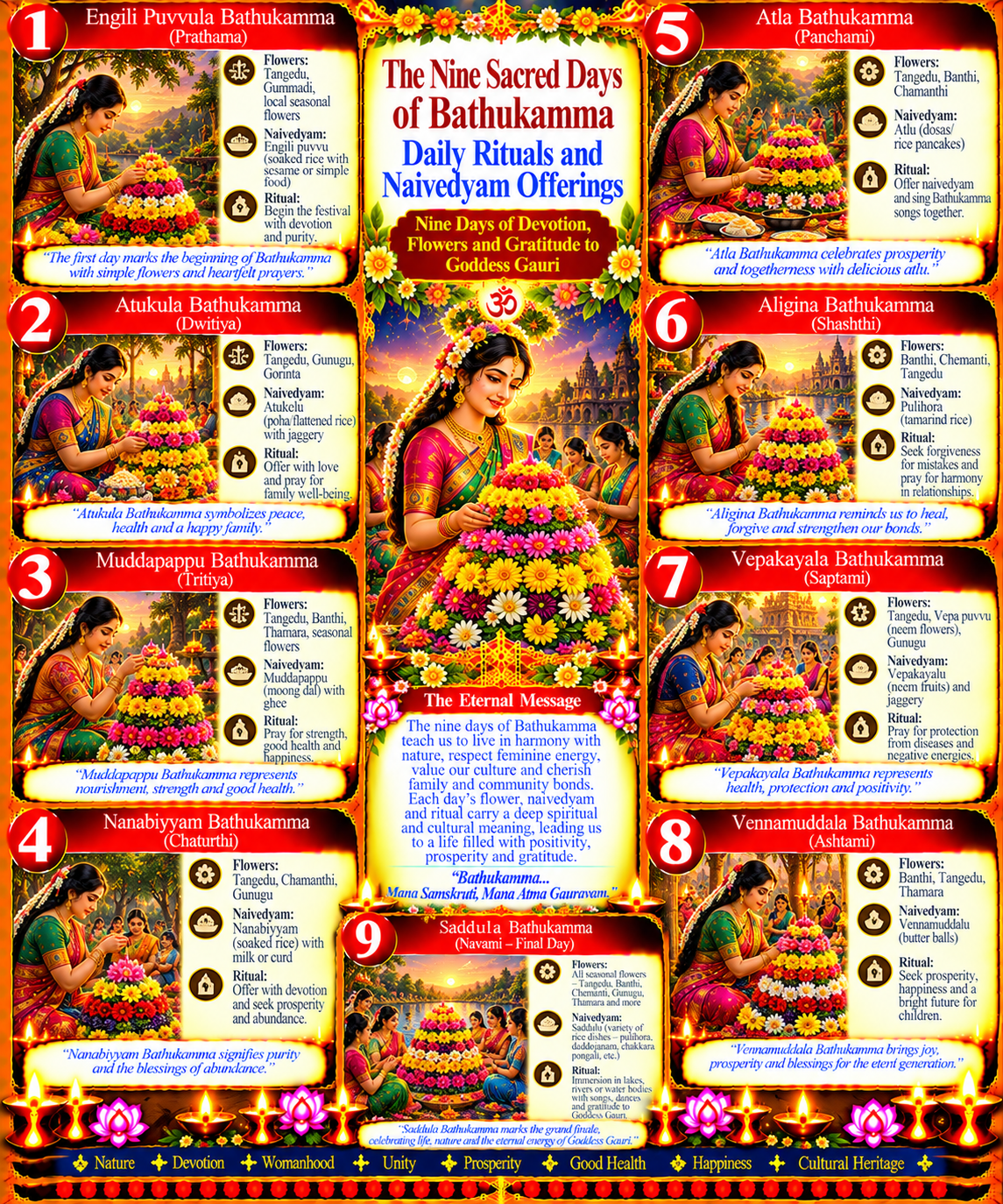
Bathukamma unfolds across nine distinct days, each characterized by specific floral tiers, theological meanings, and sacred food offerings (Naivedyam). Much like the devotional discipline observed during the sacred traditions of Varalakshmi Vratam, every day of Bathukamma honors a unique facet of maternal care.
Day 1: Engili Pula Bathukamma (Mahalaya Amavasya)
The festival begins on the new moon day of Bhadrapada (Mahalaya Amavasya). It is called Engili Pula Bathukamma because the flowers are gathered a day prior or before morning meals. Families offer Pitru Tarpana to ancestors in the morning, followed by the worship of Gauri Devi with a compact floral arrangement.
Special Naivedyam: Offerings prepared with sesame seeds (Nuvvulu), coarsened rice flour (Biyyam Pindi), and raw jaggery (Bellam).
Day 2: Atukula Bathukamma (Ashwayuja Padyami)
Celebrated on the first lunar day of Ashwayuja Shukla Paksha, this day symbolizes the fresh beginnings of autumn. Women craft small, multi-layered floral plates using yellow Marigold and white Celosia blossoms.
Special Naivedyam: Flattened rice flakes (Atukulu) blended with crushed jaggery, grated coconut, and fried grams.
Day 3: Muddappappu Bathukamma (Ashwayuja Vidiya)
On the second lunar day, the floral arrangement expands in circumference. The day emphasizes simple, pure sustenance that provides maternal strength and emotional grounding.
Special Naivedyam: Softly boiled toor dal or moong dal mash (Muddapappu) accompanied by warm cow’s milk and raw jaggery.
Day 4: Nanabiyyam Bathukamma (Ashwayuja Tadiya)
Observed on the third lunar day, the rituals celebrate agriculture and water absorption. Freshly harvested paddy grains represent fertile Mother Earth nurturing human life.
Special Naivedyam: Wet-soaked raw unpolished rice (Nanabiyyam) sweetened naturally with golden jaggery.
Day 5: Atla Bathukamma (Ashwayuja Chavithi)
On the fourth day, the floral pyramid takes on enhanced symmetry. Young daughters and married women gather to sing traditional rhythmic ballads in temple courtyards.
Special Naivedyam: Crisp mini pancakes or dosas prepared from fermented rice and black gram batter, known as Atlu.
Day 6: Aligina Bathukamma (Ashwayuja Panchami)
The sixth day is unique because no floral pyramids are arranged, and no elaborate public dancing takes place. Aligina means “to be playful or sulking.” According to folk legend, Goddess Gauri is playfully pacified by women who offer gentle prayers of apology and affection at home, giving women a much-needed day of rest before the grand finale.
Special Naivedyam: Simple fruits, dried coconut halves, and water offerings.
Day 7: Vepakayala Bathukamma (Ashwayuja Sashti)
Re-energized on the seventh day, women build large floral pyramids adorned with fragrant jasmine and orange marigolds.
Special Naivedyam: Deep-fried crisp dough morsels shaped exactly like the fruit of the neem tree (Vepakayalu), prepared from rice flour, ghee, and powdered jaggery.
Day 8: Vennamuddala Bathukamma (Ashwayuja Sapthami)
As the grand culmination nears, the penultimate eighth day celebrates dairy purity and cow veneration. The floral structure reaches impressive heights, often comprising five to seven concentric floral tiers.
Special Naivedyam: Hand-churned sweet butter globes (Vennamuddalu), softened with sesame seed powder and jaggery syrup.
Day 9: Saddula Bathukamma (Ashwayuja Ashtami / Durgashtami) — The Grand Finale
The ninth day marks the majestic zenith of the festival. Across Telangana, women create colossal multi-tiered floral wonders on broad brass trays (Tambalam), reaching towering heights of up to three to four feet. Crowning the peak is Gouramma, a conical murti of Goddess Gauri crafted lovingly from pure turmeric paste, accented with a vibrant yellow pumpkin flower (Gummadi Puvvu).
The Sacred Five Saddulu: Gastronomic and Ayurvedic Offerings
On Saddula Bathukamma, five distinct spiced and seasoned rice delicacies—collectively known as Saddulu—are prepared to offer to the Goddess:
1. Perugannam (Curd Rice) and Nuvvula Annam (Sesame Rice)
Perugannam cools the body and restores probiotic equilibrium during seasonal transitions, while Nuvvula Annam infuses vital calcium and zinc from cold-pressed sesame seeds.
Nutritional Balance and Traditional Proportions
Traditional culinary rules specify stone-ground white sesame lightly roasted without oil, blended into hand-mashed rice seasoned with pure cow ghee and mustard temperings.
2. Chitrannam (Lemon Rice) and Pulihora (Tamarind Rice)
Flavored with fresh lime juice, wild turmeric, crushed green chilies, and roasted peanuts, Chitrannam enhances vitamin C absorption, while classic tamarind Pulihora stimulates sluggish digestive fires following monsoon humidity.
Ayurvedic Immunity Benefits in Autumn Weather
The inclusion of whole turmeric roots, curry leaves, and fenugreek in Pulihora strengthens respiratory immunity against seasonal fevers common during the Sharad Ritu transition.
3. Avala Annam (Mustard Seed Flavored Rice)
Infused with freshly ground black mustard seed paste, this aromatic delicacy produces mild metabolic heat, shielding the body against evening chills during dusk water processions.
Thermal Equilibrium in Traditional Deccan Diets
The pungency of mustard sinigrin compounds balances kapha dosha, demonstrating the holistic wellness wisdom embedded in festival cuisine.
The Botanical and Ecological Marvel: Healing Wild Flowers of Telangana
Anthropological and botanical documentation preserved in historical archives of Bathukamma (Wikipedia) reveals that the festival is an extraordinary ecological ceremony. Every single flower selected possesses documented bioactive, antibacterial, and purifying properties:
Sacred Flora of the Deccan Plateau
1. Tangedu Puvvu (Senna auriculata / Tanner’s Cassia)
The golden-yellow blossom of Tangedu is the official State Flower of Telangana. In classical Ayurveda, it is revered as a panacea for skin ailments, diabetes, and urinary disorders.
Natural Reservoir Water Disinfection
When millions of Tangedu flowers are immersed into village lakes during Bathukamma, their high tannin and flavonoid content naturally disinfects standing rainwater tanks, preventing the spread of harmful waterborne pathogens post-monsoon.
Phytochemical Tannins and Microbial Control
Scientific studies confirm that aqueous extracts of Senna auriculata exhibit potent bactericidal action against common pond micro-organisms, naturally purifying communal drinking water.
2. Gunugu Puvvu (Celosia argentea / Silver Cock’s Comb)
Characterized by feathery white spikes with pink crowns, Gunugu blossoms grow wild in abundance across Deccan fallow lands. Traditionally dipped in organic vegetable dyes, they form the sturdy architectural framework of the floral pyramid.
Medicinal Value in Traditional Healing
Celosia seeds and flowers contain betalains that purify blood, relieve inflammation, and repel aquatic insect larvae when floating on lake surfaces.
Natural Ecological Preservation
Because Celosia stems absorb heavy metals from soil, harvesting them and subsequently returning them to wetlands acts as a natural phytoremediation cycle.
3. Gummadi, Banthi, and Chamanthi Blossoms
The bright orange pumpkin flower (Gummadi Puvvu) rests gracefully on the summit of the Bathukamma pyramid, symbolizing fertility, agricultural abundance, and solar energy. Marigolds (Banthi) and Chrysanthemums (Chamanthi) contribute vibrant hues and natural insect-repelling essential oils, protecting outdoor community gatherings from mosquitoes.
Step-by-Step Architecture: How to Make a Traditional Bathukamma
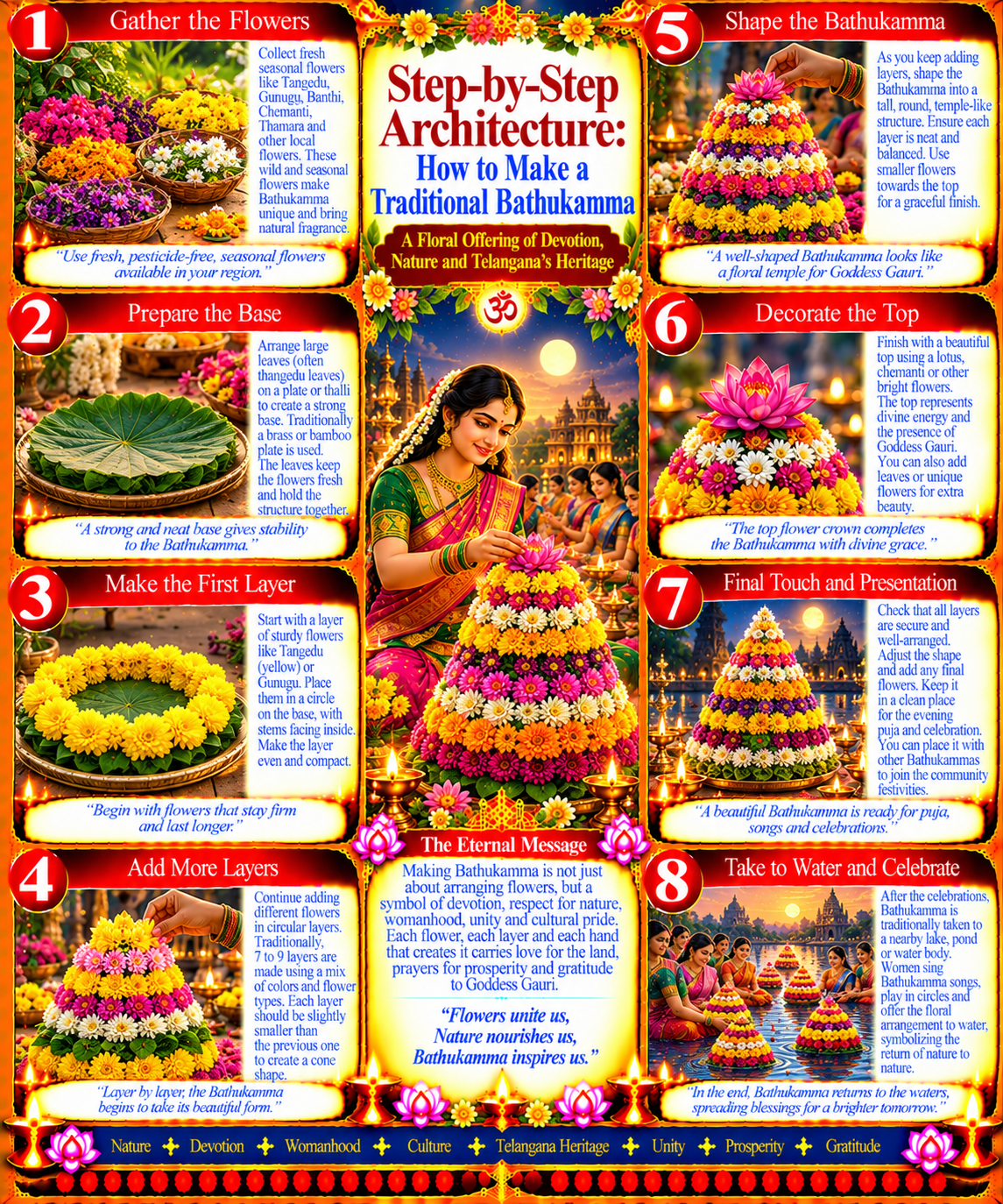
Assembling a Bathukamma is an intricate folk art requiring patience, spatial balance, and communal teamwork among family matriarchs and daughters:
- Preparing the Base: Take a broad circular brass or bronze platter called a Tambalam. Wash and polish it thoroughly, then layer the bottom with fresh pumpkin leaves or tender lotus leaves.
- Foundation Tier: Lay a bed of soft wild grass or green leaves. Place a circular row of sturdy Tangedu or Gunugu flowers pointing radially outward, stem inward.
- Concentric Layering: Gradually build concentric ascending circles using contrasting flower colors—yellow Marigolds, white Chrysanthemums, violet Katla, and crimson Hibiscus—gradually narrowing each layer to create a stepped pyramid.
- Forming the Pinnacle: On the topmost layer, place an open Gummadi blossom. At its center, gently position the sacred Gouramma idol molded from pure turmeric powder and water.
- Applying Auspicious Accents: Adorn Gouramma with fragrant vermilion (Kumkum) and sandalwood paste (Chandanam). Place a lit earthen or brass ghee lamp (Deepam) beside the Goddess just before evening worship.
Cultural Dance, Folk Songs, and the Spirit of Sisterhood
As dusk descends, women dress in their finest traditional handloom attires—unmarried girls wearing colorful Langa Voni (half sarees) and married women in opulent silk Pattu Sarees with sparkling jewelry. Carrying their floral creations upon their heads, they gather at village open grounds, community squares (Choutras), or neighborhood temple courtyards.
Placing all the Bathukammas harmoniously at the center, women form expansive concentric circles. Walking in rhythmic synchrony, they bend forward, clap their palms in coordinated meter, and sing stirring folk ballads passed down across generations. These songs narrate emotional epics of sisterhood, marital bonds, agricultural hardships, resistance against tyranny, and the supreme benevolence of Goddess Parvati.
“Bathukamma Bathukamma Uyyalo… Bangaru Bathukamma Uyyalo… Chithu Chithula Bomma Uyyalo… Shivuni Muddula Guma Uyyalo…”
— Traditional Folk Ballad of Telangana Women
The Sacred Water Immersion (Nimajjanam) and Exchange of Maleeda
After twilight dancing concludes, a mesmerizing procession carries the floral towers toward nearby lakes, rivers, or temple tanks (Cheruvulu). Much like the eco-friendly water immersion practiced during Ganesh Chaturthi water immersion rituals, the immersion (Nimajjanam) of Bathukamma is completely non-polluting and bio-restorative.
Standing along the lake shore, women chant farewell songs thanking Goddess Gauri for visiting their homes and imploring her to return next year. They gently release the floating floral towers onto the calm water, where lit ghee lamps glow like thousands of floating stars upon the ripples.
Before heading home, women respectfully retrieve the small turmeric Gouramma from the water, applying the sanctified paste to their necks and foreheads as a shield of divine protection. They then distribute Maleeda—a wholesome confection prepared by crumbling fresh multi-grain rotis and blending them with pure ghee, grated jaggery, cardamom, and sesame. Women lovingly exchange Maleeda among each other, apply vermilion (Kumkum) to each other’s foreheads, and wish one another enduring marital happiness, vitality, and peace.
Frequently Asked Questions About Bathukamma (20 Detailed FAQs)
1. What is the literal meaning of the word Bathukamma?
In Telugu, Bathuku means “life” or “to live,” and Amma means “mother.” Thus, Bathukamma translates to “Mother Goddess, Come Alive!” or “Mother, Grant Us Life,” expressing an earnest plea for divine maternal protection.
2. When is Bathukamma celebrated according to the Hindu calendar?
Bathukamma begins on the new moon day of Bhadrapada month (Mahalaya Amavasya) and concludes on Ashwayuja Ashtami (Durgashtami), spanning nine days during Sharad Navratri in September-October.
3. Why is Bathukamma declared the State Festival of Telangana?
In 2014, following the formation of Telangana, the state government declared Bathukamma the official State Festival to honor the region’s distinct cultural identity, female empowerment, and ecological heritage.
4. Which deity is primarily worshipped during Bathukamma?
Goddess Gauri (an auspicious manifestation of Goddess Parvati / Mahalakshmi) is worshipped in the form of the floral pyramid and the turmeric Gouramma idol placed at its peak.
5. What are the names of the nine days of Bathukamma?
The nine days are: 1. Engili Pula Bathukamma, 2. Atukula Bathukamma, 3. Muddappappu Bathukamma, 4. Nanabiyyam Bathukamma, 5. Atla Bathukamma, 6. Aligina Bathukamma, 7. Vepakayala Bathukamma, 8. Vennamuddala Bathukamma, and 9. Saddula Bathukamma.
6. Why is the first day called Engili Pula Bathukamma?
Because flowers are traditionally gathered on the eve of Mahalaya Amavasya or before breakfast meals, the first day is affectionately named Engili Pula (flowers picked before formal fasting/eating).
7. Why is no puja or dance held on Aligina Bathukamma (Day 6)?
Aligina means to sulk playfully. According to legend, the Goddess rests and expects gentle affection rather than grand fanfare, granting women a day of rest before the demanding final days.
8. What is the significance of Saddula Bathukamma?
Saddula Bathukamma is the grand finale observed on Durgashtami. Women create enormous floral towers, prepare five sacred rice varieties (Saddulu), perform community dances, and conduct water immersion.
9. What are the five varieties of Saddulu offered on the final day?
The five sacred rice preparations are: Perugannam (curd rice), Chitrannam (lemon rice), Pulihora (tamarind rice), Nuvvula annam (sesame rice), and Avala annam (mustard seed rice).
10. Which flowers are considered mandatory for making Bathukamma?
Essential flowers include Tangedu (Senna auriculata), Gunugu (Celosia argentea), Banthi (Marigold), Chamanthi (Chrysanthemum), and Gummadi Puvvu (Pumpkin flower).
11. Why is Tangedu flower uniquely important in Telangana?
Tangedu is the official State Flower of Telangana. It possesses exceptional antibacterial and therapeutic properties that purify water bodies when immersed during the festival.
12. What is Gouramma, and where is it placed?
Gouramma is a small conical figurine of Goddess Gauri crafted from pure turmeric paste. It is enshrined on top of an open pumpkin flower at the pinnacle of the floral pyramid.
13. What is Maleeda and why is it distributed?
Maleeda is a sweet dish made from crushed whole wheat rotis, jaggery, ghee, cardamom, and sesame. Women distribute it as prasad after the lake immersion, symbolizing warmth and mutual affection.
14. What ecological impact does the immersion of Bathukamma have on lakes?
Unlike artificial idols with chemical paints, Bathukamma flowers release natural medicinal tannins and flavonoids that cleanse algae, control mosquitoes, and purify water post-monsoon.
15. Can men participate in Bathukamma celebrations?
Men actively assist by harvesting wild flowers from fields and forests and escorting processions to water bodies, while the ritual arrangement, singing, and dancing are exclusively led by women.
16. What is the historical link between the Kakatiya dynasty and Bathukamma?
The Kakatiyas promoted the festival as an instrument of community cohesion and water management across the thousands of interconnected agricultural lakes they constructed in Warangal.
17. What traditional attires are worn during Bathukamma?
Young girls wear traditional Langa Voni (half sarees) while adult women don handloom silk Pattu Sarees, often in auspicious festive tones of yellow, red, green, and orange.
18. What themes do traditional Bathukamma songs explore?
The songs narrate folklore, mythological episodes of Parvati and Shiva, stories of courageous local women, familial joys and tribulations, and gratitude toward mother nature.
19. How does Bathukamma promote female empowerment?
Bathukamma places women at the absolute center of socio-cultural and spiritual leadership, providing a joyful public platform for collective artistic expression, sisterhood, and mutual support.
20. What timeless message does Bathukamma offer to modern society?
Bathukamma teaches modern humanity that divinity is intrinsically woven into nature, demonstrating how cultural reverence, community solidarity, and ecological preservation can harmoniously co-exist.