Raja Ratnam
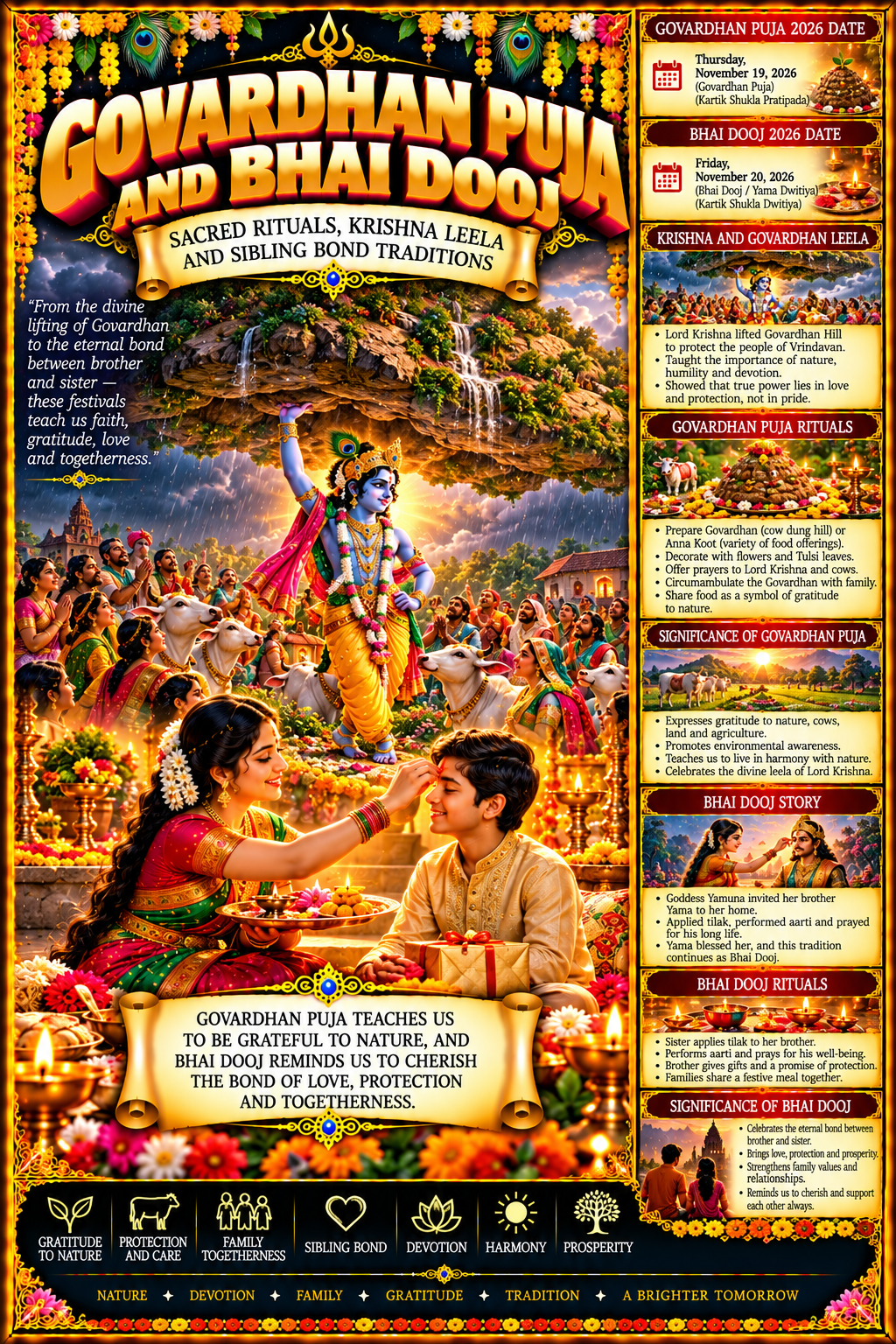
The luminous Diwali cycle reaches its grand crescendo in the two days following Lakshmi Puja, bringing families together for Govardhan Puja and Bhai Dooj. These twin holy days encapsulate the quintessential warmth of Sanatana Dharma, transitioning from cosmic prayers of wealth to profound environmental stewardship and timeless familial affection. Celebrated back-to-back in the bright lunar fortnight of Kartika, Govardhan Puja and Bhai Dooj serve as eternal reminders of humanity’s sacred bond with nature and the inviolable strength of sibling love.
While Govardhan Puja (also known as Annakut) commemorates Lord Krishna’s magnificent triumph over King Indra’s pride to protect Mother Nature, Bhai Dooj (Yama Dwitiya) honors the immortal affection between Lord Yama and his sister Yamuna. Consequently, participating in Govardhan Puja and Bhai Dooj enriches both spiritual consciousness and domestic harmony.
Govardhan Puja and Bhai Dooj 2026: Precise Dates and Shubh Muhurat
Understanding the precise astronomical tithi calculations ensures that rituals are executed at the most auspicious hours, as guided by the canonical Hindu festival calendar:
Govardhan Puja 2026 (Kartika Shukla Pratipada)
- Date: Tuesday, November 10, 2026
- Pratipada Tithi Begins: November 9, 2026, at 04:22 PM
- Pratipada Tithi Ends: November 10, 2026, at 02:48 PM
- Govardhan Puja Pratahkala Muhurat (Morning): 06:40 AM to 08:52 AM
- Govardhan Puja Sayankala Muhurat (Evening): 03:22 PM to 05:34 PM
Bhai Dooj 2026 (Kartika Shukla Dwitiya / Yama Dwitiya)
- Date: Wednesday, November 11, 2026
- Dwitiya Tithi Begins: November 10, 2026, at 02:48 PM
- Dwitiya Tithi Ends: November 11, 2026, at 01:15 PM
- Bhai Dooj Aparahna Muhurat (Tilak Timing): 01:12 PM to 03:24 PM (Duration: 2 Hours 12 Minutes)
Part 1: Govardhan Puja The Divine Krishna Leela and Ecological Devotion
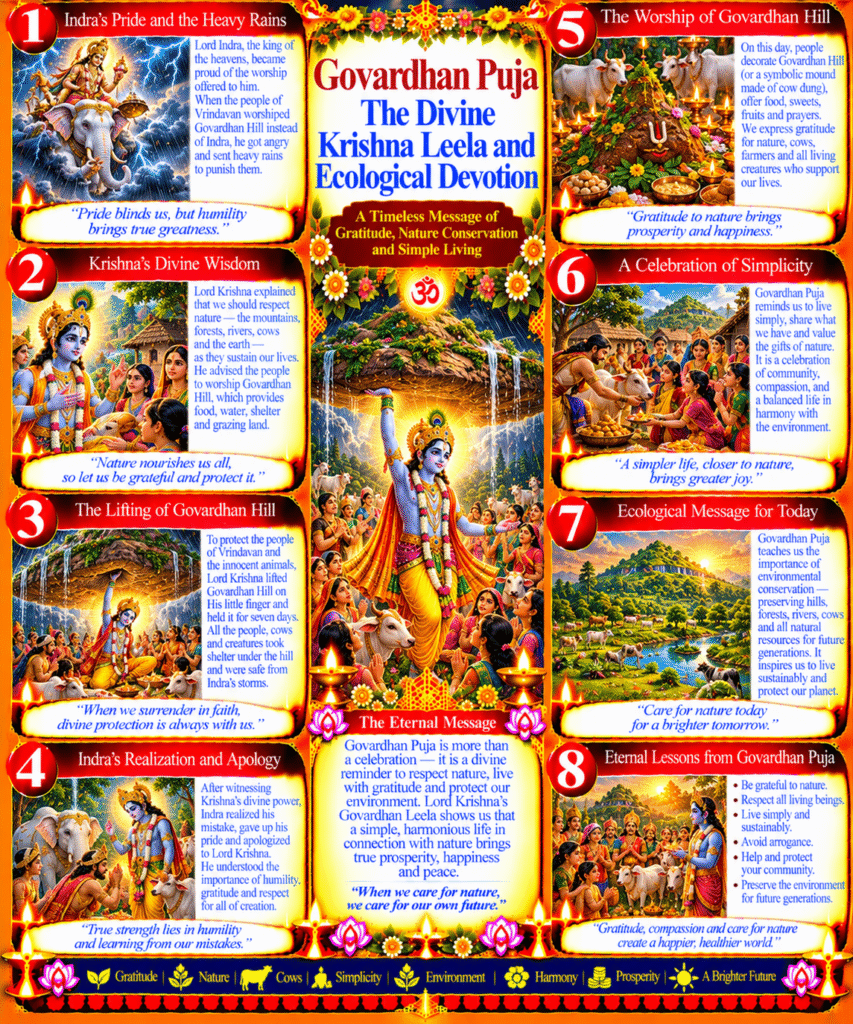
To fully experience Govardhan Puja and Bhai Dooj, one must first dive deep into the pastoral wonderland of Braj Bhoomi, where Lord Krishna taught humanity a radical theological lesson in ecological gratitude.
The Srimad Bhagavatam Chronicle: Lifting Mount Govardhan
In ancient Vrindavan, the cowherds (Gopas) prepared grand sacrificial offerings for Lord Indra, the deity of rain. A youthful Krishna questioned his father Nanda Maharaja and the elders, arguing that their true duty lay in revering Mount Govardhan, the lush pastures, the rivers, and the cows that directly sustained their livelihood, rather than appeasing a distant deity out of fear.
Infuriated by this perceived slight, Indra unleashed the devastating Samvartaka clouds, flooding Vrindavan with relentless torrents. Krishna effortlessly lifted the entire Govardhan mountain upon the little finger of his left hand, sheltering all living beings, cattle, and villagers beneath it for seven consecutive days and nights. Humbled and repentant, Indra surrendered and crowned Krishna as “Govinda”—the protector of the cows and earth.
The Spectacular Annakut: Offering the Mountain of Food
Because Krishna had fasted while holding the mountain, the overjoyed villagers prepared a colossal feast consisting of 56 delicacies (Chhappan Bhog) to nourish their savior. Today, temples and households worldwide observe Annakut by cooking vast varieties of vegetarian delicacies, grains, sweets, and savories arranged artistically before the deity.
The Sacred Cow Dung Hillock Ritual
Families mold a miniature replica of Govardhan Hill in their courtyards using sacred cow dung (Gomaya). The hillock is adorned with flowers, tree sprigs, cotton, and sugar cane stalks. Devotees circumambulate (Parikrama) the hillock singing traditional Krishna Bhajans, invoking peace for agriculture and domestic cattle.
Part 2: Bhai Dooj The Immortal Bond Between Yamraj and Yamuna
Immediately following Govardhan celebrations, the festival reaches its tender conclusion with Bhai Dooj. This sacred day stands alongside Raksha Bandhan as a pillar of Indian sibling affection, yet carries distinctive mythological significance rooted in the Suryavanshi lineage.
The Legend of Yama and the River Goddess Yamuna
Lord Yama (the god of justice and death) and Goddess Yamuna (the sacred river) were the twin children of Surya, the Sun god, and his consort Saranyu. Due to demanding duties in the netherworld, Yama rarely visited his loving sister. Yamuna persistently invited him, and on Kartika Shukla Dwitiya, Yama finally arrived at her peaceful riverbank home.
Overwhelmed with joy, Yamuna applied a fragrant vermilion Tilak to his forehead, adorned him with garlands, and prepared a lavish culinary banquet. Moved to tears by her unconditional devotion, Yamraj asked her to request any boon. Yamuna asked: “May every brother who visits his sister on this day, receives her tilak, and dines at her table be liberated from the fear of premature death and hellfire.” Yama granted this boon, inaugurating the tradition of Yama Dwitiya.
Lord Krishna and Subhadra Reunion
Another popular legend recounts Lord Krishna visiting his beloved sister Subhadra after slaying the demon Narakasura. Subhadra welcomed Krishna with an Aarti, applied an auspicious tilak to his forehead, and offered him nourishing sweets, mirroring the celebration of righteousness found during Vijayadashami and Dussehra.
Authentic Step-by-Step Bhai Dooj Tilak Vidhi
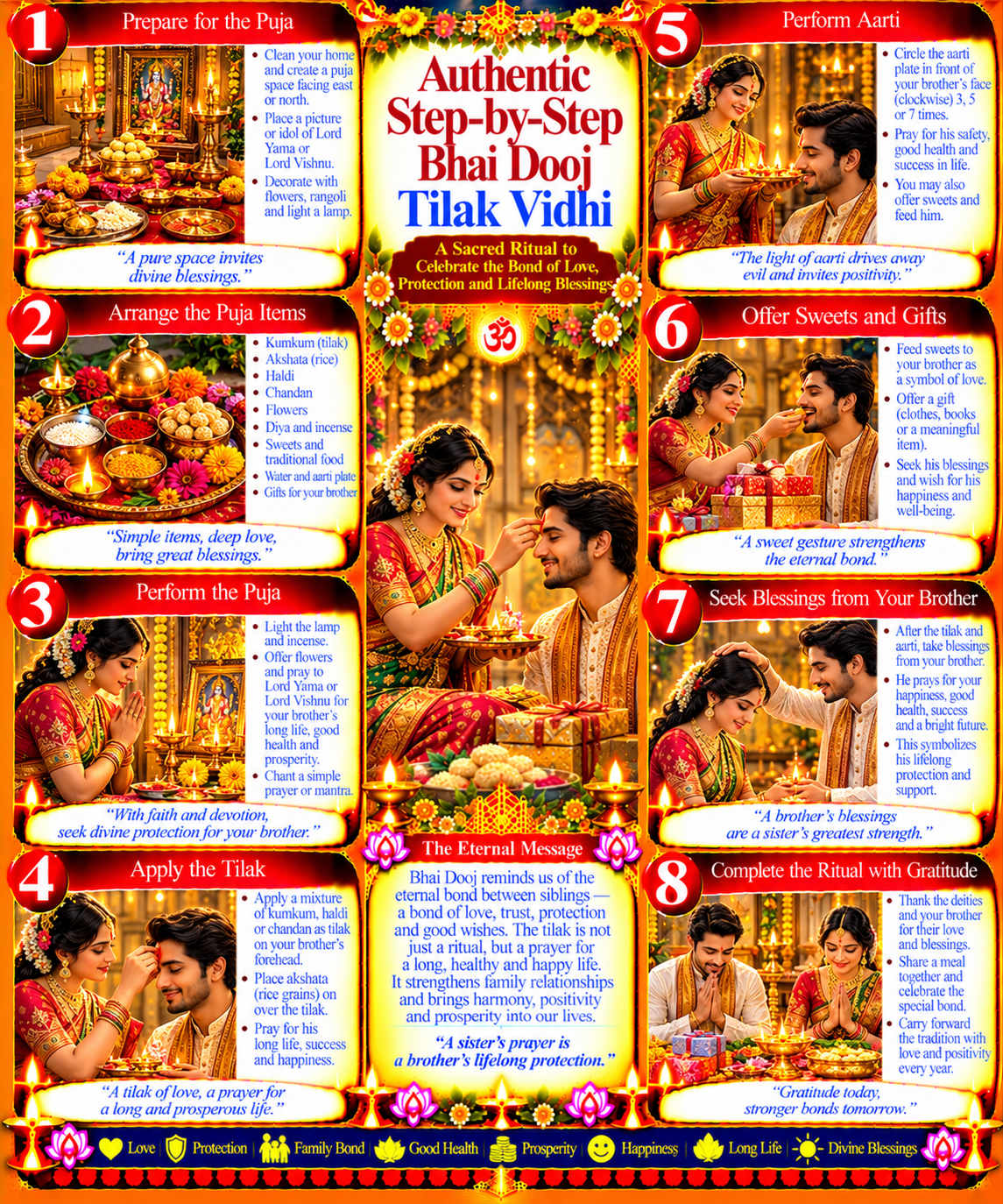
Performing the Bhai Dooj ceremony according to traditional customs brings deep spiritual merit and strengthens emotional ties. Follow this precise ritual structure:
1. Preparing the Sacred Puja Thali
The sister prepares a decorated brass or silver thali containing Roli (vermilion), Akshat (unbroken raw rice), sandalwood paste, sweet Batashas, dry coconut (Gola), a glowing ghee lamp, and fresh festive sweets.
2. Seating the Brother on a Purified Chowki
The brother sits facing the East or North direction on a wooden stool (Aasan). The sister ties a sacred protective thread (Kalava) around his right wrist.
Applying the Auspicious Tilak and Akshat
Using the ring finger of her right hand, the sister applies a vermilion and sandalwood tilak to her brother’s forehead, pressing unbroken rice grains over it. This gesture stimulates the Ajna Chakra, blessing him with wisdom and longevity.
Aarti and Gifting the Dry Coconut
The sister performs a clockwise Aarti to shield him from negative planetary influences and places a whole dry coconut into his hands, symbolizing eternal auspiciousness and divine sustenance.
Feasting and Mutual Blessings
The sister feeds her brother sweets, followed by a warm homemade festive meal. In return, the brother touches his elder sister’s feet for blessings, offers thoughtful gifts, and pledges lifelong protection and support.
Mantras for Sibling Welfare
Devotees recite: “Bhratus tavanuja yata Bhratusth sneham samarpayet | Yamasya bhagini yamuna bhratruvriddhaye shubhada.”
As chronicled in theological accounts of Mount Govardhan and Krishna Leela (Wikipedia), the divine episode in Braj Bhoomi revolutionized Sanatana Dharma’s relationship with natural ecology.
Frequently Asked Questions About Govardhan Puja and Bhai Dooj (20 FAQs)
1. What is the spiritual significance of Govardhan Puja and Bhai Dooj?
Govardhan Puja celebrates nature conservation and Lord Krishna’s divine protection, while Bhai Dooj honors the eternal bond of love, respect, and protection between brothers and sisters.
2. When will Govardhan Puja and Bhai Dooj be celebrated in 2026?
Govardhan Puja will be celebrated on Tuesday, November 10, 2026, and Bhai Dooj will be celebrated on Wednesday, November 11, 2026.
3. Why did Lord Krishna lift Mount Govardhan?
Lord Krishna lifted Mount Govardhan to shatter Lord Indra’s ego and shield the innocent inhabitants and livestock of Vrindavan from devastating torrential rains.
4. What does the Annakut offering consist of?
Annakut represents a “mountain of food” comprising 56 vegetarian items (Chhappan Bhog), including grains, lentils, vegetable curries, sweets, and savories offered to Krishna.
5. Why is cow dung used to create the Govardhan hillock at home?
In Vedic tradition, cow dung (Gomaya) is pure, antiseptic, and holy. Using it reflects deep reverence for Mother Cow (Gau Mata) and agricultural fertility.
6. Why is Bhai Dooj also called Yama Dwitiya?
It is called Yama Dwitiya because Lord Yamraj visited his sister Goddess Yamuna on this second lunar day (Dwitiya) and granted a boon of protection from untimely death.
7. What is the difference between Raksha Bandhan and Bhai Dooj?
On Raksha Bandhan, the sister ties a sacred Rakhi thread on her brother’s wrist. On Bhai Dooj, the sister applies a sacred Tilak to his forehead and hosts him for a traditional meal.
8. Why is a dry coconut (Gola) given to the brother on Bhai Dooj?
The dry coconut represents completeness, spiritual purity, and good health, serving as a talisman for the brother’s long-term prosperity.
9. What should sisters do if their brothers live far away?
Sisters can offer a Tilak to the sacred Moon (Chanda Mama), who is universally revered as the eternal brother, and pray for their brother’s well-being.
10. Can a married sister invite her brother to her marital home on Bhai Dooj?
Yes, traditionally, the brother travels to the sister’s home to receive her hospitality, symbolizing that she remains cherished and supported by her maternal family.
11. What direction should the brother face during the Tilak ritual?
The brother should sit facing North or East, which are the directions of divine solar illumination, spiritual focus, and positive energy.
12. What is the significance of the Chhappan Bhog?
Lord Krishna traditionally ate eight meals daily. Since he held Mount Govardhan for seven days without eating, the villagers cooked 7 x 8 = 56 dishes to feed him lovingly.
13. What is Bali Pratipada during Govardhan Puja?
Observed in Western and Southern India, Bali Pratipada commemorates the benevolent demon King Bali being granted annual permission by Lord Vamana to visit his earthly kingdom.
14. Why is taking a holy dip in the Yamuna River recommended on Bhai Dooj?
Scriptures state that bathing in the holy Yamuna River on Yama Dwitiya cleanses sins and prevents painful torment in Yamaloka after death.
15. What finger should be used to apply the Bhai Dooj Tilak?
The ring finger (Anamika) of the right hand is used, as it channels peaceful, cooling, and prosperous spiritual vibrations directly into the third eye chakra.
16. What dishes are traditionally prepared on Govardhan Puja?
Mixed seasonal vegetable curry (Annkut ki sabzi), puris, Kadhi-chawal, halwa, kheer, and various sweets are traditionally cooked and distributed as prasad.
17. Why do people perform Govardhan Parikrama?
Circumambulating the sacred 21-kilometer Govardhan Hill in Mathura removes physical ailments, fulfills desires, and grants intense devotional bliss (Bhakti).
18. How is Bhai Dooj celebrated in Bengal (Bhai Phonta)?
In Bengal, sisters fast until they apply a paste of sandalwood, curd, and kajal to their brother’s forehead while chanting sacred verse invocations for his immortality.
19. How is Bhai Dooj celebrated in Maharashtra (Bhau Beej)?
Sisters draw sacred geometric rangoli squares on the floor, seat their brothers within them, perform Aarti, and cook delicacies like Basundi and Puran Poli.
20. What is the overarching environmental lesson of Govardhan Puja for the modern world?
Govardhan Puja teaches that natural resources, mountains, water bodies, and flora are sacred entities that humanity must preserve with reverence rather than exploit recklessly.