 Raja Ratnam
Introduction
Satyavati in the Mahabharatam popularly known as Sathavai in regional traditions, is one of the most powerful and influential women in the Mahabharatam. Though she does not fight on the battlefield of Kurukshetra, her decisions, ambitions, and maternal instincts shape the destiny of the Kuru dynasty and ultimately lead to the great war itself.
Her life is a remarkable journey—from a humble fisherwoman to the Queen of Hastinapura, from a young girl cursed with a foul smell to the revered Queen Mother of one of India’s greatest epics.
Birth and Early Life of Satyavati

She was born to Uparichara Vasu, the king of Chedi, and a celestial nymph (apsara). Due to circumstances, she was abandoned at birth and later adopted by a fisherman chief named Dasharaja.
In her early years, she was known as Matsyagandha, meaning “one who smells of fish”, because of her association with the fishing community.
Despite her humble upbringing, possessed:
- Sharp intelligence
- Strong ambition
- Natural leadership qualities
These traits would later transform her destiny.
Meeting Sage Parashara and the Birth of Vyasa
One of the most crucial events in the Mahabharatam occurs when Satyavati meets Sage Parashara while ferrying him across a river.
The Divine Boons
Parashara, impressed by her beauty and presence, grants her:
- A divine fragrance, replacing her fishy odor
- Eternal youth and beauty
From this union, Krishna Dvaipayana Vyasa is born—who later becomes:
- The composer of the Mahabharata
- In Indian history, he was one of the greatest Sages
This moment establishes Satyavati as the mother of destiny itself, as Vyasa becomes central to the epic’s unfolding.
For official cultural and historical archives, visit the Ministry of Culture, Government of India.
Marriage to King Shantanu
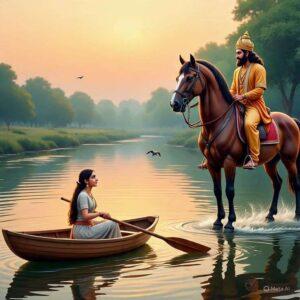
King Shantanu of Hastinapura meets Her and falls deeply in love with her. However, Dasharaja sets a strict condition for their marriage:
Only Satyavati’s sons shall inherit the throne.
This condition creates one of the most emotional and pivotal moments in the epic.
Bhishma’s Terrible Vow
To fulfill his father’s happiness:
- Devavrata, Shantanu’s son, takes the terrible vow of lifelong celibacy
- He renounces his claim to the throne forever
- He becomes Bhishma, the mighty and tragic hero of the Mahabharatam
Thus, Satyavati’s marriage indirectly gives rise to Bhishma’s lifelong suffering and sacrifice.
Satyavati as Queen of Hastinapura

As queen, Satyavati proves to be:
- Politically astute
- Deeply ambitious for her lineage
- Firm in protecting her sons’ future
She gives birth to two sons:
- Chitrangada – who dies young
- Vichitravirya – who becomes king but dies childless
With the Kuru lineage at risk, Satyavati takes another decisive step.
Preservation of the Kuru Line through Niyoga
Facing the extinction of the dynasty, Satyavati summons her firstborn son Vyasa to perform Niyoga with the widowed queens:
- Ambika
- Ambalika
From this union are born:
- Dhritarashtra (blind)
- Pandu (physically weak)
- A maid’s son Vidura (wise and righteous)
This decision ensures the continuation of the Kuru lineage but also introduces:
- Physical limitations
- Complex family dynamics
- Future conflicts
Once again, Satyavati’s actions shape the future of the Mahabharatam.
Satyavati as the Queen Mother
In her later years, Satyavati becomes the Queen Mother—the matriarch of Hastinapura. Though powerful, she witnesses:
- Family disputes
- Moral decline
- Political instability
After Pandu’s death and growing unrest in the kingdom, Satyavati realizes that the dynasty she struggled to preserve is heading toward destruction.
Retreat to the Forest and Death
Disillusioned and burdened by grief, Satyavati renounces palace life. Along with:
- Gandhari
- Kunti
- Other elders
She retires to the forest for a life of asceticism.
Satyavati eventually dies in a forest fire, marking the end of an era. Her departure symbolizes the fading of the old Kuru order before the rise of the Kurukshetra war.
Character Analysis of Satyavati in the Mahabharatam
Satyavati is neither purely virtuous nor villainous. She represents complex womanhood in ancient epics.
Her Strengths
- Visionary leadership
- Fierce maternal instinct
- Political intelligence
- Courage to make difficult decisions
Her Flaws
Excessive ambition
- Emotional manipulation
- Decisions driven by lineage rather than dharma
She embodies the truth that power always comes with consequences.
Symbolic Importance
symbolizes:
The thin line between preservation and destruction
Social mobility – from fisherwoman to queen
Feminine power in a patriarchal society
Karma and destiny shaping generations
Without Satyavati:
Bhishma’s vow would not exist
- Vyasa would not guide the epic
- The Kuru dynasty would end early
She is the silent architect of the Mahabharata
Conclusion : Satyavati in the Mahabharatam
Here is an expanded, SEO-optimized conclusion with deeper insight and multiple natural uses of the keyword “Satyavati in the Mahabharatam”, suitable for blogs, Medium, or mythology websites.
Conclusion:
She stands as one of the most influential yet complex female figures in Indian epic literature. Her life story is not merely a personal journey from a fisherwoman to the Queen of Hastinapura; it is the foundation upon which the entire Kuru dynasty is built and eventually tested. Every major lineage, conflict, and moral dilemma in the epic can be traced back to the decisions she made—often under pressure, ambition, and maternal instinct.
What makes Satyavati in the Mahabharatam truly remarkable is her ability to exercise power in a world dominated by kings and warriors. She did not rule the battlefield, yet she ruled destiny. By securing the throne for her descendants, arranging alliances, and preserving the dynasty through Niyoga, Satyavati ensured the survival of the Kurus, even when circumstances were unfavorable. However, these same decisions also introduced physical, emotional, and ethical complexities that later shaped the great Kurukshetra war.
Satyavati in the Mahabharatam also represents the dual nature of human ambition. On one hand, she is a symbol of resilience, courage, and strategic intelligence. On the other, she reminds us that ambition without balance can plant the seeds of long-term suffering. Her insistence on lineage over harmony, though understandable, indirectly led to rivalry, sorrow, and destruction across generations.
As the Queen Mother, She embodies the weight of karma. In her later years, her retreat to the forest reflects a deep realization—that even the strongest wills must ultimately surrender to dharma and destiny. Her life teaches that power is temporary, but the consequences of choices are eternal.
In conclusion, She is not just a historical or mythological character; she is a timeless lesson in leadership, motherhood, ambition, and responsibility. Her story reminds us that behind every great epic lies a silent force shaping events from the shadows—and in the Mahabharata, that force is Satyavati.
FAQs
- Who is Satyavati in the Mahabharatam?
Satyavati, also called Sathavai, is the queen of King Shantanu and the matriarch of the Kuru dynasty. She plays a major role in shaping the events of the Mahabharata.
- What was Satyavati’s original name?
Her original name was Matsyagandha, meaning “one with the smell of fish.”
- Why was Satyavati called Matsyagandha?
She was raised in a fishing community and had a natural fishy smell before receiving a divine boon.
- Who were Satyavati’s parents?
Her biological father was King Uparichara Vasu of Chedi, and she was raised by a fisherman chief named Dasharaja.
- Which sage gave Satyavati a divine fragrance?
Sage Parashara granted her a boon that replaced her fishy smell with a heavenly fragrance.
- Who was Satyavati’s first son?
Her first son was Vyasa (Krishna Dvaipayana), born from Sage Parashara.
- Why is Vyasa important in the Mahabharata?
Vyasa is:
The composer of the Mahabharata
The father of Dhritarashtra, Pandu, and Vidura
A guiding spiritual force in the epic
- Whom did Satyavati marry?
She married King Shantanu, the ruler of Hastinapura.
- What condition did Satyavati’s father place for her marriage?
Dasharaja demanded that only Satyavati’s sons should inherit the throne of Hastinapura.
- How did Bhishma’s vow happen because of Satyavati?
To fulfill this condition, Devavrata renounced marriage and kingship, taking the Bhishma Pratigya (terrible vow).
- Who were Satyavati’s sons with King Shantanu?
Her sons were:
Chitrangada
Vichitravirya
- Why did Satyavati call Vyasa back to Hastinapura?
After Vichitravirya died childless, Satyavati called Vyasa to continue the Kuru lineage through Niyoga.
- Who were born through the practice of Niyoga?
Dhritarashtra (blind)
Pandu (physically weak)
Vidura (born to a maid, wise and righteous)
- Why was Dhritarashtra blind?
Dhritarashtra was born blind because Queen Ambika closed her eyes during Niyoga.
- Why did Pandu have physical weakness?
Pandu was born pale and weak because Ambalika was frightened during Niyoga.
- Why is Vidura considered special?
Though born to a maid, Vidura was:
Extremely wise
An incarnation of Dharma
The moral voice of the Mahabharata
- What role did Satyavati play as Queen Mother?
She acted as:
The protector of the Kuru dynasty
A powerful decision-maker
A guiding authority in Hastinapura
- Why did Satyavati retire to the forest?
Seeing increasing conflict and decline in the dynasty, She renounced royal life and chose spiritual withdrawal.
- How did Satyavati die?
She died in a forest fire along with other elders during her life of asceticism.
- What is the legacy of Satyavati in the Mahabharata?
Satyavati’s legacy is that of:
A woman who rose from humble origins to power
The architect of the Kuru lineage
A symbol of ambition, destiny, and maternal stren
Frequently Asked Questions About Satyavati
Who was Satyavati in the Mahabharata?
Satyavati was the matriarch of the Kuru dynasty, wife of King Shantanu, and mother of Sage Vyasa, Chitrangada, and Vichitravirya. Her political foresight shaped the future of Hastinapur.
What boons did Satyavati receive from Sage Parasara?
Sage Parasara granted Satyavati a divine fragrance (Yojanagandha) that replaced her original fish-like odor, restored her maidenhood, and blessed her with the birth of Sage Vyasa.



“Widely regarded as the wisest man in the epic, Vidura served as the chief advisor to King Dhritarashtra and the moral compass of the Kuru kingdom. Throughout the Mahabharata, he consistently upheld truth, righteousness, and justice, offering wise counsel even when it was ignored. His teachings, known as Vidura Niti, remain a timeless guide on ethics, leadership, and human conduct.”