Raja Ratnam
- Navagraha's
- December 29, 2025
- 441 views
Navagrahas — Soul’s Journey is guided by the Cosmic Teacher
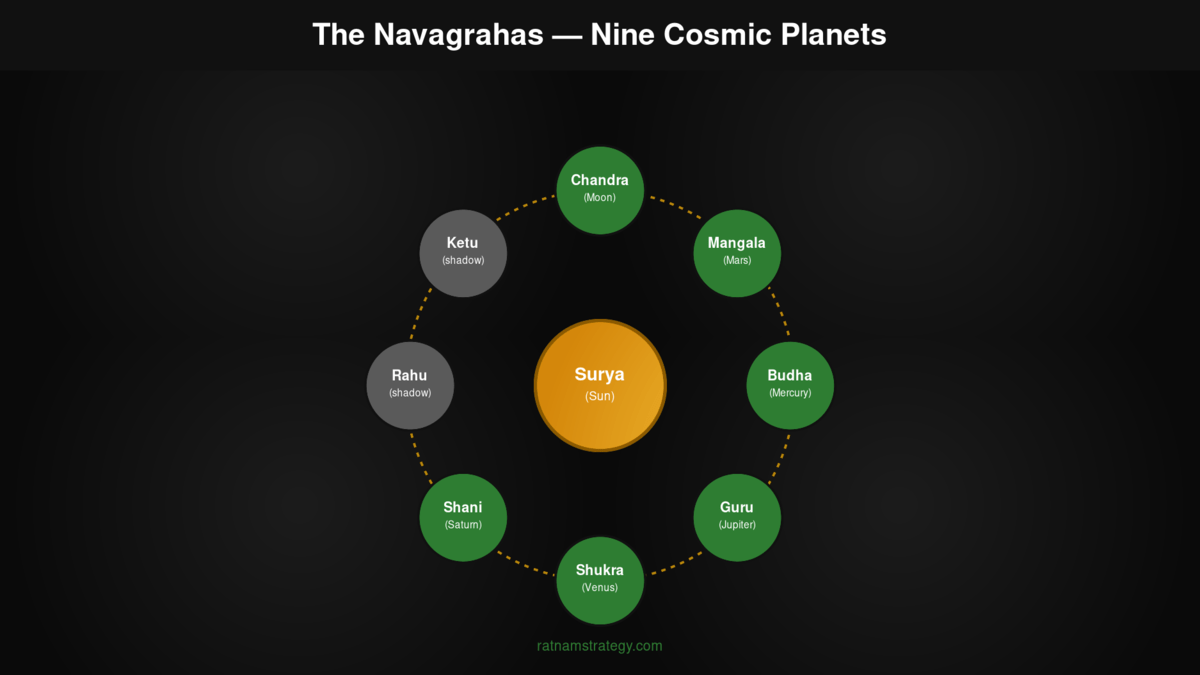
Introduction — More Than Planets, Eternal Teachers The Navagrahas are often misunderstood as mere planets that influence fate.In truth, they are cosmic teachers — divine forces that guide the soul through karma, experience, growth, and liberation. The purpose of each Graha is not to punish, but to teach.Transits are not accidents, but lessons timed by the universe. Together, the Navagrahas form a complete spiritual syllabus for human life —from birth and identity to desire, duty, wisdom, and finally moksha. Surya — Awakening the Soul (Atman) The source of life and consciousness is Surya Deva.He teaches: Surya awakens the Atman, reminding us to stand in our truth and shine without fear. Without Surya, there is no life.Without self-awareness, there is no growth. Chandra — Mastering the Mind Chandra governs the mind, emotions, and inner world.He teaches: The Moon reminds us that inner peace is more important than outer success.A calm mind reflects the divine clearly. Mangala — Right Action and Courage Mangala Deva represents energy, discipline, and righteous action.He teaches: Mangala is the inner warrior —fighting ignorance, laziness, and fear. Guru (Brihaspati) — Wisdom and Dharma Guru is the light of wisdom.He teaches: Without Guru, power becomes arrogance.With Guru, life becomes…

- Navagraha's
- December 28, 2025
- 452 views
Ketu Deva — The Planet of Moksha, Detachment, and Spiritual Awakening
Introduction — The Silent Force of Liberation Among the Navagrahas, Ketu is the most silent, mysterious, and spiritually potent graha.He does not create noise, fame, or desire — instead, he cuts attachments, dissolves ego, and pushes the soul toward liberation (Moksha). If Rahu binds the soul to illusion and desire,Ketu frees the soul through detachment and realization. Ketu represents: Ketu does not give pleasure —he gives truth. Mythological Origin of Ketu Deva The origin of Ketu is inseparable from Rahu and the great event of Samudra Manthan. When the Asura Svarbhanu disguised himself and drank Amrita,Lord Vishnu severed his body with the Sudarshana Chakra. Unlike Rahu, who retained desire and hunger,Ketu was left without a head — symbolizing ego-less existence. Thus, Ketu became: Scriptures describe Ketu as a flag without a pole —present, powerful, but unattached. Ketu Deva in Hindu Scriptures Ketu appears in: Ancient sages describe Ketu as: Unlike other planets, Ketu does not follow worldly dharma.He follows cosmic truth. For official cultural and historical archives, visit the Ministry of Culture, Government of India. Mythological Origin of Ketu Deva The origin of Ketu is inseparable from Rahu and the great event of Samudra Manthan. When the Asura Svarbhanu disguised…

- Navagraha's
- December 28, 2025
- 439 views
Rahu Deva — The Shadow Planet of Illusion, Obsession, and Transformation
Introduction — Rahu Deva It is the invisible force that shapes destiny Among the Navagrahas, Rahu Deva is the most mysterious, feared, and misunderstood force.He has no physical body, no light of his own — yet his influence is powerful enough to alter destinies, create kings, destroy empires, and awaken souls. Rahu represents: If Surya gives clarity and Mangala gives action,Rahu tests the soul by blurring truth — forcing growth through confusion. Rahu is not evil.He is the teacher of hidden karma. Mythological Origin of Rahu Deva The origin of Rahu comes from the legendary Samudra Manthan (Churning of the Ocean of Milk). When the Devas and Asuras churned the ocean for Amrita (nectar of immortality), Lord Vishnu appeared as Mohini to distribute it only to the Devas. An Asura named Svarbhanu disguised himself as a Deva and secretly drank the Amrita.Before the nectar could reach his stomach, Surya (Sun) and Chandra (Moon) exposed him. In anger, Lord Vishnu beheaded him with the Sudarshana Chakra. But since he had already tasted Amrita: Rahu survived — immortal, bodiless, and eternally hungry. From that moment, Rahu swore revenge on the Sun and Moon —causing solar and lunar eclipses by swallowing them temporarily.…

- Navagraha's
- November 25, 2025
- 692 views
Shukra Deva(Venus) — The Planet of Love, Beauty, Desire & Divine Guidance
Introduction — The Radiant Energy of Love and Harmony(Shukra (Venus)) Among the Navagrahas Shukra (Venus) — The Planet of Love & Divine Guidance(Venus) stands as the brightest and most beautiful presence in the night sky.Known as the Guru of the Asuras, Shukra is the divine embodiment of: If Brihaspati represents divine spiritual wisdom, Shukra Deva represents worldly wisdom — the art of living gracefully in the material world. In astrology, Shukra governs relationships, marriage, wealth, creativity, comfort, and attraction.In mythology, he is a master of mantras, a healer, and a compassionate guide of the Asuras. Birth of Shukra(Venus) Shukra is the son of Sage Bhrigu, one of the Saptarishis, and his wife Kavyamata. From birth, he was endowed with extraordinary intelligence, charm, and compassion.While Brihaspati guided the Devas, Shukra chose the path of guiding the Asuras (Danavas) — beings often misunderstood but filled with potential. This cosmic balance created the eternal duality: Shukra’s Tapasya to Lord Shiva The most legendary tale of Shukra describes his thousand-year penance to please Lord Shiva.He stood upside down, consumed only by air, and meditated with unwavering devotion. Pleased by his austerity, Lord Shiva granted Shukra the powerful knowledge of the “Mṛta Sañjīvani Mantra” —the…

- Navagraha's
- November 25, 2025
- 509 views
Surya Deva (Sun) — The Eternal Source of Light, Power, and Divine Energy
For official cultural and historical archives, visit the Ministry of Culture, Government of India. Related Sacred Topics & Cultural Heritage: For further spiritual exploration, read about Lord Rama’s ideal life story. For further spiritual exploration, read about the 14-year exile of Lord Rama. For further spiritual exploration, read about Ravana’s story in the Ramayana. Introduction — The Heart of the Universe Among the Navagrahas, Surya Deva stands supreme as the giver of life, light, and consciousness.He is the visible form of the divine — the eternal witness who illuminates the world every day without fail. In Vedic tradition, Surya is not merely a celestial body;He is Prana (life-force), Tejas (spiritual fire), and Chaitanya (awareness).He represents truth, clarity, discipline, and the power to rise above darkness. Without Surya, plants cannot live, Earth cannot thrive, The mind cannot awaken,andSpiritual consciousness cannot bloom. Thus, Surya is honored as Savita, the universal creator and nurturer. Mythological Origin of Surya Deva According to the Rig Veda, Surya is born from the cosmic fire of creation — Agni.Later Puranas identify him as the son of Sage Kashyapa and Aditi, the mother of the gods. He rides a divine seven-horse chariot, symbolising the seven days of the…

- Mythology , Navagraha's
- November 6, 2025
- 567 views
Shani Deva (Saturn) – Karma, Justice, Discipline
Introduction – The Power and Mystery of Shani Deva (Saturn) Among the Navagrahas, Shani Deva (Saturn) remains the most revered, feared, misunderstood, and ultimately transformative graha. Known as the Lord of Karma, Justice, Discipline, and Destiny, Shani acts as the cosmic judge who monitors the moral balance of the universe. Shani’s influence is never meant to punish out of anger—rather, he guides souls through accountability, responsibility, restraint, and spiritual awakening. His lessons are deep, life-changing, and karmically precise. Shani’s slow movement through the zodiac symbolizes patience, endurance, maturity, and long-term results. His blessings are slow but permanent; his teachings are tough but purifying. For official cultural and historical archives, visit the Ministry of Culture, Government of India. Mythological Origins of Shani Deva 1. Birth of Shani – Son of Surya and Chhaya Shani is the son of Lord Surya (Sun) and Devi Chhaya, who was created as a shadow form of Surya’s wife Sanjana. From birth, Shani exhibited extraordinary powers. When Surya refused to accept him, Shani’s angry gaze caused Surya’s chariot horses to weaken, leading Surya to realize the divine strength of his son. 2. Relationship with Yama – God of Death Shani and Yama are brothers. While Yama…

- Mythology , Navagraha's
- November 4, 2025
- 454 views
Guru Deva (Brihaspati / Jupiter) — The Divine Teacher of Gods and the Light of Wisdom
Introduction Guru (Brihaspati / Jupiter): In the grand cosmic family of the Navagrahas, Guru (Brihaspati) shines as the planet of wisdom, righteousness (dharma), knowledge, and divine counsel.Known as Devaguru — the preceptor of the Devas — he is revered not just as a planet influencing destiny, but as a living embodiment of divine wisdom and truth. Where Surya represents energy and life, and Chandra reflects emotion and mind, Guru governs knowledge, faith, and morality — the spiritual compass that guides humanity toward enlightenment. In astrology, Jupiter symbolizes expansion, prosperity, optimism, and justice. His blessings bring spiritual understanding, wealth, and harmony in life.In mythology, he stands as the Guru of the Devas, constantly guiding them against ignorance and ego. Mythological Origin of Guru (Brihaspati / Jupiter) The origins of Brihaspati are described in the Rig Veda and later in the Puranas such as the Brahmanda Purana and Matsya Purana. Brihaspati is the son of Sage Angiras, one of the Saptarishis, and Shraddha Devi.From birth, he radiated extraordinary brilliance and wisdom. His intellect and mastery of the Vedas were so profound that even the Devas sought his counsel. Recognizing his spiritual might, Lord Indra appointed Brihaspati as the Guru and priest of…

- Mythology , Navagraha's
- November 4, 2025
- 469 views
Budha (Mercury) — The Planet of Intelligence, Communication & Wit
Introduction Among the Navagrahas, Budha (Mercury) stands out as the planet of intellect, speech, learning, and trade. Representing the quicksilver quality of the mind, Budha governs our ability to analyze, communicate, and connect. In astrology, he rules logic, language, business acumen, and adaptability — the very traits that make humans the thinking species. Known as the celestial prince, Budha’s energy is youthful, playful, and curious. He represents the mind that loves to learn, negotiate, and express itself clearly. For official cultural and historical archives, visit the Ministry of Culture, Government of India. Mythological Origin of Budha Budha (Mercury) Birth of Budha — The Child of Chandra and Tara According to Hindu mythology, Budha was born from Chandra (the Moon) and Tara, the wife of Brihaspati (Jupiter). When Chandra became infatuated with Tara, she was drawn to his charm and brilliance. Their union resulted in the birth of a radiant child — Budha. When Brihaspati discovered the affair, a great celestial conflict erupted among the gods. The child, however, was so radiant and intelligent that the gods accepted him as divine. He was named Budha, meaning “the Wise” or “the Enlightened One.” Later, Budha performed intense penance to Lord Vishnu and…

- Mythology , Navagraha's
- November 3, 2025
- 460 views
Mangala (Mars) — The Fiery Planet of Power, Courage, and Discipline
Introduction — Mangala (Mars) The Red Flame of the Cosmos Among the nine celestial forces known as the Navagrahas, Mangala (Mars) stands as the radiant embodiment of courage, discipline, and willpower. His energy burns bright like the red planet that bears his name — fierce yet purifying, fiery yet purposeful. In the cosmic order, Mangala represents Shakti (divine energy in motion). He governs action, war, vitality, and justice, ensuring that dharma is protected and courage prevails over fear. In every astrological chart, Mars determines the strength of one’s drive, determination, and self-discipline. Devotees view Mangala Deva not merely as a planet, but as a divine commander, a guardian of righteousness, and a symbol of inner strength. To those who walk the spiritual path, his energy teaches that true courage is not in aggression — but in the calm mastery of the self. For official cultural and historical archives, visit the Ministry of Culture, Government of India. Mythological Origin of Mangala The birth of Mangala Deva is one of the most powerful and symbolic episodes in Hindu cosmology. According to the Skanda Purana and Matsya Purana, he was born from the fiery energy that emanated from Lord Shiva’s third eye —…

- Mythology , Navagraha's
- November 1, 2025
- 540 views
Chandra Deva – The Radiant Moon God of Mind, Peace, and Emotion
Introduction Among the celestial beings that adorn the night sky, Chandra Deva, the Moon God, holds a special place in the hearts of devotees. His gentle radiance calms the world, nourishes life, and governs the emotional and mental balance of every being. In Hinduism, Chandra is not merely a planet (graha) but a divine deity of peace, beauty, fertility, and spiritual reflection. This article explores Chandra’s mythological origins, his divine role in astrology, his connection to Soma and Nakshatras, and how modern science complements ancient beliefs about the Moon. For official cultural and historical archives, visit the Ministry of Culture, Government of India. For official cultural and historical archives, visit the Archaeological Survey of India. Birth and Origin of Chandra Deva According to the Vedic scriptures, Chandra was born from the Samudra Manthan (churning of the ocean of milk). When the gods and demons churned the cosmic ocean to obtain Amrita (nectar of immortality), several divine treasures emerged — including Chandra, the radiant moon. His cool light was said to soothe even the fiercest flames. In some texts, he is also described as the son of Sage Atri and Anasuya, born from their intense penance. Chandra’s beauty and brilliance were…