Admin
Admin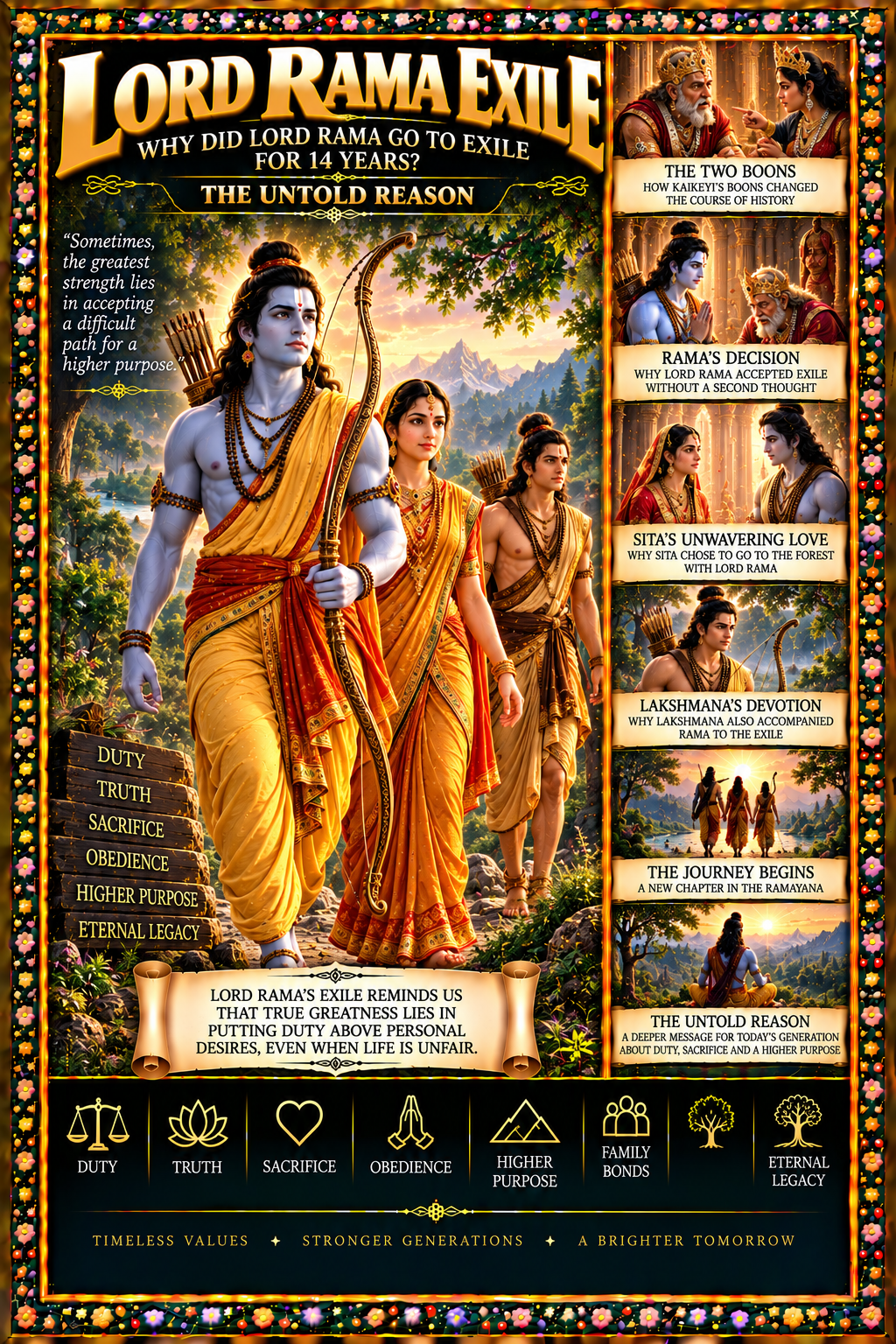
The story of Lord Rama Exile is one of the most pivotal turning points in the epic Ramayana. On the very eve of Crown Prince Rama’s grand coronation as King of Ayodhya, He was suddenly banished to the dangerous Dandaka forest for 14 years.
While most readers are familiar with the surface political drama involving Queen Kaikeyi’s two boons and the wicked instigation of the maid Manthara, ancient Vedic scriptures, Puranas, and astrological treatises reveal far deeper, cosmic, legal, and karmic reasons behind this divine Lord Rama Exile.
Why was Lord Rama exiled? Why did He accept it without a single word of protest? And why was the duration of Lord Rama Exile set precisely to 14 years instead of 10 or 20?
In this article, we uncover the untold cosmic secrets, ancient legal statutes, and divine curses that ordained the 14-year Lord Rama Exile.
The Surface Story of Lord Rama Exile: Kaikeyi’s Boons
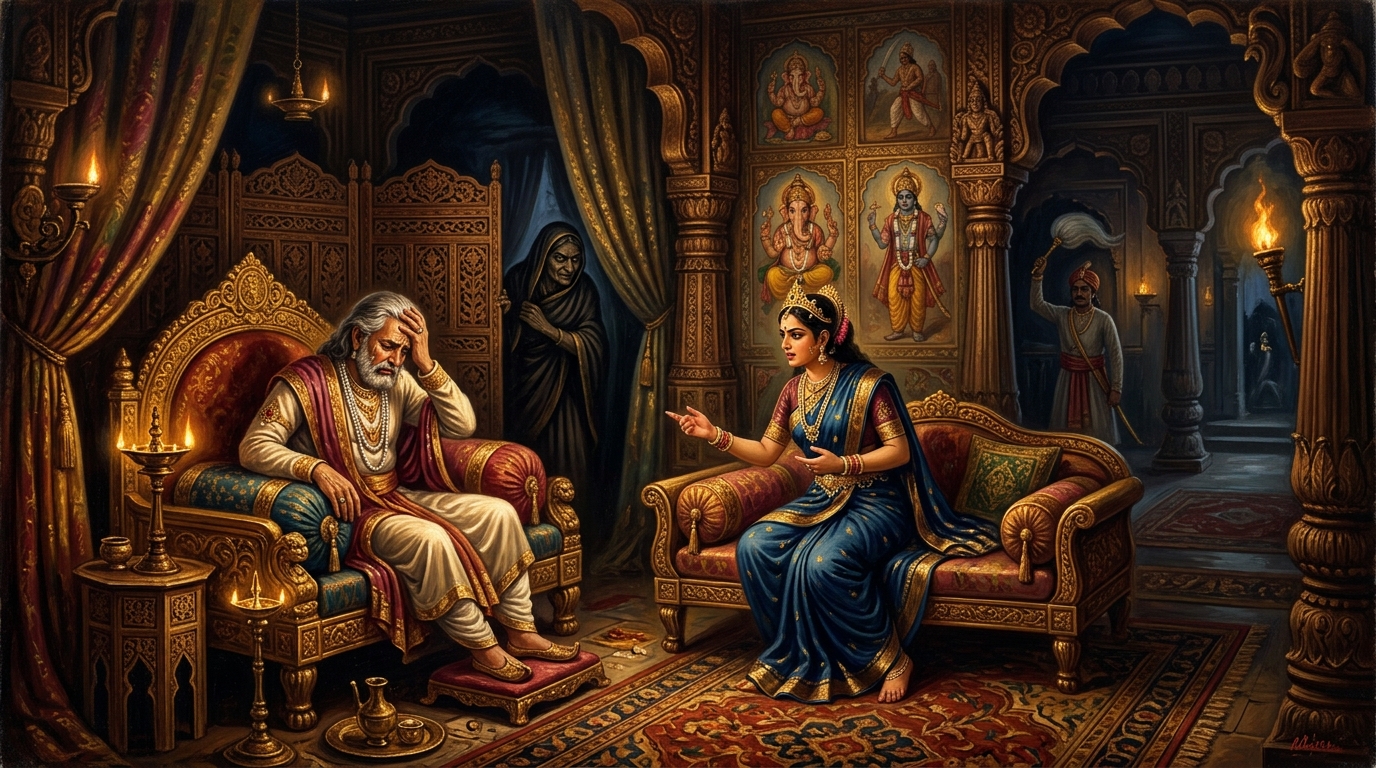
To understand the deeper secret reasons, one must first recall the narrative context established in the Ayodhya Kanda of Valmiki Ramayana regarding Lord Rama Exile.
The Battle Boon Given to Queen Kaikeyi
Years before the coronation, King Dasharatha fought alongside the Devas against the demon Sambasura in the Samshaptaka war. During a fierce battle, Dasharatha’s chariot axle broke, leaving him unconscious and mortally vulnerable. Queen Kaikeyi, skilled in charioteering and battle tactics, fearlessly drove Dasharatha’s chariot out of the battlefield, tended to his wounds, and saved his life.
Grateful for her heroism, King Dasharatha promised Kaikeyi two boons of her choosing, which she could redeem at any time of her choice.
Manthara’s Poisonous Instigation
On the eve of Rama’s coronation, Manthara, Kaikeyi’s hunchbacked maid, poisoned Kaikeyi’s mind with fear and jealousy. Manthara convinced Kaikeyi that once Rama became king, Kaikeyi’s son Bharata would be mistreated, marginalized, or even executed, and Kaikeyi would lose her royal influence to Queen Kausalya.
Inverted by fear, Kaikeyi retreated to the Kopabhavana (chamber of anger) and demanded her two long-pending boons from King Dasharatha:
- First Boon: Her son Bharata must be crowned King of Ayodhya.
- Second Boon: Lord Rama Exile to live as an ascetic in the dense Dandaka forest for 14 years.
King Dasharatha was devastated, weeping and begging Kaikeyi to spare Rama. However, Lord Rama, prioritizing Pitru Vakhya Paripalana (upholding a father’s sacred word and honor), willingly surrendered the throne, removed his royal garments, donned bark clothes (Valkala), and departed for Lord Rama Exile alongside Goddess Sita and Prince Lakshmana.
Untold Reason 1: Cosmic Masterplan Behind Lord Rama Exile
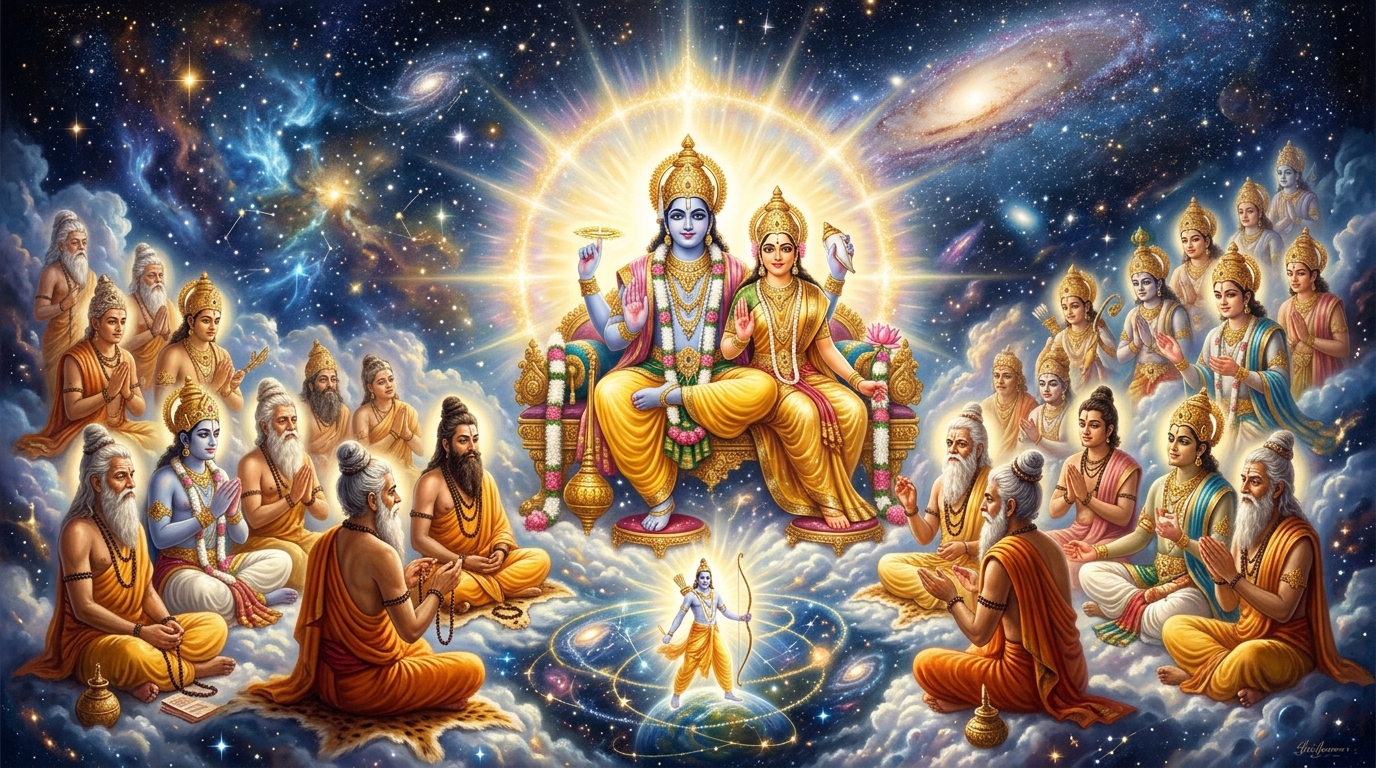
The primary cosmic purpose of Lord Vishnu’s avatar as Rama and the true reason behind Lord Rama Exile was the destruction of the demon king Ravana and the restoration of cosmic order (Dharma).
Ravana’s Invincible Boon and Human Vulnerability
Ravana had performed extreme penance to appease Lord Brahma, securing a divine boon that rendered him invincible against Devas, Asuras, Gandharvas, Nagas, and celestial beings. However, in his extreme arrogance, Ravana omitted humans (Manushya) and monkeys (Vanaras) from his list of protection, considering them too weak to pose a threat.
Because Ravana could only be slain by a human, Lord Vishnu took birth as the human prince Rama.
The Territorial Constraint of Ayodhya
Ravana’s demonic forces (led by Khara, Dushana, Kabandha, Maricha, and Surpanakha) occupied the vast Southern forests of Dandaka and Panchavati, terrorizing Vedic Rishis and disrupting sacred Yajnas.
As King of Ayodhya, Rama could not wage an unprovoked war on foreign forest territories without political complications. However, through Lord Rama Exile, He gained direct access to the deep forests, fulfilled his promise to protect the Rishis, encountered Sugriva and Hanuman, built the Vanara army, and ultimately invaded Lanka to destroy Ravana.
Without Lord Rama Exile, Rama would have remained inside the royal palace of Ayodhya, and Ravana’s destruction could not have taken place according to cosmic laws.
Untold Reason 2: Ancient Treta Yuga Legal Laws on Lord Rama Exile
Why did Kaikeyi demand specifically 14 years for Lord Rama Exile, rather than 5, 10, or 20 years?
The Legal Statute of Kingdom Forfeiture
According to ancient Vedic jurisprudence (Rajdharma) and legal statutes prevalent during the Treta Yuga, if a king, prince, or property owner abandoned his kingdom and lived outside its geographical boundaries for 14 consecutive years, his legal ownership, inheritance rights, and claim to the throne were permanently forfeited by law.
Kaikeyi and her advisors knew that if Rama returned after 5 or 10 years, the ministers and people of Ayodhya might still demand Rama’s coronation, forcing Bharata to step down. By demanding a full 14-year Lord Rama Exile, Kaikeyi intended to legally disqualify Rama from ever claiming the throne of Ayodhya again, making Bharata the permanent, undisputed legal ruler under Treta Yuga statutes.
How Bharata Outsmarted the Law
However, Queen Kaikeyi’s plan was outsmarted by her own righteous son, Bharata.
Refusing to accept the kingdom, Bharata traveled to the forest to bring Rama back from Lord Rama Exile. When Rama refused to break his father’s word, Bharata requested Rama’s sacred wooden sandals (Padukas). Bharata placed Rama’s Padukas on the throne of Ayodhya, ruling strictly as a caretaker (Trustee) in Rama’s name while living outside Ayodhya in Nandigram.
Because the throne was legally held in Lord Rama’s name by His Padukas, the 14-year forfeiture statute did not apply to Rama!
Untold Reason 3: Sage Curses Leading to Lord Rama Exile
In the Matsya Purana, Padma Purana, and Ramcharitmanas, ancient curses explain why Lord Vishnu was destined for Lord Rama Exile and spouse separation.
The Curse of Sage Bhrigu
During an ancient war between Devas and Asuras, Sage Bhrigu’s wife Kavyamata granted refuge to the Asuras. To preserve cosmic order, Lord Vishnu severed Kavyamata’s head. Overcome with grief, Sage Bhrigu cursed Lord Vishnu:
“Because you killed a woman and separated me from my beloved wife, you shall be born as a mortal on Earth, endure severe emotional torment, and suffer separation from your wife for 14 years.”
The Curse of Sage Narada
Sage Narada was once enchanted by a princess’s Swayamvara and asked Lord Vishnu for a handsome face (Hari face). Lord Vishnu playfully granted him a monkey face. When rejected at the Swayamvara, Narada cursed Lord Vishnu that He would be born as a human, suffer separation from His wife during Lord Rama Exile, and be aided only by monkeys (Vanaras).
Life Lessons from Lord Rama Exile
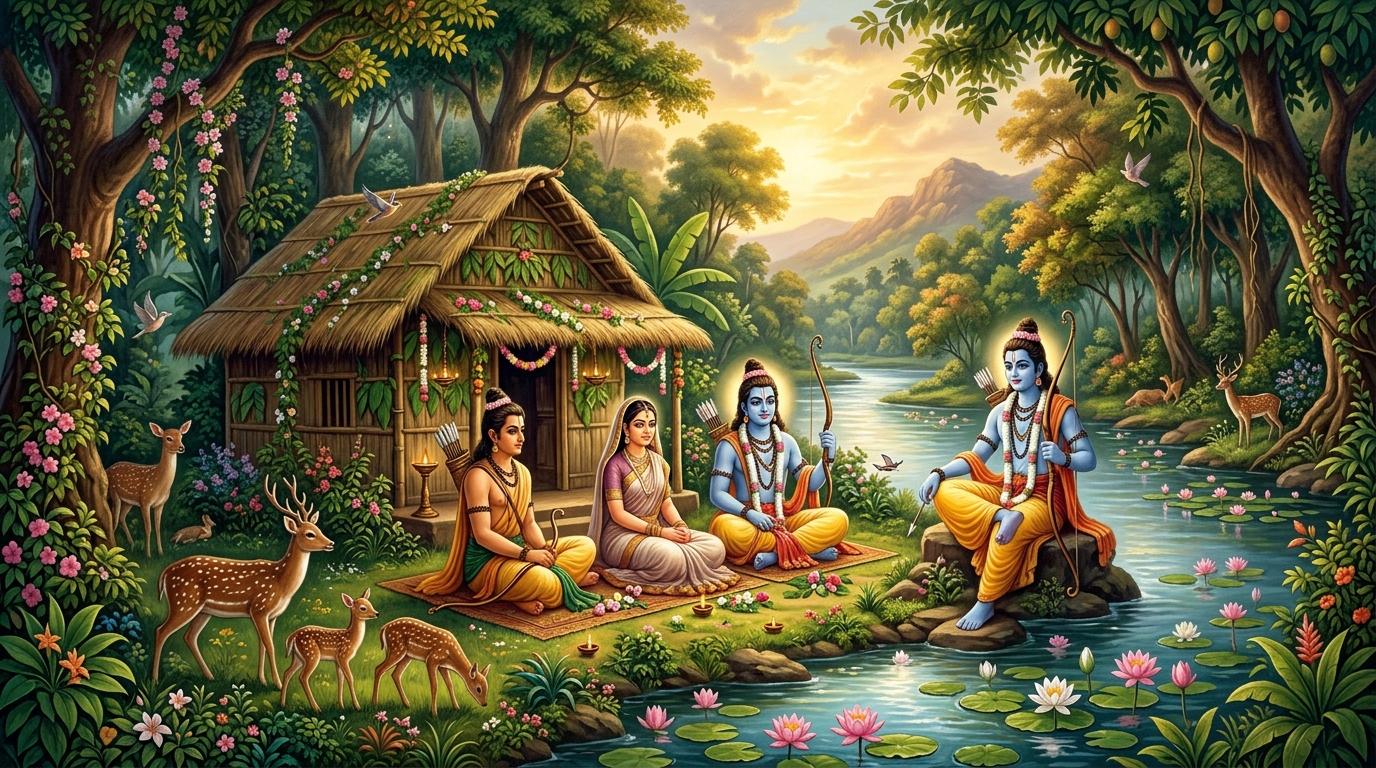
The story of Lord Rama Exile is not merely a tale of suffering; it is a masterclass in spiritual resilience, ethical governance, and devotion.
- Unshakable Dharma (Duty Over Desire): Rama gave up a kingdom in a single moment without anger or regret to uphold his father’s word.
- Grace Under Adversity (Sthitaprajna): Rama treated both royal luxury and forest hardship during Lord Rama Exile with absolute equanimity.
- The Value of Sacrificial Brotherhood: Lakshmana abandoned all royal comforts to serve Rama in Lord Rama Exile, while Bharata refused the crown out of love for his brother.
- Empowerment of the Marginalized: During Lord Rama Exile, Rama embraced tribal leaders (Guha), forest dwellers (Sabari), and Vanaras, demonstrating universal love beyond social status.
Frequently Asked Questions (FAQs) About Lord Rama Exile
1. Why did Lord Rama go to exile for 14 years?
On the surface, Lord Rama Exile occurred to fulfill the two boons granted by King Dasharatha to Queen Kaikeyi. Cosmically, it was ordained to defeat the demon king Ravana, fulfill past sages’ curses (Sage Bhrigu and Narada), and uphold righteousness.
2. Why specifically 14 years for Lord Rama Exile?
Under ancient Treta Yuga legal laws (Rajdharma), remaining away from a kingdom for 14 consecutive years meant permanent forfeiture of royal inheritance. Kaikeyi requested 14 years of Lord Rama Exile to ensure Rama could never legally claim the throne of Ayodhya again.
3. Who accompanied Lord Rama during Lord Rama Exile?
Goddess Sita (his wife) and Prince Lakshmana (his younger brother) willingly accompanied Lord Rama into the 14-year Lord Rama Exile.
4. Which forest did Lord Rama live in during Lord Rama Exile?
Lord Rama spent Lord Rama Exile in the Dandaka Forest, staying at sacred locations such as Chitrakoot, Panchavati (near modern Nashik), and Kishkindha.
5. How did Bharata rule Ayodhya during Lord Rama Exile?
Bharata refused to wear the royal crown. He placed Lord Rama’s wooden sandals (Padukas) on the throne and ruled as a humble regent from a village named Nandigram, outside Ayodhya during Lord Rama Exile.