Raja Ratnam
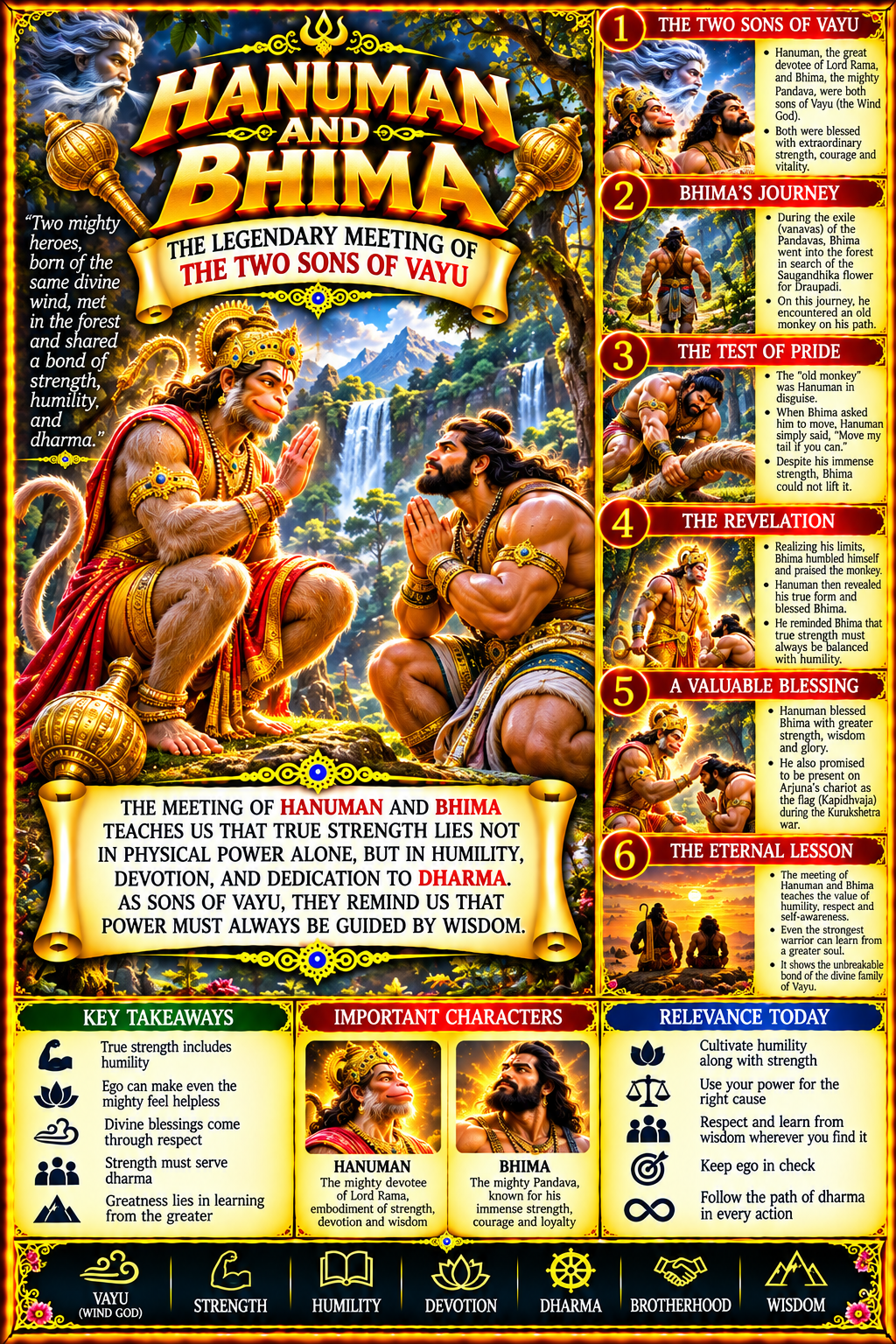
Hanuman and Bhima: The Legendary Meeting of the Two Sons of Vayu
The timeless encounter between Hanuman and Bhima represents one of the most celebrated and philosophically profound episodes in the Mahabharata. In Indian epic literature, both warriors share a sacred spiritual bond as sons of Vayu, the Wind God. Furthermore, each hero embodies the supreme strength of his respective era. Lord Hanuman champions dharma in the Treta Yuga, while Bhima defends righteousness during the turbulent Dvapara Yuga.
When the Pandavas wandered through the fragrant mountain groves during their twelve-year exile, a single golden lotus initiated an extraordinary meeting. Explore our detailed study of Hanuman in Ramayana: life story, powers and lanka dahan to appreciate his immortal stature. In addition, examine the formidable physical feats in Bhima in Mahabharata: the strongest Pandava. The sacred narrative recorded in the Vana Parva of the Mahabharata on Sacred Texts reveals how spiritual wisdom must temper physical strength. Thus, this guide examines the dramatic search for the celestial flower, the trial of the immovable tail, and the eternal promise on the battlefield of Kurukshetra.
The Mythological Setting: Draupadi’s Quest and the Meeting of Hanuman and Bhima
During the Pandavas’ forest exile, Queen Draupadi sat upon the slopes of Mount Gandhamadana. Suddenly, a gentle mountain breeze carried an exquisite blossom radiating celestial fragrance. In Sanskrit lore, this extraordinary bloom was the celestial Saugandhika lotus described on Wisdom Library.
Enchanted by its otherworldly perfume, Draupadi showed the multi-petaled golden flower to Bhima. She requested that he venture into the high peaks to collect more blossoms for their forest hermitage. Furthermore, eager to bring joy to Draupadi, the mighty second Pandava took up his golden bow and heavy mace. Consequently, Bhima charged fearlessly into the wilderness, determined to fulfill her wish at any cost.
Bhima’s Quest into the Forbidden Mountain Groves of Mount Gandhamadana
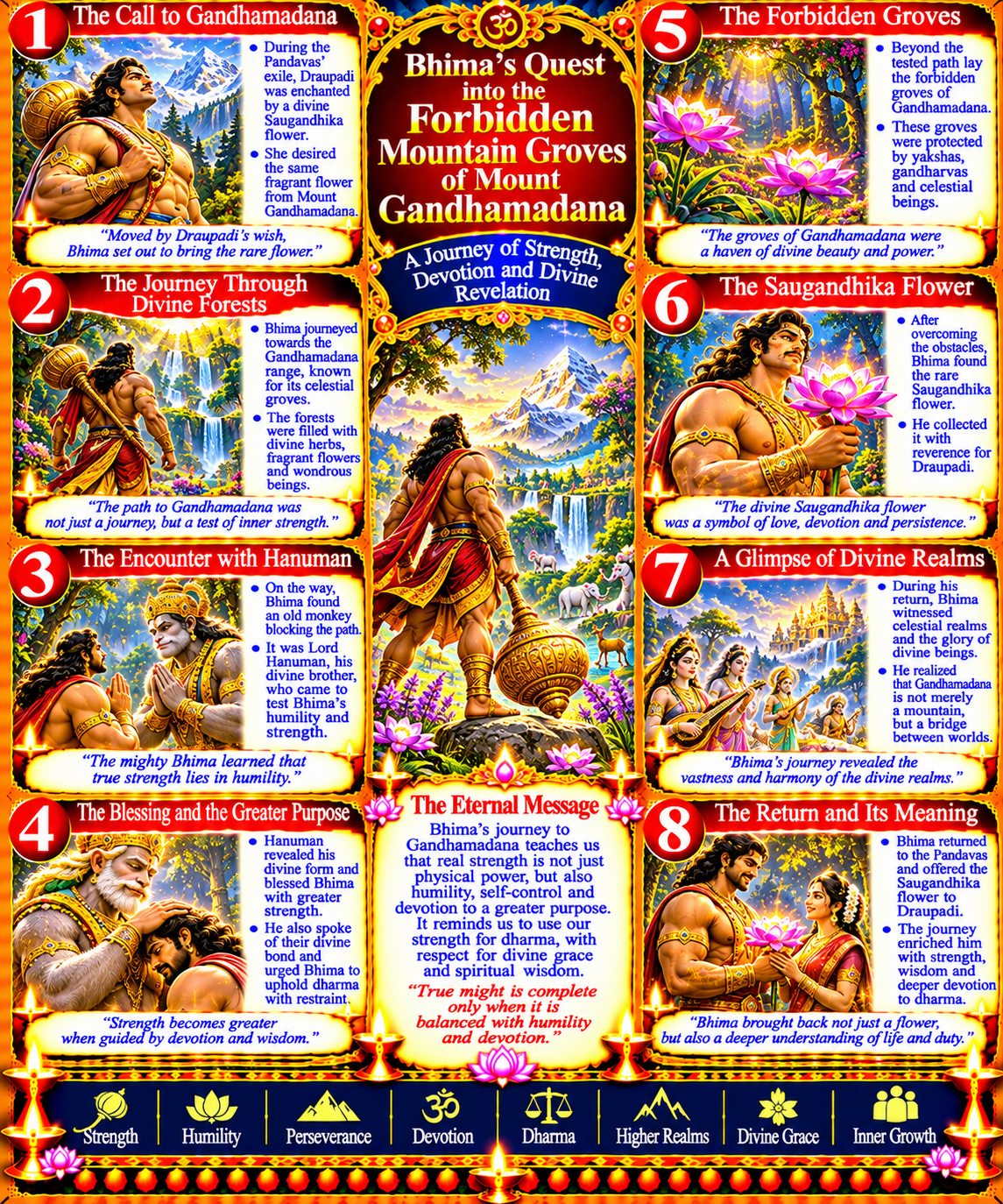
Mount Gandhamadana was no ordinary wilderness. Specifically, it housed the private celestial gardens of Kubera, the god of wealth. Divine Yakshas, Rakshasas, and Gandharvas fiercely guarded the sacred mountain lakes.
Bhima marched up the jagged rocky ascents with unstoppable velocity. Indeed, he possessed the physical strength of ten thousand wild elephants. He uprooted towering sal trees and hurled aside charging tigers with casual ease. His resonant war cries echoed across deep mountain valleys, shattering the peaceful silence of the forest.
The Roar of the Pandava Warrior and the Disturbed Wilderness
However, Bhima’s thunderous commotion reflected growing personal pride. He believed no mortal or celestial entity could withstand his brute force. His fierce roars terrified peaceful forest deer and disturbed hermitages where ascetics practiced silent meditation. In other words, physical pride was clouding the noble warrior’s righteous discernment.
The Sacred Plantain Groves of the Chiranjivi Hermits
Deep within a secluded valley of dense plantain trees, Lord Hanuman sat absorbed in meditation upon Lord Rama. As one of the immortal Chiranjivis, Hanuman had chosen this quiet peak to dwell in eternal contemplation. Suddenly, the crashing of falling timber and boastful shouts reached his acute ears. Consequently, the great monkey hero opened his eyes to investigate the disturbance.
Verse Citations from the Vana Parva of the Mahabharata
The critical edition of the Ganguli translation of the Mahabharata on Wisdom Library captures this exact moment. Hanuman recognized that the approaching warrior was his own spiritual younger brother, born of Vayu through Queen Kunti. Therefore, Hanuman resolved to protect Bhima from arrogant destruction by humbling his vanity before he reached Kubera’s perilous lakes.
The Humbling Encounter: How Hanuman and Bhima Crossed Paths on the Path
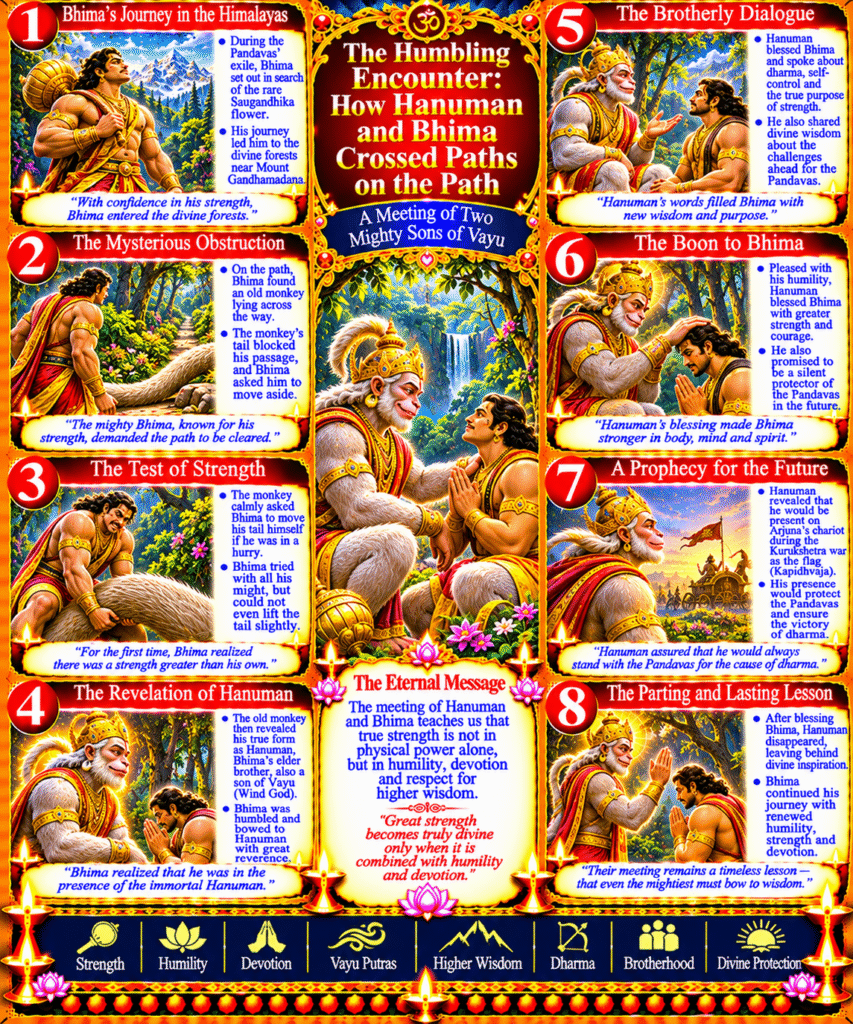
To deliver this crucial spiritual lesson, Hanuman orchestrated an ingenious test. Rather than confronting Bhima with weapons, the ancient hero adopted a humble disguise.
1. The Disguise of the Feeble Old Monkey Across the Narrow Pass
Hanuman shrank his colossal frame into that of an aged, decrepit monkey. He lay directly across the narrow mountain ledge, blocking the only pathway forward. Furthermore, he stretched his long, rough tail across the stone road.
Bhima arrived at the narrow gorge, eager to proceed. Seeing a frail monkey obstructing his way, Bhima shouted impatiently. He commanded the monkey to move aside immediately, warning that he was a mighty Pandava prince. In contrast, the old monkey blinked slowly and spoke in a weak, trembling voice.
2. The Trial of the Immovable Tail and the Humbling of Physical Pride
The old monkey explained that he was too sick and aged to stand. He gently suggested that if Bhima was in a hurry, he could leap over him. However, Bhima refused, stating that scriptures forbid leaping disrespectfully over living elders.
Then, the monkey suggested that Bhima simply lift his tail aside using his hand. Smiling condescendingly, Bhima reached down with his left hand to flick the tail away. Surprisingly, the tail remained completely stationary. Perplexed, Bhima grasped the tail with both hands, planting his feet firmly into the mountain rock.
Bhima pulled with all his legendary might. Veins bulged along his neck, sweat poured from his brow, and the earth groaned beneath his feet. Nevertheless, despite straining his full strength, Bhima could not lift the tail even a hair’s breadth from the ground.
3. The Revelation of Hanuman’s True Identity and Fraternal Embrace
Exhausted, panting, and utterly humiliated, Bhima released the tail. His arrogance evaporated instantly. Realizing that he stood before an extraordinary divine being, Bhima bowed his head in deep reverence. He folded his palms and pleaded to know who this divine master was.
With boundless affection, the old monkey smiled and revealed his identity as Hanuman, the devoted servant of Lord Rama. Bhima’s heart overflowed with reverence and joy. The mighty Pandava fell at his elder brother’s feet. Hanuman lovingly lifted Bhima and embraced him, filling the younger warrior with divine vitality and renewed spiritual clarity.
4. The Darshan of the Colossal Cosmic Form (Vishwaroopa)
Deeply moved, Bhima requested to see the gigantic form that Hanuman assumed when leaping across the southern ocean to Lanka. Initially, Hanuman hesitated, explaining that appearances adjust according to the cosmic age (Yuga Dharma).
However, yielding to Bhima’s earnest devotion, Hanuman expanded his form. He grew as colossal as Mount Meru, radiating blazing golden effulgence like a thousand rising suns. Overwhelmed by the dazzling sight, Bhima covered his eyes with trembling hands. Hanuman gently contracted back to normal size, blessing Bhima with invincible inner fortitude.
5. The Eternal Promise on Arjuna’s Chariot Banner (Kapi Dhwaja)
Before parting, Hanuman guided Bhima safely to Kubera’s lake, where golden Saugandhika flowers blossomed in abundance. Furthermore, knowing that a great war for dharma approached, Hanuman granted Bhima a decisive cosmic boon.
Hanuman promised to manifest invisibly on the banner of Arjuna’s chariot, known as the Kapi Dhwaja. Whenever Bhima roared on the battlefield, Hanuman promised to amplify his war cries across the skies, shattering the resolve of the Kaurava army. Review how divine destinies intertwined during the war in Karna vs Arjuna: who was the greatest archer. Similarly, see how demonic pride inevitably falls in Indrajit vs Lakshmana in Ramayana. Thus, Hanuman’s presence ensured that righteous dharma prevailed on the plains of Kurukshetra.
Master Comparison Table: Spiritual Attributes of Hanuman and Bhima
| Attribute / Dimension | Lord Hanuman (Treta Yuga) | Bhima (Dvapara Yuga) |
|---|---|---|
| Spiritual Lineage | Spiritual son of Vayu and Anjana | Spiritual son of Vayu and Queen Kunti |
| Era (Yuga) | Treta Yuga (Age of strict virtue) | Dvapara Yuga (Age of declining righteousness) |
| Primary Deity / Allegiance | Unconditional devotee of Lord Sri Rama | Protector of the Pandavas and Lord Sri Krishna |
| Mastery of Ego | Complete egoless humility and selfless service | Fierce physical pride tempered into disciplined duty |
| Primary Weapon | Divine mace (Gada), fist, and supreme mountain rocks | Heavy golden mace (Gada) and sheer physical grappling |
| Role in the Mahabharata War | Resided on Arjuna’s chariot banner (Kapi Dhwaja) | Vanquished Duryodhana, Dushasana, and the Kauravas |
| Immortal Status | Chiranjivi (Immortal through all cosmic cycles) | Mortal hero who attained Svarga through righteous karma |
Core Philosophical Lessons from the Meeting of the Two Vayuputras
The encounter between the two brothers carries timeless metaphysical guidance for contemporary seekers. First, brute physical force without humility leads inevitably to spiritual ruin. Second, senior spiritual masters correct genuine seekers out of compassion rather than malice.
Moreover, true strength reveals itself through restraint rather than aggressive display. Hanuman possessed the power to shatter mountains, yet he gently lay in the dust as an aged monkey. Read our account of family bonds and righteous vows in Hidimbi in Mahabharata: marriage to Bhima and legacy. Ultimately, when human strength bows before divine wisdom, ordinary mortals transform into unconquerable defenders of cosmic dharma.
Frequently Asked Questions About Hanuman and Bhima
1. Why are Hanuman and Bhima considered brothers?
Both are spiritual sons of Vayu, the Wind God, born through divine boons in two distinct cosmic ages.
2. Where did Hanuman and Bhima meet in the Mahabharata?
They met in a plantain forest on Mount Gandhamadana during the Pandavas’ twelve-year forest exile.
3. Why did Bhima travel into Mount Gandhamadana?
Bhima climbed the mountain to retrieve celestial Saugandhika lotus flowers requested by Queen Draupadi.
4. What disguise did Hanuman take when meeting Bhima?
Hanuman transformed himself into an old, frail monkey lying directly across the narrow mountain path.
5. Why did Bhima refuse to jump over the old monkey?
Bhima refused out of scriptural etiquette, stating that sacred laws forbid disrespectfully leaping over elder living beings.
6. What test did Hanuman give to Bhima?
Hanuman challenged Bhima to simply lift his monkey tail aside with his hand to clear the pathway.
7. Could Bhima lift Hanuman’s tail?
No, despite straining with the strength of ten thousand elephants, Bhima could not lift the tail an inch.
8. How did Bhima react after failing to move the tail?
Bhima realized the monkey was an enlightened celestial being, bowed in deep humility, and requested his identity.
9. Why did Hanuman decide to test Bhima?
Hanuman wanted to shatter Bhima’s growing pride and protect him from arrogant destruction by Kubera’s guards.
10. Did Hanuman reveal his colossal cosmic form to Bhima?
Yes, at Bhima’s earnest request, Hanuman showed his radiant cosmic Vishwaroopa that once leapt across the ocean.
11. What promise did Hanuman make for the Kurukshetra War?
Hanuman promised to sit on the banner of Arjuna’s chariot and roar to terrify the Kaurava army.
12. What is the name of Arjuna’s chariot banner?
Arjuna’s chariot banner is known as the Kapi Dhwaja, meaning the flag bearing the divine monkey crest.
13. What is the Saugandhika flower?
It is a celestial, fragrant golden lotus blossoming in the divine lakes of Kubera on Mount Gandhamadana.
14. In which book of the Mahabharata does this meeting occur?
This sacred episode occurs in the Vana Parva (Aranyaka Parva) of the epic Mahabharata.
15. What is the core spiritual lesson of this episode?
The story teaches that physical might without humility is vanity, and true strength lies in selfless surrender.
16. Did Hanuman fight against the Kauravas directly?
No, Hanuman remained on the chariot flagstaff, lending his spiritual presence and terrifying war roars to Pandava victories.
17. How are Treta Yuga and Dvapara Yuga connected in this story?
The meeting unites Hanuman, the Treta Yuga hero, with Bhima, the Dvapara Yuga warrior, bridging two great epics.
18. Is Hanuman an immortal Chiranjivi?
Yes, Hanuman received the boon to live on earth as an immortal Chiranjivi as long as Rama’s name is chanted.
19. Did Bhima successfully collect the Saugandhika flowers?
Yes, blessed with Hanuman’s guidance and strength, Bhima reached the lake and gathered the flowers for Draupadi.
20. Where can readers find authenticated stories from the Mahabharata?
Ratnam Strategy provides comprehensive, scripture-backed analyses of Indian epics, temple lore, and ancient philosophical teachings.