Raja Ratnam
- Mahabharatam
- September 6, 2026
- 107 views
Ekalavya in Mahabharata: Story of Supreme Guru Bhakti & The Guru Dakshina Sacrifice
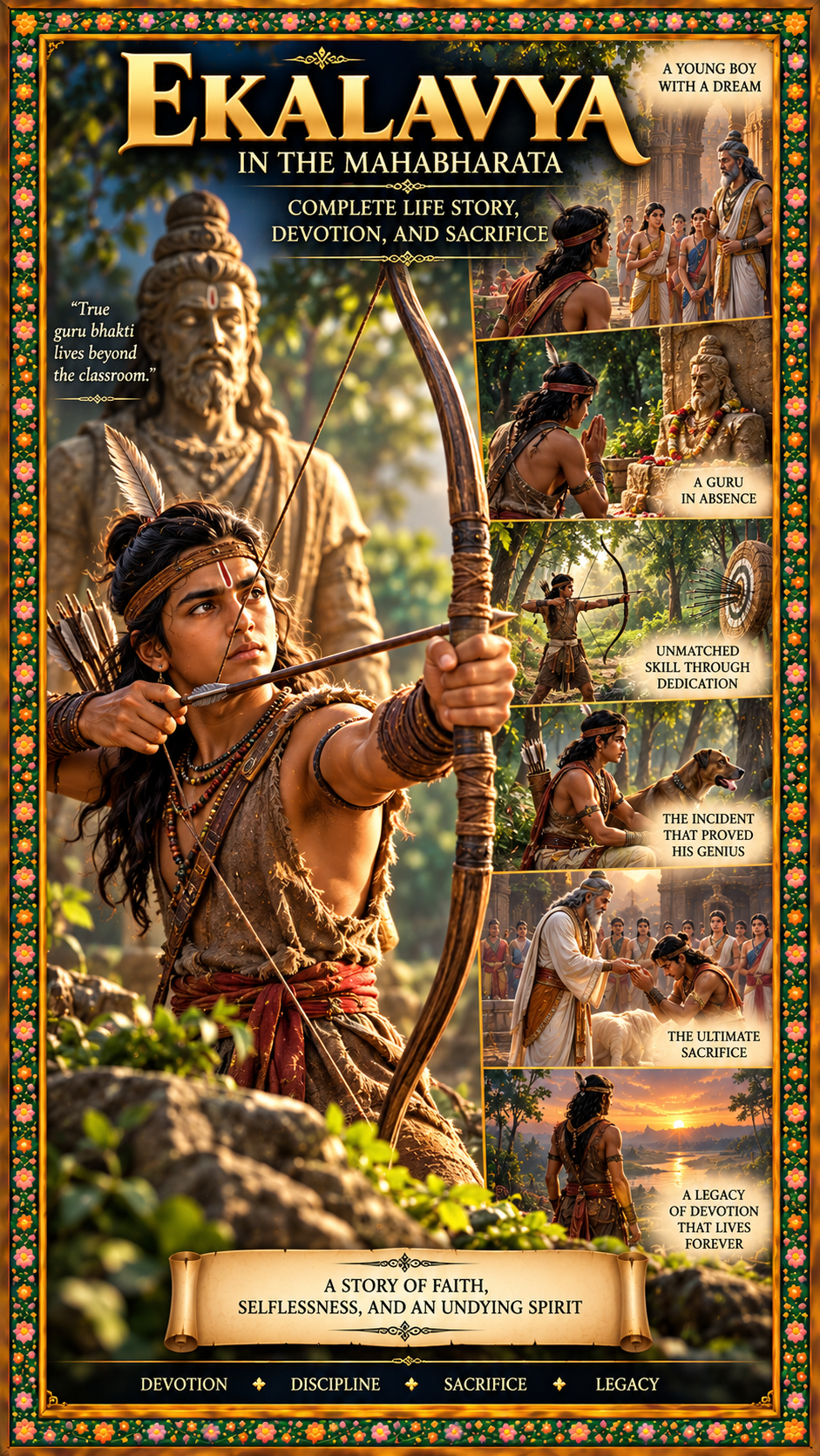
In the quiet shadows of the Hastinapur forest, far away from the royal archery grounds, a young Nishadha boy stood alone before a humble statue sculpted from clay. Without a master to correct his grip or praise his stance, Ekalavya practiced day and night with pure devotion, shooting arrows until his fingers bled. His extraordinary discipline made him one of the greatest archers of his generation, rivaling the royal prince Arjuna. Yet his story remains one of the most touching in the Mahabharata – a testament to what absolute dedication can achieve, and the heavy price an outsider paid to honor his silent teacher. While most readers know about Ekalavya’s legendary sacrifice of his right thumb, there are many lesser-known aspects of his life, his hidden royal lineage, and his post-sacrifice career as a formidable warrior that are rarely discussed. Exploring the life of Ekalavya in the Mahabharata reveals a narrative that challenges the boundaries of traditional caste structures and explores the true nature of the teacher-student relationship (Guru-Shishya Parampara). The Birth and Lineage of Ekalavya in the Mahabharata Ekalavya is commonly described as a forest-dwelling tribal boy belonging to the Nishada community. His father, Hiranyadhanus, was the king of…
- Festivals , Mythology
- September 4, 2026
- 107 views
Varaha Jayanti: Lord Vishnu’s Boar Avatar Story, Puja Vidhi & Powerful Mantras
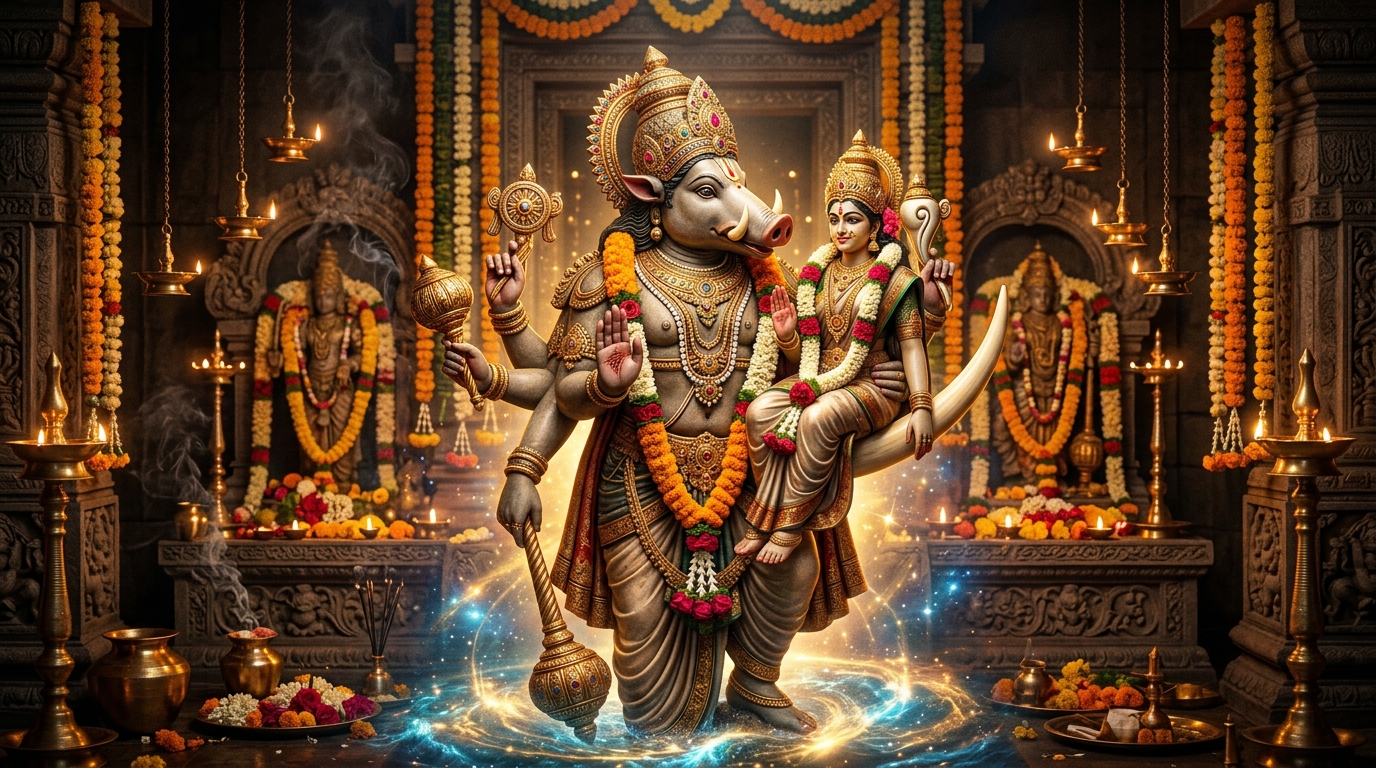
When the demon Hiranyaksha dragged the earth into the murky depths of the cosmic ocean, the universe trembled in darkness. In that critical hour, Lord Vishnu assumed the form of Lord Varaha – a colossal, radiant boar possessing unbreakable strength. Plunging fearlessly into the dark abyss, He defeated the demon and gently lifted Mother Earth (Bhudevi) upon His gleaming white tusks, restoring balance and life to creation. Celebrated as Varaha Jayanti, this sacred day reminds us that no matter how deep the darkness appears, divine protection always rises to safeguard the earth. Observed on the third day (Tritiya) of the waxing moon phase (Shukla Paksha) in the Hindu lunar month of Bhadrapada, Varaha Jayanti celebrates the victory of righteousness (Dharma) over cosmic chaos, environmental restoration, and divine protection. Worshipping Lord Varaha on this auspicious day brings immense courage, spiritual purity, freedom from obstacles, and lasting prosperity. In this comprehensive guide, explore the detailed mythological story of Lord Varaha, the profound spiritual symbolism of His incarnation, step-by-step Puja Vidhi rituals, powerful Varaha mantras, and frequently asked questions. The Divine Story of Varaha Avatar Celebrated on Varaha Jayanti The legend of Varaha Avatar is narrated in several ancient texts, including the Vishnu…
- Mahabharatam
- August 30, 2026
- 130 views
Kripacharya in Mahabharata: The Immortal Kulaguru of Hastinapur & Chiranjivi Story
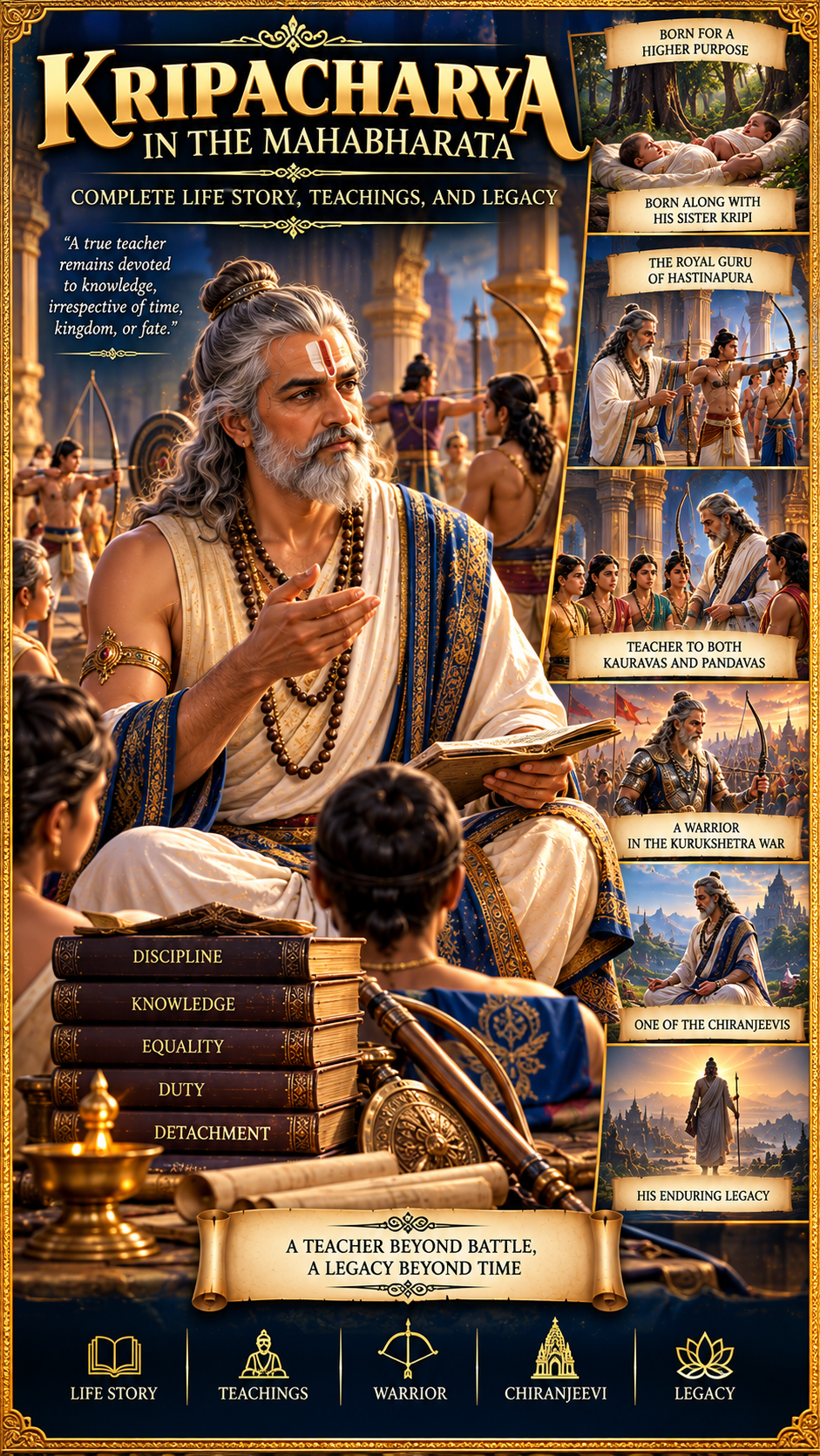
Long before Dronacharya arrived at the gates of Hastinapur, the royal Pandava and Kaurava boys learned their very first archery stances and moral lessons from one gentle, dignified teacher: Kripacharya. Found as an abandoned infant in the tall reed grasses by King Shantanu, Kripa grew into the trusted royal Kulaguru of the dynasty. Surviving the catastrophic eighteen-day war of Kurukshetra, he was blessed as a Chiranjivi – an immortal who walks through the ages, carrying forward the living memory, wisdom, and moral conscience of an entire heroic era. Unlike other warriors who were driven by ambition or revenge, Kripacharya in the Mahabharata represents stability, continuity, and the preservation of Kuru traditions. His role was not to instigate conflicts, but to provide steady, wise counsel to the throne of Hastinapur across three generations of kings. The Birth and Lineage of Kripacharya in the Mahabharata Kripacharya’s lineage begins with the great sage Gautama. His father was the sage Sharadvan, who was born with a natural talent for archery and performed intense penance to master all military arts. Alarmed by his growing power, Indra sent a beautiful Apsara named Janapadi to disrupt his meditation. Though Sharadvan resisted the distraction, the sudden disturbance caused…
- Mahabharatam
- August 23, 2026
- 108 views
Dronacharya in Mahabharata: Complete Biography, Astras, Warfare & Legacy
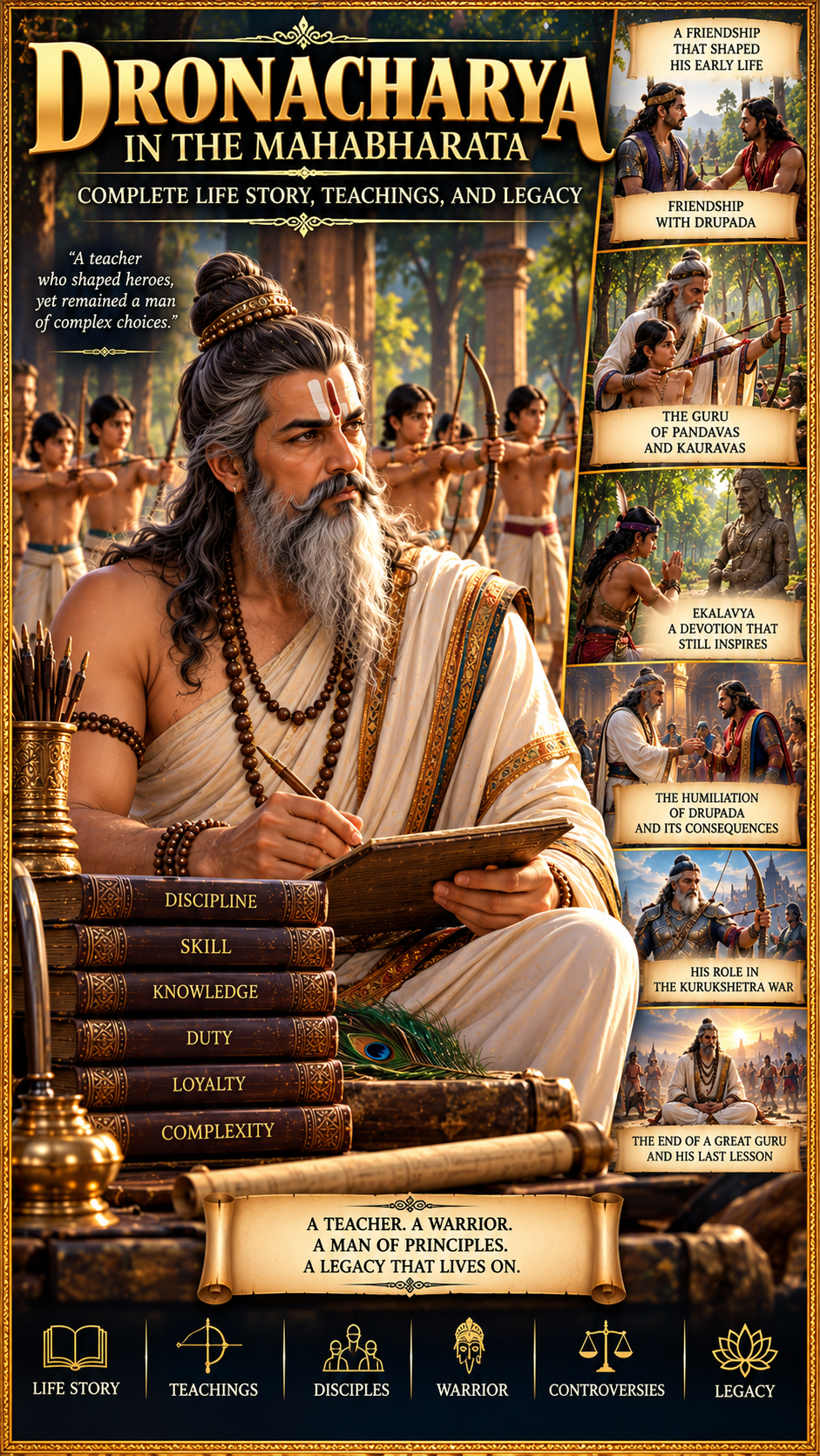
With a simple handful of blades of grass, an impoverished Brahmin once stunned the young princes of Hastinapur by retrieving a lost ball from the bottom of a dry well. That master was Dronacharya, a military genius who would mold young boys into the most formidable warriors of the ancient world. Yet behind his unmatched mastery of celestial weapons lay a tragic life of conflicting loyalties – torn between the fierce love for his son Ashwatthama, the debt he owed to the royal throne, and the heartbreaking duty of fighting against the very students he loved most. To truly understand Dronacharya in the Mahabharata, one must explore past his reputation as a master archer and examine the deep conflicts of interest, the tragic demands of his career, and his final days on the battlefield of Kurukshetra. His journey represents the light of knowledge combined with the shadows of political compromise. The Birth and Lineage of Dronacharya in the Mahabharata Dronacharya was not born in a conventional royal family. He was the son of the revered sage Bharadwaja. The story of his birth is unique: he was generated from a vessel or pot (known in Sanskrit as a *Drona*), which is…
- Mahabharatam , Women Characters
- August 16, 2026
- 110 views
Subhadra in Mahabharata: Krishna’s Sister, Arjuna’s Beloved & Mother of Abhimanyu
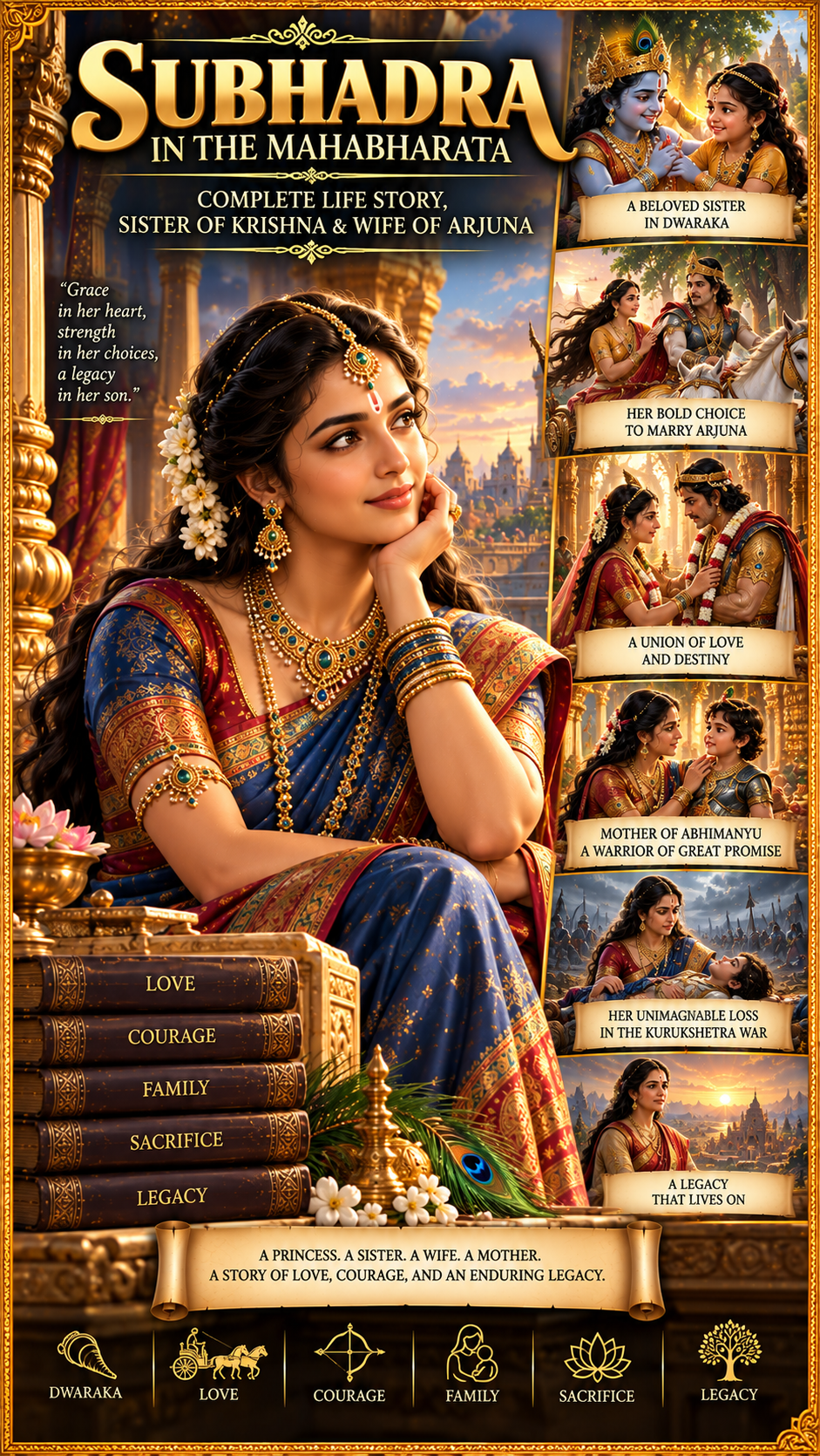
Growing up in the joyful coastal kingdom of Dwaraka, Princess Subhadra was the cherished younger sister of Lord Krishna and Balarama. Spirited, intelligent, and courageous, she took the reins of her own chariot when Arjuna courted her, driving them toward their wedding with quiet confidence. As the beloved mother of the brave teenage warrior Abhimanyu and grandmother of King Parikshit, Subhadra became the sacred bridge through whom the future of the Pandava lineage survived when all other royal heirs had fallen. While characters like Draupadi are associated with public humiliation, vengeance, and the fiery initiation of war, Subhadra in the Mahabharata represents a different dimension of strength: the unifying thread of the family, a mother who instilled legendary courage in her son, and the woman whose direct descendant (Parikshit) saved the Pandava lineage from extinction. The Lineage and Childhood of Subhadra in the Mahabharata Subhadra was born into the Yadava clan (specifically the Vrishni branch) as the daughter of Vasudeva and Rohini. She was the younger sister of Balarama and Lord Krishna. Born in Dwaraka, a magnificent coastal city renowned for its wealth, advanced architecture, and military strength, Subhadra grew up surrounded by affection. Because she was the youngest sibling,…

- Mahabharatam , Women Characters
- August 9, 2026
- 158 views
Hidimbi in Mahabharata: The Rakshasi Who Became Queen & Mother of Ghatotkacha
In the dense, uncharted wilderness beyond the borders of Hastinapur, the Pandavas walked weary and hunted after escaping the burning palace of Lakshagriha. It was here that prince Bhima encountered Hidimbi, a forest-dwelling maiden of the Rakshasa clan. Choosing love, compassion, and dharma over the predatory instincts of her kin, Hidimbi sheltered the exiled princes. Raising her heroic son Ghatotkacha alone in the deep woods with fierce pride and noble values, she proved that true nobility is defined not by royal birth, but by sacrifice and honor. To truly understand Hidimbi in the Mahabharata, one must look past the superficial labels of “demoness” or “rakshasi” and analyze her choices, her devotion, and the critical role she played in helping the Pandavas survive their early trials. Her story teaches us that nobility is not defined by birth or lineage, but by actions, love, and adherence to Dharma. The Lineage and Identity of Hidimbi in the Mahabharata Hidimbi lived with her brother Hidimba in the dense, dark forests located in the northern region of ancient India (believed to be parts of modern-day Himachal Pradesh, where she is still worshipped as a deity today). They belonged to the Rakshasa clan, a group of…
- Mahabharatam , Women Characters
- August 2, 2026
- 197 views
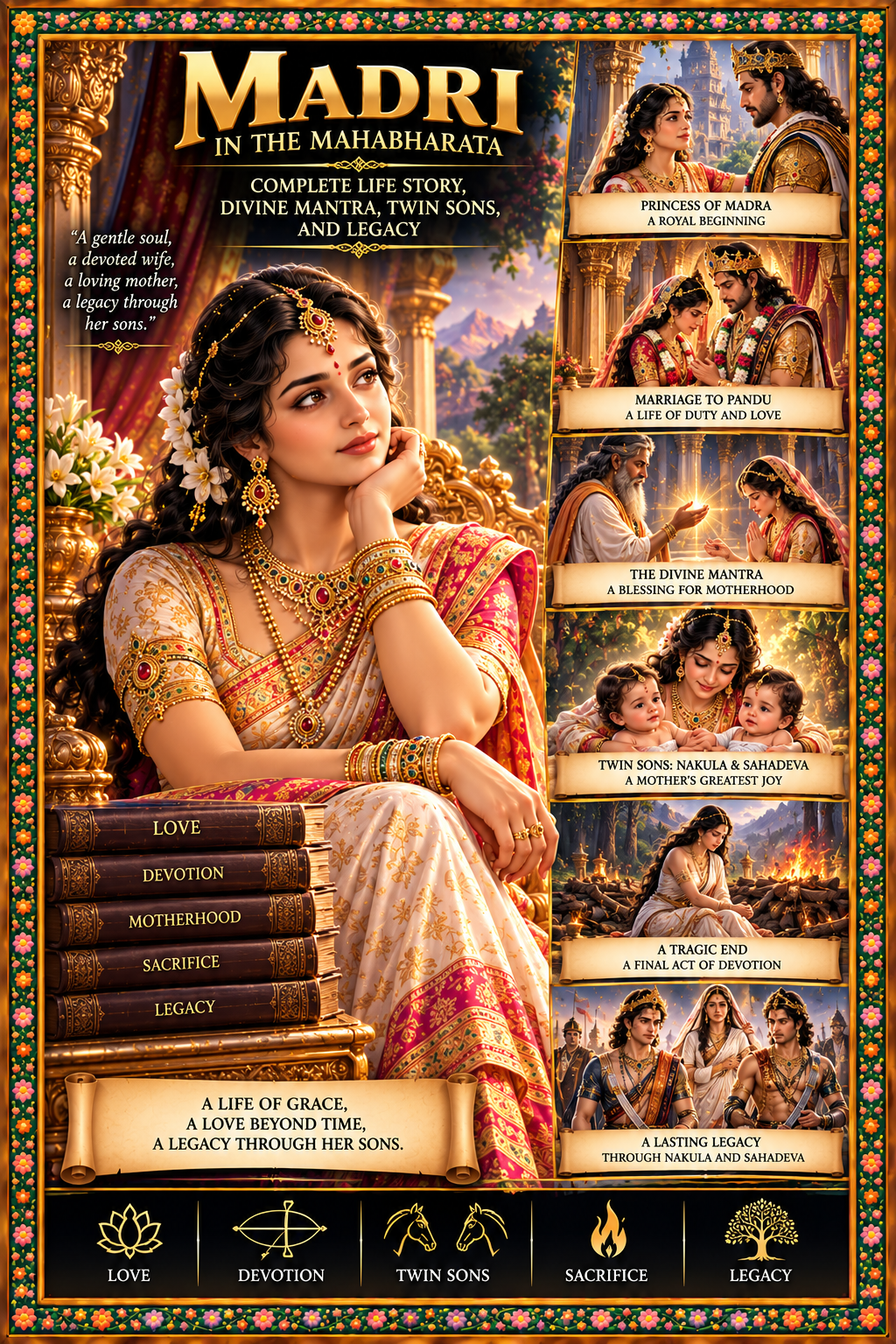
Madri in Mahabharata: Princess of Madra, Mother of the Twins & Tragic Sati
Entering the grand palace of Hastinapur as the radiant princess of Madra, Madri brought joy and beauty into the life of King Pandu. When a tragic sage’s curse forced Pandu into ascetic exile in the Himalayan mountains, Madri chose to share his simple forest life alongside elder queen Kunti. Through Kunti’s sacred boon, Madri invoked the divine Ashwini Kumaras and gave birth to the devoted twin princes, Nakula and Sahadeva. Though her life ended early in the quiet forest glades, her legacy lived on through the unbreakable bond her sons shared with their three elder brothers. Understanding the character of Madri in the Mahabharata requires looking beyond the popular perception of her as simply the “second queen.” She represents a complex human journey: a princess who had to live in the shadow of a senior queen, a wife who shared her husband’s exile, a mother who brought divine children into the world, and a woman whose final decision changed the course of Hastinapur’s history. The Lineage of Madri in the Mahabharata: The Princess of Madra Madri was the princess of the Madra kingdom, a prosperous region located in the north-western part of ancient India (corresponding to modern-day Punjab and parts…
- Women Characters
- July 27, 2026
- 212 views
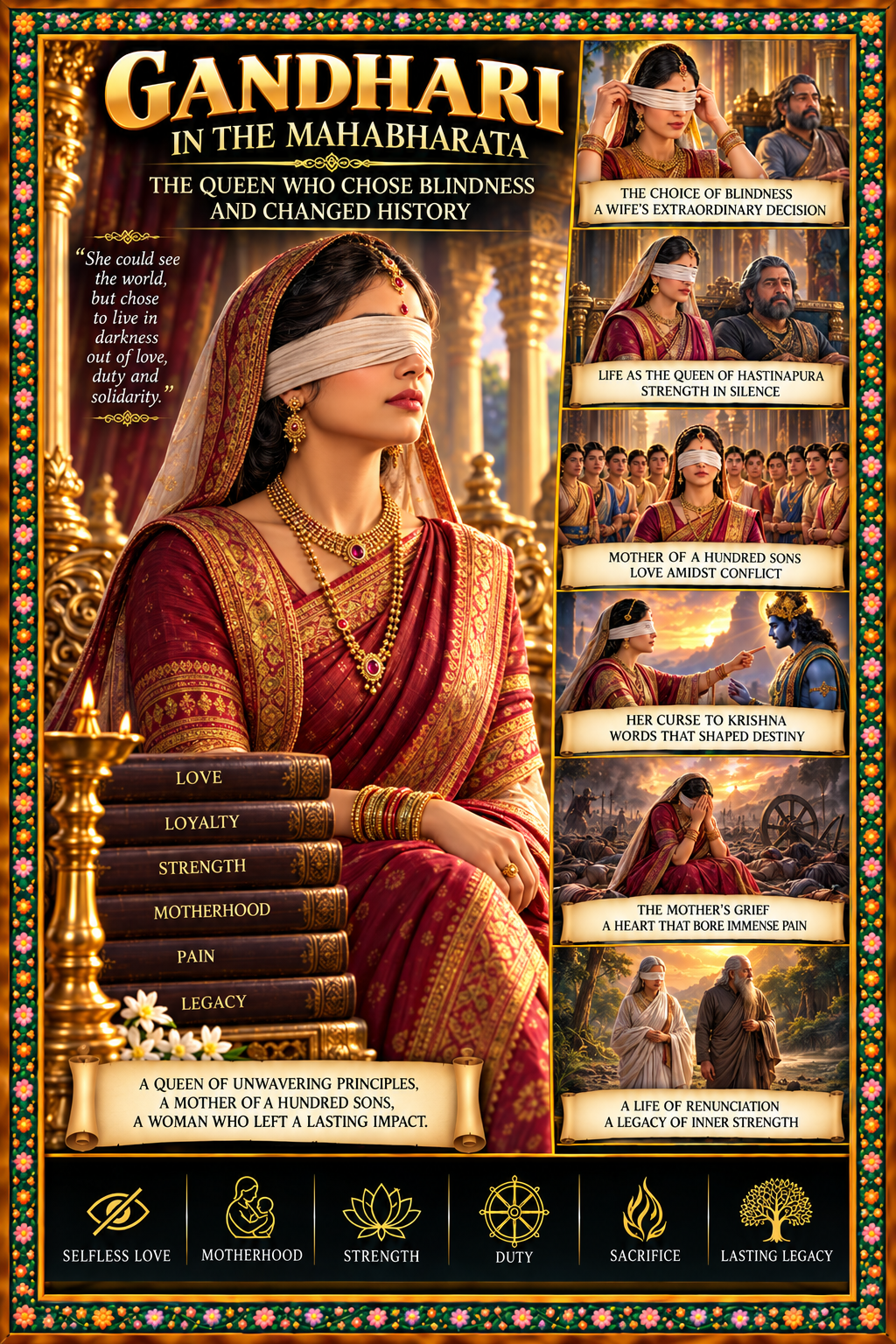
Gandhari in Mahabharata: Why She Blindfolded Herself & The Curse on Krishna’s Dynasty
Upon learning that her betrothed husband, Prince Dhritarashtra, was born without sight, the young princess of Gandhara made a choice that stunned the royal court of Hastinapur. She tied a thick cloth over her own eyes, choosing to share in her husband’s eternal darkness for the rest of her days. Gandhari was a queen of formidable willpower and devotion to dharma. For eighteen days of war, she refused to grant an unconditional blessing of victory to her eldest son Duryodhana, famously reminding him: ‘Where there is righteousness, there is victory.’ Her life was an intense journey of immense maternal grief, moral conviction, and royal tragedy. The story of Gandhari in the Mahabharata is not merely about sacrifice – it is about duty, motherhood, pain, and destiny. Gandhari’s life demonstrates how personal choices can influence generations and alter the course of history. Her unwavering devotion to her husband, her deep love for her children, and her commitment to Dharma make Gandhari in the Mahabharata one of the most inspiring and complex female characters in Indian mythology. This detailed guide explores the complete life of Gandhari in the Mahabharata, including her marriage to Dhritarashtra, the reason behind her blindfold, her role during…
- Women Characters
- July 25, 2026
- 213 views
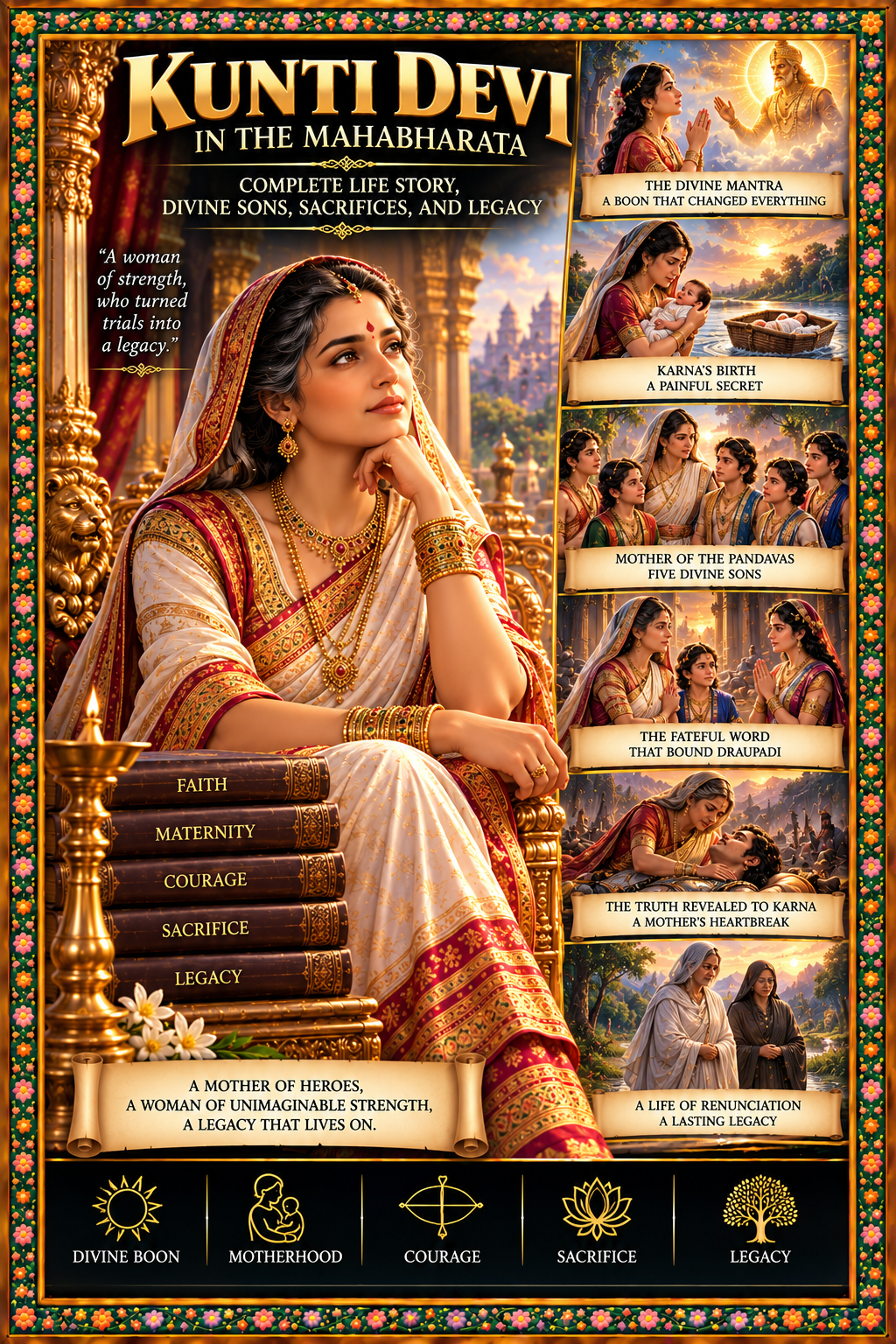
Kunti in Mahabharata: The Secret Boon of Sage Durvasa, Divine Sons & Sacrifices
Introduction – Kunti Devi in Mahabharata Long before she became the venerable queen mother of the Pandavas, young princess Pritha received a divine boon from the fiery sage Durvasa that could summon any god to grant her a child. When teenage curiosity led her to call upon Surya, the sun god, she was blessed with a radiant baby born with golden armor – a secret she was forced to send down the river in a floating basket with a weeping heart. Throughout a lifetime marked by widowhood, forest exile, and royal conspiracies, Queen Kunti stood as the unwavering moral anchor of the Pandava brothers, guiding them through trials with wisdom and quiet resilience. Her life teaches us that courage, patience, and faith can overcome even the greatest challenges. From receiving a divine boon in her youth to witnessing the Kurukshetra War, Kunti’s journey remains one of the most inspiring stories in Hindu mythology. In this comprehensive guide by Ratnam Strategy, you’ll discover Kunti Devi’s birth, childhood, marriage, divine sons, greatest sacrifices, role in the Mahabharata, and timeless lessons. For official cultural and historical archives, visit the Ministry of Culture, Government of India. Who Was Kunti Devi? Pritha Kunti Devi was…
- Festivals
- July 20, 2026
- 137 views
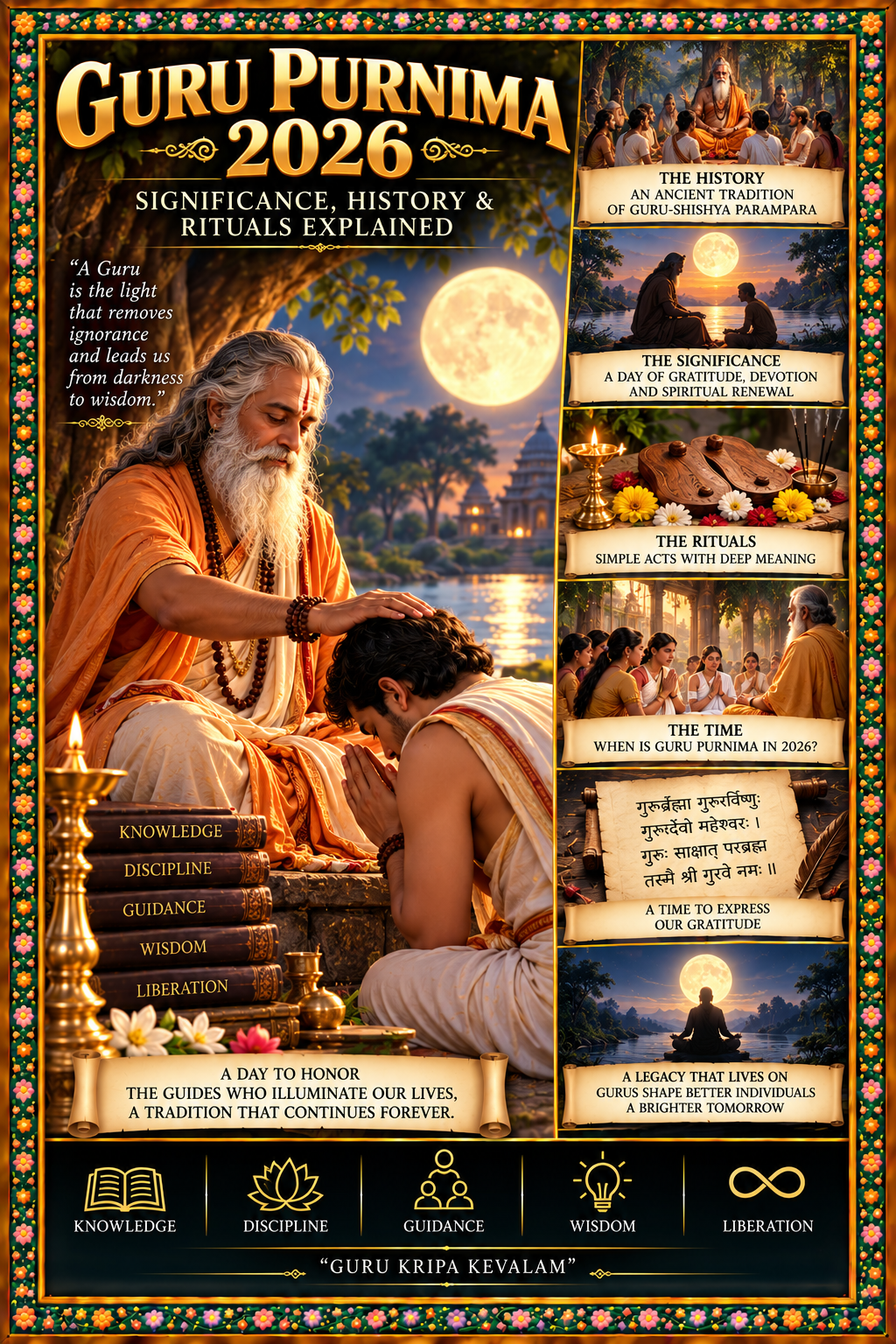
Guru Purnima: Date, Significance, Vyasa Puja Vidhi & Spiritual Importance
About the Author Under the bright silver light of the full moon in the sacred month of Ashadha, disciples and seekers across India bow in gratitude before their spiritual teachers. Known as Guru Purnima or Vyasa Purnima, this auspicious day celebrates the birth of Sage Veda Vyasa, the great master who organized the four Vedas and composed the Mahabharata. In Indian tradition, a true Guru does not merely impart academic knowledge; they serve as a gentle light dispelling the darkness of ignorance, guiding young minds toward wisdom, humility, and purpose. Raja Ratnam believes in making mythology accessible and meaningful for modern readers,helping them understand the moral, ethical, and cultural significance behind characters like Rama, Laxman, Shani Deva, and many more. Connect with the author: info@ratnamstrategy.com Introduction Guru Purnima is one of the most sacred festivals in the Hindu, Buddhist, and Jain traditions. Celebrated on the full moon day (Purnima) of the Hindu month of Ashadha, Guru Purnima is dedicated to honoring teachers, spiritual gurus, mentors, and guides who illuminate our lives with wisdom and knowledge. In Indian culture, a Guru is considered greater than even parents because while parents give birth to the body, a Guru awakens the soul. The festival reminds…