Raja Ratnam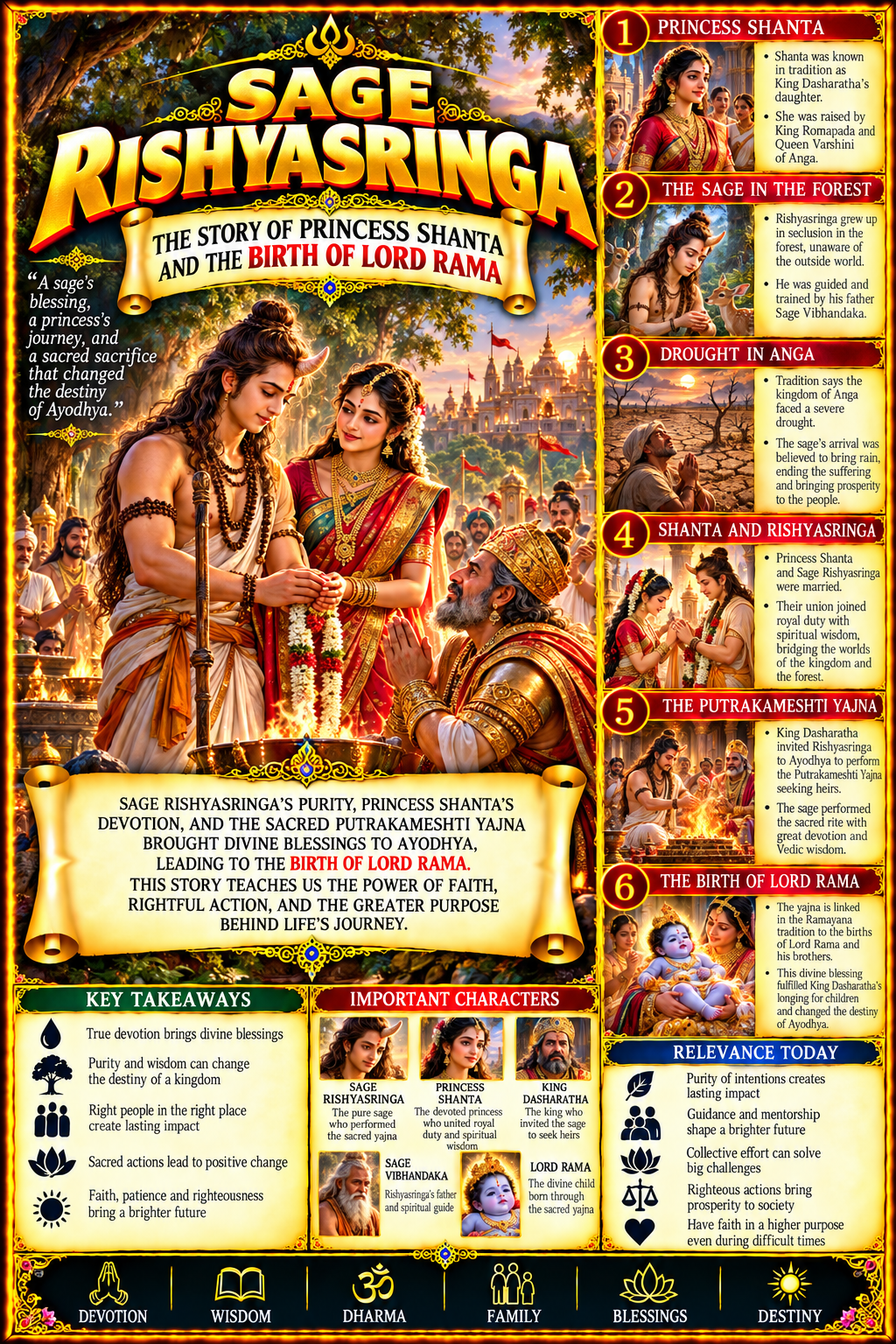
Long before the war of Lanka began, the fate of the Solar Dynasty rested upon an extraordinary hermit named Sage Rishyasringa. Born with a small horn on his head, Rishyasringa grew up in total forest solitude. He had never seen a city, heard music, or met any human being besides his ascetic father. Yet, this gentle forest sage possessed immense spiritual energy. Wherever he walked, rain clouds followed his footsteps, and sacred fires answered his prayers with divine blessings.
Devotees across the world worship Lord Rama as the ideal hero of Indian epic tradition. However, Rama’s appearance on earth began through a sacred ritual led by his own brother-in-law. The Bala Kanda of the Valmiki Ramayana and the Tirtha-yatra Parva of the Mahabharata on Sacred Texts record this profound story. The life of Sage Rishyasringa unites intense spiritual penance, royal duty, and the forgotten legacy of Princess Shanta, Rama’s elder sister.
Ancient scriptural summaries in Wisdom Library’s encyclopedia entry on Rishyasringa highlight his supreme discipline. His story reveals how innocent spiritual power can heal parched lands and restore cosmic order. Let us explore his miraculous forest childhood, the salvation of the kingdom of Anga, and the sacred ritual that blessed Ayodhya with four divine princes.
The Forest Childhood of Sage Rishyasringa
The lineage of Sage Rishyasringa stems from venerable Vedic seers. His grandfather was Sage Kashyapa, and his father was the stern hermit Vibhandaka Muni. Vibhandaka lived by a quiet lake deep inside an uninhabited wilderness, practicing severe spiritual austerities day and night.
According to the narrative in the Valmiki Ramayana Bala Kanda on Wisdom Library, a divine nymph born as a doe drank water from the lake and conceived a child. When the infant arrived, he possessed human form with a small deer horn emerging from his crown. Vibhandaka named his son Rishyasringa, meaning ‘deer-horned,’ and chose to raise him far away from human society.
Vibhandaka wanted to protect the boy from the grief, vanity, and conflicts of mortal cities. The young boy studied the Sama Veda, learned sacrificial rituals, and gathered wild berries in peace. He grew to manhood without ever seeing a woman, believing that all creatures were either forest animals or ascetic sages wearing tree bark.
The Famine of Anga and King Romapada’s Dilemma
While Rishyasringa lived in peace, a terrible crisis struck the kingdom of Anga. King Romapada, a close ally of King Dasharatha, committed an accidental moral mistake that displeased the gods. In response, Lord Indra withheld rainfall. For twelve consecutive years, not a single drop of rain fell upon the parched earth.
Crops withered, rivers dried into dust, and famine threatened the entire population. In desperation, King Romapada summoned his wisest counselors. The royal seers studied ancient prophecies and gave the king a clear directive:
“Rain will fall upon Anga only when Sage Rishyasringa steps into your kingdom. His pure soul commands nature itself. Yet you must not anger his father Vibhandaka, whose curse can burn your cities to ash.”
The king could not use soldiers or force against holy ascetics. Therefore, his ministers devised a gentle plan. They built a floating garden on a grand barge and sent graceful, cultured courtesans upriver to invite the innocent young hermit to Anga.
The Floating Ashram and the Journey to Anga
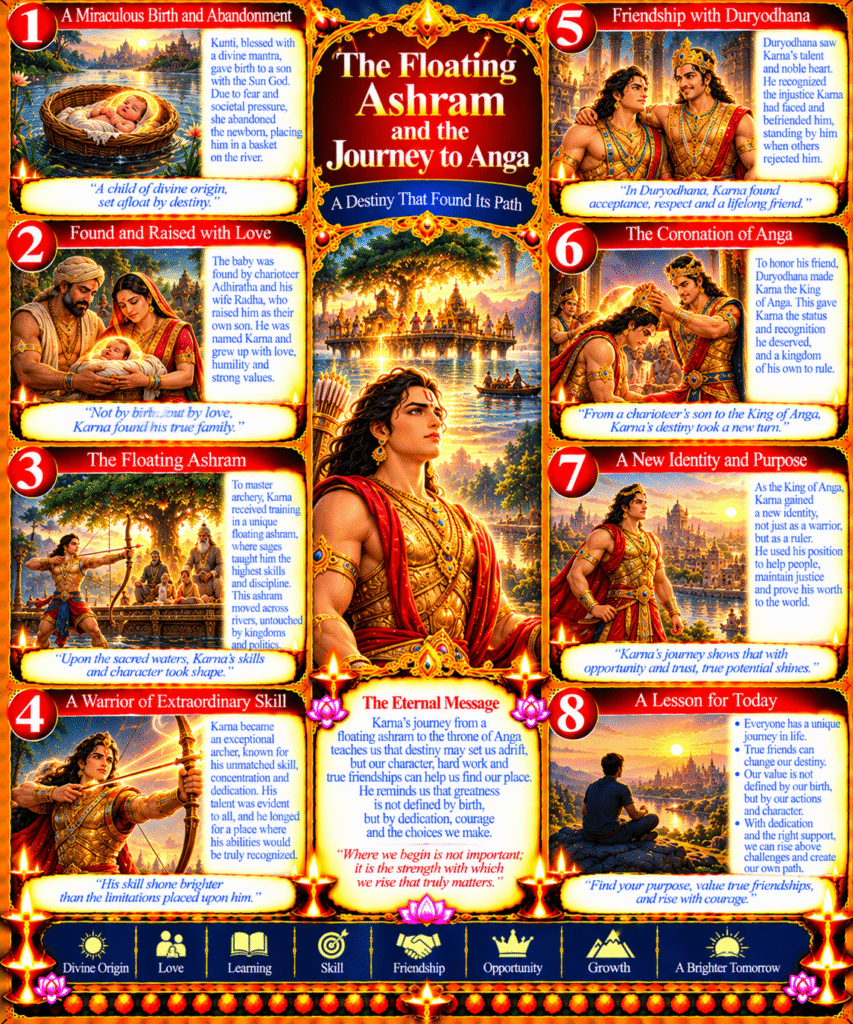
The artisans of Anga decorated the river vessel with blooming flowers, fruit trees, and fragrant bowers. When Vibhandaka left the hermitage to gather roots in the deep forest, the courtesans sailed near Rishyasringa’s dwelling.
Rishyasringa greeted the visitors with classical Vedic courtesy. Because he had never seen women, he innocently believed they were radiant young hermits from a distant sanctuary. The visitors offered him delicious honey cakes and spiced fruits, which delighted the youth. Their kind words and joyful songs sparked deep curiosity in his heart.
When Vibhandaka returned that evening, he noticed his son’s distracted gaze and neglected rituals. Although the father warned him against forest demons, Rishyasringa’s mind remained fascinated by the visitors. The next morning, Rishyasringa stepped onto the floating barge to visit their hermitage. The crew cast off the ropes immediately, steering the vessel toward Anga.
The Miracle of Rain and Marriage to Princess Shanta
As soon as Sage Rishyasringa stepped onto the dry soil of Anga, thunder roared across the skies. Dark monsoon clouds covered the plains, and torrential rain swept across the kingdom. Rivers filled, lakes overflowed, and the long famine ended instantly.
King Romapada bowed before the young sage with immense gratitude. To honor the rishi and welcome him into the royal family, the king offered him the hand of Princess Shanta in marriage. Princess Shanta was the biological daughter of King Dasharatha and Queen Kausalya of Ayodhya. Because Romapada had no children of his own, Dasharatha had given Shanta to him in loving adoption.
When Vibhandaka arrived in the city full of wrath, he saw his son happily married to a virtuous princess and celebrated as a savior. Satisfied by the king’s humility and his son’s dignity, Vibhandaka blessed the couple and returned to his forest hermitage in peace.
The Sacred Putrakameshti Yajna of Ayodhya
Across the plains in Ayodhya, King Dasharatha carried a heavy sorrow. Despite his vast empire and righteous rule, he had no sons to continue the royal lineage. This dynastic concern cast a shadow over the court, much like the grief described in the story of Lord Rama’s exile and Dasharatha’s grief.
The royal preceptor Sage Vasishtha advised the king to invite Sage Rishyasringa to preside over the sacred Putrakameshti Yajna. Although Vasishtha was a master of Vedic knowledge, ancient rules required a chief priest of complete ascetic detachment. Dasharatha traveled to Anga and warmly invited his daughter Shanta and son-in-law Rishyasringa to Ayodhya.
On the northern banks of the sacred Sarayu river, Rishyasringa performed the grand sacrifice with strict Vedic discipline. As he offered the final oblations into the blazing altar, a radiant divine messenger (Prajapatya Purusha) arose from the fire. The being held a golden vessel filled with divine payasam, a celestial nectar prepared by the gods.
The Birth of the Four Princes and Enduring Legacy
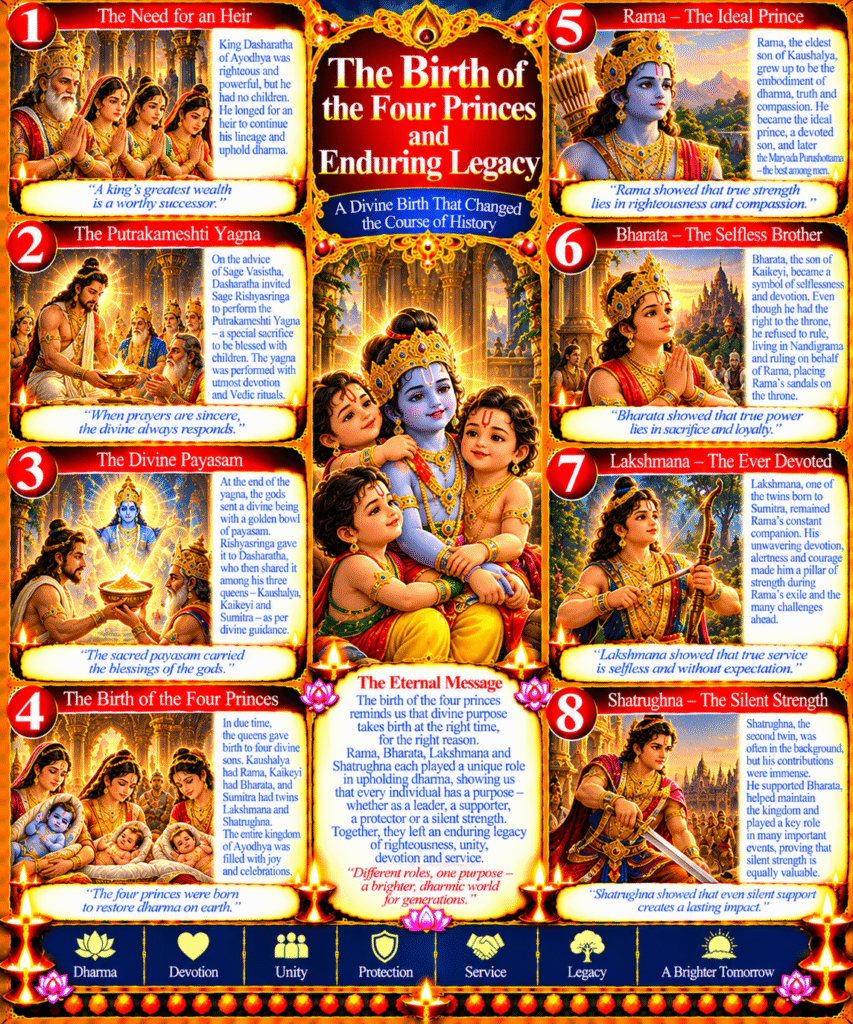
King Dasharatha received the golden vessel with reverent joy. He distributed the sacred payasam among his three queens. Queen Kausalya received half and gave birth to Lord Rama. Queen Kaikeyi received one-eighth and gave birth to Bharata. Queen Sumitra received two separate portions and gave birth to the devoted twins: Lakshmana from the Ramayana and Shatrughna.
Through Rishyasringa’s sacred yajna, the divine incarnations arrived to establish the golden standard of Rama Rajya and ethical governance. While martial legends like Indrajit vs Lakshmana in the Ramayana highlight battlefield heroics, Rishyasringa provided the peaceful foundation that made the entire epic possible.
After completing the ritual, Rishyasringa refused royal wealth and retired with Princess Shanta to the serene forests of the Western Ghats. Tradition identifies his final sanctuary with modern Sringeri in Karnataka, near the ancient Kigga temple. To this day, devotees visit the shrine to pray for rain, keeping the legacy of the gentle horned sage alive.
Frequently Asked Questions About Sage Rishyasringa
1. Who was Sage Rishyasringa in Indian mythology?
Sage Rishyasringa was a deer-horned hermit whose pure austerities ended Anga’s drought and enabled the divine birth of Lord Rama.
2. Why was Sage Rishyasringa born with a deer’s horn on his head?
His mother was a celestial nymph cursed to live as a doe, causing Rishyasringa to inherit a deer’s horn upon his forehead.
3. Who were the parents of Sage Rishyasringa?
His father was the renowned ascetic Vibhandaka Muni, and his mother was a celestial nymph liberated from a doe’s curse at his birth.
4. Why did Vibhandaka raise Rishyasringa in total forest isolation?
Vibhandaka raised him in complete isolation to shield his pure mind from mundane societal desires, moral corruption, and worldly sorrow.
5. How did King Romapada of Anga learn about Rishyasringa?
Court astrologers revealed an ancient prophecy that only the arrival of the pure-hearted hermit Rishyasringa could end Anga’s severe drought.
6. Why was Anga suffering from a catastrophic twelve-year drought?
King Romapada had accidentally offended a holy Brahmin, causing Lord Indra to withhold rainfall until a soul of spotless purity purified the kingdom.
7. How did the courtesans of Anga bring Rishyasringa to the capital?
They arrived on a camouflaged floating barge disguised as an ashram and charmed the innocent hermit with sweet delicacies and melodious songs.
8. What was Rishyasringa’s reaction when he first saw women?
Because he had never seen a woman, Rishyasringa innocently believed the courtesans were radiant, sweet-voiced young hermits from another ashram.
9. Why did torrential rain fall when Rishyasringa stepped into Anga?
In Vedic tradition, cosmic forces naturally align with absolute spiritual purity, prompting Lord Indra to release heavy rains upon his arrival.
10. Who was Princess Shanta and how was she related to Lord Rama?
Princess Shanta was the biological daughter of King Dasharatha and Queen Kausalya, making her the elder sister of Lord Rama.
11. Why did King Dasharatha give his daughter Shanta in adoption to Romapada?
King Dasharatha gave Shanta in adoption to his close friend King Romapada to relieve his sorrow over remaining childless.
12. Why did Sage Rishyasringa marry Princess Shanta?
King Romapada offered his adopted daughter Shanta in marriage as an expression of eternal gratitude for saving Anga from famine.
13. Why couldn’t Sage Vasishtha alone conduct the Putrakameshti Yajna?
Prophecy required an officiant completely detached from dynastic politics and worldly ambition, a rare quality found only in Rishyasringa.
14. What was the Putrakameshti Yajna performed by King Dasharatha?
It was a sacred Vedic sacrificial ritual performed on the banks of the Sarayu river to obtain noble, righteous sons.
15. What divine being emerged from the sacrificial fire of the Yajna?
A glowing celestial being named Prajapatya Purusha emerged from the sacrificial flames holding a golden bowl of divine payasam.
16. How did King Dasharatha divide the divine payasam among his queens?
Dasharatha gave half to Kausalya, one-fourth to Sumitra, one-eighth to Kaikeyi, and the remaining portion to Sumitra again.
17. Which divine princes were born from the sacred Putrakameshti Yajna?
The sacred yajna blessed Ayodhya with Lord Rama, Bharata, and the twin princes Lakshmana and Shatrughna.
18. Where did Sage Rishyasringa and Princess Shanta live after the Yajna?
They returned to Anga and later retired to a forest hermitage near modern Sringeri in Karnataka for silent meditation.
19. Is Sage Rishyasringa mentioned in the Mahabharata?
Yes, Sage Lomasha narrates Rishyasringa’s full life story to Yudhishthira in the Tirtha-yatra Parva of the Mahabharata.
20. What is the core spiritual lesson of Sage Rishyasringa’s life?
His life demonstrates that inner spiritual purity must ultimately serve the welfare of humanity and the fulfillment of cosmic Dharma.