Raja Ratnam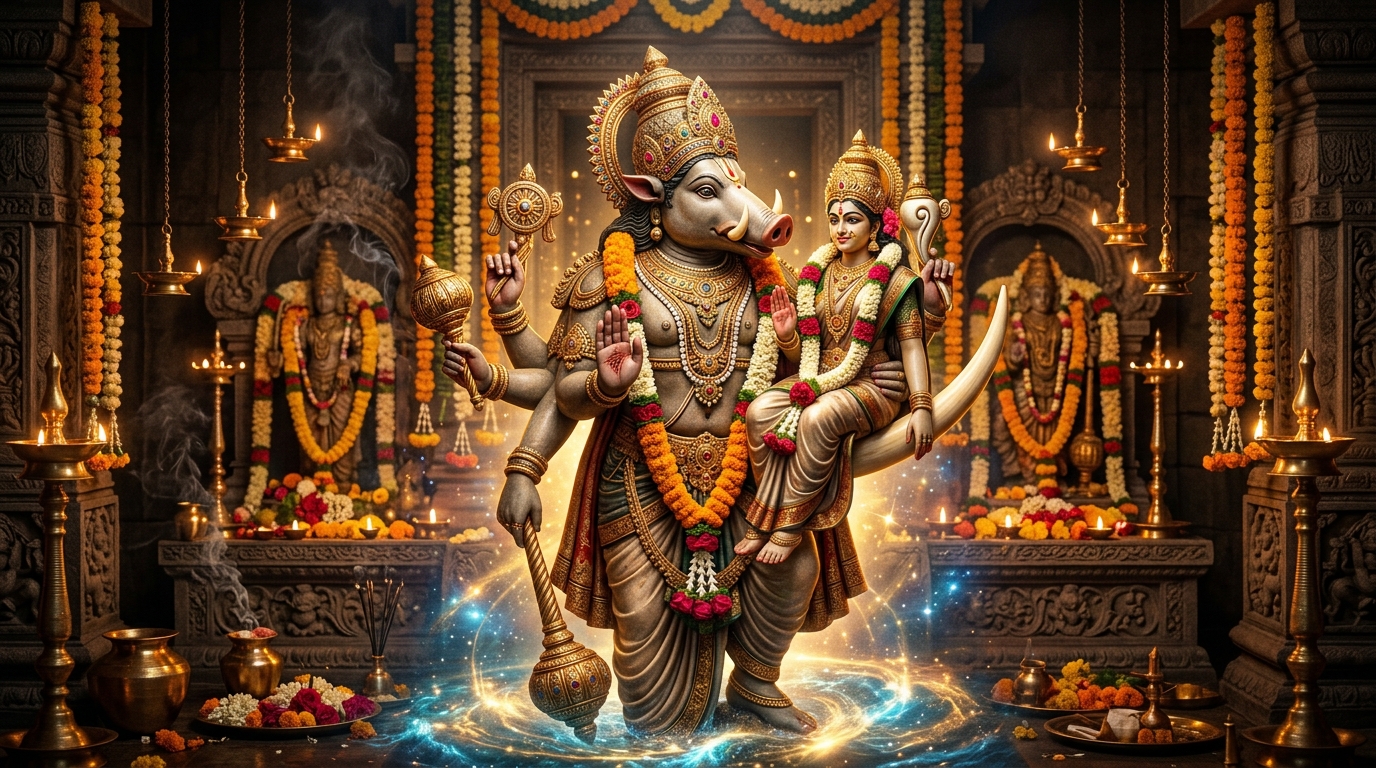
When the demon Hiranyaksha dragged the earth into the murky depths of the cosmic ocean, the universe trembled in darkness. In that critical hour, Lord Vishnu assumed the form of Lord Varaha – a colossal, radiant boar possessing unbreakable strength. Plunging fearlessly into the dark abyss, He defeated the demon and gently lifted Mother Earth (Bhudevi) upon His gleaming white tusks, restoring balance and life to creation. Celebrated as Varaha Jayanti, this sacred day reminds us that no matter how deep the darkness appears, divine protection always rises to safeguard the earth.
Observed on the third day (Tritiya) of the waxing moon phase (Shukla Paksha) in the Hindu lunar month of Bhadrapada, Varaha Jayanti celebrates the victory of righteousness (Dharma) over cosmic chaos, environmental restoration, and divine protection. Worshipping Lord Varaha on this auspicious day brings immense courage, spiritual purity, freedom from obstacles, and lasting prosperity.
In this comprehensive guide, explore the detailed mythological story of Lord Varaha, the profound spiritual symbolism of His incarnation, step-by-step Puja Vidhi rituals, powerful Varaha mantras, and frequently asked questions.
The Divine Story of Varaha Avatar Celebrated on Varaha Jayanti

The legend of Varaha Avatar is narrated in several ancient texts, including the Vishnu Purana, Bhagavata Purana, and Matsya Purana. The story highlights how unchecked ego and tyranny threaten cosmic balance, requiring divine intervention to preserve existence.
The Tyranny of the Demon Hiranyaksha
The cosmic story begins with the twin demons Hiranyaksha and Hiranyakashipu, born to Sage Kashyapa and Diti. Hiranyaksha performed severe austerities to appease Lord Brahma and obtained a boon of invincibility, granting him protection from gods, devas, humans, and wild beasts. However, in his arrogance, Hiranyaksha neglected to list the wild boar among the creatures from which he sought protection.
Consumed by pride and greed for power, Hiranyaksha terrorized the three worlds. He dragged Mother Earth (Bhudevi) into the deep primordial cosmic ocean (Garbhodaka Ocean), causing planetary instability and placing all life on the verge of destruction. Desperate for help, the Devas and Sage Manu prayed intensely to Lord Brahma and Lord Vishnu for cosmic protection.
The Emerging of Lord Varaha from Lord Brahma’s Nostril
As Lord Brahma meditated on a solution, a tiny creature no larger than a thumb emerged from Lord Brahma’s right nostril. Within moments, the tiny form expanded rapidly, growing into a colossal, radiant cosmic boar whose roar shook the heavens and filled the universe with divine vibrations.
Realizing that this was none other than Supreme Lord Vishnu taking the form of Varaha Avatar, the Devas, Rishis, and Gandharvas sang hymns of praise. Lord Varaha possessed glowing red eyes, sharp tusks as bright as lightning, and a majestic body representing the sacred Vedic Yajnas (sacrifices).
The Battle with Hiranyaksha and the Rescue of Bhudevi
Lord Varaha dove into the deep, turbulent cosmic ocean to search for Bhudevi. Using His acute sense of smell and divine perception, He located Mother Earth resting on the ocean bed. Placing Bhudevi gently upon His sharp ivory tusks, Lord Varaha began ascending toward the cosmic surface.
Enraged by the rescue, Hiranyaksha intercepted Lord Varaha in the ocean depths, challenging Him to a duel and hurling insults at the Supreme Lord. A monumental cosmic battle ensued, lasting for thousands of divine years. Armed with His divine mace (Gada) and Sudarshana Chakra, Lord Varaha struck down Hiranyaksha, liberating the universe from his tyranny.
Lord Varaha then placed Mother Earth safely in her proper cosmic orbit, stabilizing her continents and oceans. Touched by Lord Varaha’s divine grace, Goddess Bhudevi married Lord Vishnu in Her manifestation as Varahi / Bhu Devi, symbolizing the eternal bond between God and Mother Earth.
For official cultural and historical archives, visit the Incredible India Official Tourism Authority.
Spiritual Significance and Cosmic Symbolism of Varaha Jayanti
The Varaha Avatar carries deep philosophical, ecological, and spiritual teachings for humanity:
- Protection of Mother Earth (Environmental Harmony): Lord Varaha’s rescue of Bhudevi represents humanity’s sacred duty to protect, respect, and preserve the environment from greed and destruction.
- Triumph over Greed and Ego: Hiranyaksha symbolizes extreme possessiveness, materialism, and arrogance. Lord Varaha vanquishing Hiranyaksha signifies the destruction of toxic ego through divine grace.
- Yajna Varaha (The Vedic Symbol): Scriptures describe Varaha as Yajna Varaha – His four legs represent the four Vedas, His tusks represent the sacred sacrificial posts (Yupa), His tongue represents the sacred altar fire, and His body embodies Vedic rituals.
- Rescuing Souls from Darkness: Just as Varaha lifted Earth out of murky ocean depths, He lifts human souls out of the dark ocean of ignorance, Maya, and worldly suffering (Samsara).
Step-by-Step Varaha Jayanti Puja Vidhi and Rituals
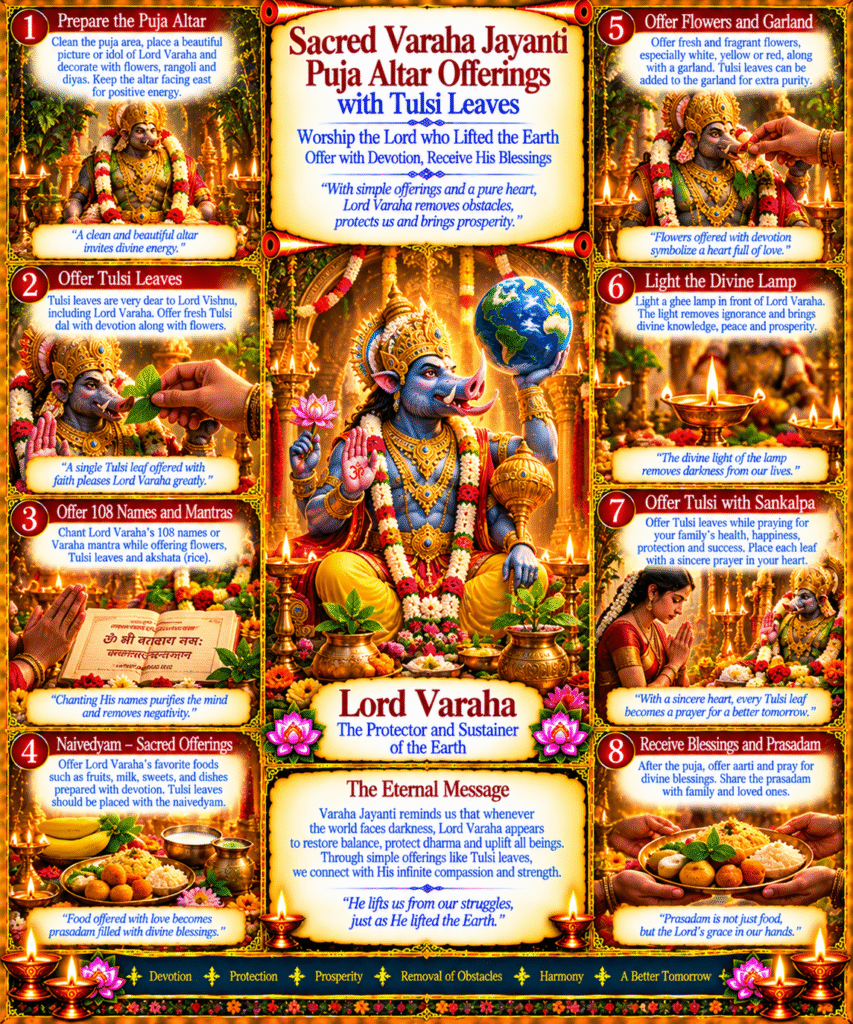
Performing Varaha Jayanti Puja with devotion brings divine blessings, house protection, land prosperity, and freedom from negative energies.
1. Morning Preparation and Fasting (Vrata)
- Holy Bath: Wake up during Brahma Muhurta and take a bath, ideally adding a pinch of sesame seeds or Ganga jal to the water.
- Sankalpa: Take a formal vow (Sankalpa) to observe Varaha Jayanti Vrata with pure heart and devotion.
- Altar Setup: Clean the Puja room. Place a wooden platform (Chowki) covered with a yellow cloth. Install an image or idol of Lord Vishnu / Lord Varaha along with Goddess Lakshmi / Bhudevi.
2. The Sacred Worship Procedure
- Lighting the Lamp: Light a brass Ghee lamp (Diya) and burn fragrant Dhoop incense.
- Panchamrut Abhishekam: Symbolically wash the idol with milk, curd, honey, ghee, sugar, and holy Ganga water.
- Offerings:
- Chandan & Kumkum: Apply yellow sandalwood paste and Kumkum to the deity.
- Flowers & Tulsi: Offer fresh yellow marigold flowers, lotus, and sacred Tulsi leaves (essential for Lord Vishnu worship).
- Akshata: Offer unbroken yellow-tinted rice grains.
- Naivedya (Food Offering): Offer sweet kheer, panakam, fruits, coconuts, and butter to Lord Varaha.
- Chanting Mantras: Recite the Varaha Kavacham, Vishnu Sahasranama, or Varaha Gayatri Mantra 108 times.
- Aarti: Perform Aarti with camphor (Karpura Aarti) while singing Vishnu Aarti.
- Charity (Dana): Donate food, yellow clothes, sesame seeds, and grains to the needy or Brahmins.
Powerful Varaha Mantras for Varaha Jayanti Worship
Chanting Varaha mantras on Varaha Jayanti removes property disputes, fear of enemies, bodily ailments, and negative planetary influences (especially Rahu-Ketu afflictions).
1. Varaha Moola Mantra
ॐ नमः श्रीवराहाय धरण्युद्धरणाय स्वाहा॥
(Om Namah Shri Varahaya Dharanyuddharanaya Swaha)
>
Meaning: Salutations to Lord Varaha who raised Mother Earth from the cosmic depths.
2. Varaha Gayatri Mantra
ॐ धनुर्धराय विद्महे माद्रीगात्राय धीमहि तन्नो वराहः प्रचोदयत्॥
(Om Dhanurdharaya Vidmahe Madrigatraya Dhimahi Tanno Varahah Prachodayat)
3. Simple Chanting Mantra
ॐ वराहाय नमः॥ (Om Varahaya Namaha)
Famous Varaha Temples in India to Visit on Varaha Jayanti
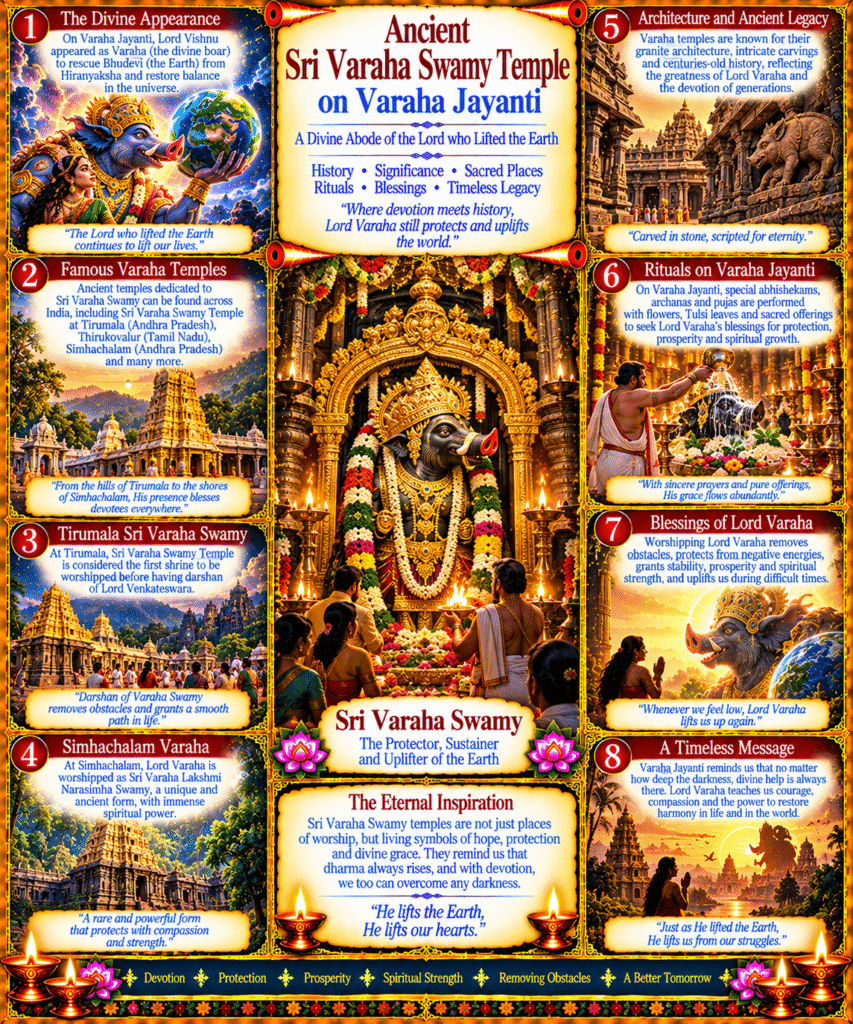
Devotees visit sacred temples dedicated to Lord Varaha on Varaha Jayanti:
- Sri Varahaswamy Temple, Tirumala (Andhra Pradesh): Located on the banks of Swami Pushkarini in Tirumala. According to tradition, pilgrims must worship Bhu Varahaswamy before visiting Lord Venkateswara.
- Bhu Varaha Swamy Temple, Srimushnam (Tamil Nadu): One of the eight Swayambhu (self-manifested) Vishnu Kshetras.
- Varaha Temple, Pushkar (Rajasthan): An ancient temple built in the 12th century dedicated to Varaha Avatar.
- Varaha Cave Temple, Mahabalipuram (Tamil Nadu): A UNESCO World Heritage rock-cut cave featuring magnificent carvings of Varaha lifting Bhudevi.
Related Sacred Topics & Cultural Heritage: For further spiritual exploration, read about Lord Rama’s ideal life story. For further spiritual exploration, read about the 14-year exile of Lord Rama. For further spiritual exploration, read about Ravana’s story in the Ramayana.
Frequently Asked Questions (FAQs) About Varaha Jayanti 2026 (20 Questions & Answers)
1. When is Varaha Jayanti in 2026?
Varaha Jayanti 2026 will be celebrated on Monday, September 14, 2026 (Bhadrapada Shukla Tritiya Tithi).
2. Who is Lord Varaha in Vedic scriptures?
Lord Varaha is the third incarnation (Avatar) of Lord Vishnu in the Dashavatara series, assuming the divine boar form to rescue Mother Earth (Bhudevi) from the cosmic ocean.
3. What is the story behind the Varaha Avatar of Lord Vishnu?
When demon king Hiranyaksha dragged Earth to the bottom of the cosmic ocean (Garbhodaka Ocean), Lord Vishnu manifested as Lord Varaha from Brahma’s nostril, lifted Earth on his tusks, and restored her to her celestial orbit.
4. Who was Hiranyaksha, and why did he submerge the Earth into the cosmic ocean?
Hiranyaksha was a powerful Asura king, twin brother of Hiranyakashipu, who obtained invincibility boons and submerged Earth to challenge divine authority and disrupt Vedic sacrifices.
5. How did Lord Varaha rescue Goddess Bhudevi (Earth) from the cosmic waters?
Lord Varaha dove into the deep cosmic ocean, lifted Mother Earth gently upon his powerful white tusks, and raised her above the waters while defeating Hiranyaksha in battle.
6. What is the spiritual significance of Lord Varaha’s boar form?
The boar form symbolizes Yajna-Varaha – the personification of Vedic ritual sacrifice. His tusks represent sacred altars, his eyes represent day and night, and his breath represents Vedic mantras.
7. How did Lord Varaha defeat the demon king Hiranyaksha in battle?
Lord Varaha fought Hiranyaksha in a fierce mace dual underwater and in the sky, eventually striking the demon behind the ear with his divine mace (Gada) to liberate the worlds.
8. Why is Varaha Jayanti celebrated on Bhadrapada Shukla Tritiya?
Bhadrapada Shukla Tritiya marks the sacred tithi when Lord Varaha manifested to save Goddess Bhudevi and restore cosmic harmony.
9. How should one observe Varaha Jayanti Vrat (fasting)?
Devotees observe a day-long fast, wake up during Brahma Muhurat, perform ritual bath, worship Lord Varaha with tulsi leaves, and break the fast after evening prayers.
10. What is the step-by-step Varaha Jayanti Puja Vidhi at home?
Install Lord Varaha idol/photo, offer Panchamrit bath, yellow flowers, sandalwood paste, tulsi leaves, light lamps, recite Varaha Kavacham, and offer coconut and fruits as Naivedyam.
11. What powerful mantras should be chanted on Varaha Jayanti for land and wealth blessings?
Chant “Om Namo Bhagavate Varaharupaya Bhur-Bhuva-Svaha Pataye Bhupatitvam Me Dehi Dadapaya Swaha” and “Om Varahayai Namaha”.
12. Why is Lord Varaha worshiped for resolving property, land, and real estate obstacles?
Since Lord Varaha rescued Earth (Bhudevi), worshiping him removes Vaastu defects, land disputes, property litigation, and brings agricultural prosperity.
13. Who is Goddess Bhudevi, and what is her relationship with Lord Varaha?
Goddess Bhudevi is the divine consort of Lord Vishnu representing Earth Mother. She was rescued by Lord Varaha and gave birth to Narakasura (Bhuma).
14. What temple is famous for Lord Varaha worship in Tirumala (Sri Varahaswamy Temple)?
Sri Varahaswamy Temple situated on the banks of Swami Pushkarini in Tirumala is the ancient abode of Lord Varaha in South India.
15. Why is visiting Sri Varahaswamy Temple in Tirumala required before worshiping Lord Venkateswara?
According to legend, Lord Venkateswara borrowed land from Lord Varaha on Venkatadri hill. Devotees must pay respects to Varahaswamy first before seeking Darshan of Lord Venkateswara.
16. What offerings and naivedyam are prepared for Lord Varaha on Varaha Jayanti?
Offerings include sesame seeds (Til), jaggery sweets, coconut, yellow rice, tulsi leaves, and fresh fruits.
17. What boons are granted by worshiping Lord Varaha with devotion?
Devotees receive protection from fear, courage, land and home ownership, freedom from debt, and spiritual liberation.
18. What is the iconographic description of Lord Varaha holding Earth on his tusks?
Lord Varaha is depicted with a boar head and four-armed human body (Nri-Varaha), holding Shankha, Chakra, Gada, with Goddess Bhudevi seated gracefully on his left tusk.
19. Is Varaha Jayanti observed along with Gowri Habba or Hartalika Teej?
Yes, Bhadrapada Shukla Tritiya also coincides with Hartalika Teej and Gowri Habba in various regional calendars across India.
20. How does Ratnam Strategy cover the cosmic significance of Varaha Avatar?
Ratnam Strategy explores Varaha Avatar as an ancient allegory of environmental preservation, cosmic order, and divine protection of Mother Earth.
21. What is the cosmic message of Varaha Jayanti for humanity?
The cosmic message of Varaha Jayanti is that divine providence will always rescue Earth and humanity from the depths of ignorance, greed, and destruction whenever cosmic order (Dharma) is threatened.