Raja Ratnam
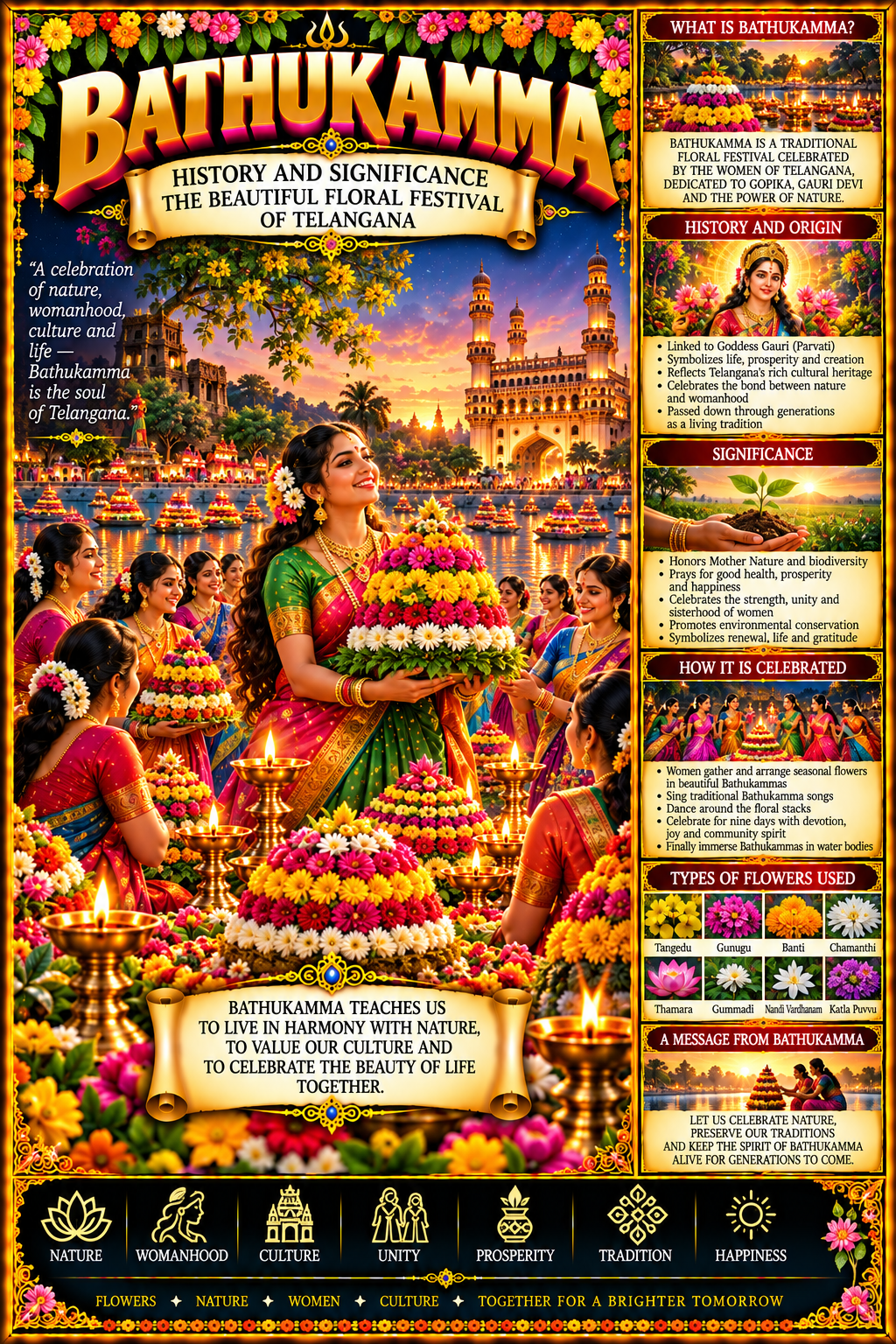
For centuries, before the arrival of the dry winter, the women of Telangana have gathered in village squares carrying stepped towers of wild flowers. Exploring Bathukamma History and Significance reveals a festival deeply rooted in medieval agrarian life, royal patronage under the Kakatiya dynasty, and heroic resistance during the anti-feudal struggles of the twentieth century. Recognized today as the official State Festival of Telangana, Bathukamma is far more than a seasonal ritual; it is a living historical archive of feminine resilience, community cooperation, and cultural identity.
Historical Origins: Agrarian Roots in the Medieval Deccan Plateau
Long before formal temple rituals dominated the cultural landscape of southern India, agrarian communities on the dry, granite-strewn Deccan plateau developed intimate spiritual traditions connected to the monsoon cycle. Historical research and regional folk archives indicate that Bathukamma originated as an agrarian nature thanksgiving observed at the close of the southwest monsoon (Varsha Ritu) and the onset of autumn (Sharad Ritu).
Unlike classical Vedic rites centered on stone or metal idols, the indigenous communities of the Godavari and Krishna river basins worshipped living vegetation. The seasonal timing coincided with the harvesting of maize and millets, as well as the replenishment of village irrigation tanks. For medieval agrarian families, celebrating wild flowers was a practical expression of gratitude to Mother Nature for rainfall, crop fertility, and the survival of livestock.
The Kakatiya Era: Royal Patronage of Queen Rudrama Devi and King Prataparudra
The definitive golden age of Bathukamma’s historical evolution occurred between the twelfth and fourteenth centuries under the illustrious Kakatiya dynasty of Warangal (Orugallu). Celebrated for their progressive governance, military architecture, and sophisticated agrarian engineering, the Kakatiya rulers elevated what was once a localized village custom into a kingdom-wide state celebration.
During the reign of Rani Rudrama Devi (1262-1289 CE), one of the few sovereign queens to rule in medieval India, the floral festival received unprecedented royal patronage. Epigraphical records and historical chronicles from the period describe grand assemblies at the Thousand Pillar Temple in Hanumakonda and the Ramappa Temple in Palampet, where noblewomen and peasant women gathered together without caste divisions to sing praises to the Mother Goddess.
The Kakatiyas were pioneering water managers who built an interconnected chain of thousands of irrigation tanks (known in Telugu as Cheruvulu), including the massive Ramappa, Pakhal, and Laknavaram lakes. The festival’s culminating ritual – immersing medicinal wildflowers into these community reservoirs – was systematically encouraged by Kakatiya administrators as a traditional ecological practice to purify lake waters after heavy monsoon siltation.
Cultural Resilience Through Centuries of Feudal Change
Following the decline of the Kakatiyas, the Deccan plateau experienced successive administrative transitions under the Bahmani Sultanate, the Qutb Shahi rulers of Golconda, and eventually the Asaf Jahi Nizams of Hyderabad. Throughout these political upheavals, Bathukamma remained a resilient domestic anchor for rural Telugu society.
Because the celebration was conducted entirely outdoors in public courtyards and led exclusively by women without needing temple priests, it could not be suppressed or dismantled by administrative decree. Mothers passed down the intricate floral stacking techniques and melodic folk ballads orally from generation to generation, ensuring that the cultural heritage of the Deccan remained vibrant and intact.
The 20th Century: Bathukamma as a Vehicle of Anti-Feudal Resistance (1946-1951)
During the historic Telangana Peasant Armed Struggle (1946-1951), when rural peasants rose against oppressive feudal landlords (Jagirdars and Deshmukhs) and the armed Razakars, Bathukamma took on a powerful socio-political dimension. Feudal overseers frequently attempted to restrict peasant gatherings, but they could not ban women from coming together for their sacred autumn floral prayers.
Courageous peasant women adapted traditional folk melodies, weaving covert messages of solidarity, resistance, and village news into the verses they clapped to in concentric circles. What appeared to colonial and feudal authorities as a simple harvest dance was, in truth, an unyielding underground network of community solidarity, demonstrating that cultural traditions can serve as instruments of social liberation.
The Modern Renaissance and Declaration as State Festival (2014)
In the twenty-first century, Bathukamma experienced a dramatic cultural rebirth as the defining emblem of the Telangana Statehood Movement. Demonstrators, artists, and cultural leaders organized colossal public floral celebrations across the region, using the festival to assert Telangana’s distinctive cultural identity on the national stage.
Following the formal formation of the state of Telangana in June 2014, the Government of Telangana officially declared Bathukamma as the Official State Festival (Rashtra Panduga). Today, celebrated by millions across urban cities, rural villages, and the international Telugu diaspora in North America, Europe, Australia, and the Middle East, Bathukamma stands as a globally recognized symbol of eco-feminism, botanical heritage, and cultural pride.
Explore the Complete Bathukamma Festival Series
To fully experience every facet of this nine-day floral festival, explore our specialized guides:
- Mythological Folklore & Stories: Discover the legendary origins of Princess Bathukamma, King Dharmangada, and Goddess Gauri in our guide to why Bathukamma is celebrated in Telangana.
- Botanical Science & Healing Flora: Learn about Gunugu, Tangedu, and ancient water-purification virtues in Bathukamma flowers and their sacred meaning.
- Folk Traditions, Songs & 9-Day Calendar: Read full song lyrics, clapping dance choreography, and daily rituals in Bathukamma traditions, songs, and celebrations explained.
- The Grand Finale & 5 Saddulu Recipes: Experience the ninth day, Shobha Yatra, and lake immersion in our guide to Saddula Bathukamma grand finale.
Frequently Asked Questions: Bathukamma History & Heritage
1. When was Bathukamma first documented in historical records?
Folkloric and oral historical evidence traces Bathukamma to early medieval agrarian rites in the Deccan, with prominent epigraphical and literary mentions emerging during the Kakatiya era between the 12th and 14th centuries CE.
2. What role did Queen Rudrama Devi play in Bathukamma history?
Queen Rudrama Devi provided official royal patronage to Bathukamma, transforming localized rural gatherings into celebrated state events across the Kakatiya capital of Warangal and encouraging the construction of community water tanks that supported the floral immersion rituals.
3. Why did medieval Deccan communities build flower towers instead of stone idols?
Agrarian communities worshipped nature as the immediate living giver of life. Using freshly bloomed wild flowers was accessible to every household regardless of wealth, honored the seasonal autumn biodiversity, and supported local water health.
4. What is the historical link between Kakatiya lake engineering and Bathukamma?
The Kakatiyas constructed an ingenious network of interconnected lakes (Cheruvulu) across Telangana. The annual immersion of thousands of medicinal wild flowers into these tanks acted as an eco-cleansing treatment, purifying water supplies after monsoon siltation.
5. How did peasant women use Bathukamma songs during the 1946-1951 Telangana Rebellion?
Peasant women used the communal evening dance circles as a secure, decentralized communication channel. By adapting traditional folk lyrics, they shared political updates, spread messages of solidarity, and encouraged resistance against feudal landlords and Razakars.
6. When was Bathukamma officially declared the State Festival of Telangana?
Following the creation of Telangana as a separate state, the state government formally recognized Bathukamma as the official State Festival (Rashtra Panduga) in 2014, sponsoring cultural exhibitions and statewide public celebrations.
7. How does Bathukamma differ historically from North Indian Sharad Navratri?
While North Indian Navratri centers on fasting, temple visits, and worshipping clay murtis of Goddess Durga, Bathukamma is completely outdoors, women-led, non-priestly, and centered on living conical floral towers and communal folk dancing.
8. What was the cultural role of Bathukamma during the Telangana Statehood agitation?
Bathukamma served as the premier cultural symbol of regional identity, uniting millions of people across caste and economic lines through public floral rallies that demonstrated Telangana’s unique heritage.
9. Which dynasties ruled Telangana during Bathukamma’s historical development?
The major historical periods shaping Bathukamma include the Satavahanas, Chalukyas, Kakatiyas, Bahmani and Qutb Shahi periods, and the Asaf Jahi era, with the Kakatiya period leaving the deepest cultural imprint.
10. How is Bathukamma history celebrated internationally today?
Telugu diaspora associations host annual Bathukamma gatherings in major global cities across the United States, United Kingdom, Canada, Australia, and Gulf nations, featuring traditional Pochampally attire, authentic folk singing, and floral displays.