Raja Ratnam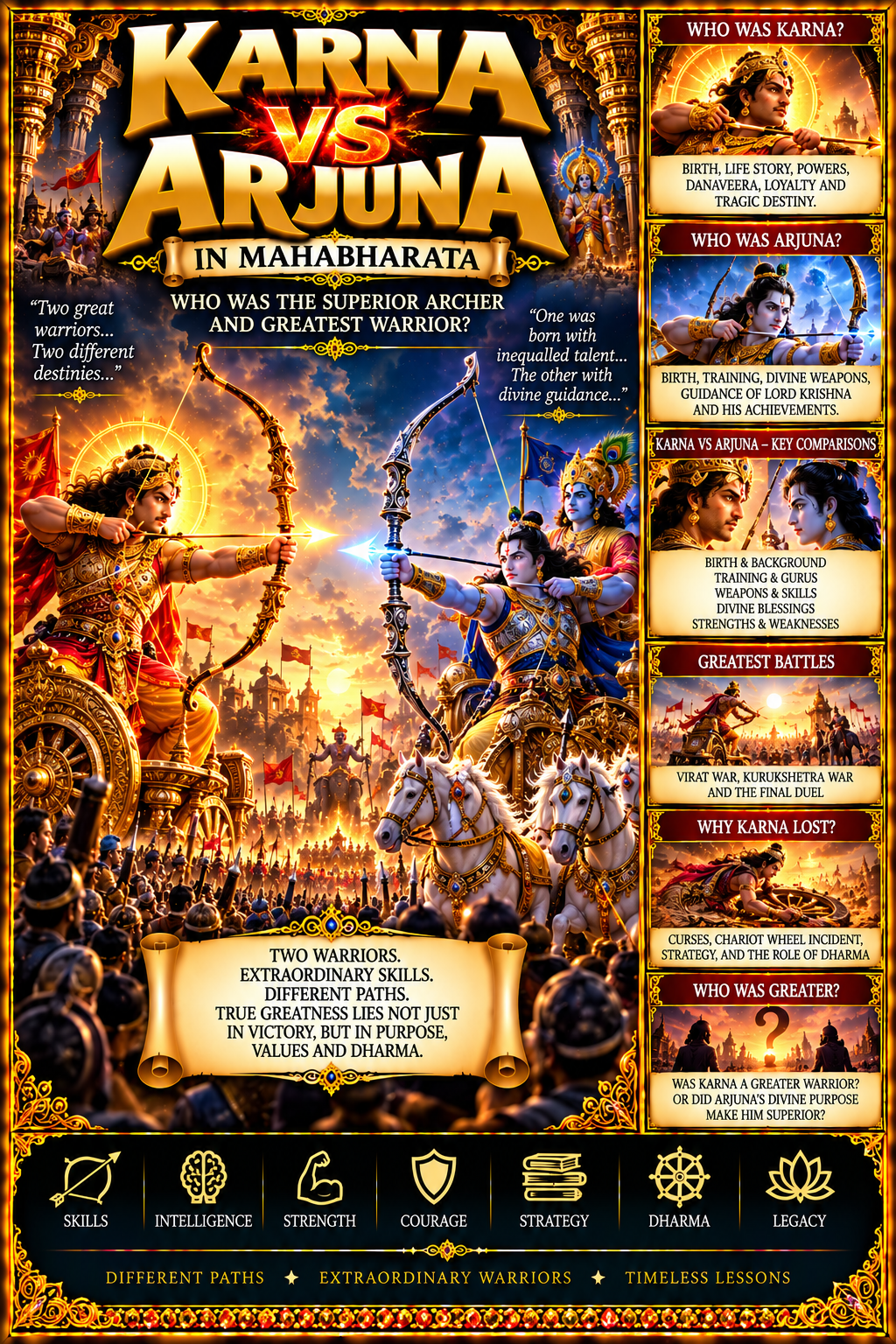
The rivalry between Karna and Arjuna in the epic Mahabharata stands as one of the most intense, passionate, and enduring debates in world literature. For thousands of years, scholars, devotees, and casual readers have passionately argued over a singular question: Who was truly the superior archer—Karna or Arjuna?
Both warriors possessed divine parentage, peerless martial training, celestial weapons (Divyastras), and unwavering courage on the battlefield of Kurukshetra. Karna, the son of the Sun God Surya, is revered as Daanveer—a tragic hero whose loyalty, generosity, and resilience matched his fearsome archery. On the other side stood Arjuna, the son of Indra, the favorite disciple of Dronacharya, and the supreme warrior of Dharma guided by none other than Lord Krishna.
To definitively understand the clash between Karna vs Arjuna, one must move past emotional retellings and analyze the authentic verses of the Vyasa Mahabharata. In this definitive guide, we compare their divine origins, gurus, celestial weapons, pre-war clashes, the climatic 17th day duel of Kurukshetra, a head-to-head comparison table, and 20 detailed frequently asked questions.
1. Divine Birth and Early Upbringing: Surya Putra vs. Indra Putra
To understand the fundamental nature of their rivalry, one must first look at the divine forces that shaped their birth and childhood.
Karna: The Secret Son of Surya and the Burden of Destiny
Karna was born to Princess Kunti through the solar boon granted by Sage Durvasa. Born out of wedlock, the infant Karna came into the world endowed with divine golden armor (Kavacha) fused to his skin and divine golden earrings (Kundala), rendering him virtually invincible from birth. Cast adrift in the river Ganga by a fearful young Kunti, he was discovered and lovingly raised by the royal charioteer Adhiratha and his wife Radha. Because of his upbringing in the Suta community, Karna faced continuous social humiliation, denied royal rights, and branded as a Sutaputra.
Arjuna: The Crown Prince and Destined Hero of Dharma
Arjuna was born as the third Pandava brother, fathered by Indra, the king of the devas, upon Kunti’s invocation. Welcomed with celestial showers of flowers and divine prophecies foretelling that he would equal Lord Shiva in battle, Arjuna was raised amidst royal luxury, undisputed princehood, and the highest standards of Kshatriya education in Hastinapur.
2. Mentorship and Martial Training: Parashurama vs. Dronacharya
The caliber of an ancient warrior was defined by his Guru. Both archers received instruction from the greatest masters of their era.
Arjuna’s Training Under Guru Dronacharya
Under Guru Dronacharya, Arjuna displayed unmatched single-minded focus. In the legendary bird’s eye test, while other princes saw the tree, branches, and sky, Arjuna saw only the eye of the bird. Arjuna practiced archery in total darkness to master blind target acquisition (Shabdavedhi). Pleased with his unyielding dedication, Dronacharya promised to make Arjuna the unrivaled archer of the mortal realm—a promise that famously influenced Drona’s controversial demand for Ekalavya’s thumb.
Karna’s Training Under Bhagavan Parashurama
Rejected by Dronacharya from learning the highest divine weapons due to his non-royal status, Karna sought out the legendary warrior-sage Bhagavan Parashurama. Knowing Parashurama only taught Brahmins, Karna disguised himself as a Brahmin student. Under Parashurama, Karna mastered warfare, archery, and the invocation of the supreme Brahmashira and Brahmanda weapons. However, when Parashurama discovered Karna’s true identity after Karna stoically endured a stinging insect biting through his thigh without waking his resting Guru, Parashurama cursed him: “You shall forget the incantation of the Brahmashira Astra at the exact moment of your greatest need in battle.”
3. Divine Bows and Celestial Arsenals: Vijaya vs. Gandiva
Both warriors wielded legendary celestial bows crafted by the gods themselves.
Arjuna’s Gandiva Bow
Crafted by Lord Brahma and gifted to Arjuna by Agni (the Fire God) during the burning of the Khandava forest, the Gandiva was indestructible. Accompanied by two inexhaustible quivers (Akshaya Tunira), the bow produced thunderous reverberations that panicked enemy ranks across miles.
Karna’s Vijaya Bow
The Vijaya Dhanush was originally crafted by Vishwakarma for Lord Shiva to destroy the demon cities of Tripura. Passed down to Parashurama and gifted to Karna, the Vijaya bow’s string could never be cut, and it amplified the kinetic energy of every released arrow, creating a divine protective perimeter around its wielder.
4. Head-to-Head Comparison Table: Karna vs. Arjuna
| Attribute | Karna (Surya Putra) | Arjuna (Indra Putra) |
|---|---|---|
| Father | Surya Deva (Sun God) | Indra Deva (King of Gods) |
| Primary Mentor | Bhagavan Parashurama | Guru Dronacharya, Lord Shiva, Indra |
| Celestial Bow | Vijaya Dhanush | Gandiva Bow |
| Charioteer | King Shalya (reluctant & demoralizing) | Lord Sri Krishna (Supreme Guide & Divine Charioteer) |
| Signature Weapons | Vasavi Shakti, Brahmashira, Bhargavastra | Pashupatastra, Brahmashira, Vaishnavastra, Raudrastra |
| Inherent Armor | Kavacha & Kundala (Donated to Indra) | Blessed by divine boons and cosmic protection |
| Major Vulnerabilities | 3 Severe Curses (Parashurama, Brahmin, Bhoomi Devi) | Emotional hesitation (resolved by the Bhagavad Gita) |
| Battlefield Success | Slain by Arjuna on Day 17 of Kurukshetra | Survived the war; led the Pandavas to total victory |
5. Clashes Before Kurukshetra: The Historical Record
While the Kurukshetra duel was their final confrontation, the two archers clashed multiple times before the great war:
1. The Rangabhoomi Exhibition
At the graduation arena in Hastinapur, Arjuna demonstrated dazzling archery. Karna strode into the arena and duplicated every single feat of Arjuna with effortless grace, proving his technical equality to the royal prince.
2. The Draupadi Swayamvara
When the disguised Pandavas won Draupadi’s hand, furious kings attacked them. Karna engaged the disguised Arjuna in a fierce duel. Astonished by the Brahmin’s archery, Karna asked, “Are you the God of Archery, or are you Parashurama, or are you Arjuna?” Karna eventually withdrew, marveling at his opponent’s prowess.
3. The Battle of Virata (Gograhana)
The clearest demonstration of Arjuna’s solitary martial supremacy occurred during the Virata War. Facing the entire Kaurava high command alone—including Bhishma, Drona, Kripa, Ashwatthama, Duryodhana, and Karna—Arjuna defeated each warrior systematically. Arjuna struck Karna repeatedly, piercing his armor and forcing Karna to flee the battlefield twice before putting the entire Kaurava army to sleep with the Sammohanastra.
6. The Climactic Duel on Day 17 of Kurukshetra
On the 17th day of the Kurukshetra War, Karna was appointed Supreme Commander of the Kaurava army. Wielding the Vijaya bow, Karna fought with unmatched ferocity, unleashing the unstoppable Bhargavastra which devastated Pandava battalions.
When Karna and Arjuna faced each other in their final duel, arrows darkened the sky. Karna aimed the lethal snake arrow (Nagastra) directly at Arjuna’s neck. In an act of divine intervention, Lord Krishna pressed his foot down on the chariot, sinking the vehicle four inches into the mud so that the arrow struck only Arjuna’s golden diadem instead of his throat.
Soon after, the cosmic curses took effect:
- The Earth Cursed Him: The left wheel of Karna’s heavy war chariot sank into the blood-soaked earth.
- The Guru’s Curse Triggered: Under severe stress, Karna forgot the mantras to summon the Brahmashira Astra.
- The Charioteer Abandoned Him: King Shalya refused to assist him in lifting the wheel.
As Karna dismounted and desperately pleaded for adherence to the Kshatriya code of Dharma while he lifted his wheel, Lord Krishna reminded him of his past unrighteous deeds: the humiliation of Draupadi in the dice hall, the treacherous murder of young Abhimanyu, and the poisoning of Bhima. Prompted by Krishna, Arjuna released the divine crescent-shaped Anjalika Astra, beheading Karna and concluding the greatest personal rivalry in ancient history.
7. The Deciding Factor: Talent Without Dharma vs. Skill Guided by God
When evaluated purely by physical strength and raw archery skill, Karna was in every way Arjuna’s equal, and in certain respects (such as raw physical endurance and weapon amplification through the Vijaya bow), he even held distinct advantages.
Why then did Arjuna emerge victorious?
The epic Mahabharata delivers a profound philosophical verdict: Skill and valor separated from Dharma will always collapse under the weight of destiny. Karna chose to ally with Duryodhana’s injustice, lending his immense power to unrighteousness (Adharma). Arjuna, though burdened by doubt, surrendered his ego to Lord Krishna and fought as an instrument of divine justice. As Sanjaya concludes in the final verse of the Bhagavad Gita:
“Yatra yogeshvarah krishno yatra partho dhanur-dharah |
Tatra shrir vijayo bhutir dhruva nitir matir mama ||”
(Wherever there is Krishna, the Lord of Yoga, and wherever there is Arjuna, the supreme archer, there will certainly be wealth, victory, extraordinary power, and morality.)
Related Sacred Character Guides & Epics
To explore deeper into the heroes and battles of the Mahabharata, read our dedicated guides:
- Arjuna in Mahabharata: The Greatest Archer & Hero of Dharma
- Karna in Mahabharata: Full Story, Powers, Curse & Death
- Krishna in Mahabharata: The Divine Role of the Supreme Guide
- Dronacharya in the Mahabharata: Life Story, Teachings and Legacy
- Ekalavya in the Mahabharata: The Ultimate Student Devotion
- Bhishma in the Mahabharata: The Immortal Pillar of Dharma
Frequently Asked Questions (FAQs) About Karna vs Arjuna (20 Questions & Answers)
1. Who was the superior archer between Karna and Arjuna?
While Karna possessed equal or superior raw strength and mastered the Vijaya bow, Arjuna proved superior in consistency, tactical versatility, mental composure, and adherence to Dharma under the guidance of Lord Krishna.
2. Who were the biological fathers of Karna and Arjuna?
Karna was the son of Surya Deva (the Sun God), while Arjuna was the son of Indra Deva (the King of the Gods). Both were born to the same mother, Queen Kunti.
3. Did Karna ever defeat Arjuna in direct combat?
Karna pushed Arjuna to his limits during their 17th day duel and struck Arjuna’s chariot, but Karna never decisively defeated Arjuna in any historical battle documented in the Vyasa Mahabharata.
4. What happened between Karna and Arjuna in the Virata War?
During the Virata battle, Arjuna fought the entire Kaurava army single-handedly and defeated Karna twice in one-on-one combat, forcing Karna to retreat from the battlefield.
5. Why did Parashurama curse Karna?
Parashurama cursed Karna because Karna disguised himself as a Brahmin to learn archery. When a blood-sucking insect bit Karna’s thigh and Karna endured the pain without flinching, Parashurama knew Karna was a Kshatriya and cursed him to forget his divine weapon invocations when he needed them most.
6. What was the name of Karna’s bow, and how powerful was it?
Karna wielded the Vijaya bow, originally crafted by Vishwakarma for Lord Shiva. The bow amplified the power of every arrow and could not be broken by any mortal weapon.
7. What was the name of Arjuna’s bow?
Arjuna wielded the Gandiva bow, gifted to him by Agni Deva, accompanied by two quivers that never ran out of arrows.
8. Why did Lord Krishna step down on Arjuna’s chariot during the duel?
When Karna fired the deadly Nagastra aimed at Arjuna’s neck, Krishna pressed his foot into the chariot platform, sinking the wheels into the ground so that the weapon only blew off Arjuna’s crown instead of severing his head.
9. Did Arjuna have celestial weapons that Karna did not possess?
Yes. Arjuna possessed the Pashupatastra (personally granted by Lord Shiva), the Raudrastra, the Sammohanastra, and weapons of the Dikpalas (guardians of the directions) that Karna did not have.
10. Why did Indra take Karna’s armor (Kavacha) and earrings (Kundala)?
Indra disguised himself as a Brahmin beggar to ask for Karna’s divine Kavacha and Kundala to protect Arjuna, knowing Karna’s vow of never turning away a Brahmin seeking charity.
11. What weapon did Indra give Karna in exchange for his armor?
Impressed by Karna’s generosity, Indra gifted him the Vasavi Shakti, a divine dart capable of killing any enemy once, which Karna was later forced to use against Ghatotkacha.
12. Why did Karna use the Vasavi Shakti against Ghatotkacha instead of Arjuna?
Ghatotkacha unleashed catastrophic nocturnal sorcery on the 14th night, threatening to wipe out the entire Kaurava army. The desperate soldiers forced Karna to fire the one-time Vasavi Shakti to save their lives, neutralizing the threat to Arjuna.
13. Was it unfair of Arjuna to shoot Karna while he was lifting his chariot wheel?
While shooting an unarmed warrior violated the basic Kshatriya code, Krishna justified it by reminding Karna that he had abandoned all codes of Dharma when he mocked Draupadi and participated in the slaughter of an unarmed Abhimanyu.
14. What were the three major curses that doomed Karna on the 17th day?
1. Parashurama’s curse causing him to forget the Brahmashira invocation; 2. A Brahmin’s curse that his chariot wheel would sink into the earth; 3. Bhoomi Devi’s curse to swallow his chariot wheel in battle.
15. Why was Shalya a disadvantage to Karna as a charioteer?
King Shalya agreed to be Karna’s charioteer only after secretly promising Yudhishthira that he would demoralize Karna throughout the battle by constantly praising Arjuna and criticizing Karna’s abilities.
16. What was Arjuna’s reaction upon learning that Karna was his elder brother?
When Kunti revealed the truth after the war during the tarpana rituals, Arjuna and the Pandavas were shattered by grief and wept bitterly, feeling that their entire victory was tainted with fraternal blood.
17. Could Karna have won if he kept his Kavacha and Kundala?
With his divine armor intact, Karna could not be killed by physical weapons, but Krishna and the gods would have found an alternative spiritual means to defeat him because Adharma cannot prevail over cosmic law.
18. Who was more generous between Karna and Arjuna?
Karna is universally celebrated as Daanveer (the hero of charity) because he gave away his own flesh and life-saving armor without hesitation, making his generosity unmatched.
19. What is the key moral lesson of the Karna vs Arjuna rivalry?
The rivalry teaches that immense talent, loyalty, and valor cannot save a person if they align themselves with tyranny and moral corruption. Surrendering to truth and righteousness (Dharma) is the only path to true victory.
20. How does Ratnam Strategy analyze the Karna vs Arjuna debate?
Ratnam Strategy provides an objective, authentic scriptural analysis grounded in the Sanskrit Vyasa Mahabharata—honoring Karna’s immense tragedy and peerless charity while acknowledging Arjuna’s undisputed tactical supremacy and devotion to Dharma.