Raja Ratnam
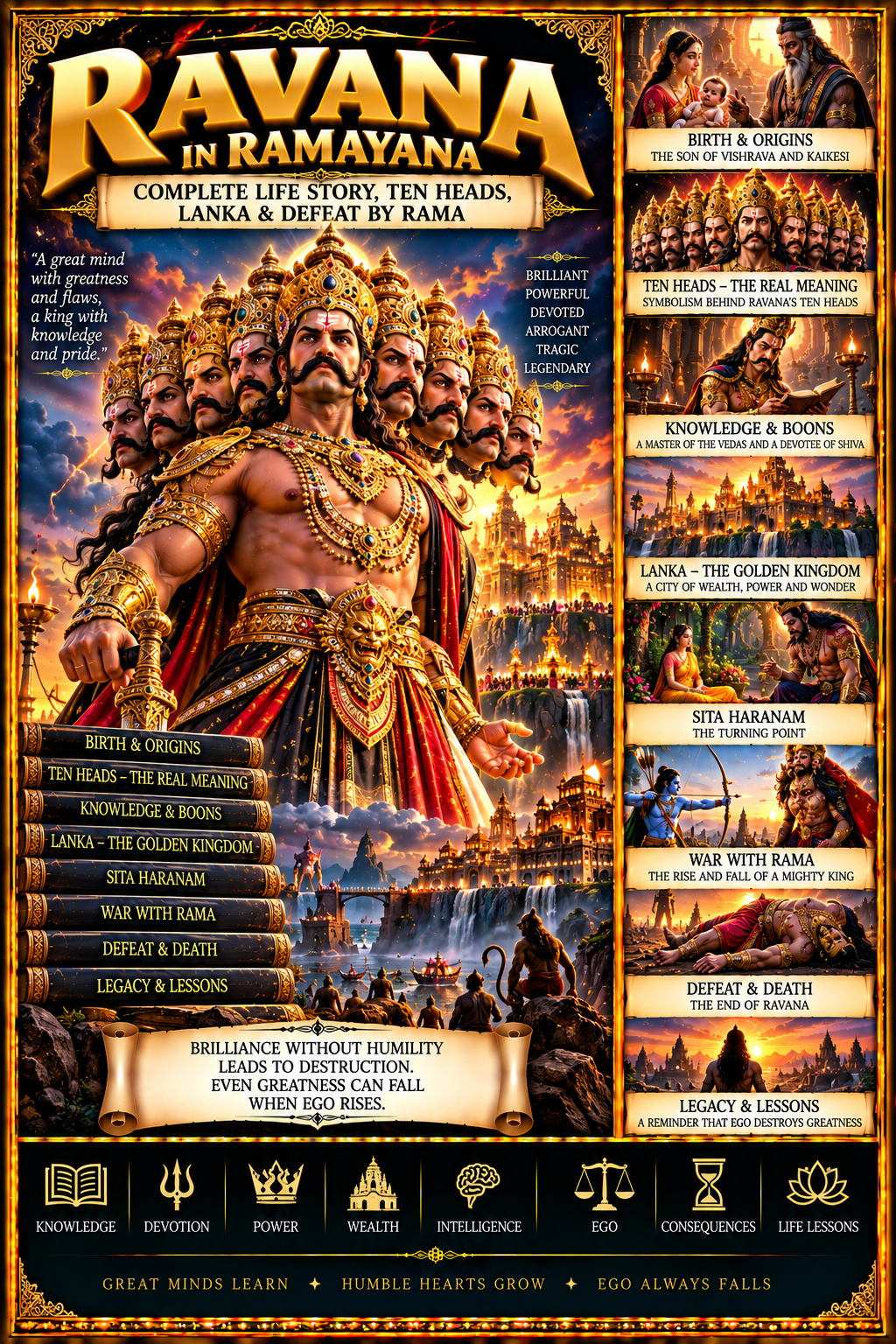
High above the southern ocean atop Mount Trikuta stood the golden city of Lanka, ruled by a monarch of terrifying intellect and unyielding devotion. Ravana was no ordinary demon king; he was a master of the veena who composed the thunderous Shiva Tandava Stotram, a scholar who knew the four Vedas by heart, and a ruler whose golden kingdom dazzled the three worlds. Yet, despite his genius and unmatched spiritual penances, one fatal flaw sealed his doom: an uncontrolled ego that refused to listen to dharma. When he abducted Goddess Sita, he set into motion the catastrophic war that ended his golden empire at the hands of Lord Rama.
Yet, despite his immense virtues, scholarship, and spiritual penance, Ravana allowed his uncontrollable ego, lust, and arrogance to govern his destiny. His unlawful abduction of Goddess Sita set into motion the final battle of Lanka and his ultimate defeat at the hands of Lord Rama.
In this comprehensive guide, let us explore the complete life story of Ravana in Ramayana, his divine birth, the secret of his ten heads (Dashanana), the golden empire of Lanka, his scholars’ achievements, the epic war, and 20 detailed frequently asked questions.
The Birth, Ancestry, and Lineage of Ravana in Ramayana

To understand the character of Ravana in Ramayana, one must trace his unique dual heritage.
Half-Brahmin and Half-Rakshasa Lineage
Ravana was the son of Sage Vishrava (a great Vedic Rishi and grandson of Lord Brahma) and Princess Kaikesi (an Asura princess). Because of his lineage, Ravana was half-Brahmin and half-Asura:
- From his father, Rishi Vishrava, he inherited immense intellectual capacity, Vedic wisdom, spiritual discipline, and mastery over sacrificial rituals.
- From his mother, Kaikesi, he inherited physical strength, royal ambition, warrior pride, and Asura traits.
Ravana grew up alongside his siblings: his brothers Kumbhakarna (the giant warrior) and Vibhishana (the righteous devotee of Vishnu), and his sister Surpanakha.
For official cultural and historical archives, visit the Ministry of Culture, Government of India.
For official cultural and historical archives, visit the Sacred Texts Ramayana Archive.
The Tapasya, Boons, and Ten Heads of Ravana in Ramayana

The rise to supreme power of Ravana in Ramayana began with his extraordinary penance (Tapasya).
Severe Penance on Mount Gokarna
Ravana and his brothers performed intense penance on Mount Gokarna to appease Lord Brahma. Ravana meditated for 10,000 years, standing on one foot amidst sacrificial fires.
To prove his unyielding devotion, Ravana cut off one of his own heads and offered it into the sacrificial fire (Yajna Kunda) at the end of every 1,000 years. By the 9,000th year, he had sacrificed nine heads.
As he raised his sword to sever his tenth head, Lord Brahma appeared, restored all nine severed heads, and granted him extraordinary boons:
- Invincibility Boon: Ravana could not be slain by Devas, Asuras, Gandharvas, Nagas, or celestial beings. (In his pride, Ravana omitted humans and monkeys, considering them too weak to threaten him).
- Nectar of Immortality (Amrita): Lord Brahma placed a vessel of divine nectar near Ravana’s navel, allowing his heads to regenerate whenever severed in battle.
- Ten Heads Manifestation: He gained the ability to manifest ten heads (Dashanana) and twenty arms at will during combat.
The Golden City of Lanka and Empire of Ravana in Ramayana

How did Ravana in Ramayana become the ruler of the legendary golden city of Lanka?
Conquering Lanka from Kubera
Lanka was originally built by the celestial architect Vishwakarma for Kubera, the God of Wealth and Ravana’s half-brother. Driven by ambition, Ravana attacked Kubera, defeated him, and seized Lanka as his capital. He also seized Kubera’s flying chariot, the Pushpaka Vimana, which could fly at the speed of thought.
Under Ravana’s rule, Lanka flourished into an golden empire crafted with solid gold, precious gems, and grand architecture. It was said that poverty was non-existent in Lanka, and even the humblest homes possessed golden pillars.
The Virtues and Scholars Attributes of Ravana in Ramayana
Scriptures emphasize that Ravana in Ramayana was not merely a villain; he possessed extraordinary talents and virtues:
- Mastery Over the Vedas and Shastras: Ravana had mastered the 4 Vedas (Rigveda, Yajurveda, Samaveda, Atharvaveda) and 6 Vedangas/Shastras. His ten heads metaphorically represented the intellect of ten great scholars combined.
- Great Shiva Bhakta: Ravana was an ardent devotee of Lord Shiva. When he attempted to lift Mount Kailash, Lord Shiva pressed the mountain down with his big toe, trapping Ravana’s arm. To appease Shiva, Ravana plucked his own nerves to string a Veena and composed the hypnotic Shiva Tandava Stotram. Impressed, Shiva named him Ravana (one who roars terrifyingly) and granted him the divine sword Chandrahas.
- Author of Authoritative Texts: Ravana authored the Ravana Samhita (on Vedic astrology), Arka Prakasham (on Siddha medicine), and Ravanahatha (an ancient musical instrument).
The Abduction of Goddess Sita by Ravana in Ramayana
The turning point of Ravana in Ramayana occurred in the Dandaka forest during Lord Rama’s 14-year exile.
The Surpanakha Incident and Maricha’s Golden Deer
When Ravana’s sister Surpanakha attempted to harm Sita and was disfigured by Lakshmana, she fled to Lanka and incited Ravana by describing Sita’s incomparable beauty.
Desiring to avenge his sister and possess Sita, Ravana enlisted the demon Maricha, who transformed into a golden deer (Maricha) to lure Lord Rama and Lakshmana away from their hermitage at Panchavati.
Disguised as a wandering mendicant (Sanyasi), Ravana approached Goddess Sita, breached the sacred boundary (Lakshmana Rekha), and abducted Her in his flying chariot, transporting Her to the Ashoka Vatika in Lanka.
The Battle of Lanka and Defeat of Ravana in Ramayana by Lord Rama

The abduction of Sita led directly to the epic Battle of Lanka between the forces of Lord Rama and Ravana in Ramayana.
Building the Rama Setu and the War of Lanka
With the help of Hanuman, Sugriva, and the Vanara army, Lord Rama built the ocean bridge Rama Setu to reach Lanka. Ravana’s righteous brother Vibhishana advised Ravana to return Sita and seek Rama’s forgiveness. When Ravana humiliated Vibhishana, Vibhishana defected to Rama’s side.
A fierce war erupted. One by one, Ravana’s mighty commanders – Kumbhakarna, Meghnada (Indrajit), Prahasta, and Atikaya – fell on the battlefield.
The Final Duel and the Brahmastra
On the final day, Lord Rama and Ravana engaged in a monumental duel. Whenever Rama severed one of Ravana’s ten heads with an arrow, a new head instantly regenerated due to the nectar of immortality in Ravana’s navel.
Sage Agastya taught Lord Rama the sacred Aditya Hrudayam hymn to recharge his energy. Vibhishana then revealed the secret that the nectar of immortality was stored in Ravana’s navel.
Lord Rama invoked the divine Brahmastra arrow, aiming directly at Ravana’s navel. The arrow dried up the divine nectar and pierced Ravana’s heart, bringing an end to the ten-headed King of Lanka. As Ravana lay dying, Lord Rama sent Lakshmana to sit at Ravana’s feet to learn governance, diplomacy, and statecraft from the dying scholar.
Related Sacred Topics & Cultural Heritage: For further spiritual exploration, read about the 14-year exile of Lord Rama.
Related Ramayana and Dasara Guides
To deepen your understanding of the epic stories, traditions, and divine figures connected to Dasara, explore our dedicated guides:
• Learn why effigies of Lanka’s king are burned in Why Is Ravana Burned on Dasara? Meaning and Story Behind the Tradition.
• Plan your rituals and auspicious muhurat timings with Vijayadashami 2026: Date, Puja Time, Significance and Traditions.
• Discover the complete arc of Lanka’s ruler in Ravana in Ramayana: Complete Life Story.
• Explore the spiritual meaning behind his physical form in Ravana’s Ten Heads: The Real Story Behind the Ten-Headed King.
• Understand the virtues of the supreme hero in Lord Rama: The Ideal Hero of the Ramayana.
• Read the untold story of the royal exile in Lord Rama’s 14-Year Exile.
• Learn about the heroic devotions of Hanuman: The Unmatched Hero and Lakshmana: An Unsung Hero.
Frequently Asked Questions About Ravana (20 Questions & Answers)
1. Who was Ravana in the Ramayana?
Ravana was the powerful King of Lanka, a renowned Vedic scholar, a great musician, and a devout devotee of Lord Shiva. Despite his immense intellect and power, his arrogance and abduction of Sita led to his downfall.
2. Who were Ravana’s parents and royal ancestors?
Ravana was the son of the great Vedic sage Vishrava and the demon princess Kaikesi. Through his father, he was the grandson of Sage Pulastya, one of the Mind-born sons (Prajapatis) of Lord Brahma.
3. What is the significance of Ravana’s birth in the sage Vishrava’s lineage?
Born to a Brahmana father and a Rakshasa mother, Ravana possessed both supreme Vedic intelligence and immense physical demoniac strength, making him a unique and formidable figure in ancient epics.
4. Why did Ravana have ten heads?
Ravana’s ten heads represent his profound mastery over the six Shastras and four Vedas, as well as the ten negative human emotional vices (ego, anger, lust, greed, pride, envy, mind, intellect, memory, and self-centeredness).
5. What do the ten heads of Ravana symbolize spiritually?
Spiritually, Ravana’s ten heads signify how an individual possessed of extraordinary knowledge can still fall into ruin if their intellect remains enslaved by unchecked ego and sensory desires.
6. Which boons did Ravana obtain through intense penance to Lord Brahma?
Ravana performed severe austerities to Lord Brahma and received a boon granting him invincibility against devas, Asuras, serpents, celestial beings, and wild beasts. In his pride, he omitted humans and monkeys from his request.
7. Why was Ravana called ‘Ravana’ by Lord Shiva?
When Ravana arrogantly attempted to lift Mount Kailash, Lord Shiva pressed his big toe, trapping Ravana’s hands beneath the mountain. Ravana roared in intense pain and sang praise to Shiva. Impressed by his roar and hymn, Shiva named him Ravana (‘one who roars loudly’).
8. How did Ravana compose the famous Shiva Tandava Stotram?
Trapped under Mount Kailash, Ravana composed and sang the Shiva Tandava Stotram, an intricate 15-verse hymn praising Lord Shiva’s cosmic dance, pleasing Shiva and earning his liberation along with the divine sword Chandrahas.
9. What was the name of Ravana’s kingdom and capital city?
Ravana ruled the island kingdom of Lanka, with its legendary capital city constructed entirely of gold (Suvarna Lanka), originally built by divine architect Vishwakarma for Kubera before Ravana claimed it.
10. Who was Mandodari, and what was her role in Ravana’s life?
Mandodari was Ravana’s chief queen, daughter of Mayasura. Known for her virtue and wisdom, she repeatedly advised Ravana to return Sita to Lord Rama and seek peace, though Ravana ignored her righteous counsel.
11. Why did Ravana abduct Mata Sita from Panchavati?
Ravana abducted Mata Sita to avenge the disfigurement of his sister Surpanakha by Lakshmana, and driven by a desire to challenge Lord Rama and assert his supreme power across Aryavarta.
12. Who was Vibhishana, and why did he leave Ravana to join Lord Rama?
Vibhishana was Ravana’s younger brother who practiced righteousness (Dharma). When Ravana kicked him out of the court for advocating Sita’s return, Vibhishana sought refuge with Lord Rama and aided the cause of justice.
13. Who was Kumbhakarna, and why did he fight for Ravana despite knowing the truth?
Kumbhakarna was Ravana’s giant brother who slept for six months at a time due to a divine curse. Though he recognized that Ravana was wrong, he fought out of familial loyalty and met his death against Lord Rama.
14. Who was Meghnada (Indrajit), and how did he earn his name?
Meghnada was Ravana’s heroic eldest son who earned the title Indrajit (‘Conqueror of Indra’) after defeating Lord Indra in battle. He possessed celestial weapons and mastered sorcery before being slain by Lakshmana.
15. What weapons did Lord Rama use to defeat Ravana in Lanka?
Lord Rama used the divine Brahmastra arrow crafted by Lord Brahma, infused with the power of the cosmic gods, to strike Ravana’s navel and end the war of Lanka on Vijayadashami.
16. Where was Ravana’s vulnerable spot, and how did Rama learn about it?
Ravana had a vessel of nectar (Amrita) stored in his navel that rendered him immortal against normal weapons. Vibhishana revealed this secret to Lord Rama on the battlefield.
17. What advice did Ravana give to Lakshmana as he lay dying on the battlefield?
As Ravana lay dying, Lord Rama instructed Lakshmana to sit at Ravana’s feet as a student. Ravana shared valuable lessons on governance, statecraft, the danger of delaying good deeds, and the perils of underestimating enemies.
18. Is Ravana revered or worshiped in any parts of India?
Yes, Ravana is respected for his Vedic scholarship and devotion to Lord Shiva in places like Bisrakh (Uttar Pradesh), Mandsaur (Madhya Pradesh), and Baijnath (Himachal Pradesh).
19. What major lesson does Ravana’s downfall teach about ego and intellect?
Ravana’s life demonstrates that intellect, wealth, and power are meaningless without humility and moral integrity. Pride and unchecked desire lead to self-destruction regardless of one’s achievements.
20. How does Ratnam Strategy cover Ravana’s character arc in the Ramayana?
Ratnam Strategy provides an objective, deeply researched analysis of Ravana as a complex epic figure – highlighting his immense talents, scriptural contributions, tragic fatal flaws, and enduring lessons for humanity.
Related Articles & Sacred Character Guides
- Lord Rama: The Ideal Hero of the Ramayana
- Lord Rama’s 14-Year Exile: The Untold Reason
- Ravana’s Ten Heads: The Real Story Behind the Ten-Headed King
- Hanuman: The Unmatched Hero of the Ramayana
- Lakshmana from Ramayana: An Unsung Hero
- Why Is Ravana Burned on Dasara? Meaning and Story
- Vijayadashami 2026: Date, Puja Time and Traditions