Admin
Admin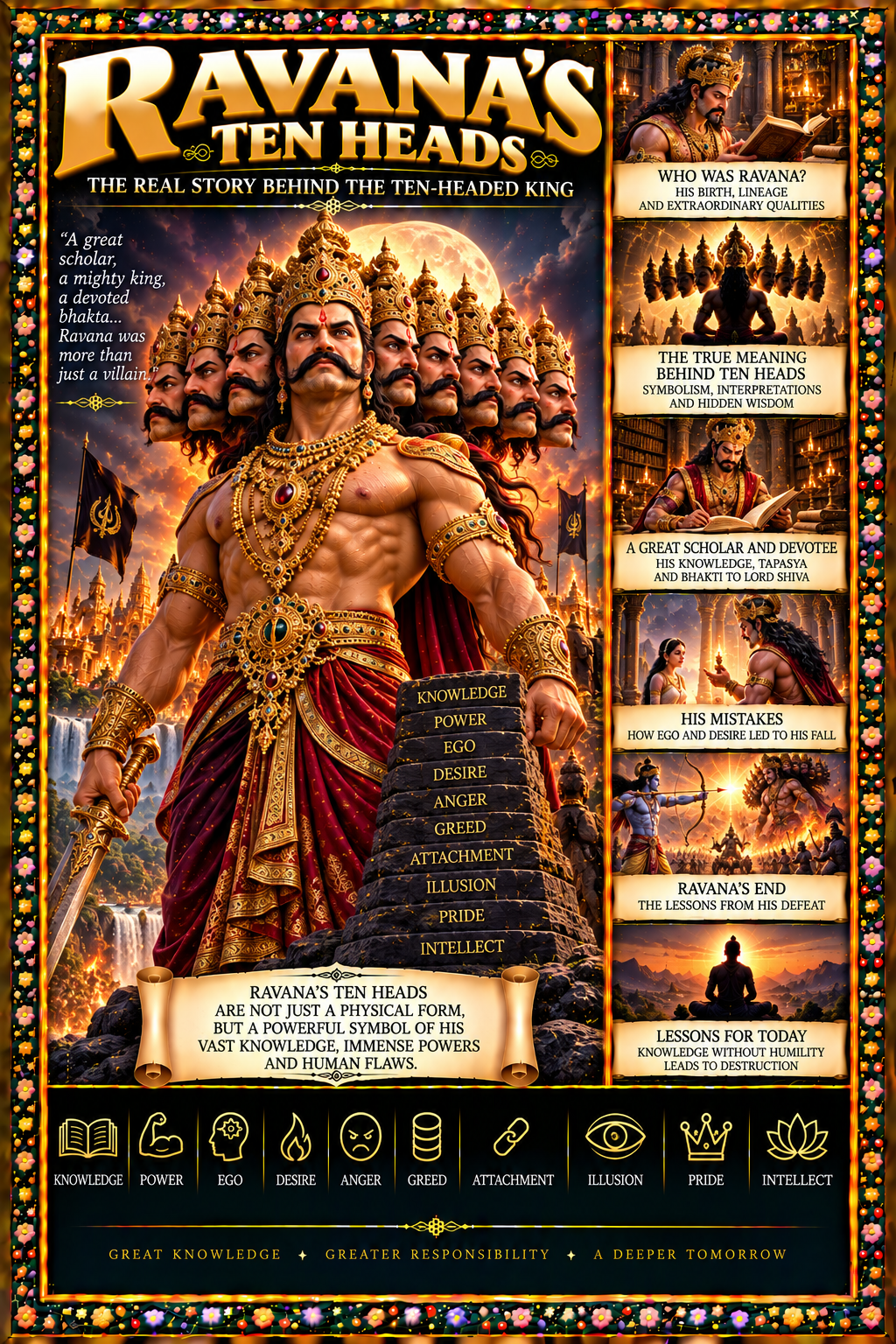
The legend of Ravana’s Ten Heads (known in Sanskrit as Dashanana or Dashagriva) is one of the most intriguing, multi-layered stories in Hindu mythology. Ravana, the king of Lanka in the epic Ramayana, is widely depicted in temple sculptures, classical paintings, and Ramlila plays as a towering demon king with ten heads and twenty arms.
Was Ravana literally born with ten biological heads, or did He manifest them through divine boons and illusive powers? Or does the imagery of Ravana’s Ten Heads carry a deep psychological, philosophical, and astrological symbolism representing human emotions, intellect, and spiritual vices?
In this comprehensive guide, we uncover the real story, scriptural origins, 4 sacred images, and profound spiritual symbolism behind Ravana’s Ten Heads.
The Mythological Origin of Ravana’s Ten Heads
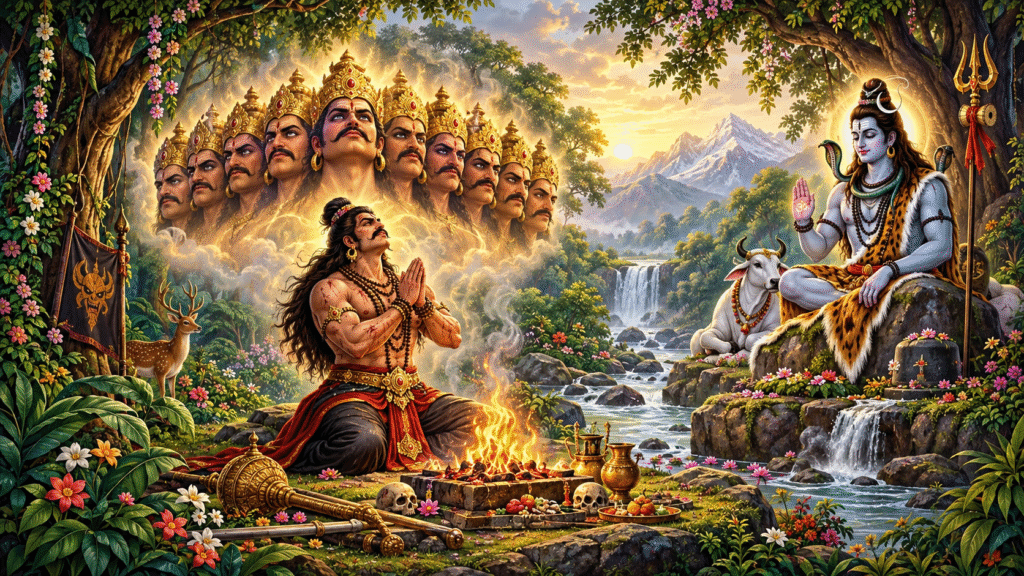
To understand the story of Ravana’s Ten Heads, one must explore his unique lineage and his extreme penance to Lord Brahma.
The Divine Lineage of Ravana
Ravana was not a typical demon. He was the son of Sage Vishrava (a revered Vedic Rishi and grandson of Lord Brahma) and Princess Kaikesi (an Asura princess). This unique lineage made Ravana half-Brahmin and half-Rakshasa. From his father, he inherited immense intellectual capacity, Vedic wisdom, and mastery over spiritual rituals. From his mother, he inherited immense physical power, ambition, and royal pride.
The Sacrifice of Ten Heads to Lord Brahma
According to the Uttara Kanda of Valmiki Ramayana, Ravana and his brothers performed intense penance on Mount Gokarna to attain supreme power. Ravana meditated for 10,000 years, standing on one foot amidst sacrificial fires.
At the end of every 1,000 years of penance, Ravana offered one of his own heads as a sacred sacrifice into the Yajna Kunda (sacrificial fire pit) to demonstrate absolute devotion. By the 9,000th year, he had sacrificed nine of his heads.
Just as Ravana raised his sword to sever his tenth and final head, Lord Brahma appeared, deeply pleased by his extraordinary sacrifice and willpower. Lord Brahma restored all nine severed heads to Ravana’s body, granted him a divine boon of invincibility against gods and celestial beings, and bestowed upon him the ability to manifest ten heads at will.
The 10 Negative Emotions Represented by Ravana’s Ten Heads
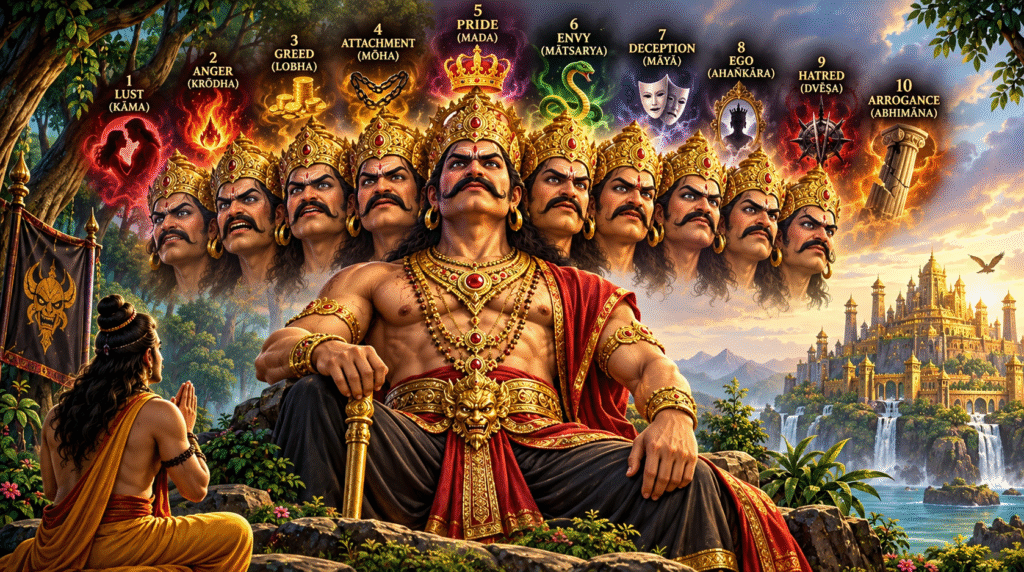
Beyond physical manifestation, ancient Vedic scholars and spiritual masters explain that Ravana’s Ten Heads represent the ten negative psychological traits and afflictions of the human mind.
Even though Ravana was a great king and scholar, he allowed these ten negative emotions to govern his actions, leading to his ultimate downfall:
- Kama (Lust / Unchecked Desire): Represented by his unlawful desire for Goddess Sita.
- Krodha (Anger / Wrath): Represented by his explosive temper when challenged or advised.
- Moha (Delusion / Attachment): Represented by his blind attachment to material wealth and pride.
- Lobha (Greed / Avarice): Represented by his desire to conquer all three worlds.
- Mada (Pride / Arrogance): Represented by his supreme ego as an unbeatable ruler.
- Matsarya (Envy / Jealousy): Represented by his envy toward the Devas and Lord Vishnu.
- Manas (Unruly Mind): Represented by his inability to control impulsive thoughts.
- Buddhi (Corrupted Intellect): Represented by using high intelligence for adharma (righteousness inverted).
- Chitta (Past Grudges & Resentment): Represented by holding deep grudges against gods and Rishis.
- Ahamkara (Ego / Self-Centeredness): The central head representing supreme self-absorption.
The destruction of Ravana’s Ten Heads by Lord Rama symbolizes the victory of spiritual purity over these ten inner vices.
The 6 Shastras and 4 Vedas Symbolized by Ravana’s Ten Heads
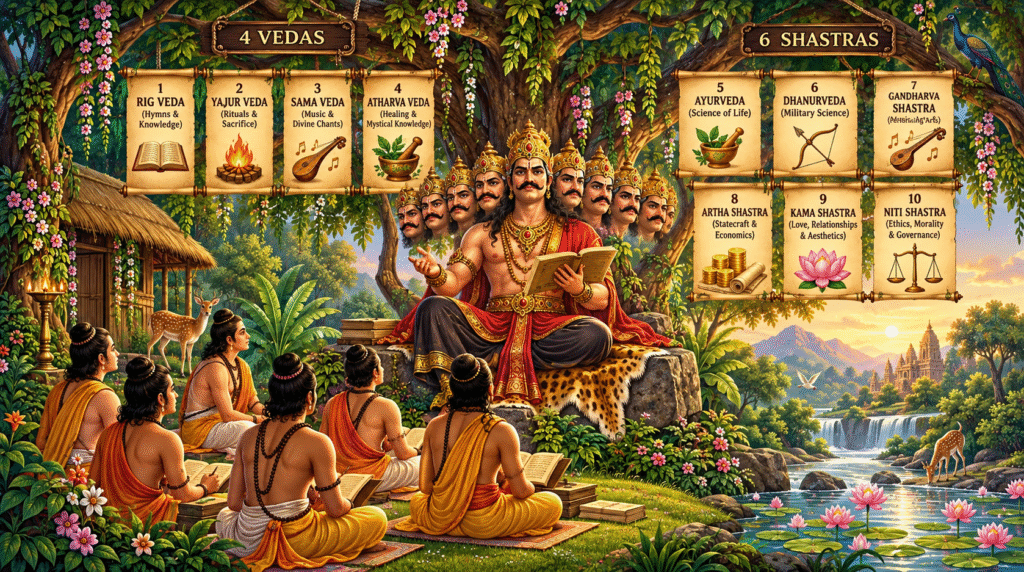
Another famous scriptural interpretation explains that Ravana’s Ten Heads symbolize his unmatched intellectual mastery over ten sacred Vedic scriptures:
- The 4 Vedas: Rigveda, Yajurveda, Samaveda, and Atharvaveda.
- The 6 Vedangas / Shastras:
- Shiksha (Phonetics & Pronunciation)
- Kalpa (Ritual Instructions)
- Vyakarana (Sanskrit Grammar)
- Nirukta (Etymology & Word Origins)
- Chhandas (Vedic Metrics & Poetry)
- Jyotisha (Vedic Astrology & Astronomy)
Because Ravana possessed the intellect of ten great scholars combined, ancient poets metaphorically described him as having ten heads. He was an expert veena player, the composer of the famous Shiva Tandava Stotram, and the author of Ravana Samhita (an authoritative text on Vedic astrology).
The Illusion vs Reality of Ravana’s Ten Heads in Battle
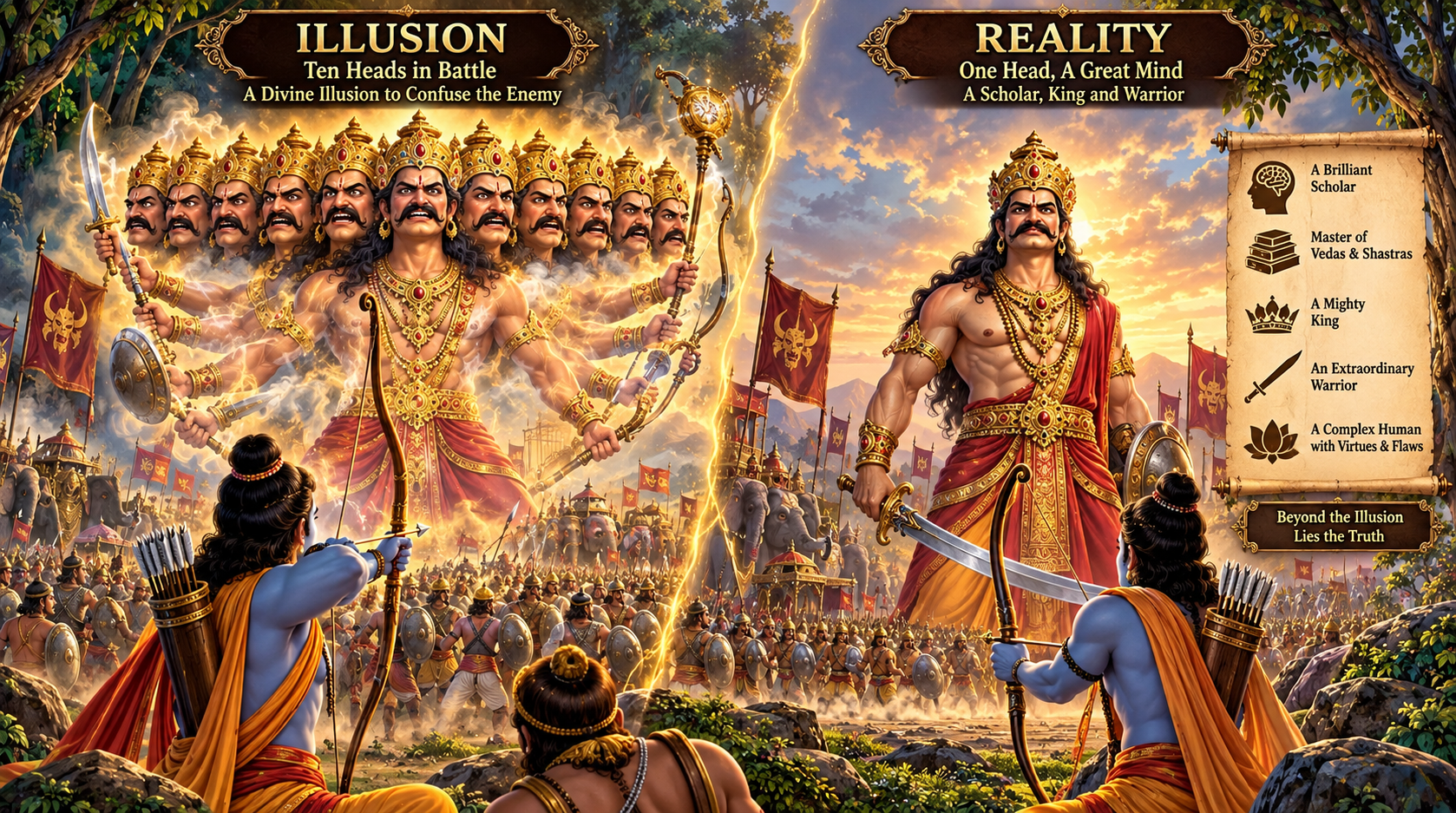
During the grand war in Lanka, Ravana’s Ten Heads played a crucial role in combat through Asuri Maya (demonic illusive powers).
When fighting Lord Rama, Ravana manifested ten physical heads and twenty arms to strike psychological terror into the Vanara army and shoot arrows in ten directions simultaneously.
Whenever Lord Rama severed one of Ravana’s heads with a divine arrow, a new head instantly regenerated in its place! This occurred because the nectar of immortality (Amrita) was stored near Ravana’s navel, granted by Lord Brahma. Only when Sage Agastya revealed the secret Aditya Hrudayam hymn to Rama, and Vibhishana revealed the secret of the navel, did Lord Rama shoot the divine Brahmastra into Ravana’s navel, drying up the nectar and severing all ten heads permanently.
Life Lessons from the Legend of Ravana’s Ten Heads
The story of Ravana’s Ten Heads offers timeless wisdom for modern living:
- Vast Knowledge Without Humility Is Dangerous: Ravana knew all four Vedas, yet his arrogance destroyed his kingdom.
- A Single Uncontrolled Vice Can Ruin Ten Virtues: Despite his immense scholarship, courage, and devotion to Lord Shiva, Ravana’s uncontrolled lust and ego led to his doom.
- Mastery Over the Ten Senses: Humanity must master the five senses of perception (Gyanendriyas) and five senses of action (Karmendriyas) to achieve true spiritual liberation.
Frequently Asked Questions (FAQs) About Ravana’s Ten Heads
1. Why did Ravana have ten heads?
Ravana gained his ten heads through extreme penance to Lord Brahma, during which he sacrificed his heads into the sacrificial fire. Brahma restored them and granted him the ability to manifest ten heads at will. Symbolically, the ten heads represent his mastery over 4 Vedas and 6 Shastras, as well as the 10 negative human vices.
2. What are the names and meanings of the 10 heads of Ravana?
The ten heads represent ten mental traits: Kama (Lust), Krodha (Anger), Moha (Delusion), Lobha (Greed), Mada (Pride), Matsarya (Envy), Manas (Unruly Mind), Buddhi (Intellect), Chitta (Will/Resentment), and Ahamkara (Ego).
3. Was Ravana born with ten heads or did he gain them later?
Ravana was born with a single physical head. He gained the ability to manifest ten heads (Dashanana) after sacrificing nine heads during his 10,000-year penance to Lord Brahma on Mount Gokarna.
4. How did Lord Rama cut off Ravana’s ten heads?
Whenever Lord Rama cut off one of Ravana’s heads, a new head regenerated due to the nectar of immortality (Amrita) in Ravana’s navel. Lord Rama used the divine Brahmastra arrow to strike Ravana’s navel, drying the nectar and severing all ten heads permanently.
5. What is Ravana called in Sanskrit because of his ten heads?
Ravana is known in Sanskrit scriptures as Dashanana (the ten-faced one) and Dashagriva (the ten-necked one).
6. What scriptures did Ravana master to symbolize his ten heads?
Ravana mastered the four Vedas (Rigveda, Yajurveda, Samaveda, Atharvaveda) and the six Shastras/Vedangas (Shiksha, Kalpa, Vyakarana, Nirukta, Chhandas, and Jyotisha).
7. Who revealed the secret to destroying Ravana’s ten heads?
Vibhishana, Ravana’s righteous younger brother, revealed the secret that the nectar of immortality was stored in Ravana’s navel, which enabled Rama to defeat the ten-headed demon king.
8. Did Ravana physically possess ten heads or was it a symbolic representation?
Scriptures describe both: physically, Ravana could manifest ten heads in battle through illusive powers (Asuri Maya); metaphorically, the ten heads represented his ten-fold intellect and ten negative ego traits.
9. What sacred hymn did Ravana compose for Lord Shiva?
Ravana composed the grand Shiva Tandava Stotram, a hypnotic 15-verse hymn praising the cosmic dance and power of Lord Shiva.
10. What musical instrument did Ravana play to praise Lord Shiva?
Ravana was a master player of the Veena (and invented the Ravanahatha, an ancient bowed string instrument). He even played the Veena using his own severed nerves when trapped under Mount Kailash.
11. What was the name of Ravana’s father and mother?
Ravana’s father was Sage Vishrava (a Vedic Rishi), and his mother was Princess Kaikesi (an Asura princess), making Ravana half-Brahmin and half-Asura.
12. Was Ravana considered a Brahmin?
Yes, because his father Sage Vishrava was a renowned Brahmin, Ravana was considered a Brahmin by birth and possessed immense Vedic knowledge.
13. What famous astrological treatise did Ravana write?
Ravana authored the Ravana Samhita, an authoritative ancient text on Vedic astrology, planetary influences, and horoscope reading.
14. Why do people burn effigies of Ravana’s ten heads during Dussehra?
During Dussehra (Vijayadashami), effigies of Ravana’s ten heads are burned to celebrate the victory of Lord Rama (Good over Evil) and to symbolize burning away our own ten inner vices.
15. Which hymn did Lord Rama recite to gain strength before severing Ravana’s ten heads?
Sage Agastya taught Lord Rama the sacred Aditya Hrudayam hymn, invoking the Sun God (Surya) for victory, invincibility, and cosmic energy before the final battle.
16. What is the central head among Ravana’s ten heads?
The central and largest head represents Ahamkara (Ego / Self-Centeredness), which feeds and controls the other nine negative emotions.
17. How long did Ravana perform penance before receiving the ten heads boon?
Ravana performed penance for 10,000 years on Mount Gokarna, sacrificing one head into the sacrificial fire after every 1,000 years.
18. Why couldn’t Devas and Gods defeat Ravana’s ten heads?
Lord Brahma’s boon rendered Ravana invincible against Devas, Asuras, Gandharvas, and celestial beings. Only a mortal human (Lord Rama) could defeat him.
19. What is the medicinal text composed by Ravana?
Ravana wrote Arka Prakasham, a famous treatise on Siddha and Ayurvedic herbal medicine.
20. What is the main spiritual lesson behind the story of Ravana’s ten heads?
The story teaches that immense knowledge and power are meaningless without humility and self-control. Uncontrolled ego, lust, and anger will destroy even the most brilliant individual.