Raja Ratnam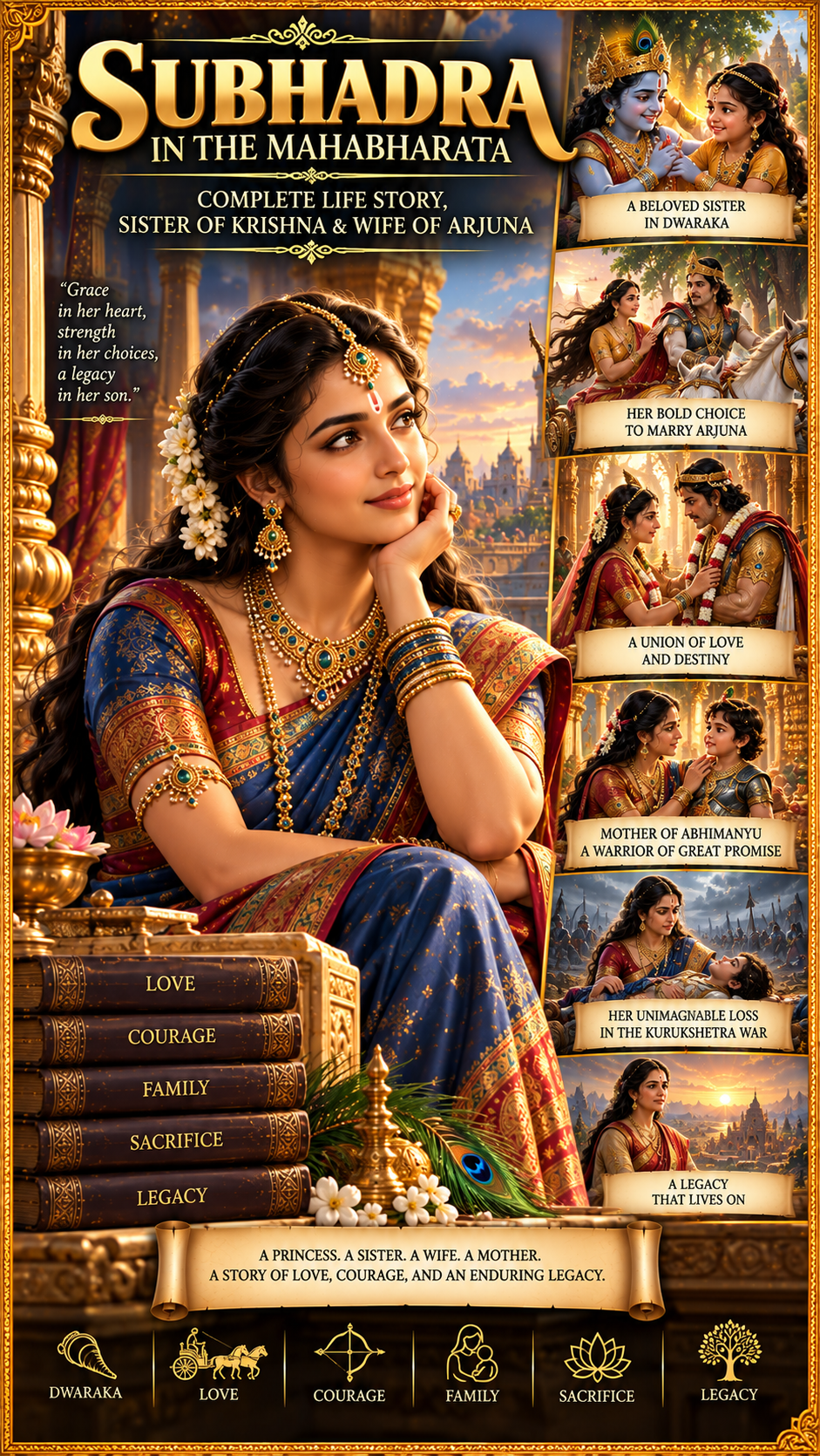
The Mahabharata is a grand canvas of epic battles, political maneuvers, and moral dilemmas. Among the key women who shape the narrative of the Kuru dynasty, Subhadra in the Mahabharata occupies a central and highly revered position. Known as the sister of Lord Krishna and Balarama, the beloved wife of the Pandava warrior Arjuna, and the mother of the tragic hero Abhimanyu, Subhadra is a key figure whose presence bridges the powerful Vrishni clan of Dwaraka with the Pandavas of Indraprastha. Her story is one of royal grace, romantic choice, quiet strength, immense maternal sacrifice, and structural legacy.
While characters like Draupadi are associated with public humiliation, vengeance, and the fiery initiation of war, Subhadra in the Mahabharata represents a different dimension of strength: the unifying thread of the family, a mother who instilled legendary courage in her son, and the woman whose direct descendant (Parikshit) saved the Pandava lineage from extinction.
The Lineage and Childhood of Subhadra in the Mahabharata
Subhadra was born into the Yadava clan (specifically the Vrishni branch) as the daughter of Vasudeva and Rohini. She was the younger sister of Balarama and Lord Krishna. Born in Dwaraka, a magnificent coastal city renowned for its wealth, advanced architecture, and military strength, Subhadra grew up surrounded by affection.
Because she was the youngest sibling, she was deeply pampered by her brothers. Lord Krishna, in particular, shared an exceptionally close, telepathic bond of affection with her, guiding her throughout her life. In the epic, Subhadra is described as possessing great beauty, high intellect, sweet speech, and a cheerful disposition. Her name, “Subhadra,” translates to “glorious” or “very auspicious,” reflecting the positive energy she brought to the Yadava household.
For official cultural and historical archives, visit the Ministry of Culture, Government of India.
The Love Story and Elopement of Subhadra in the Mahabharata
The Divine Intervention of Lord Krishna for Subhadra in the Mahabharata
Driving the Chariot: Consent and Valor of Subhadra in the Mahabharata
The marriage of Subhadra in the Mahabharata is one of the most romantic and celebrated tales in the epic. During Arjuna‘s twelve-year exile, he visited the holy site of Prabhasa. There, Lord Krishna met him and suggested that they travel to Dwaraka.
At a festival on the Raivataka hill, Arjuna caught a glimpse of Princess Subhadra. He was instantly captivated by her grace and beauty. Subhadra, having heard numerous tales of Arjuna’s unparalleled archery skills and chivalry, also felt a mutual attraction.
However, a major political hurdle stood in their way. Subhadra’s elder brother, Balarama, had already decided to marry her to Duryodhana, the eldest Kaurava prince, to strengthen the Yadavas’ alliance with Hastinapur. Knowing that Balarama would oppose a marriage with Arjuna (who was then in exile), Lord Krishna devised a brilliant strategy.
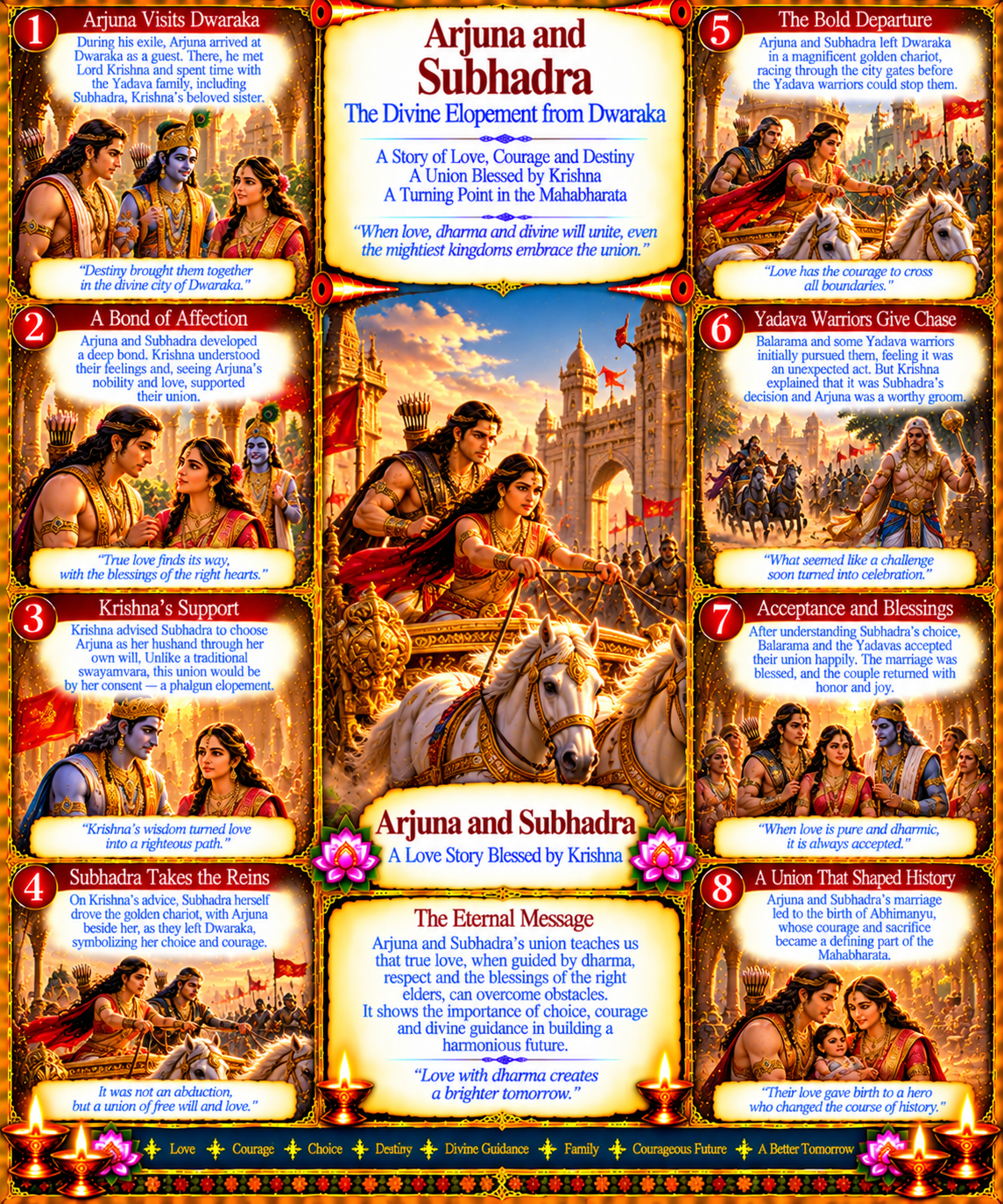
Krishna advised Arjuna that for a bold Kshatriya warrior, elopement (*Harana*) was a sanctioned form of marriage. Crucially, Krishna suggested that Subhadra should drive the chariot herself during the escape. This ensured that it was not a forced abduction, but an active, willful choice by the princess, shielding Arjuna from accusations of cowardice or dishonorable conduct.
Executing the plan, Arjuna arrived in a chariot outside the Dwaraka temple where Subhadra was worshipping. Subhadra boldly took the reins, guiding the horses toward the border. When Balarama and the other Yadava warriors learned of the elopement, they were furious and prepared for war. However, Krishna pacified them, pointing out Arjuna’s noble character, the mutual love between the couple, and the fact that Subhadra herself had driven the chariot, proving her consent. Convinced, Balarama relented, and the Yadavas celebrated the wedding of Arjuna and Subhadra in Dwaraka with grand festivities.
Arrival at Indraprastha: How Subhadra in the Mahabharata won Draupadi’s Heart
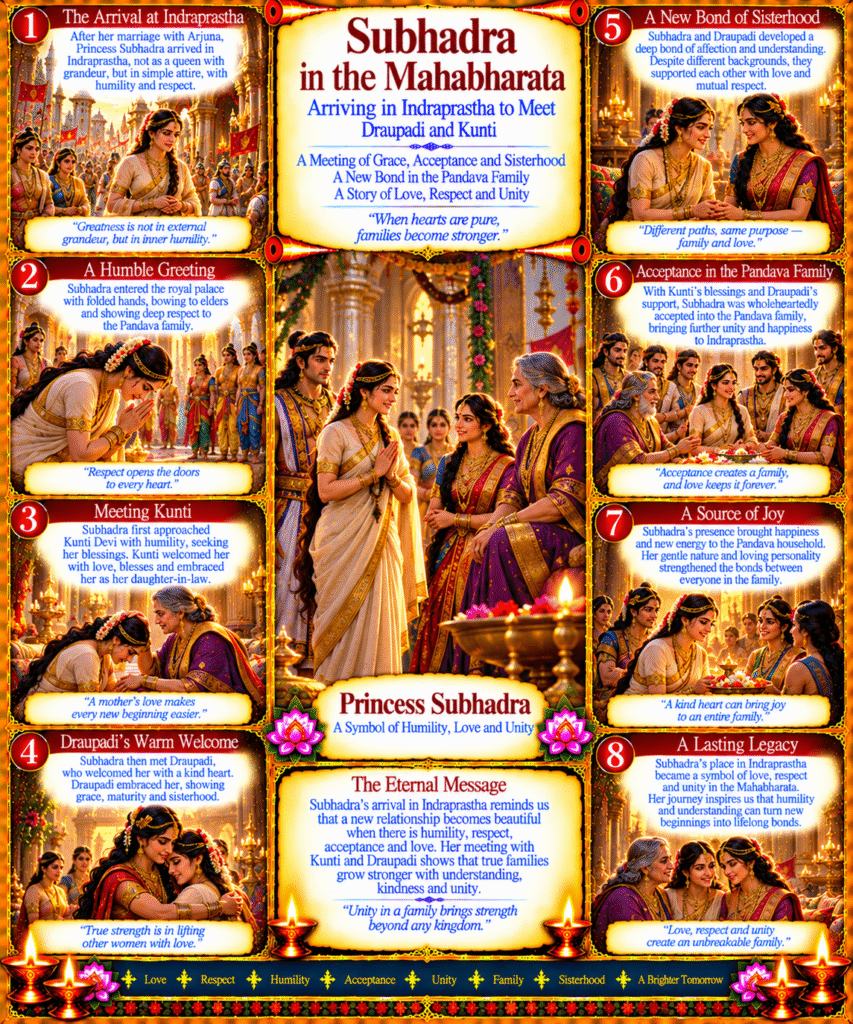
After spending a year in Dwaraka, Arjuna returned to Indraprastha with his new bride. However, they faced a delicate domestic situation. Arjuna was already married to Draupadi, the proud and fiery empress of the Pandavas, who held a strict rule that no other wife of the Pandavas should reside in the inner palace.
To prevent domestic discord, Krishna advised Subhadra on how to win Draupadi’s heart. Dressed in the simple, humble attire of a cowherd girl (*Gopika*), Subhadra entered the palace and bowed down before Draupadi, declaring herself as her humble maid and sister.
Draupadi, moved by Subhadra’s humility, sweet nature, and complete lack of royal ego, embraced her warmly. Draupadi declared that they would live as sisters, and Subhadra was accepted into the family with joy. Throughout their lives, there was never any friction between Draupadi and Subhadra in the Mahabharata, and they raised their children together with mutual love and respect.
Mother of Abhimanyu: Instilling Courage by Subhadra in the Mahabharata
The Education of Abhimanyu Under Subhadra in the Mahabharata
Hearing the Story of the Chakravyuh from Arjuna and Subhadra in the Mahabharata
The Unborn Child’s Reception of the Legend from Subhadra in the Mahabharata
Spiritual Teachings and Training in Dwaraka of Subhadra in the Mahabharata
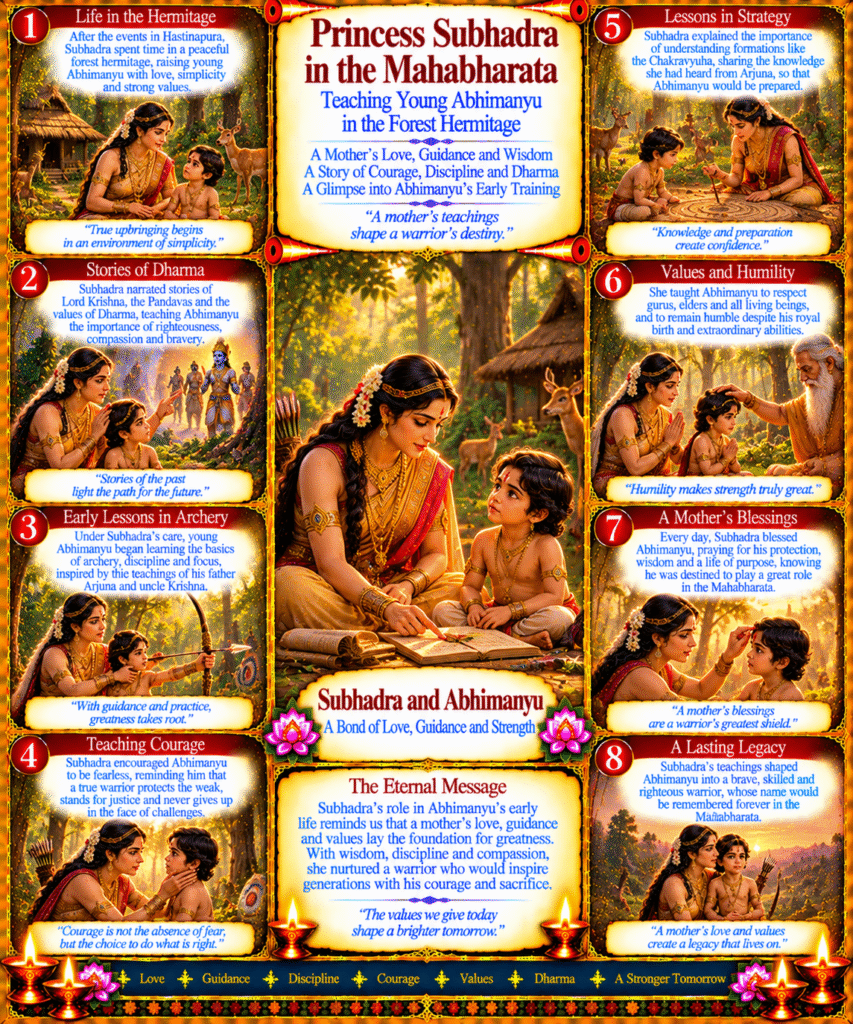
The greatest contribution of Subhadra in the Mahabharata to the epic’s narrative is her role as a mother. She gave birth to Abhimanyu, a child of extraordinary beauty, strength, and divine attributes (believed to be the incarnation of Varchas, the son of the Moon god).
An iconic legend in the Mahabharata describes how, while Subhadra was pregnant, Arjuna narrated the complex secret of entering the Chakravyuh (a multi-tiered, revolving circular military formation). Subhadra fell asleep halfway through the explanation, meaning the unborn Abhimanyu learned how to enter the formation but never heard how to safely exit it.
During the Pandavas’ thirteen-year exile (which followed the game of dice), Subhadra lived in Dwaraka under the protection of her brother Krishna. She raised Abhimanyu in the Yadava court, where he was trained in archery and warfare by Krishna’s son Pradyumna and Krishna himself. Subhadra raised Abhimanyu to be a warrior of impeccable integrity, courage, and dedication to Dharma.
Grief and Resilience of Subhadra in the Mahabharata
The Kurukshetra War brought immense tragedy to Subhadra in the Mahabharata. On the thirteenth day of the war, the young, sixteen-year-old Abhimanyu was trapped inside the Chakravyuh. Fighting valiantly against the greatest Kaurava warriors, he was brutally and unfairly slain in a joint attack by multiple older commanders.
The news of Abhimanyu’s death shattered Subhadra. Her grief was shared by Kunti, Draupadi, and Arjuna. However, showing the quiet resilience that defined her character, Subhadra consoled her daughter-in-law, Uttara (Abhimanyu’s pregnant widow), urging her to stay strong for the sake of the child in her womb.
Near the end of the war, Ashwatthama unleashed the deadly Brahmashira weapon to destroy the womb of Uttara, attempting to wipe out the Pandava lineage completely. Lord Krishna intervened, using his divine energy to revive the stillborn child in Uttara’s womb. This child was named Parikshit (meaning “the tested one”). Subhadra took charge of raising Parikshit, instilling in him the values of his father Abhimanyu and the wisdom of the Yadava and Pandava clans.
The Lasting Legacy of Subhadra in the Mahabharata
After the Pandavas decided to retire and embark on their final journey to the Himalayas (*Mahaprasthanika Parva*), they crowned Parikshit as the King of Hastinapur. Because Yuyutsu (Dhritarashtra’s surviving son) was appointed as the regent, Subhadra was designated as the royal matriarch, guiding the young king and ensuring the smooth transition of the dynasty.
Subhadra’s legacy also holds immense spiritual and cultural importance:
- Jagannath Temple, Puri: Subhadra is worshipped as a central deity alongside her brothers Jagannath (Krishna) and Balabhadra (Balarama) in the world-famous Jagannath Temple in Puri, Odisha. She is represented as a loving, protective sister standing between her brothers.
- Ratha Yatra: During the annual Ratha Yatra festival, Subhadra has her own dedicated chariot, the *Darpadhalana* (meaning “trampler of pride”), which is pulled by millions of devotees.
- Symbol of Devotion and Grace: Subhadra in the Mahabharata represents the grace that binds families, the courage of a mother, and the quiet strength to rebuild a dynasty after total devastation.
Frequently Asked Questions (FAQs) About Subhadra in the Mahabharata
1. Who was Subhadra in the Mahabharata?
Subhadra was the daughter of Vasudeva and Rohini, the younger sister of Lord Krishna and Balarama, the wife of Arjuna, and the mother of Abhimanyu.
2. How was Subhadra related to Lord Krishna?
Subhadra was the younger sister of Lord Krishna. They belonged to the Vrishni/Yadava clan of Dwaraka.
3. How did Arjuna and Subhadra marry?
They married by elopement (*Harana*) from Dwaraka. On Lord Krishna’s advice, Subhadra drove the chariot during their escape to show her consent, which pacified Balarama.
4. Why did Balarama initially oppose Subhadra’s marriage to Arjuna?
Balarama wanted Subhadra to marry Duryodhana, the eldest Kaurava prince, to build a powerful political alliance with Hastinapur.
5. Who was Subhadra’s son?
Her son was Abhimanyu, a legendary warrior who fought heroically and died in the Kurukshetra War.
6. What is the story of Subhadra sleeping during the Chakravyuh narration?
While pregnant, Subhadra listened to Arjuna explaining how to enter the Chakravyuh. She fell asleep before he explained how to exit it, meaning the unborn Abhimanyu only learned how to enter the formation.
7. How did Subhadra win Draupadi’s affection?
On Krishna’s advice, Subhadra entered Indraprastha dressed in simple cowherd garments, humbly presenting herself as a sister and maid to Draupadi, which touched Draupadi’s heart.
8. Where did Subhadra live during the Pandavas’ exile?
She lived in Dwaraka under the protection of Lord Krishna and Balarama, raising her son Abhimanyu.
9. Who was Subhadra’s daughter-in-law?
Her daughter-in-law was Uttara, the princess of Matsya kingdom and wife of Abhimanyu.
10. Who was Subhadra’s grandson?
Her grandson was King Parikshit, who succeeded the Pandavas as the King of Hastinapur.
11. How did Subhadra’s grandson Parikshit survive Ashwatthama’s attack?
Ashwatthama launched a Brahmashira weapon to kill the unborn Parikshit in Uttara’s womb. Lord Krishna used his divine energy to enter the womb and revive the child.
12. What role did Subhadra play after the Kurukshetra War?
She helped raise her grandson Parikshit and served as the royal matriarch, guiding the transition of the Kuru dynasty.
13. Where is Subhadra worshipped as a goddess today?
She is worshipped alongside Krishna (Jagannath) and Balarama (Balabhadra) in the Jagannath Temple in Puri, Odisha.
14. What is the name of Subhadra’s chariot in Ratha Yatra?
Her chariot is named *Darpadhalana* (or *Debadalana*), which means “the trampler of pride.”
15. Who was Subhadra’s mother?
Her mother was Rohini, the first wife of Vasudeva.
16. Did Subhadra have any other children besides Abhimanyu?
No, Abhimanyu was her only child mentioned in the epic.
17. How did Subhadra react to the death of her son Abhimanyu?
She was devastated but showed immense resilience, focusing on protecting and guiding her pregnant daughter-in-law Uttara to ensure the lineage survived.
18. What is the meaning of the name Subhadra?
The name Subhadra means “highly auspicious,” “glorious,” or “bringer of good fortune.”
19. How did Subhadra’s marriage affect the Kurukshetra War?
Her marriage cemented the alliance between the Pandavas and the Yadavas, ensuring the support of Krishna and several Yadava warriors during the war.
20. What is the spiritual significance of Subhadra in the Mahabharata?
Subhadra represents the unifying power of love, quiet resilience in times of tragedy, and the protective sisterly energy that stands beside the divine.