Raja Ratnam

With a gentle smile, twinkling eyes, and a sweet modak resting in his hand, Lord Ganesha is the most dearly loved deity across Indian homes. Before starting a journey, taking an exam, or entering a new home, families first bow to Ganapati. With his large elephant head symbolizing expansive wisdom and his tiny mouse vehicle reminding us that humility accompanies true greatness, Ganesha welcomes every beginner with blessings of joy and good fortune.
From bustling Indian temples to quiet home shrines, from art galleries to school books, Ganesha’s presence is felt deeply in Hindu culture and beyond. But what makes him so special? Let’s explore the origins, symbolism, stories, and significance of this iconic deity.
For official cultural and historical archives, visit the Incredible India Official Tourism Authority.
Related Sacred Topics & Cultural Heritage: For further spiritual exploration, read about Lord Rama’s ideal life story. For further spiritual exploration, read about the 14-year exile of Lord Rama. For further spiritual exploration, read about Ravana’s story in the Ramayana. For further spiritual exploration, read about the Vijayadashami and Dasara festival.
The Divine Birth of About lord Ganesh
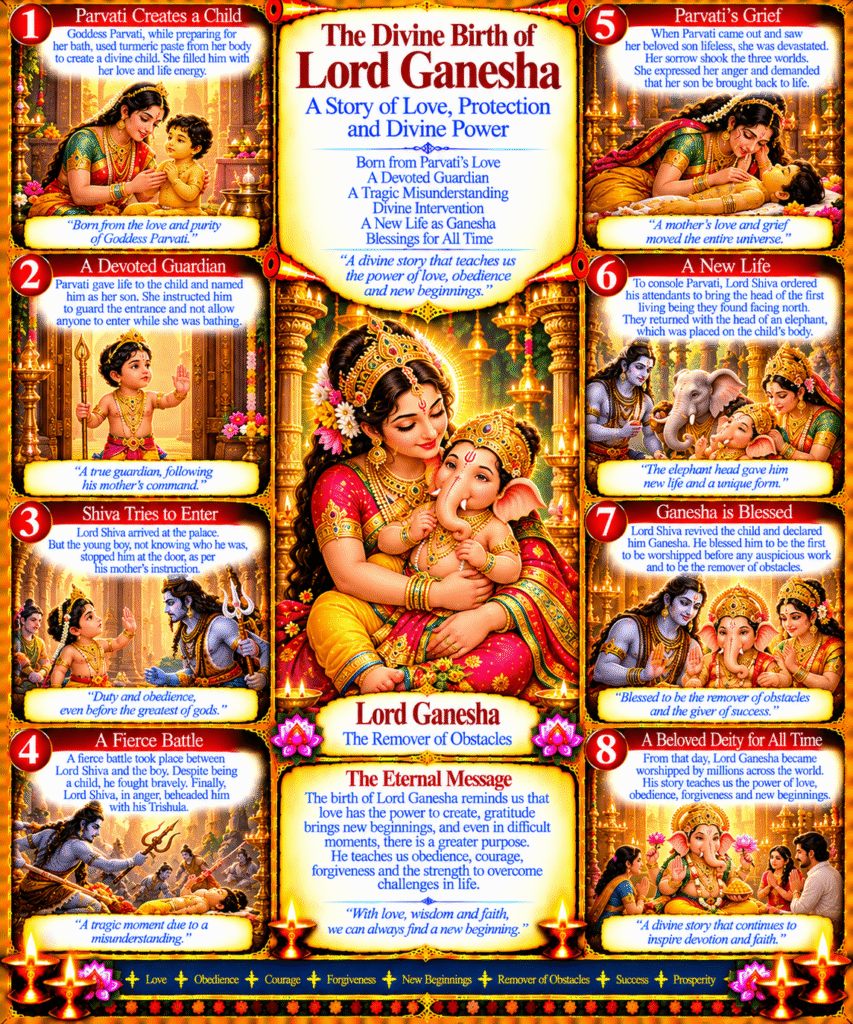
According to popular Hindu mythology, Lord Ganesha was created by Goddess Parvati, the consort of Lord Shiva. The story goes that Parvati, longing for a loyal companion, fashioned a boy from sandalwood paste and breathed life into him. Her instructions were for him to guard her privacy as she bathed.
A boy, unaware of Shiva’s identity, stopped Shiva from entering his home when he returned home. Shiva was angered by the boy’s defiance and severed his head in battle. Seeing Parvati’s grief, Shiva vowed to restore the boy to life. The first animal they encountered facing north was an elephant, so he ordered his attendants to bring its head to him.
about lord Ganesh, thus, the boy was reborn with an elephant’s head and was given the name Ganesh – Gana meaning followers or attendants of Shiva, and Isha meaning lord. From then on, Ganesh became the leader of Shiva’s celestial troops and was bestowed with many boons and honors by the gods.
Ganesh’s Symbolism: More Than Just a Myth
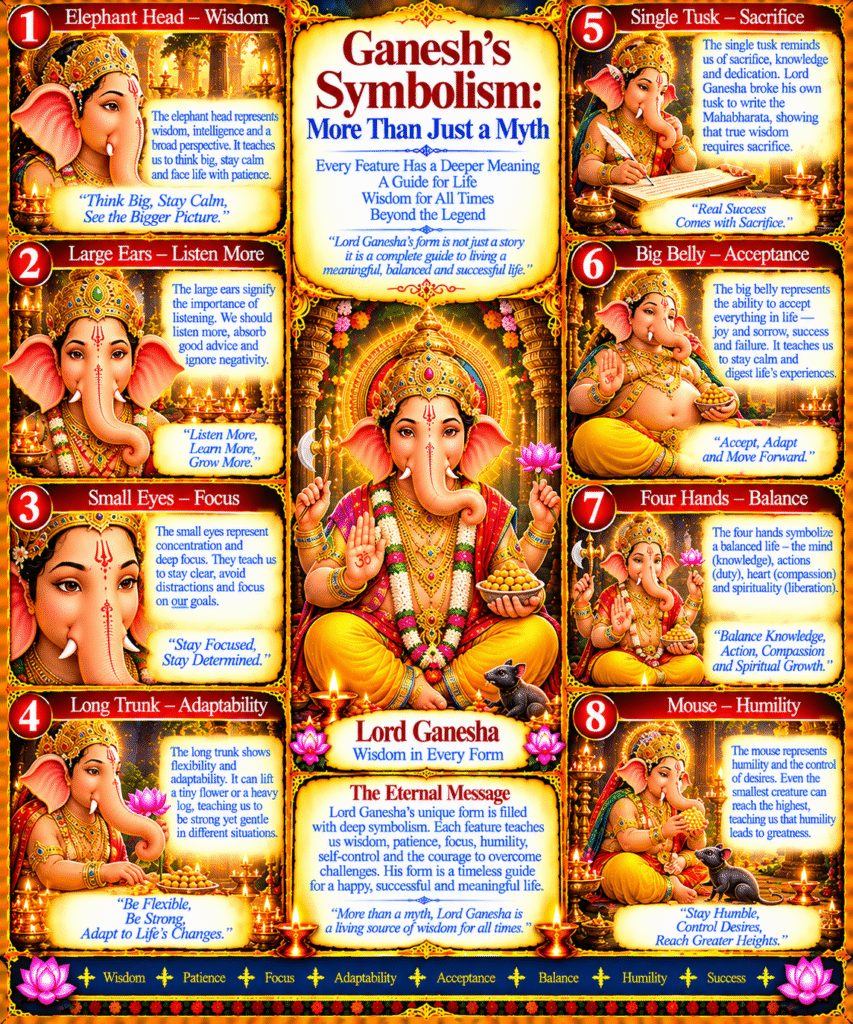
Every aspect of Lord Ganesha’s form is rich in symbolic meaning:
Elephant Head: Signifies wisdom, knowledge, and the ability to overcome obstacles.
Large Ears: Indicate a capacity to listen carefully and absorb knowledge.
Small Eyes: Symbolize concentration and a focused mind.
Adaptability and strength are represented by the trunk, a flexible and efficient tool.
The Broken Tusk represents sacrifice and the ability to retain what is good while discarding what is not.
Mouse (Mushika): His mount symbolizes desire, which can be controlled through wisdom.
Ganesha’s image reminds devotees to pursue knowledge and self-discipline while staying humble and aware of life’s deeper truths.
about lord Ganesh- Patron of Arts, Sciences, and Intellect
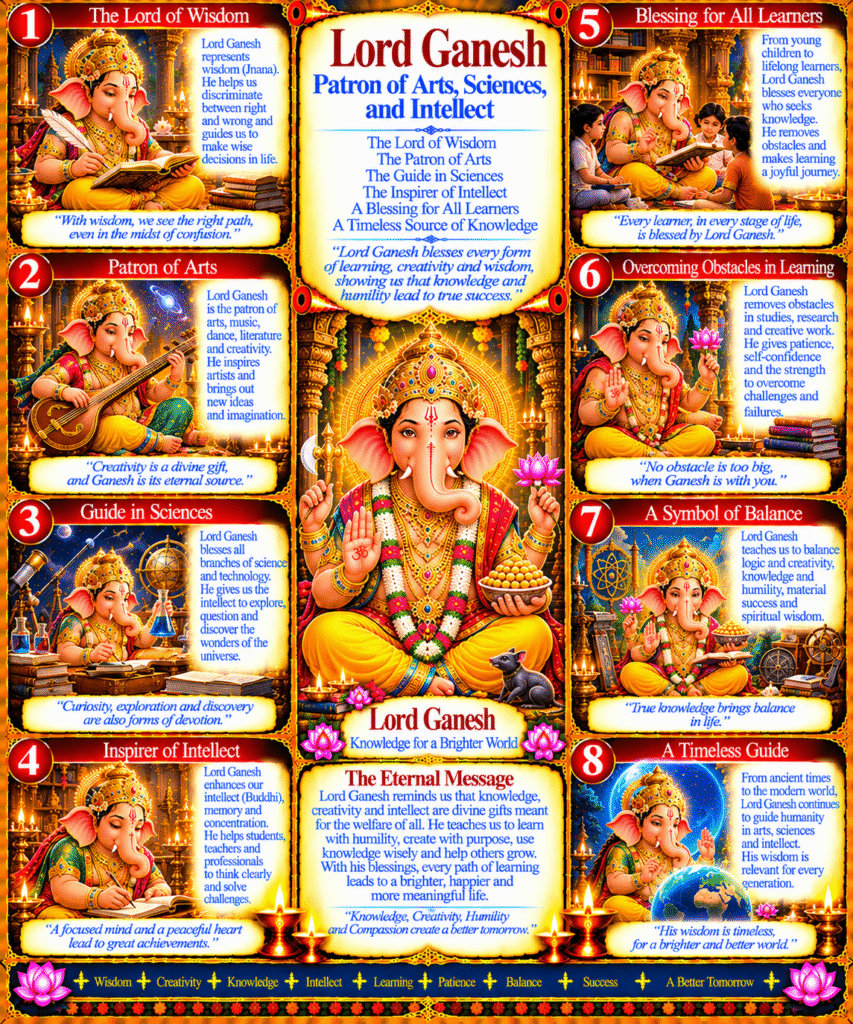
Ganesha is not only the remover of obstacles but also the patron of learning, intellect, arts, and sciences. Students, writers, musicians, and entrepreneurs often pray to him before starting any venture. His blessings are considered essential for achieving success without hindrance.
Religions, weddings, and festivals traditionally invoke Ganesh at the beginning. A salutation to Ganesh is celebrated at the beginning of every major work in classical Indian literature.
Popular Legends and Stories
The Race Around the World
One of the most beloved stories features Ganesha and his brother Kartikeya, racing to circle the world. While Kartikeya sets off on his peacock, Ganesha calmly walks around his parents, Shiva and Parvati, declaring that they are his world. Impressed, they declare Ganesha the winner, showcasing his intelligence and deep devotion.
Ganesh and the Writing of the Mahabharata
It is believed that sage Vyasa chose Ganesh to write the epic Mahabharata as he dictated it. Ganesh agreed on the condition that Vyasa would not pause in his recitation. Vyasa, in turn, asked Ganesh to understand each verse before writing it down, allowing him time to compose as he went. This tale highlights Ganesh’s intellect and composure.
about lord Ganesh: Ganesh Across Cultures
Though rooted in Hindu tradition, Lord Ganesh is revered beyond India. He is worshipped in Nepal, Sri Lanka, Thailand, Indonesia (especially Bali), and even in Buddhist and Jain traditions. His image is a global icon of wisdom, learning, and auspicious beginnings.
Even in the modern world, Ganesh’s influence is evident in yoga studios, meditation spaces, artworks, and academic settings – wherever people seek inspiration, clarity, and focus.
about lord Ganesh : Conclusion
Lord Ganesha’s charm lies not only in his unique appearance but in the profound life lessons he imparts – think clearly, act wisely, and always be humble. He is a beacon of hope for those embarking on new paths, facing obstacles, or simply seeking peace and understanding.
Whether you’re praying before a new job, writing your first book, starting a business, or beginning a spiritual journey – Ganesh stands by your side, blessing you with wisdom, success, and courage.
lord Ganesh’s brother’s name?
Lord Ganesh’s brother’s name is Kartikeya.
lord Ganesh’s birthday?
Lord Ganesh’s birthday is celebrated as Ganesh Chaturthi.
lord Ganesh’s birthplace?
Among the places of Lord Ganesh’s birth is Mount Kailash, which is the divine abode of Lord Shiva and Goddess Parvati.
lord Ganesh’s birthday 2025?
Wednesday, 27 August 2025, aligning with Shukla Paksha Chaturthi in the Hindu month of Bhadrapada.
children of lord Ganesh?
Two sons: Shubha and Labha
Different names of lord Ganesh?
Vinayaka, Vighneshwara, Ganapati, Lambodara, Ekadanta
Daughter of lord Ganesh?
Santoshi Mata
Jai Shri Ganesh! 🙏