Raja Ratnam
The Mahabharata is a monument of classical literature, exploring the depths of righteousness, duty, and human emotion. Among the many women characters who leave a permanent mark on the epic, the story of Hidimbi in the Mahabharata is one of the most unique, touching, and spiritually significant. Unlike other royal queens who came from established dynasties, Hidimbi belonged to the Rakshasa clan—the forest-dwelling tribes of ancient India. Yet, her transformation from a forest dweller to the devoted wife of the Pandava prince Bhima, and the mother of the legendary warrior Ghatotkacha, stands as a testament to her noble character, high intelligence, and profound sacrifices.
To truly understand Hidimbi in the Mahabharata, one must look past the superficial labels of “demoness” or “rakshasi” and analyze her choices, her devotion, and the critical role she played in helping the Pandavas survive their early trials. Her story teaches us that nobility is not defined by birth or lineage, but by actions, love, and adherence to Dharma.
The Lineage and Identity of Hidimbi in the Mahabharata
Hidimbi lived with her brother Hidimba in the dense, dark forests located in the northern region of ancient India (believed to be parts of modern-day Himachal Pradesh, where she is still worshipped as a deity today). They belonged to the Rakshasa clan, a group of forest dwellers often portrayed in ancient texts as possessors of magical powers, shape-shifting abilities, and a fierce, independent lifestyle.
Hidimba was the powerful and tyrannical chieftain of the forest, who ruled over the wilderness with terror. Hidimbi, his sister, lived under his authority but possessed a gentler, more compassionate nature. In the epic, she is described as having the ability to cast illusions and transform her physical appearance at will. Her natural form was that of a forest dweller, but she could easily assume the form of a celestial maiden of breathtaking beauty—a skill she would later use during a fateful encounter that changed the course of her life.
For official cultural and historical archives, visit the Ministry of Culture, Government of India.
The Fateful Encounter: How Hidimbi in the Mahabharata Met Bhima
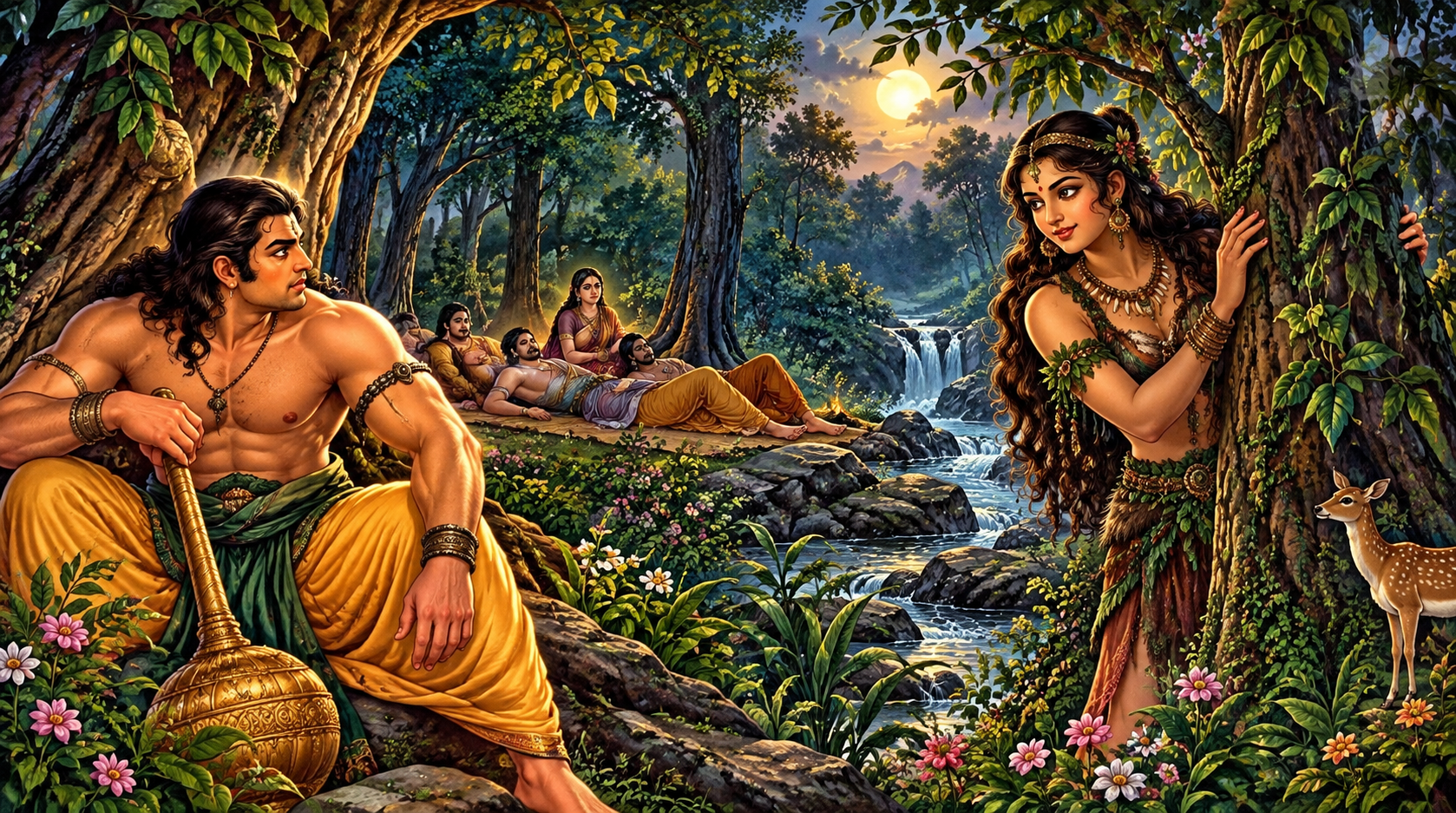
The journey of Hidimbi in the Mahabharata begins when the Pandavas, along with their mother Kunti, escaped the burning palace of wax (Lakshagraha) in Varanavata. Exhausted, hungry, and fleeing for their lives, they wandered into the deep forest ruled by Hidimba. While Kunti and the other brothers slept under a massive banyan tree, the mighty Bhima stayed awake to guard them.
Smelling the scent of humans, the hungry chieftain Hidimba ordered his sister Hidimbi to go and kill them so they could feast on their flesh. Following her brother’s orders, Hidimbi approached the sleeping family. However, the moment she saw Bhima sitting guard, she was instantly struck by his magnificent physique, noble posture, and radiant face. Instead of fear or bloodlust, a deep feeling of love and admiration arose in her heart.
Realizing that her brother would kill this noble prince, Hidimbi decided to defy Hidimba. She used her magical powers to transform herself into a beautiful human woman, dressed in elegant forest garments and flowers. She approached Bhima, confessed her love, and warned him of her brother’s impending arrival and deadly intentions. She urged Bhima to flee with his family, offering to use her magic to carry them to safety. Bhima, possessing the pride of a Kshatriya warrior, refused to run away in fear, declaring that he would face whatever danger came their way.
The Epic Duel and the Victory of Bhima
When Hidimba realized that his sister was taking too long, he grew suspicious and entered the clearing. Seeing Hidimbi in her beautiful human form conversing with a human prince, Hidimba was filled with rage. He accused his sister of betraying her clan and attempted to attack her. Bhima stepped in to protect Hidimbi, initiating a colossal battle.
The fight between Bhima and Hidimba shook the entire forest. They wrestled, uprooting massive trees and throwing giant rocks at each other. The noise woke Kunti and the other Pandava brothers. Seeing the beautiful woman standing nearby, Kunti asked who she was. Hidimbi introduced herself, explained the situation, and declared her love for Bhima, pleading with Kunti to accept her as a daughter-in-law.
Eventually, Bhima overcame Hidimba, lifting him high in the air and breaking his back, ending the tyrant’s reign over the forest. With Hidimba dead, the forest dwellers welcomed the victory, and Hidimbi was freed from her brother’s control.
The Gandharva Marriage of Hidimbi in the Mahabharata
The Marriage Vows and Blessings for Hidimbi in the Mahabharata
The Forest Life and Adventures of Hidimbi in the Mahabharata
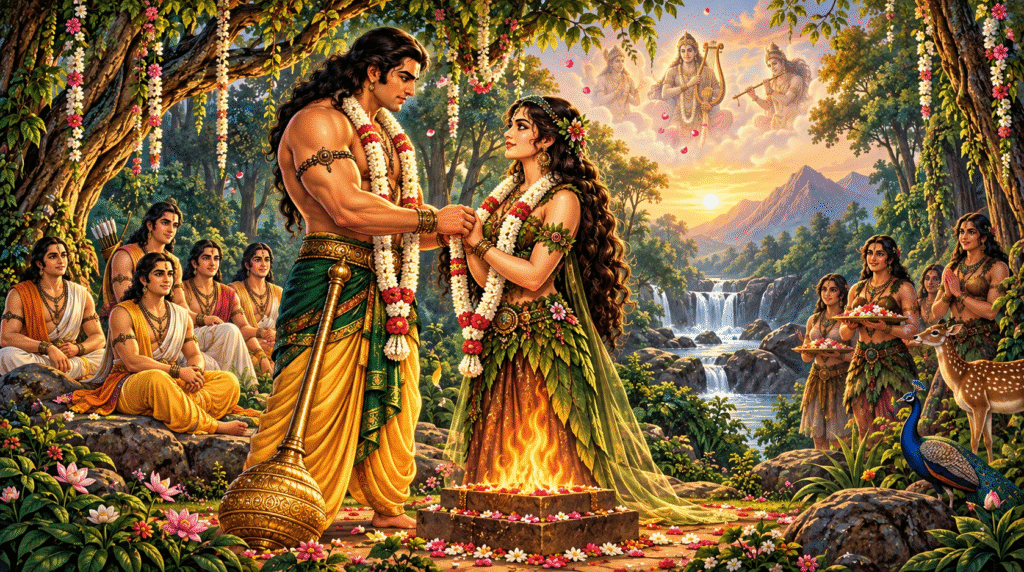
Following the battle, Hidimbi approached Kunti and Yudhishthira, begging them to allow Bhima to marry her. She argued that she had saved the family by warning them of her brother’s trap, and she had forsaken her own clan out of love for Bhima. She promised that she would only keep Bhima with her during the day in the forest, and return him to his family every evening, and that once she bore a son, she would release Bhima completely from his marriage vows.
Kunti, recognizing the gratitude they owed to Hidimbi and seeing her genuine devotion, agreed to the alliance. Yudhishthira sanctioned the marriage under the traditional Gandharva Vivaha customs (a marriage based on mutual consent and love, common in forest regions).
The marriage of Hidimbi in the Mahabharata was a period of great joy. Bhima lived with Hidimbi in the scenic valleys of the Himalayas, exploring beautiful lakes, gardens, and peaks. Hidimbi used her magical powers to make their time together wonderful, creating celestial bowers and serving her husband with absolute devotion. True to her promise, she ensured Bhima returned to his family’s camp regularly, showing deep respect for his duties to his mother and brothers.
Mother of Ghatotkacha: Raising a Legend of Hidimbi in the Mahabharata
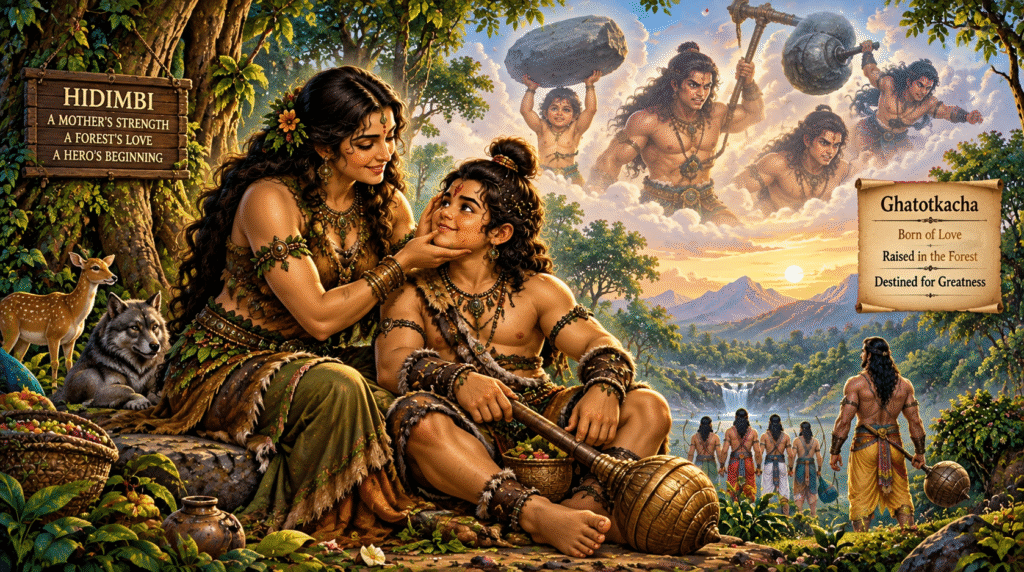
The Rapid Growth and Powers of Ghatotkacha, Son of Hidimbi in the Mahabharata
Training and Education in the Forest by Hidimbi in the Mahabharata
Values of Truth and Valiancy Taught by Hidimbi in the Mahabharata
Divine Blessings and Weapons Given to Ghatotkacha, Son of Hidimbi in the Mahabharata
In due course, Hidimbi gave birth to a son. Because he was born without hair on his head and had a head shaped like a pot, he was named Ghatotkacha (meaning “bald pot”).
Ghatotkacha was half-human and half-Rakshasa, inheriting the immense physical strength and courage of his father Bhima, along with the magical shape-shifting abilities and forest mastery of his mother Hidimbi. He grew rapidly, reaching adulthood almost immediately after birth, in accordance with the unique attributes of the Rakshasa clan.
From his childhood, Hidimbi raised Ghatotkacha with noble values. Despite living in the forest, she taught him to respect his father’s lineage, bow down to his elders, and always stand on the side of righteousness (Dharma). Ghatotkacha became fiercely loyal to his father and the Pandavas, promising them that whenever they needed his help, he would appear instantly to fight for them.
The Sacrifice and Separation of Hidimbi in the Mahabharata
True to the promise she made before her marriage, once Ghatotkacha was born, Hidimbi in the Mahabharata released Bhima from his vows. The Pandavas needed to move on to other kingdoms to gather allies and prepare for their eventual reclaim of Hastinapur.
Hidimbi did not demand to accompany them to the royal cities, knowing that a forest queen would face prejudice and political complications in the rigid social structure of Hastinapur. Instead, she chose to remain in the forest, raising Ghatotkacha alone in the wilderness. This quiet sacrifice is one of the most poignant moments of her life: she chose her husband’s duty and her son’s peace over her personal happiness.
Years later, during the Kurukshetra War, Hidimbi sent her only son, Ghatotkacha, to fight for the Pandavas. Ghatotkacha proved to be one of the most formidable warriors on the battlefield, devastating the Kaurava army with his colossal size and magical combat. In a desperate move to save his army, Karna was forced to use the divine weapon (Vasavi Shakti)—which he had saved specifically to kill Arjuna—to slay Ghatotkacha.
The death of Ghatotkacha was a massive blow to the Pandavas, but his sacrifice saved Arjuna’s life, ensuring the ultimate victory of Dharma. Hidimbi, hearing of her son’s heroic death, bore the immense grief of a mother with quiet dignity, knowing that her son had fulfilled his duty and entered the halls of eternal glory.
The Legacy and Worship of Hidimbi in the Mahabharata
Hidimbi’s legacy extends far beyond the pages of the epic text. In modern India, she is revered as a powerful goddess.
- The Hadimba Temple: Located in Manali, Himachal Pradesh, the famous Hadimba Temple (built in 1553 CE by Maharaja Bahadur Singh) is dedicated to her. It is a beautiful wooden structure built around a cave where she is believed to have performed intense penance (*Tapas*) to attain divine status.
- Deification: Over centuries, she transformed from a mythological character to a protector deity of the valley, representing strength, nature, and motherly protection.
- Symbol of True Virtue: Hidimbi in the Mahabharata serves as a powerful reminder that virtues like loyalty, love, and righteousness are not the monopoly of high-born royalty. She chose Dharma over her own brother, loved unconditionally, and made the ultimate maternal sacrifice for the survival of the Pandavas.
—
Frequently Asked Questions (FAQs) About Hidimbi in the Mahabharata
1. Who was Hidimbi in the Mahabharata?
Hidimbi was a forest dweller (belonging to the Rakshasa clan), the sister of the chieftain Hidimba, the first wife of the Pandava prince Bhima, and the mother of the warrior Ghatotkacha.
2. What is the relation between Hidimbi and Bhima?
Hidimbi was the first wife of Bhima. They were married in the forest under the Gandharva Vivaha custom after Bhima defeated her brother Hidimba.
3. Who was Hidimbi’s brother, and what happened to him?
Hidimbi’s brother was Hidimba, the tyrannical Rakshasa chieftain of the forest. He attempted to kill the Pandavas and Kunti, but Bhima fought and killed him in an epic duel.
4. How did Hidimbi in the Mahabharata help the Pandavas?
She warned Bhima of her brother’s plot to kill them and offered to help them escape using her magical powers, thereby saving their lives.
5. What kind of marriage did Bhima and Hidimbi have?
They had a Gandharva marriage, which is a marriage based on mutual love and consent without elaborate rituals, common in ancient Indian forests.
6. What promise did Hidimbi make to Kunti before marrying Bhima?
She promised that she would only keep Bhima with her during the day and return him to his family at night, and that she would release him from all vows once she gave birth to a son.
7. Who was the son of Hidimbi in the Mahabharata?
Her son was Ghatotkacha, a powerful warrior who played a critical role in the Kurukshetra War.
8. Why was Hidimbi’s son named Ghatotkacha?
He was named Ghatotkacha because he was born bald, and his head was shaped like a pot (*Ghatam*).
9. What powers did Ghatotkacha inherit from Hidimbi?
Ghatotkacha inherited shape-shifting abilities, forest camouflage, flight, and the power to cast illusions from his mother’s Rakshasa lineage.
10. Did Hidimbi live in Hastinapur with Bhima?
No, she chose to remain in the forest to avoid the social prejudices of the royal court and to raise her son in the safety of the wilderness.
11. How did Hidimbi’s son Ghatotkacha die in the war?
Ghatotkacha was killed by Karna during the Kurukshetra War. Karna was forced to use the Vasavi Shakti, a divine weapon that could only be used once, to stop Ghatotkacha’s devastating night attack.
12. Where is Hidimbi worshipped today?
She is worshipped as a deity in the Kullu Valley of Himachal Pradesh, India. The famous Hadimba Temple in Manali is dedicated to her.
13. When was the Hadimba Temple built?
The temple was built in 1553 CE by Maharaja Bahadur Singh, constructed around the cave where Hidimbi performed penance.
14. What are the key virtues of Hidimbi in the Mahabharata?
She represents unconditional love, loyalty to Dharma over family ties, absolute trust, and maternal strength in the face of sacrifice.
15. Did Bhima have other wives besides Hidimbi?
Yes, Bhima later married Draupadi (the princess of Panchala) and Valandhara (the princess of Kasi).
16. Did Hidimbi attend Yudhishthira’s coronation?
According to some regional retellings, she attended the Rajasuya and final Ashvamedha sacrifices, where she was treated with great respect by Kunti and Draupadi.
17. How did Hidimbi react to Ghatotkacha’s death?
She bore the news of her son’s death with quiet dignity, knowing he died a hero’s death defending his father’s family and establishing Dharma.
18. What is the meaning of the name Hidimbi?
The name Hidimbi is a patronymic or clan name associated with her family and forest territory.
19. Why did Kunti support Bhima’s marriage to Hidimbi?
Kunti recognized the gratitude they owed to Hidimbi for saving their lives, and she valued the alliance with the powerful forest dwellers to protect them during their exile.
20. Why is the story of Hidimbi in the Mahabharata unique?
It is unique because it shows a non-Aryan, forest-dwelling woman possessing higher virtues, loyalty, and dedication to Dharma than many of the civilized royal characters in the epic.