 Raja Ratnam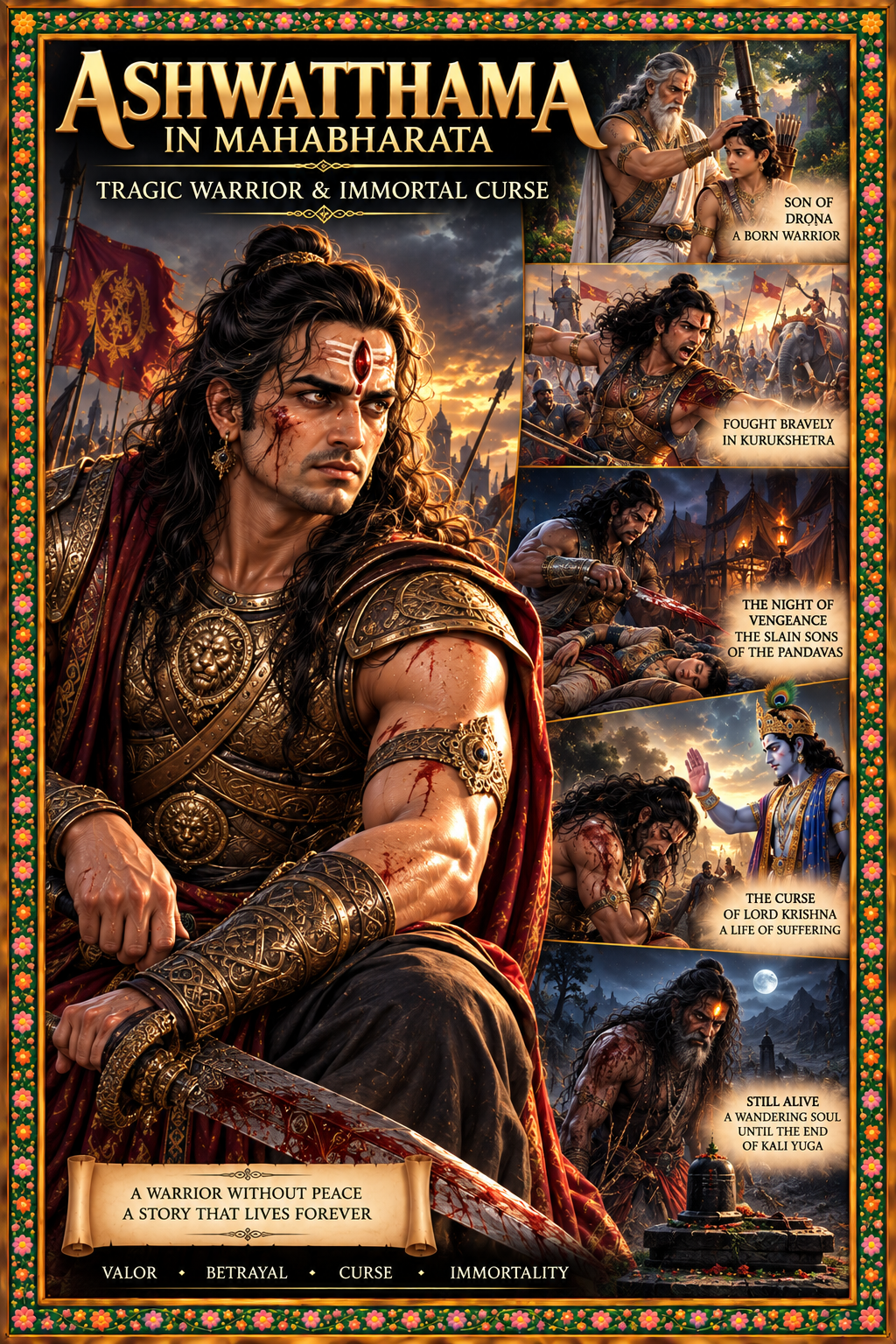
Introduction: Who Is Ashwatthama in Mahabharata?
Ashwatthama in Mahabharata stands as one of the most complex and tragic characters in the epic. Neither entirely evil nor fully righteous, he represents uncontrolled rage, wounded pride, and the devastating consequences of adharma. Born to the great teacher Dronacharya, Ashwatthama possessed immense power, divine weapons, and unmatched battlefield skill. Yet, his life ended not with glory—but with an eternal curse.
Ashwatthama is remembered as a Chiranjivi (immortal being), condemned to roam the earth in pain and isolation until the end of Kali Yuga. His story is not just about war—it is a moral warning.
For official cultural and historical archives, visit the Ministry of Culture, Government of India.
Birth and Early Life of Ashwatthama
Ashwatthama was born to Dronacharya and Kripi, the sister of Kripacharya. His birth itself was extraordinary. After years of intense penance and prayer to Lord Shiva, Drona was blessed with a powerful son.
It is believed that Ashwatthama was born with a divine gem (Mani) embedded in his forehead. This gem granted him:
- Immunity from disease
- Freedom from hunger and thirst
- Protection from weapons
- Superhuman strength
His name “Ashwatthama” means “the sound of a horse”, signifying strength and fearlessness.
Ashwatthama as the Son of Dronacharya
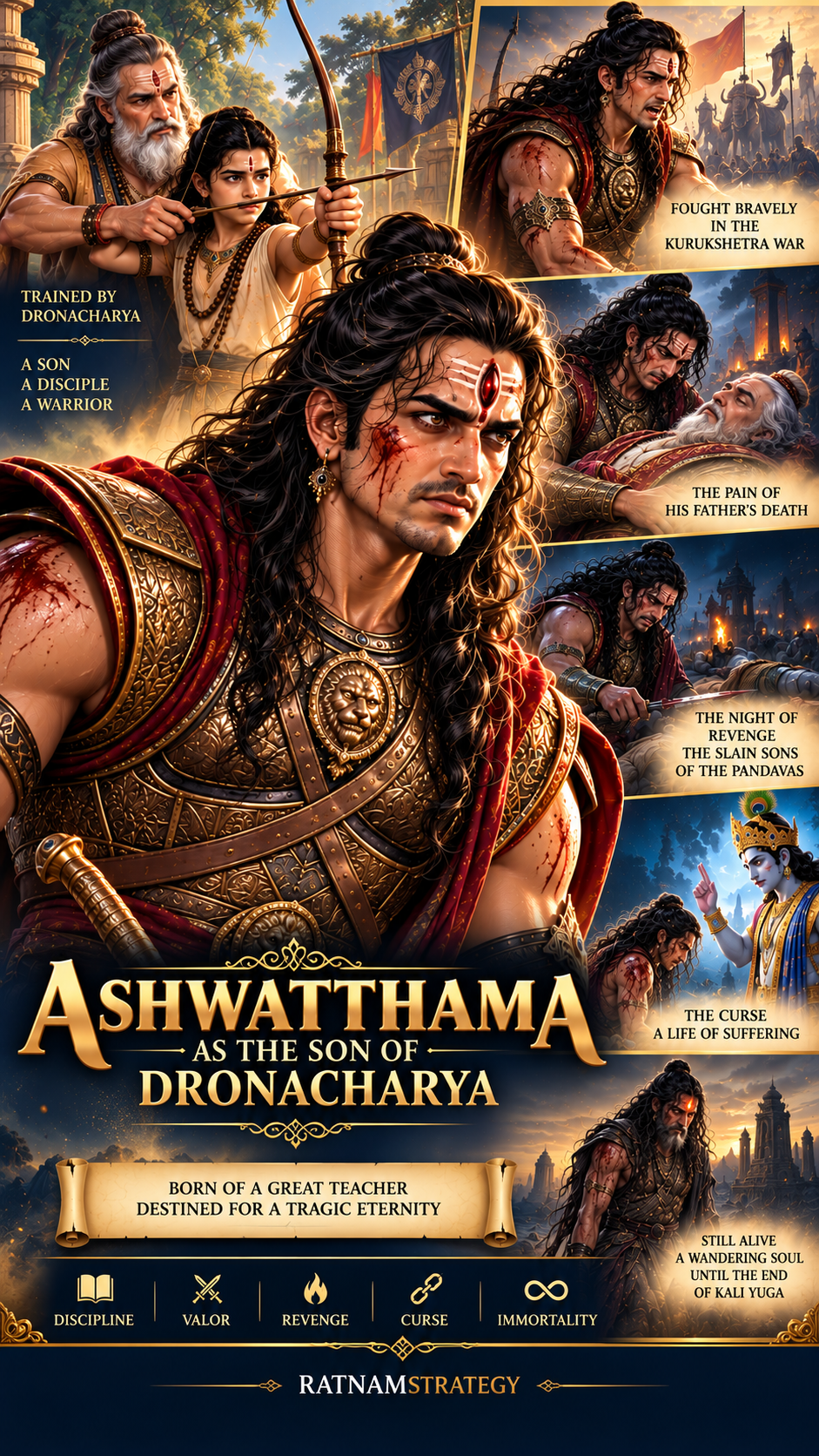
Growing up under Dronacharya, Ashwatthama received elite training in warfare, archery, and divine weapons. He studied alongside the Kauravas and Pandavas but developed deep loyalty toward Duryodhana, who respected and supported him.
Despite his skills, Ashwatthama suffered from emotional insecurity—largely due to his father’s poverty and humiliation in early life. This insecurity later transformed into anger and arrogance.
Role of Ashwatthama in the Kurukshetra War
During the Kurukshetra War, Ashwatthama fought fiercely on behalf of the Kauravas. His strength, combined with divine weapons like the Narayanastra, made him a terrifying force on the battlefield.
However, his fate changed drastically after the death of Dronacharya.
The Death of Dronacharya and Ashwatthama’s Rage
When Drona was killed through strategic deception involving the half-truth about Ashwatthama’s death, Ashwatthama was consumed by uncontrollable fury. This moment marked his moral downfall.
The Night Massacre: Ashwatthama’s Greatest Sin
In a moment of blind revenge, Ashwatthama committed the most horrifying act in the Mahabharata.
At night, while the Pandava camp slept, Ashwatthama—along with Kripacharya and Kritavarma—launched a brutal attack. Ashwatthama slaughtered:
- The sons of Draupadi (Upapandavas)
- Dhrishtadyumna (commander of Pandava army)
Mistaking the sleeping children for the Pandavas, Ashwatthama committed Brahmahatya-equivalent sin, killing innocent, unarmed warriors.
Ashwatthama and Draupadi: The Curse of Immortality
When Draupadi learned that all her sons were murdered, her grief shook the universe. Ashwatthama was captured and brought before the Pandavas.
Draupadi’s Mercy vs Krishna’s Justice
Draupadi, despite her pain, showed compassion and asked for Ashwatthama’s release. However, Lord Krishna declared that Ashwatthama’s crime demanded punishment.
The Curse
Lord Krishna cursed Ashwatthama:
- His forehead gem was removed, causing endless bleeding
- He would wander the earth for 3,000 years
- He would suffer pain, loneliness, and disease
- He would be immortal but miserable
This curse made Ashwatthama a Chiranjivi, not as a blessing—but as eternal punishment.
Ashwatthama and the Brahmastra Incident
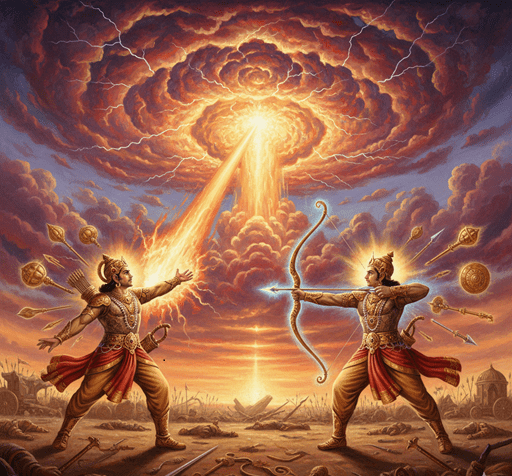
In desperation, Ashwatthama released the Brahmastra against the unborn child of Uttara (Parikshit). Arjuna countered with his own Brahmastra.
Lord Krishna intervened and saved Parikshit, ensuring the continuation of the Kuru lineage. This act sealed Ashwatthama’s fate forever.
Is Ashwatthama Still Alive? Immortality Legends
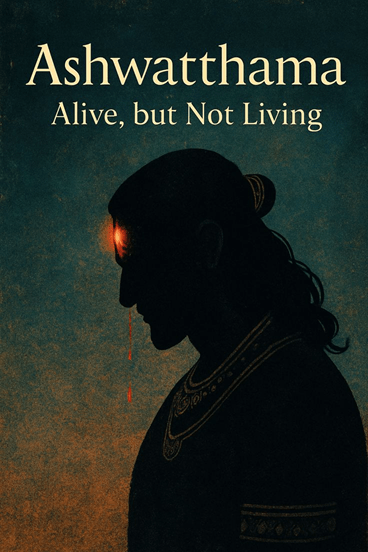
One of the most mysterious aspects of Ashwatthama in Mahabharata is his immortality. According to legends:
- He roams forests and mountains
- Some believe he appears at sacred sites
- His wounds never heal
While no proof exists, Ashwatthama remains a powerful symbol of living guilt and eternal suffering.
Symbolism and Moral Lessons from Ashwatthama’s Life
Ashwatthama represents:
- The danger of uncontrolled anger
- The destruction caused by revenge
- Power without wisdom
- Adharma leading to eternal suffering
His life teaches that skill, lineage, and devotion mean nothing without righteousness.
Ashwatthama in Modern Culture and Beliefs
Ashwatthama appears in:
- Indian folklore
- Television serials
- Spiritual discussions
He is often used as a reminder that even the greatest warriors fall when they abandon dharma.
Final Thoughts: Ashwatthama in Mahabharata
Ashwatthama in Mahabharata is not just a villain—he is a tragic lesson written in blood and sorrow. His immortality is not power but punishment, reminding humanity that dharma alone grants peace.
FAQs: Ashwatthama in Mahabharata
1. Who was Ashwatthama in Mahabharata?
Ashwatthama was the son of Guru Dronacharya and a mighty warrior who fought on the side of the Kauravas in the Kurukshetra war.
2. Why is Ashwatthama famous in Mahabharata?
Ashwatthama is famous for his immense power, his role in the Kurukshetra war, the night massacre of the Pandava sons, and the curse of immortality given by Lord Krishna.
3. Who were Ashwatthama’s parents?
Ashwatthama’s father was Dronacharya, the royal teacher of the Kuru princes, and his mother was Kripi, sister of Kripacharya.
4. What divine power did Ashwatthama possess at birth?
Ashwatthama was born with a divine gem (Mani) on his forehead that protected him from hunger, disease, fear, and weapons.
5. Why did Ashwatthama fight for the Kauravas?
Ashwatthama fought for the Kauravas due to loyalty toward Duryodhana and deep devotion to his father, Dronacharya.
6. What role did Ashwatthama play in the Kurukshetra war?
He was one of the strongest Kaurava warriors and used powerful celestial weapons against the Pandavas.
7. How did Dronacharya’s death affect Ashwatthama?
The death of Dronacharya broke Ashwatthama emotionally and pushed him toward extreme revenge and adharma.
8. What was the night massacre committed by Ashwatthama?
Ashwatthama killed the sleeping sons of the Pandavas and Dhrishtadyumna in a night attack, mistaking them for the Pandava brothers.
9. Why is Ashwatthama’s night attack considered a sin?
Because it violated the rules of war by killing unarmed and sleeping warriors, making it an act of grave adharma.
10. What is the Brahmashira Astra?
The Brahmashira Astra is a powerful celestial weapon capable of destroying entire lineages and causing massive destruction.
11. Why did Ashwatthama use the Brahmashira Astra?
He used it out of fear and desperation to escape Arjuna and the Pandavas after committing the night massacre.
12. How did Ashwatthama attack Uttara’s womb?
Unable to withdraw the Brahmashira Astra, Ashwatthama redirected it toward Uttara’s unborn child to end the Pandava lineage.
13. How was Parikshit saved from Ashwatthama’s weapon?
Lord Krishna entered Uttara’s womb and protected the unborn Parikshit, saving the Pandava dynasty.
14. What curse did Lord Krishna give Ashwatthama?
Krishna cursed him to live as an immortal, suffer from pain and disease, wander alone, and be separated from humanity.
15. Why is Ashwatthama called a Chiranjivi?
Ashwatthama is called a Chiranjivi because he was cursed with immortality and cannot die until the end of the age.
16. Is Ashwatthama still alive according to Hindu belief?
Yes, according to legend, Ashwatthama still roams the earth as an immortal being.
17. Where is Ashwatthama believed to live now?
Folklore suggests he wanders forests, mountains, and sacred places, avoiding human settlements.
18. Was Ashwatthama evil or misunderstood?
Ashwatthama was not purely evil; he was a tragic figure whose anger, grief, and poor choices led to his downfall.
19. What moral lesson does Ashwatthama’s life teach?
His story teaches that power without righteousness and control leads to destruction and eternal suffering.
20. Why is Ashwatthama important in Mahabharata today?
Ashwatthama remains relevant as a symbol of the consequences of revenge, unchecked anger, and moral failure.

I like what you guys tend to be up too. This type of clever work and exposure!
Keep up the very good works guys I’ve added you guys to our blogroll.
Thank you so much! 😊
Really glad you’re enjoying the content and the work we’re putting out. It means a lot that you’ve added us to your blogroll—truly appreciate the support!
We’ll keep sharing valuable and engaging content. Looking forward to staying connected! 🚀
894016 739178We are a group of volunteers and opening a new scheme in our community. Your internet web site given us with valuable details to function on. Youve done an impressive job and our entire community will likely be grateful to you. 108675
Thank you so much for your kind words! We’re truly happy to hear that our website has been helpful to your community initiative. Your appreciation means a lot to us and motivates us to continue sharing valuable content and resources.
Wishing you and your team of volunteers great success with your new scheme. We hope your project brings positive change and benefits to many people in your community. Thank you once again for your support and encouragement!
This one has been my go to since the day I signed up. The game library is massive and the promotions keep things exciting. I always feel safe and well taken care of while playing here. Definitely worth the switch. phjiligames
Here’s a warm, appreciative reply you can use:
Thank you so much for sharing your experience! 😊 We’re thrilled to hear that you’ve been enjoying the game library and promotions since day one. Your trust and support mean a lot to us. Wishing you plenty of fun and exciting moments ahead! 🎮✨