Raja Ratnam
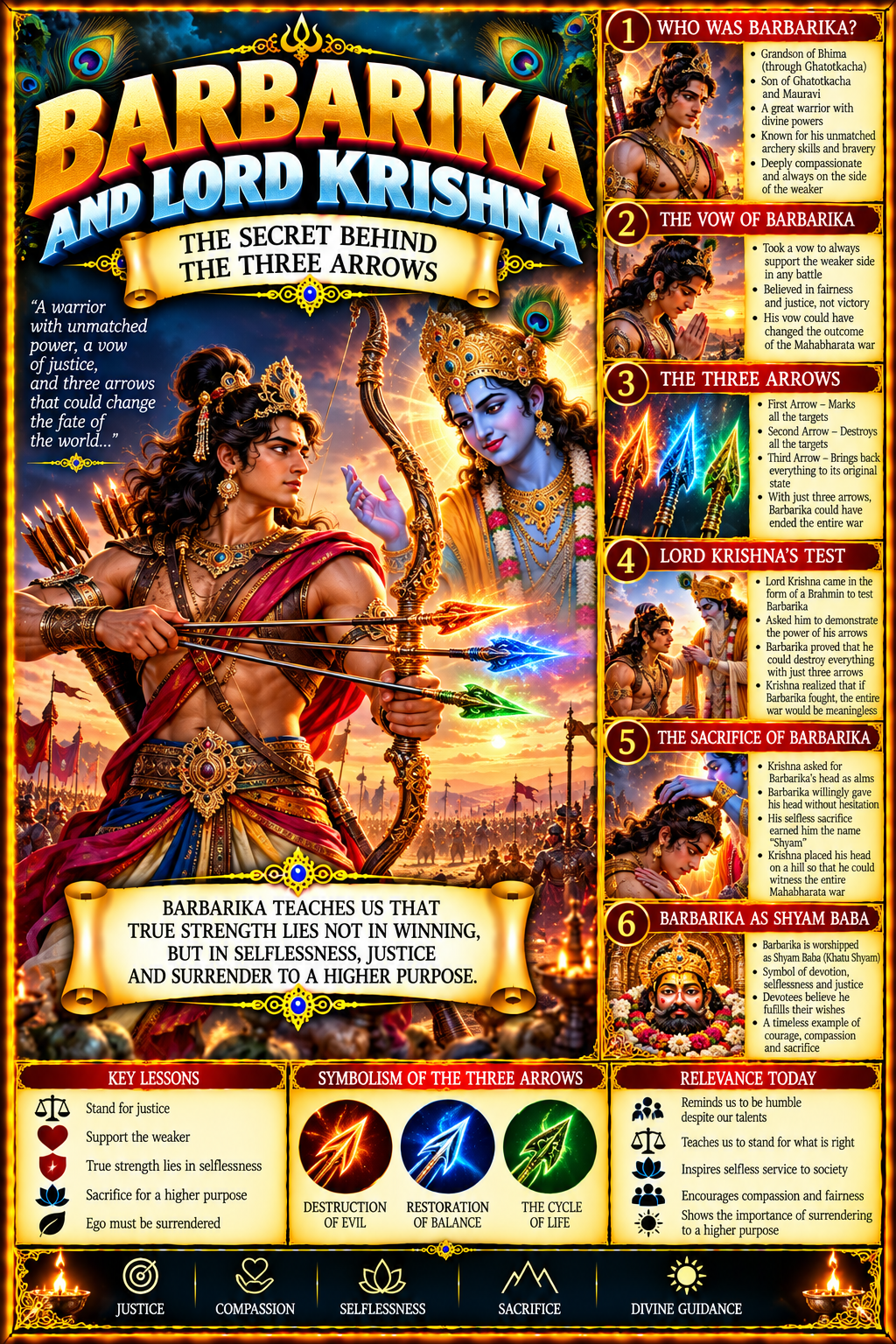
In the vast tapestry of ancient Indian lore and the Kurukshetra epic, the extraordinary narrative of Barbarika and Lord Krishna stands as one of the most intellectually fascinating, spiritually profound episodes of Sanatana Dharma. While millions of seekers revere the great warriors who clashed over eighteen cataclysmic days, few realize that a solitary youth held the power to terminate the entire war in less than a minute. Armed with only three infallible celestial arrows (Teen Baan) and bound by an innocent yet dangerous vow, the encounter between Barbarika and Lord Krishna redefined the laws of karma, divine duty, and absolute surrender.
Revered today across millions of sanctified shrines throughout India as Khatu Shyam Ji (the supreme deity of the defeated), Barbarika’s lineage connects directly to the core protagonists of the epic. As the illustrious grandson of the mighty Pandava prince Bhima in the Mahabharata and the divine demoness Hidimbi in the Mahabharata, and the son of the colossal nocturnal titan Ghatotkacha in the Kurukshetra War, Barbarika inherited both immense physical strength and mystic occult supremacy. Yet, it was neither brute strength nor sorcery that marked his legend, but his dialogue under a sacred Peepal tree with Lord Krishna in the Mahabharata.
Documented in sacred regional traditions and archived in ancient Sanskrit texts such as the Skanda Purana preserved on digital scholarly portals like Wisdom Library, Barbarika’s tale illustrates why raw military omnipotence must always bow to cosmic balance. This comprehensive treatise explores the metaphysical mechanics of the Three Arrows, the paradoxical leaf test, the selfless sacrifice of his head (Sheesh Daan), and his eternal elevation as Shyam Baba.
Who Was Barbarika? The Lineage, Austerities, and the Encounter of Barbarika and Lord Krishna
To comprehend why the young warrior posed such an existential challenge to the destiny of Kurukshetra, one must explore his celestial heritage and rigorous spiritual training. Barbarika was born to Ghatotkacha and Princess Maurvi (also known in regional texts as Ahilawati or Kamakantaka), the daughter of the serpent king Muru. From his earliest childhood, Barbarika exhibited extraordinary spiritual inclination. Rather than pursuing mundane kingdom affairs, he retreated into deep forest hermitages to perform rigorous tapasya (ascetic penances).
His unwavering devotion pleased Goddess Kamakhya (Mahamaya) and the Eight Mother Goddesses (Ashtamatrikas). Blessed by the divine feminine Shakti and Lord Shiva, Barbarika was granted a celestial bow alongside three infallible arrows known across Vedic history as Teen Baan. With these weapons, Barbarika became technically invincible; no celestial armor, magical cloaking, or divine chariot could shield an opponent once his arrows were loosed.
The Sacred Maternal Vow: “Hare Ko Sahara” (Supporting the Defeated)
As the drums of Kurukshetra sounded, Barbarika wished to witness the epic war and utilize his peerless martial gifts. Before granting her blessings for his departure, his mother Maurvi extracted a solemn, inviolable promise from her dutiful son. Knowing the destructive power of his arrows, she asked:
“O son, if you must participate in this colossal conflict, which army will you fight for? Promise me that you will never champion the arrogant or the victorious; you shall always raise your bow to shield whichever side is losing and facing defeat.”
Barbarika bowed to his mother and gave his sacred word: “Hare ko Sahara” – he would fight exclusively on behalf of the losing side. With a light blue steed (Leela Ghoda) and his quiver bearing just three arrows, the young warrior rode forth toward the plains of Kurukshetra, completely unaware of the lethal mathematical paradox his vow entailed.
The Secret Behind the Three Arrows (Teen Baan): Unrivaled Cosmic Firepower
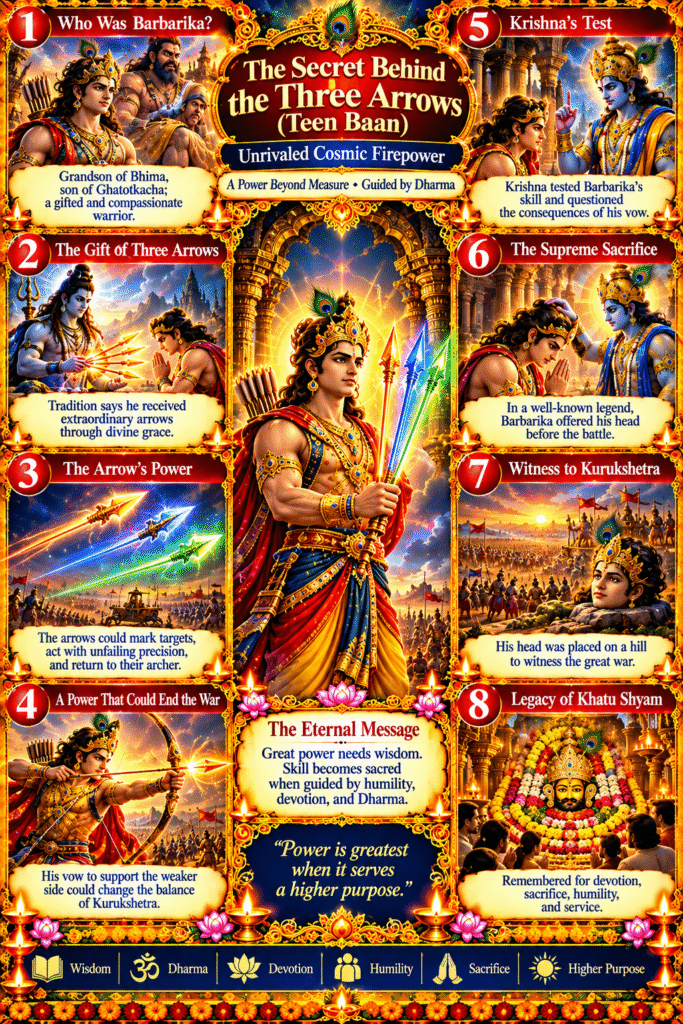
While renowned archers of the epic – such as depicted in our martial analysis of Karna vs Arjuna in the Mahabharata – carried thousands of specialized shafts, celestial quivers, and destructive astras like the Brahmashira or Vaishnavastra, Barbarika carried strictly three arrows. Each arrow performed an exact, irreversible cosmic function governed by pure intent and infallible divine guidance.
1. The First Arrow: Identifying and Marking the Targets to be Destroyed
The first arrow was released not to kill, but to scan the entire battlefield. Flying through the atmosphere at supersonic speed, it released a subtle red kumkum (vermilion) powder, marking every single entity, warrior, or weapon that Barbarika intended to destroy. It ignored friends and unerringly targeted foes, hovering instantaneously over thousands of combatants.
2. The Second Arrow: Identifying and Protecting the Allies to be Spared
The second arrow was released to mark all entities, protectors, and friendly formations with sacred yellow or white marks, designating them as inviolable allies who must be shielded from harm. No weapon could harm those whom the second arrow touched.
3. The Third Arrow: Infallible Execution and Return to the Quiver
The third and final arrow was the ultimate executioner. Once released, it traveled with inexorable divine precision, severing the heads or piercing the hearts of every target marked in red by the first arrow. After liquidating every earmarked enemy, the third arrow returned quietly into Barbarika’s quiver, untainted and ready for another cycle.
The Astrological and Metaphysical Mechanism of the Teen Baan
The three arrows represented the three primordial gunas (Sattva, Rajas, and Tamas) and the three phases of cosmic existence: creation (designation), preservation (protection), and dissolution (annihilation). By operating through spiritual resonance rather than physical trajectories, the Teen Baan bypassed conventional martial defenses.
The Divine Intervention: Lord Krishna Tests Barbarika Under the Peepal Tree
Omniscient to the events of the three worlds, Lord Krishna recognized the cataclysmic threat Barbarika’s vow posed to the divine plan of Dharma. If Barbarika joined the war, the outcome would not be a victory for righteousness, but total universal annihilation. Disguising Himself as an elderly Brahmin priest, Krishna intercepted Barbarika as he rested beneath a gigantic Peepal (sacred fig) tree near Kurukshetra.
The Brahmin playfully taunted the young warrior: “Young prince, you ride toward the greatest war in cosmic history with merely three arrows in your quiver! Do you intend to fight mighty maharathis like Bhishma, Drona, Karna, and Arjuna with mere toys?” Barbarika smiled respectfully and explained that just a single arrow was sufficient to wipe out all opposing ranks, while three arrows could finish the entire war in moments.
The Challenge: Piercing Every Leaf of the Peepal Tree
To verify his claim, the Brahmin posed an impossible challenge: “If your arrows are truly infallible, pierce every single leaf of this towering Peepal tree with a single shot.” Barbarika calmly accepted the challenge. He closed his eyes, meditated upon Goddess Kamakhya, and released the first arrow.
The arrow flew into the dense canopy with lightning velocity, marking every leaf on the thousands of branches with red vermilion. However, while Barbarika’s eyes were closed, Krishna discreetly plucked a solitary green leaf and hid it firmly beneath his bare left foot, seeking to test if the celestial missile could penetrate the divine presence.
The Infallible Arrow Circles Lord Krishna’s Foot
Having marked every leaf on the tree, the arrow descended from the canopy and began hovering intensely around Krishna’s foot, vibrating with piercing energy. Barbarika looked at the disguised Brahmin with folded hands and said:
“O holy Brahmin, please lift your foot! There is a leaf concealed beneath your sole. My arrow must mark that leaf to fulfill its command, and if you do not lift your foot, it will pierce through your flesh to reach the leaf.”
Lord Krishna gently lifted His foot, marveling at the arrow’s absolute precision. It marked the hidden leaf and returned safely into Barbarika’s quiver. Krishna now knew without a shadow of a doubt that Barbarika’s archery was beyond any mortal or celestial defense.
The Cosmic Paradox: Why Lord Krishna Demanded Barbarika’s Head (Sheesh Daan)
Having witnessed the infallible power of the Teen Baan, Krishna inquired: “On whose side will you fight in this war, noble youth?” Barbarika proudly reiterated his sacred vow: “I have promised my mother that I will support whichever army is on the verge of defeat (‘Hare ko Sahara’).”
It was at this moment that Krishna unveiled the devastating, terrifying logic hidden within Barbarika’s vow:
The Oscillating Slaughter: The Inevitable Doom of Both Armies
The horrifying mathematical truth was undeniable: by perpetually fighting for the losing side, Barbarika would oscillate back and forth between both armies until every single warrior on both sides was killed. In the end, he would stand alone on a desolated, blood-soaked plain, forced either to kill himself or survive as the sole soul in a lifeless cosmos. The righteous cause of Dharma and the restoration of truth would be entirely obliterated.
The Demand for the Supreme Sacrifice: Guru Dakshina
To preserve the cosmic order, Krishna revealed that before inaugurating a war of righteous cleansing, ancient Vedic injunctions required the voluntary sacrifice of the purest, most valorous warrior on the battlefield to sanctify the earth. There were only three eligible warriors of such peerless stature: Lord Krishna Himself, Arjuna, and Barbarika. Because Krishna was the cosmic guide and Arjuna was the instrument of Dharma, Barbarika stood as the supreme candidate.
Disguised as the Brahmin, Krishna asked for charity (Daan). Barbarika promised to grant whatever the holy man requested. Krishna then asked: “Give me your head.” Barbarika was stunned, but instantly realized that no ordinary mortal priest could demand such a staggering sacrifice or understand the profound intricacies of cosmic war.
Revelation of the Vishwaroopa and the Severing of the Head
Barbarika bowed humbly and requested the Brahmin to reveal his true identity. Lord Krishna then manifested His divine, blinding Vishwaroopa (Universal Cosmic Form). Barbarika was filled with transcendental ecstasy. He declared: “O Supreme Lord, my life and my head are blessed to be surrendered at Your divine lotus feet. I have only one final wish: I yearn to witness the great war of Kurukshetra from its beginning to its final victory.”
Krishna granted his boon with boundless love. Barbarika drew his sharp blade, severed his own head with unflinching devotion, and placed it reverently into Lord Krishna’s hands. For this unparalleled act of self-immolation for the protection of Dharma, Barbarika earned the eternal title Sheesh Ke Daani (“The Supreme Giver of the Head”).
The Severed Head on the Hilltop: Witnessing the True Reality of Kurukshetra
Lord Krishna bathed Barbarika’s severed head in sacred amrita (nectar) and consecrated it atop a high hilltop overlooking the plains of Kurukshetra. With divine sight and consciousness intact, Barbarika watched every maneuver, clash, and celestial weapon unleashed over the eighteen tumultuous days.
When the war concluded with the victory of the Pandavas, a bitter dispute arose among the victorious brothers. Arjuna boasted that his archery and the Gandiva bow had won the day; Bhima claimed that his mace and sheer physical brute strength had broken the Kaurava backbone. Full of pride, the brothers turned to Lord Krishna to adjudicate who the greatest warrior of Kurukshetra truly was.
Smiling serenely, Krishna replied: “None of you can offer an objective judgment, for you were blinded by the fury of your own battles. Let us ask Barbarika’s head, which witnessed the entire war with untainted clarity from the mountain summit.”
Barbarika’s Stunning Testimony: The Cosmic Truth
Standing before the hilltop, the Pandavas asked Barbarika: “O noble son, tell us: whose valor and weapons truly annihilated the Kaurava hordes?” Barbarika smiled and delivered words that forever shattered their mortal egos:
“On the battlefield of Kurukshetra, I saw neither Arjuna firing arrows nor Bhima wielding the mace. I saw only one reality: the incandescent Sudarshana Chakra of Lord Krishna spinning across the skies, severing the heads of the unrighteous! And behind it, I saw Goddess Mahakali drinking the blood of those destined to fall. You warriors were merely puppets and instruments; it was Lord Krishna who fought, willed, and won the war from beginning to end.”
Hearing this revelation, the Pandava brothers hung their heads in shame, completely cured of their vanity and filled with deep gratitude for the Lord’s unfathomable grace.
From Barbarika to Khatu Shyam Ji: Lord Krishna Kali Yuga Blessing
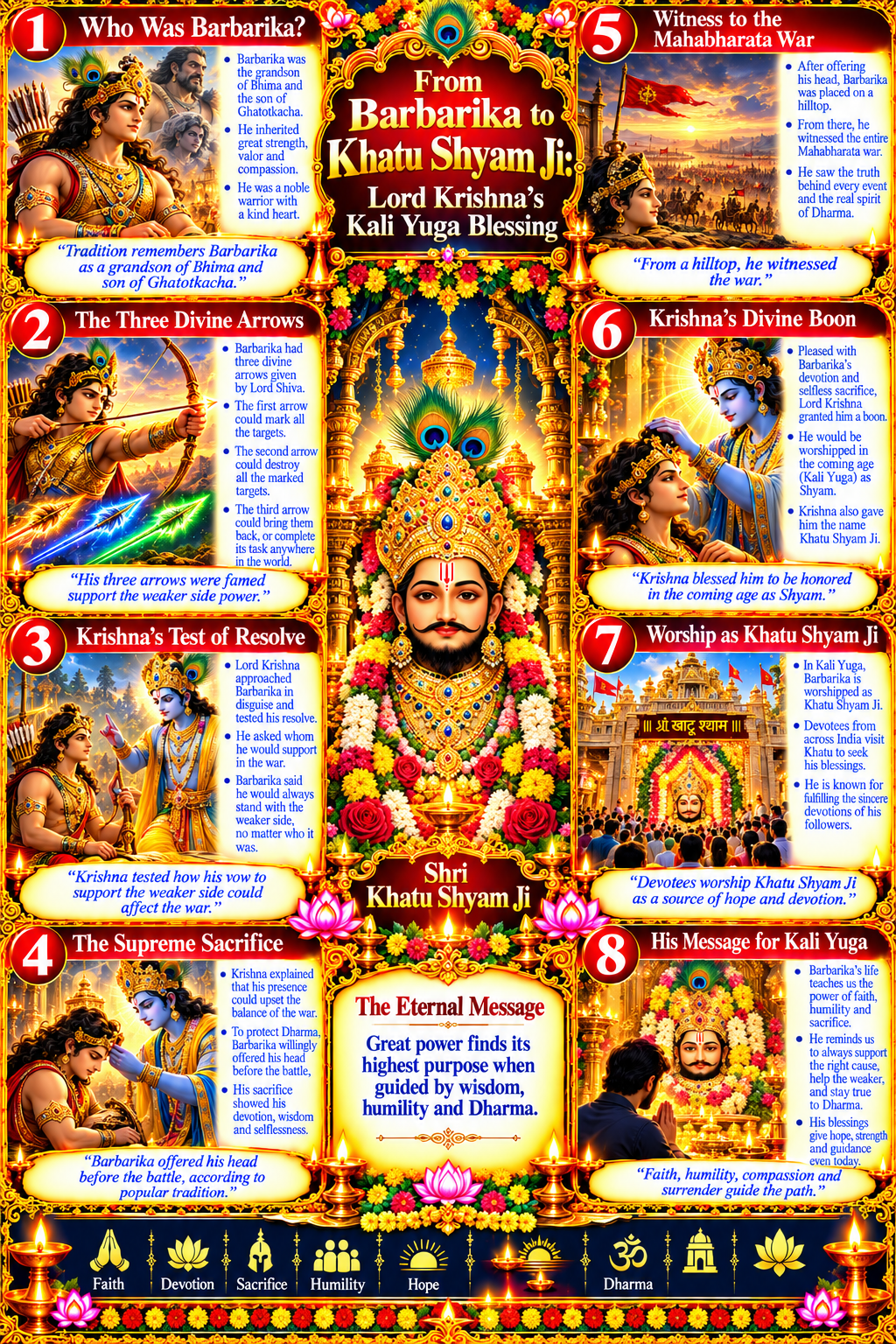
Moved by Barbarika’s boundless humility, absolute sacrifice, and clear spiritual sight, Lord Krishna bestowed upon him the highest blessing ever granted to any entity in Vedic lore:
“Barbarika, because you surrendered your head for the protection of righteousness without hesitation, you shall be worshipped in the age of Kali Yuga under My very own name: Shyam. Whoever chants your name with genuine devotion and seeks your refuge shall never return empty-handed. You shall forever be the supreme refuge of the defeated and the broken-hearted (‘Hare Ka Sahara, Khatu Shyam Hamara’).”
Centuries later, according to sacred history maintained by the Devasthan Department of the Government of Rajasthan, the divine head was unearthed in the sacred village of Khatu in Sikar district, Rajasthan. King Roopsingh Chauhan constructed a magnificent temple where millions of pilgrims flock annually, especially during the vibrant Phalguna Mela, to seek the blessings of Khatu Shyam Ji.
Recognized by cultural conservation projects overseen by the Ministry of Culture, Government of India, the devotion to Shyam Baba represents one of India’s most vibrant living traditions of faith, charity, and devotional surrender.
Strategic Comparison: Barbarika’s Three Arrows vs Major Celestial Astras
To appreciate how Barbarika’s Teen Baan compared to the supreme weapons of the Mahabharata era, the following matrix analyzes their destructive power, precision, and operating mechanisms:
| Celestial Weapon / Astra | Presiding Deity | Operating Mechanism | Destructive Capacity | Vulnerability / Counter |
|---|---|---|---|---|
| Barbarika’s Teen Baan (Three Arrows) | Goddess Kamakhya & Lord Shiva | Triadic marking (Target, Protect, Execute) with infallible recall | Capable of ending the entire Kurukshetra war in under one minute | Moral paradox of the user’s vow; neutralized only via Sheesh Daan |
| Brahmashira Astra | Lord Brahma | Four-headed fiery manifestation; incinerates entire realms | Causes complete environmental devastation for 12 years | Can only be recalled by an ascetic of pure celibate focus (e.g., Arjuna) |
| Pashupatastra | Lord Shiva | Cosmic dissolution weapon launched via mind, eyes, or bow | Instant destruction of any target in creation; cannot be blocked | Cannot be discharged against lesser foes or mortal soldiers |
| Vaishnavastra | Lord Vishnu | Infallible divine missile that tracks targets across dimensions | Vanquishes any warrior unless they surrender peacefully | Prostrates before Lord Vishnu or His divine incarnations |
| Vasavi Shakti (Indra’s Dart) | Lord Indra | Single-use infallible celestial spear given to Karna | Guaranteed one-shot elimination of any chosen enemy | Can only be fired once, after which it permanently returns to Indra |
| Sudarshana Chakra | Lord Krishna / Vishnu | Autonomous cosmic spinning disc of supreme divine will | Annihilates adharma across space and time; cuts through illusions | Supreme ultimate authority; no weapon in creation can withstand it |
Philosophical Breakdown: The Limit of Kinetic Firepower
While the Brahmashira or Pashupatastra caused planetary devastation, Barbarika’s arrows were surgically clean. They eliminated adharma without collateral damage to nature. Yet, because his weapon was bound to a rigid emotional vow rather than spiritual discernment, it required the intervention of Lord Krishna to prevent catastrophe.
Philosophical Dimension: The Illusion of Individual Agency (Karta Bhav)
Barbarika’s story is the ultimate cure for spiritual pride (Ahamkara). When the Pandavas believed they were the authors of victory, Barbarika’s severed head reminded them that human agency is merely a vehicle for divine timing. As declared in Chapter 11, Verse 33 of the Bhagavad Gita: “Nimitta-matram bhava savya-sachin” (“Be merely an instrument, O ambidextrous archer”).
Spiritual Dimension: The Archetype of Total Surrender (Sharanagati)
In offering his head, Barbarika demonstrated the highest rung of Bhakti Yoga: Atma-Nivedana (complete surrender of the self). He did not negotiate, lament his lost martial fame, or question the Lord’s justice. Consequently, he attained eternal worship exceeding that of the kings who ruled Hastinapur.
Scriptural Citation: Skanda Purana (Maheshvara Khanda, Kaumarika Khanda, Chapters 60-66)
The primary scriptural authority for the episode of Barbarika, his penance at Gupta Kshetra, and his dialogue with Lord Krishna is comprehensively detailed in the Kaumarika Khanda of the sacred Skanda Purana.
Theological Note on the Name “Shyam”: Bestowed by Lord Krishna
The conferring of Krishna’s own name “Shyam” upon Barbarika signifies non-difference between the devotee and the Lord in the state of perfect devotion, immortalized in the sacred greeting “Jai Shri Shyam”.
Frequently Asked Questions About Barbarika and Lord Krishna (20 Detailed FAQs)
1. Who was Barbarika in the Mahabharata?
Barbarika was the grandson of the Pandava prince Bhima and Hidimbi, and the son of Ghatotkacha and Princess Maurvi (Ahilawati). He was an invincible warrior blessed with three infallible arrows by Goddess Kamakhya and Lord Shiva.
2. What is the secret behind Barbarika’s Three Arrows (Teen Baan)?
The secret of the Teen Baan lies in their triadic function: the first arrow marks all targets to be destroyed, the second marks all entities to be spared, and the third instantly destroys all marked enemies before safely returning to the quiver.
3. Why did Barbarika vow to fight for the losing side?
Before departing for Kurukshetra, his mother Maurvi made him promise that he would never side with the powerful or arrogant, but would always raise his bow to support whichever side was facing defeat (“Hare ko Sahara”).
4. Why did Lord Krishna disguise Himself as a Brahmin?
Lord Krishna disguised Himself as a Brahmin priest to examine Barbarika’s prowess, test his archery skills under a Peepal tree, and demonstrate the catastrophic paradox inherent in his vow.
5. What was the Peepal leaf test conducted by Krishna?
Krishna challenged Barbarika to pierce every leaf of a giant Peepal tree with a single arrow. While Barbarika shot the arrow, Krishna secretly hid one leaf beneath His foot. The arrow marked all leaves on the tree and then hovered around Krishna’s foot until He lifted it, proving its infallibility.
6. Why couldn’t Barbarika be allowed to fight in the Kurukshetra war?
Because Barbarika vowed to support the losing side, he would first help the Pandavas, forcing the Kauravas to lose. He would then have to switch to the Kauravas to save them, decimating the Pandavas. This oscillating slaughter would continue until both armies were completely annihilated.
7. Why did Krishna ask for Barbarika’s head as charity (Sheesh Daan)?
Krishna requested Barbarika’s head to prevent universal slaughter and to fulfill the scriptural requirement of sacrificing the purest, bravest warrior to sanctify the battlefield of Kurukshetra before the war began.
8. Why is Barbarika called “Sheesh Ke Daani”?
“Sheesh Ke Daani” translates to “The Supreme Giver of the Head.” Barbarika earned this sacred title because he severed and donated his own head without a moment of hesitation upon Lord Krishna’s request.
9. What was Barbarika’s final dying wish?
Barbarika requested that despite losing his head, he wished to witness the entire 18-day Kurukshetra war from beginning to end. Krishna granted this wish by placing his conscious head atop a high mountain overlooking the battlefield.
10. What did Barbarika’s head see during the Kurukshetra war?
Barbarika testified that neither Arjuna nor Bhima won the war. He saw only Lord Krishna’s Sudarshana Chakra executing the unrighteous across the skies and Goddess Mahakali drinking their blood, proving that all events were manifestations of Krishna’s divine will.
11. How is Barbarika connected to Khatu Shyam Ji?
Impressed by his supreme sacrifice, Lord Krishna blessed Barbarika that in Kali Yuga he would be worshipped under Krishna’s own name, “Shyam.” His head was later discovered in Khatu village (Rajasthan), where he is enshrined as Khatu Shyam Ji.
12. What is the meaning of the slogan “Hare Ka Sahara, Khatu Shyam Hamara”?
The phrase translates to “Khatu Shyam is the ultimate support of the defeated.” It honors Barbarika’s maternal vow to always protect and uplift whoever is helpless, broken, or losing in the battle of life.
13. Which Hindu scripture narrates the complete story of Barbarika?
The story of Barbarika is detailed in the Skanda Purana, specifically within the Kaumarika Khanda of the Maheshvara Khanda, as well as in ancient regional Mahabharata traditions.
14. Why is Barbarika worshipped as Baliyadev in Gujarat?
In Gujarat, Barbarika is revered as Baliyadev (the deity of supreme sacrifice and childhood health), where devotees pray to his sacred image for the protection of children and family prosperity.
15. What color was Barbarika’s celestial steed?
Barbarika rode a distinctive bluish-gray celestial horse known as “Neela Ghoda” (or Leela Ghoda). Devotees of Khatu Shyam Ji affectionately refer to the deity as “Neele Ke Aswar” (the rider of the blue horse).
16. Could any warrior in Kurukshetra counter the Three Arrows?
No warrior, including Bhishma, Drona, Karna, or Arjuna, possessed the means to block or survive Barbarika’s Three Arrows because the weapons functioned by divine Shakti and unerringly targeted or protected entities across the cosmos.
17. Who was Barbarika’s mother and what was her significance?
His mother was Maurvi (also known as Ahilawati or Kamakantaka), the daughter of the demon king Muru. She instilled in him supreme ethical values, devotion to Shakti, and the foundational vow to protect the downtrodden.
18. Where is the main temple of Khatu Shyam Ji located?
The main temple is situated in the town of Khatu in the Sikar district of Rajasthan, India. It attracts millions of devotees each year, especially during the annual Phalguna Shukla Ekadashi fair.
19. What is the spiritual moral of the dialogue between Barbarika and Lord Krishna?
The episode teaches that individual power and good intentions, if disconnected from cosmic discernment and Dharma, can lead to catastrophe. True spiritual greatness lies in surrendering one’s ego and personal agenda to the divine will.
20. Why did Krishna honor Barbarika above all warriors who survived Kurukshetra?
While the surviving warriors harbored subtle arrogance about their triumphs, Barbarika gave up his life, fame, and martial glory without complaint, embodying the pinnacle of pure surrender and unalloyed devotion.