Raja Ratnam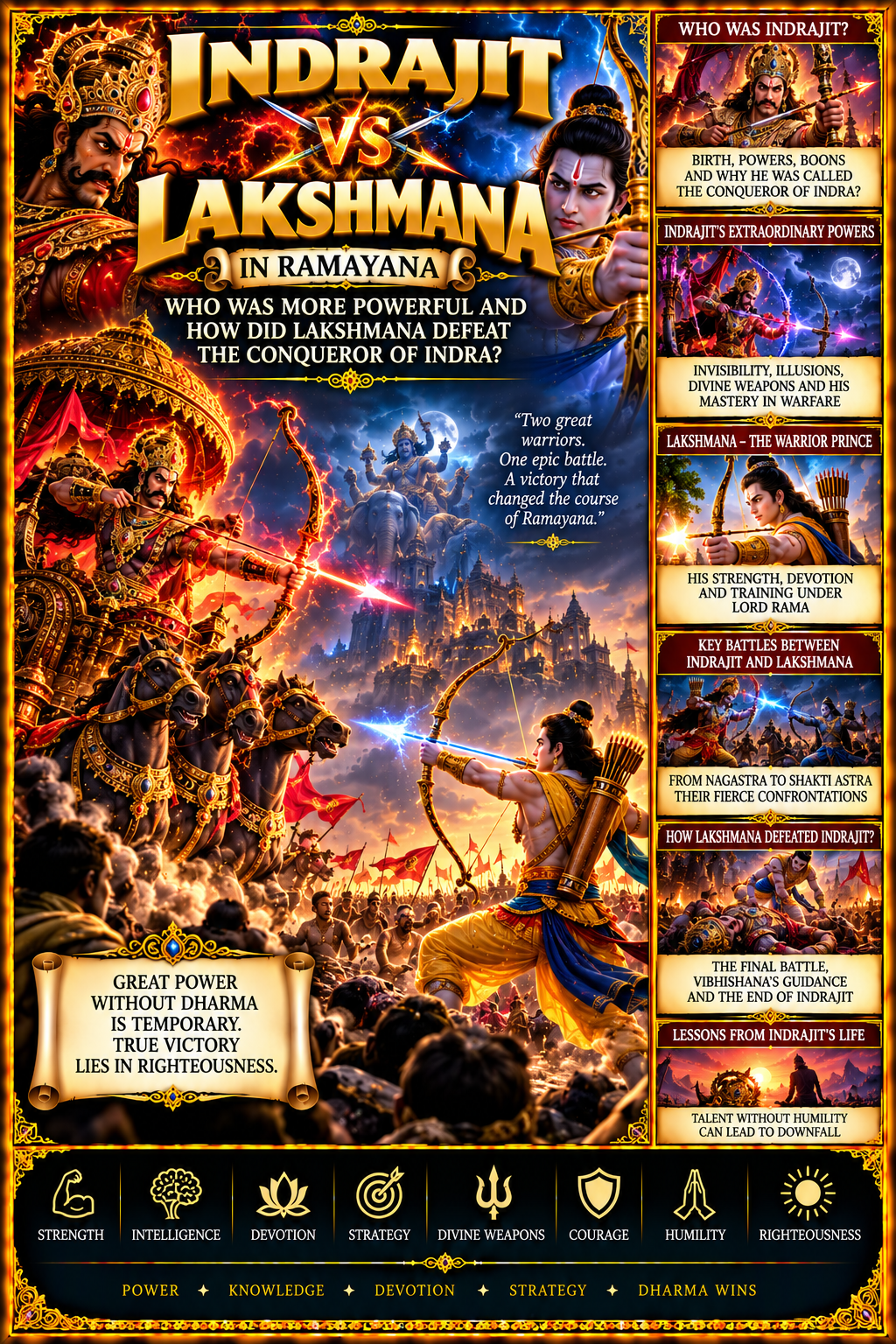
In the grand canvas of the Valmiki Ramayana, while the ultimate philosophical showdown is fought between Lord Rama and Ravana, the most ferocious, technically terrifying martial confrontation unfolds between their respective champions: Meghnada (Indrajit), the crown prince of Lanka, and Lakshmana, the devoted younger brother of Rama and earthly avatar of Adi Shesha. This monumental duel has fascinated scholars, military tacticians, and spiritual seekers across millennia: between the master of celestial sorcery and the master of ascetic self-conquest, who was truly the superior warrior?
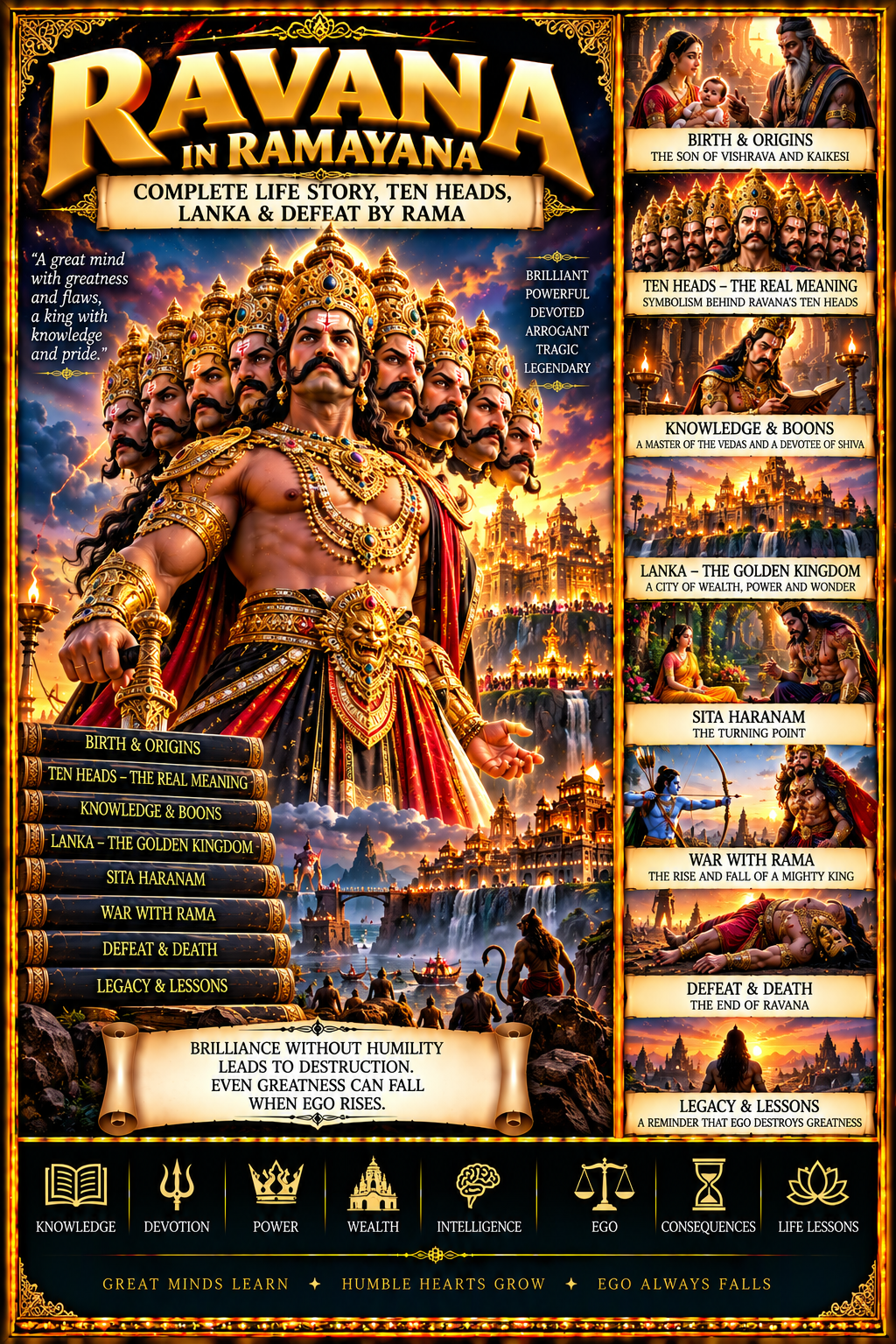
To understand the depth of this war within a war, one must explore not just physical archery, but the metaphysical layers of destiny, divine boons, moral virtue, and the pivotal sacrifice of 14 sleepless years. For readers exploring our deep dives into Ravana in Ramayana: The Great Ruler of Lanka and the overarching epic of The Journey of Rama, Sita, and Lakshmana, this definitive comparison provides an authentic, scripture-backed analysis of the deadliest battle fought under the skies of Lanka.
Who Was Meghnada? The Rise of Indrajit, the Supreme Mahamaharathi
Meghnada was the eldest son of Ravana and Queen Mandodari. At the moment of his birth, his father forced the planetary deities (Navagrahas) into the eleventh house to ensure the child was immortal, invincible, and destined for supreme sovereignty. When the infant uttered his first cry, it reverberated across the cosmos like rolling thunder (Megha-Nada, sound of the clouds).
Under the tutelage of Shukracharya, Meghnada mastered every branch of warfare, celestial metallurgy, and occult mysticism (Maya Vidya). He performed severe austerities at the sacrificial altars, invoking Lord Shiva and Lord Brahma. In return, he obtained the three supreme celestial weapons of the universe: the Brahmanda Astra, the Vaishnava Astra, and the Pashupatastra. He was also blessed with a divine celestial chariot drawn by dark spectral horses that could become invisible and maneuver freely through the clouds.
His defining milestone occurred during Ravana’s invasion of the celestial realm (Amaravati). Meghnada personally engaged Lord Indra, king of the Devas, shattered the celestial army, tied Indra in celestial bonds, and dragged him prisoner to Lanka. Lord Brahma himself had to intervene to negotiate Indra’s release, granting Meghnada the eternal title Indrajit (“The Conqueror of Indra”) and ordaining that he would be undefeated in battle as long as he completed the secret Nikumbhila Yajna before entering combat.
Who Was Lakshmana? The Embodiment of Adi Shesha and Unwavering Dharma

Lakshmana, the son of King Dasharatha and Queen Sumitra, was the primal serpent Adi Shesha (Ananta), upon whose thousand hoods the universe rests. In the human realm, Lakshmana epitomizes unswerving fraternal loyalty, selfless duty, and disciplined focus. When Rama was banished to the forest for 14 years, Lakshmana renounced every royal comfort to serve as the sentinel, protector, and shield of Rama and Sita.
Trained by the revered sage Vishvamitra alongside Rama, Lakshmana possessed mastery over divine astras, including the Agneyastra, Varunastra, Vayuastra, and the infallible Aindrastra (the weapon of Indra). Unlike warriors who relied on sorcery, Lakshmana’s martial prowess was founded upon direct physical archery, unmatched reflex speed, and unbreakable vows of ascetic self-restraint.
The Three Climactic Encounters Between Lakshmana and Indrajit
The warfare between Indrajit and the forces of Rama was characterized by three distinct stages, each showcasing Indrajit’s terrifying sorcery and the divine resilience of Rama’s legion:
1. The First Encounter: The Nagapasha Trap
On the battlefield of Lanka, Indrajit ascended into the sky, utilizing his cloaking ability to disappear from visible sight. Raining down millions of invisible arrows, he bound both Rama and Lakshmana with the deadly Nagapasha (the serpent noose), which constricted their life-breath and rendered both unconscious. Believing the war was won, Indrajit returned triumphant to Lanka. The princes were revived only when Lord Garuda, king of eagles and eternal enemy of serpents, arrived on the battlefield, causing the spectral serpents to flee in terror.
2. The Second Encounter: The Shakti Weapon and Sanjeevani
Enraged by the monkey army’s continuous advance, Indrajit entered the battlefield with reinforced fury. Facing Lakshmana in an open duel, arrows clashed with blinding flash fires. Realizing Lakshmana was matching every celestial weapon, Indrajit unleashed his dreaded Veeraghati Shakti, a javelin of pure celestial fire gifted by Maya. The weapon struck Lakshmana directly in the chest, thrusting him into deep suspended animation near death.
It was during this crisis that Lord Hanuman embarked on his legendary flight to the Himalayas, lifting the entire Dronagiri Mountain to deliver the medicinal herb Sanjeevani before dawn, as explored in our tribute to Hanuman in Ramayana: The Loyal Devotee and Mighty Warrior. Lakshmana arose revitalized, ready for the final retribution.
3. The Third Encounter: The Battle of Nikumbhila and the Final Decapitation
Recognizing that an open war of attrition was failing, Indrajit retreated to the subterranean temple of Goddess Pratyangira at Nikumbhila to perform his secret ritual. Had he completed this sacrifice, an invincible celestial chariot and divine steeds would have arisen from the sacrificial fire, rendering him completely untouchable by any being in existence.
Warned by Vibhishana, Lakshmana, accompanied by Hanuman and Angada, breached the sacred grove, desecrated the sacrificial fire, and forced Indrajit into combat before the invocation was complete. Deprived of his invulnerability, Indrajit fought with unmatched desperation, discharging the Maheshwara and Indra weapons. Finally, Lakshmana invoked the Aindrastra with a solemn vow of truth:
“If Rama, the son of Dasharatha, is ever truthful in speech, virtuous in deed, and peerless in righteousness, then, O sacred Aindrastra, sever the head of this son of Ravana!”
The crescent-shaped arrow sliced through Indrajit’s defenses, severing his head from his torso. His mortal remains fell to the earth, ending the reign of terror of Lanka’s greatest prince.
The Cosmic Boon: Why Only a Man Who Had Not Slept for 14 Years Could Slay Indrajit

The theological question often asked is: why could Lord Rama himself not kill Indrajit? When Indrajit pleased Lord Brahma with his penances, Brahma granted him a boon that he could only be slain by a mortal human who met three extraordinary spiritual prerequisites:
- He must have conquered sleep entirely for fourteen continuous years (Gudakesha).
- He must have remained completely celibate (Brahmacharya) for fourteen consecutive years.
- He must not have looked upon the face of any woman other than his mother’s feet during that entire period.
While Lord Rama was an ascetic in the forest, he lived in the company of his wife Sita. Lakshmana, on the other hand, had requested Goddess Nidra (the deity of sleep) to bestow his share of sleep upon his wife Urmila in Ayodhya so that he could guard Rama day and night without blinking. When Sita’s jewelry was discovered in Kishkindha, Lakshmana famously declared that he recognized only her anklets (Nupura), for he had never raised his eyes above her feet. Thus, by divine design, Lakshmana was the only soul in the three worlds capable of piercing Indrajit’s cosmic immunity.
Comprehensive Comparison: Indrajit vs Lakshmana
The following detailed matrix evaluates both warriors across classical martial parameters according to the Valmiki Ramayana:
| Metric / Parameter | Indrajit (Meghnada) | Lakshmana (Sumitranandana) |
|---|---|---|
| Spiritual Lineage | Grandson of Sage Pulastya, Son of Ravana & Mandodari | Son of King Dasharatha & Sumitra; Avatar of Adi Shesha |
| Warrior Classification | Supreme Mahamaharathi (capable of fighting 720,000 warriors simultaneously) | Atirathi / Mahamaharathi (unmatched master of direct celestial archery) |
| Greatest Military Feat | Defeated and captured Lord Indra; bound Rama & Lakshmana with Nagapasha | Breached Nikumbhila Yajna; destroyed Indrajit’s celestial defenses; slew Indrajit |
| Core Combat Style | Nocturnal warfare, Maya (sorcery, invisibility, illusions, shapeshifting) | Direct archery, lightning-fast release, unbreakable mental resolve, satvic focus |
| Supreme Astras Possessed | Brahmanda Astra, Vaishnava Astra, Pashupatastra, Nagapasha, Shakti | Aindrastra, Agneyastra, Varunastra, Vayuastra, Vishnu Astras |
| Weakness / Vulnerability | Over-reliance on ritual invulnerability; arrogance born of dark boons | Bound strictly by Kshatriya codes of honor; vulnerable to unexpected nocturnal weapons |
| Spiritual Title | Indrajit (Conqueror of the Devas) | Gudakesha (Conqueror of Sleep), Ramanuja (Shadow of Rama) |
| Final Outcome | Decapitated by Lakshmana’s Aindrastra outside Nikumbhila Temple | Emerged victorious; crowned King of Lanka’s conquerors alongside Rama |
The Core Philosophy: Maya (Illusion) vs Satya (Truth)
The clash between Indrajit and Lakshmana is a profound spiritual allegory. Indrajit represents the pinnacle of Tamasic capability: incredible raw talent, unmatched discipline, yet channeled toward ego, deceit, cloaked warfare, and the defense of an unjust regime. When Indrajit killed an illusory phantom of Sita (Maya Sita) before Rama’s army, he used psychological cruelty as a strategic weapon.
In contrast, Lakshmana represents Satva and disciplined Tapasya (penance). He conquered his senses, gave up sleep, food, and pleasure, and acted purely as an instrument of divine justice. His final arrow triumphed not merely because of physical kinetic force, but because it was charged with the truth of Rama’s righteousness. As the ancient shloka reminds us: Yato Dharmas Tato Jayah (“Where there is Dharma, there is Victory”).
Frequently Asked Questions About Indrajit vs Lakshmana
1. Who was more powerful between Indrajit and Lakshmana?
In terms of raw magical firepower and destructive astras (holding Brahmanda, Vaishnava, and Pashupatastra), Indrajit had unmatched cosmic destructive capacity. However, in terms of ascetic discipline, moral purity, and ultimate victory, Lakshmana proved superior by neutralizing Indrajit’s illusions and slaying him.
2. Why is Meghnada called Indrajit?
He earned the title Indrajit (Conqueror of Indra) after invading heaven, overpowering the king of gods Indra, tying him in chains, and parading him back to Lanka until Lord Brahma intervened to ransom Indra.
3. Why could only Lakshmana kill Indrajit and not Lord Rama?
Lord Brahma had granted Indrajit a boon that he could only be killed by a warrior who had conquered sleep, remained celibate, and fasted from food for 14 continuous years. Lakshmana was the only person in the universe who fulfilled this extraordinary vow.
4. How did Lakshmana manage to live without sleep for 14 years?
When leaving for exile, Lakshmana prayed to Goddess Nidra (the deity of sleep) to spare him for 14 years so he could guard Rama and Sita day and night. His wife Urmila volunteered to sleep continuously for 14 years in Ayodhya, absorbing his quota of sleep.
5. What was the Nikumbhila Yajna performed by Indrajit?
The Nikumbhila Yajna was a secret sacrificial rite dedicated to Goddess Pratyangira. Had Indrajit completed the ritual, an invincible celestial chariot and indestructible horses would have emerged from the sacrificial fire, making him immortal in combat.
6. How did Lakshmana stop the Nikumbhila Yajna?
Guided by Vibhishana, Lakshmana, Hanuman, and the Vanara army ambushed the sacred grove of Nikumbhila, disrupted the rituals, hurled obstacles into the sacrificial flames, and forced Indrajit into battle before he could finish the fire sacrifice.
7. What weapon did Lakshmana use to kill Indrajit?
Lakshmana used the sacred Aindrastra (the celestial weapon of Lord Indra), invoking the righteousness and absolute truthfulness of Lord Rama to sever Indrajit’s head.
8. Was Indrajit an Atirathi or a Mahamaharathi?
Indrajit is classified as a Mahamaharathi, capable of fighting twelve Atirathis (720,000 enemy warriors) simultaneously. He was the only mortal warrior in the Ramayana era to possess the three supreme astras: Brahmashira, Vaishnava, and Pashupatastra.
9. Why did Indrajit’s supreme weapons fail against Lakshmana?
When Indrajit discharged the Vaishnava Astra and Maheshwara Astra against Lakshmana, the weapons circled Lakshmana and prostrated at his feet before returning, because Lakshmana was the divine avatar of Adi Shesha, an inseparable part of the Supreme Divinity.
10. What was the Maya Sita incident?
To demoralize Rama’s army, Indrajit created an illusory double of Sita and decapitated her in front of Hanuman and the Vanaras. The ruse temporarily caused overwhelming grief until Vibhishana revealed that it was a demonic illusion designed to buy time for the Nikumbhila Yajna.
11. Why did Indrajit bind Rama and Lakshmana with the Nagapasha?
Using his invisibility, Indrajit launched thousands of spectral venomous serpent-arrows (Nagapasha) from the clouds, paralyzing both princes. They were only freed when the divine eagle Garuda appeared, causing the serpents to flee in terror.
12. What was the Shakti weapon that struck Lakshmana?
The Veeraghati Shakti was an infallible celestial javelin gifted to Indrajit by Maya Danava. When struck in the chest, Lakshmana fell into a mortal coma that could only be cured by the Sanjeevani herb before sunrise.
13. Who brought the Sanjeevani herb to revive Lakshmana?
Lord Hanuman flew overnight across thousands of miles to Mount Dronagiri in the Himalayas. Unable to identify the specific glowing herb, Hanuman lifted the entire mountain peak and flew back to Lanka before sunrise.
14. Did Indrajit know that Rama and Lakshmana were divine?
Yes, after failing to defeat them on the third day and seeing his supreme weapons prostrate before Lakshmana, Indrajit realized they were divine incarnations. He pleaded with Ravana to make peace and return Sita, but when Ravana refused, Indrajit chose dutiful loyalty to his father till death.
15. What was Mandodari’s reaction to Indrajit’s death?
Mandodari was shattered by grief, crying that with the death of her mighty son Meghnada, Lanka’s supreme pillar had collapsed and the defeat and death of Ravana was now inevitable.
16. Who was Indrajit’s wife?
Indrajit’s wife was Sulochana, the virtuous daughter of Seshanaga (the serpent king). She was renowned for her fierce devotion and satitva.
17. What happened to Sulochana after Indrajit was killed?
Sulochana approached Lord Rama’s camp to claim Indrajit’s severed head. Rama treated her with supreme honor and chivalry, handing over the remains with full military respects, after which Sulochana performed Sati on her husband’s pyre.
18. What is the meaning of Gudakesha?
Gudakesha is a Sanskrit title composed of ‘Gudaka’ (sleep) and ‘Isha’ (master/lord), meaning ‘one who has conquered sleep’. It is bestowed upon Lakshmana for his 14-year sleepless penance, and later upon Arjuna in the Mahabharata.
19. What is the major spiritual lesson of Indrajit vs Lakshmana?
The battle illustrates that occult powers, sorcery, and destructive weapons are meaningless if disconnected from Dharma. Ascetic purity, moral duty, and surrender to truth always triumph over deceitful illusions.
20. How does Ratnam Strategy cover the epics of India?
Ratnam Strategy delivers deep, research-based spiritual and martial analysis of Indian mythology, connecting historical Sanskrit verses with timeless leadership and strategic wisdom.