Raja Ratnam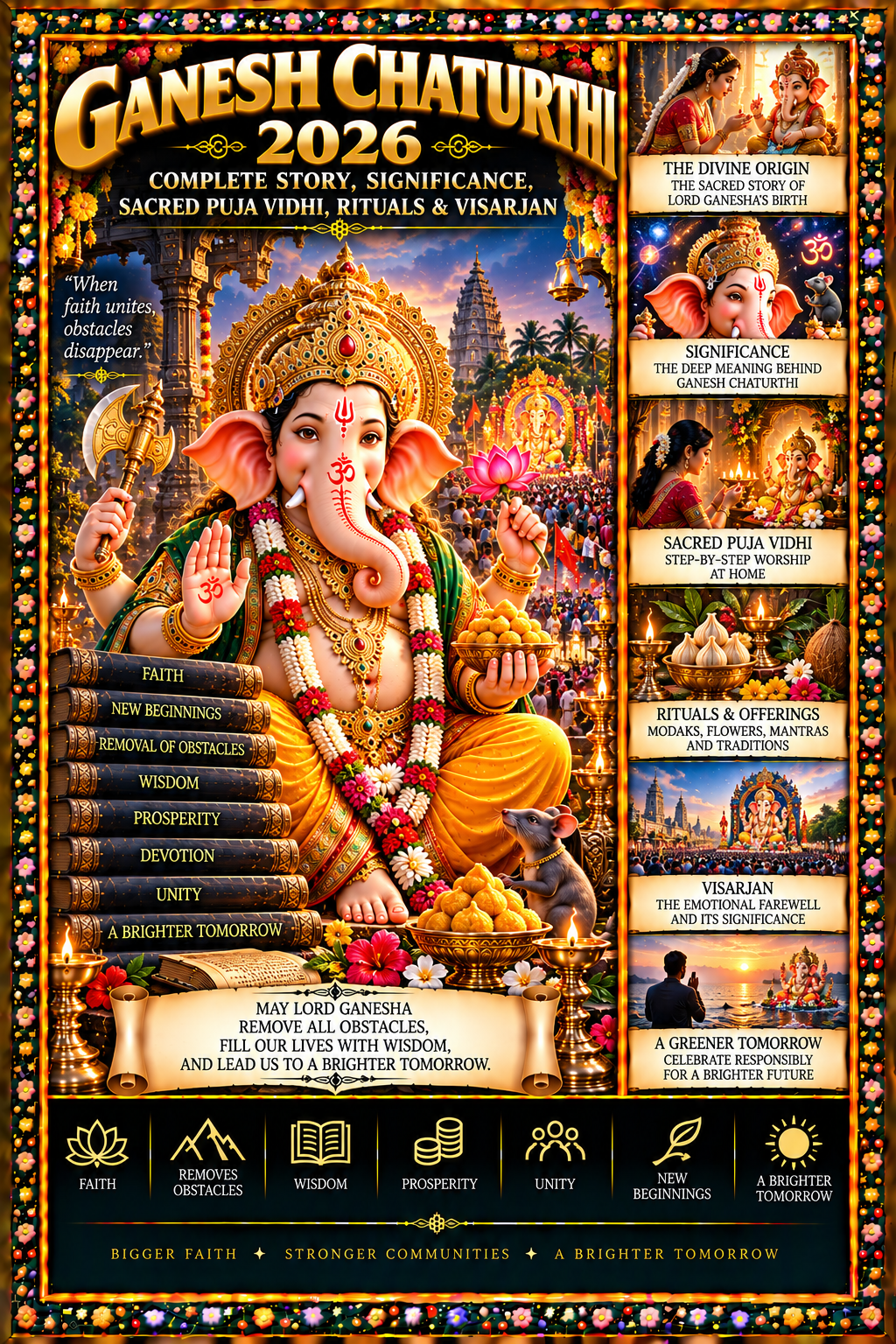
Every year as the monsoon recedes in the month of Bhadrapada, neighborhoods and homes fill with the sweet aroma of freshly steamed modaks and the joyful ringing of brass bells. Families welcome clay idols of the beloved elephant-headed deity into their living rooms, singing praises to the remover of obstacles. Ganesh Chaturthi is a joyful family homecoming, celebrating the arrival of Lord Ganesha from Mount Kailash to bring wisdom, laughter, and fresh beginnings into every household.
Lord Ganesha is universally revered as Pratham Pujya (the first worshipped deity), meaning no sacred ritual, wedding, new business venture, or housewarming ceremony begins without invoking His divine blessings. During Ganesh Chaturthi, millions of homes, public pandals, and community centers welcome elaborate idols of Ganesha, filling the atmosphere with sacred mantras, beating dhol-tasha drums, fragrant flowers, and the irresistible aroma of freshly steamed modaks.
To truly immerse in the festival of Ganesh Chaturthi, one must explore its deep mythological origins, understand the profound symbolism behind Ganesha’s unique physical form, follow the sacred step-by-step Puja Vidhi, and reflect on the philosophical spiritual wisdom of Ganesh Visarjan.
The Divine Birth and Origin Story Behind Ganesh Chaturthi
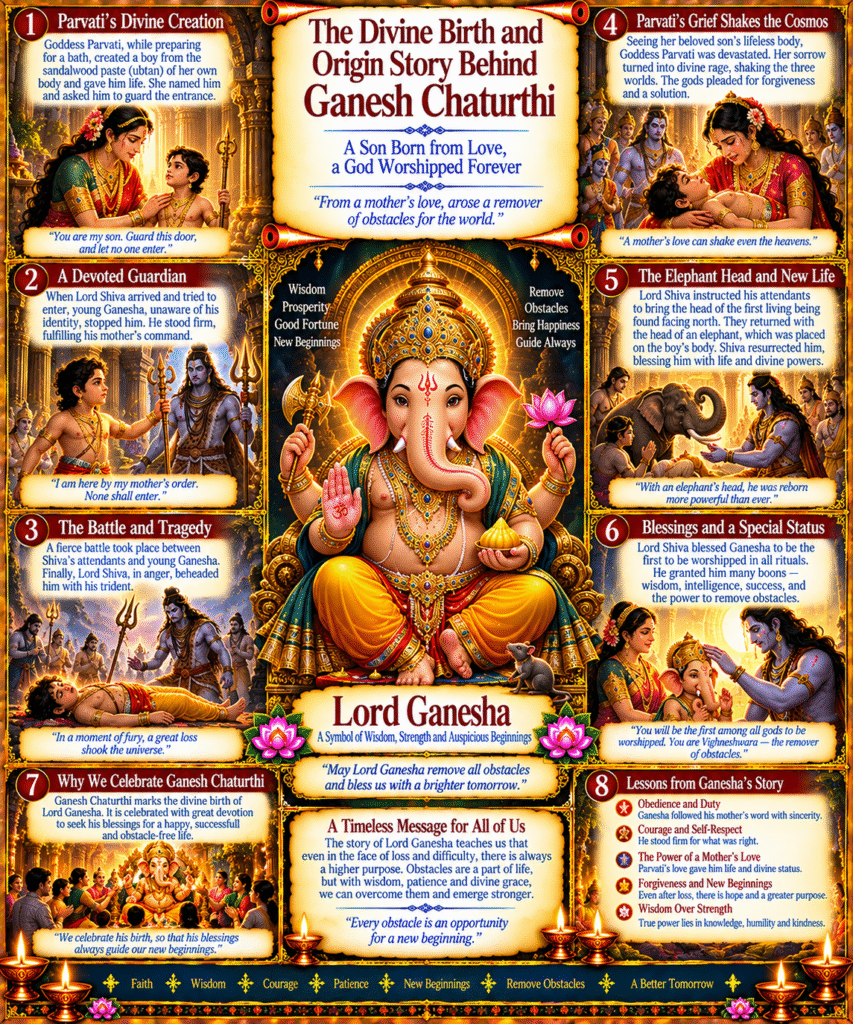
The timeless story of Lord Ganesha’s birth is narrated in several Puranas, including the Shiva Purana and Brahmavarta Purana. The legend highlights maternal devotion, cosmic balance, and the divine appointment of Ganesha as the supreme ruler of obstacles.
Goddess Parvati Creates Ganesha from Sacred Paste
According to the Shiva Purana, Goddess Parvati wished to have a faithful guardian to guard her personal quarters while she bathed. Taking sandalwood paste, turmeric, and divine clay (Uptan) from her own body, she lovingly sculpted the form of a handsome young boy. Breathing life (Prana) into the form, she created her divine son.
Goddess Parvati instructed the young boy to stand guard at the entrance of her abode on Mount Kailash and strictly instructed him not to allow anyone inside without her permission. Dutiful and devoted to his mother, the boy took up his post with absolute resolve.
The Celestial Encounter with Lord Shiva
Shortly after, Lord Shiva returned to Mount Kailash from his deep meditation. Unaware of Shiva’s identity, the young boy blocked Lord Shiva’s path, refusing to let him pass. Lord Shiva, surprised by the boy’s insistence, tried to reason with him, but the boy remained steadfast in executing his mother’s command.
Escalating into a fierce celestial conflict, Lord Shiva’s ganas (attendants) and deities attempted to move the boy, but he single-handedly held them off with extraordinary strength. Enraged by the defiance, Lord Shiva severed the boy’s head with his trident (Trishula).
The Elephant Head and the Blessing of Pratham Pujya
When Goddess Parvati emerged and witnessed her son slain, her grief turned into fierce cosmic rage. She threatened to unleash her power as Adi Parashakti to destroy the universe unless her son was brought back to life and honored with supreme status.
Realizing the gravity of the situation, Lord Shiva dispatched his celestial attendants to travel north and bring back the head of the first living creature they encountered whose mother was sleeping facing away from her child. The attendants found a noble mother elephant and returned with the head of a mighty elephant.
Lord Shiva attached the elephant head to the boy’s body and restored his life. Surrounding devas and devis showered blessings upon the divine child. Lord Shiva named him Ganesha (Leader of the Ganas) and Vighnaharta (Remover of Obstacles), bestowing upon him the cosmic boon that Ganesha would always be worshipped before any other deity in all worlds.
For official cultural and historical archives, visit the Incredible India Official Tourism Authority.
Symbolism Behind Lord Ganesha’s Form on Ganesh Chaturthi
The distinct appearance of Lord Ganesha is not merely mythological imagery; every physical trait represents a timeless lesson for personal growth, spiritual enlightenment, and practical living.
- Large Elephant Head: Represents vast intelligence, expansive wisdom, and high intellectual capacity.
- Small Sharp Eyes: Symbolizes deep concentration, keen observation, and foresight to look beyond superficial appearances.
- Large Flapping Ears: Teaches the importance of active listening and patience – listening more while speaking less.
- Single Broken Tusk (Ekadanta): Symbolizes sacrifice and singular focus. Legend states Ganesha broke his own tusk to write the epic Mahabharata as dictated by Sage Vyasa.
- Trunk: Demonstrates high adaptability, balance, and efficiency – strong enough to uproot trees, yet delicate enough to pick up a single blade of grass.
- Large Belly (Lambodara): Represents the ability to digest and absorb all life experiences – both sweet and bitter – with calm equanimity.
- Four Arms and Symbolic Objects:
- Pasha (Noose): To capture obstacles and pull devotees toward righteousness.
- Ankusha (Goad): To guide humanity away from negative ego and harmful desires.
- Modak (Sweet Dish): Symbolizes the ultimate sweet reward of spiritual enlightenment and knowledge.
- Varada Mudra (Blessing Hand): Assures fearlessness and divine protection to all devotees.
- The Tiny Mouse (Mushaka): Symbolizes the human mind and unruly desires. Ganesha riding the mouse demonstrates self-control, mastering ego, and guiding desires toward noble purposes.
Step-by-Step Ganesh Chaturthi Puja Vidhi and Rituals
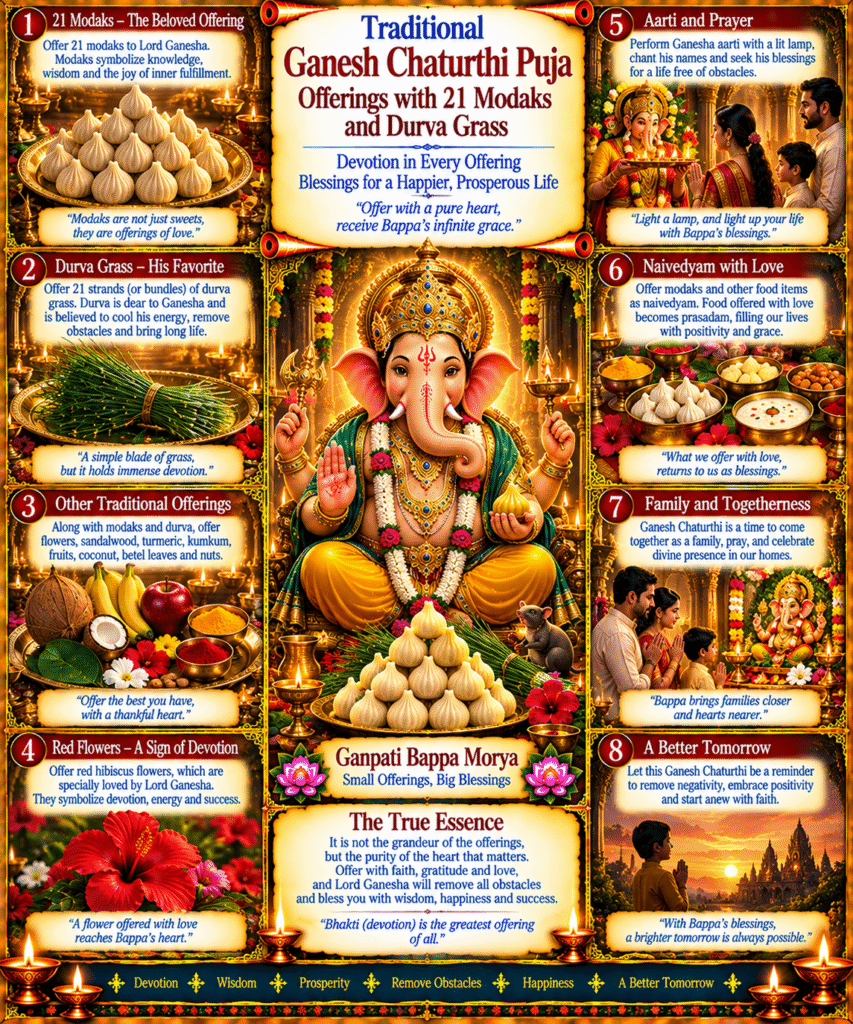
Performing the Ganesh Chaturthi Puja at home brings positive energy, peace, and abundance to the household. The traditional Vedic worship follows sixteen steps known as Shodashopachara Puja.
1. Preparation and Setup for the Idol
- Cleanliness: Clean the altar (Puja Mandir) or dedicated space thoroughly.
- Altar Elevation: Place a clean wooden platform (Chowki) covered with a red or yellow silk cloth.
- Rangoli: Draw a traditional Rangoli at the entrance and in front of the altar using natural powders.
- Ganesh Idol Installation: Gently place the eco-friendly clay Ganesha idol facing North or East.
2. The 16 Sacred Steps of Shodashopachara Worship
- Avahana: Invoking the divine presence of Lord Ganesha into the idol with Vedic mantras.
- Asana: Offering a comfortable seat to the deity.
- Padhya: Offering clean water to wash the feet of the Lord.
- Arghya: Offering holy water mixed with flowers and rice for washing hands.
- Snana: Symbolically offering a bath with clean water, followed by Panchamrut (milk, curd, honey, ghee, and sugar).
- Vastra & Yagnopavita: Offering fresh red cloth (Angavastram) and sacred thread (Janeyu).
- Gandha: Applying fragrant sandalwood paste (Chandan) and Kumkum on Ganesha’s forehead.
- Pushpa & Durva: Offering fresh red hibiscus flowers and 21 sacred blades of Durva grass.
- Dhupa: Burning fragrant incense sticks or Dhoop to purify the air.
- Deepa: Lighting a brass ghee lamp (Diya) to illuminate the altar.
- Naivedya: Offering Ganesha’s favorite sweet delicacies – 21 steamed Ukadiche Modaks, Ladoos, bananas, coconut, and fresh fruits.
- Tambula: Offering betel leaves, betel nuts (Supari), and cloves.
- Aarti: Singing the joyful Ganesha Aarti (Jai Ganesh Jai Ganesh Deva or Sukh Karta Dukh Harta) while waving the camphor lamp.
- Pradakshina: Circumambulating the altar clockwise three times in reverence.
- Pushpanjali: Offering handfuls of fresh flowers while praying for peace and obstacle-free success.
- Kshama Prarthana: Seeking forgiveness for any unintended mistakes committed during the worship.
Sacred Offerings for Ganesh Chaturthi: Durva Grass and Modaks
Two items hold immense spiritual importance in Ganesh Chaturthi worship: Durva Grass and Modaks.
The Mystery of 21 Durva Grass Blades
According to legend, a fierce demon named Analasura emitted burning flames that scorched the world. Lord Ganesha swallowed the demon to protect creation. However, Ganesha experienced unbearable heat in His stomach. Rishis and sages gathered and offered 21 blades of cooling Durva grass (Cynodon dactylon) to Ganesha. The grass immediately absorbed the excess heat and restored comfort. Hence, offering 21 blades of fresh Durva grass during Ganesh Chaturthi is believed to grant instant peace and relieve physical and mental afflictions.
The Sweet Modak: Ganesha’s Supreme Delicacy
The Modak is a dumpling stuffed with sweet grated coconut and jaggery, wrapped in soft rice flour dough. The word Modak derives from Moda, which means joy or bliss. The outer rice shell represents the hard struggle of spiritual discipline, while the inner coconut-jaggery filling represents the sweet nectar of self-realization. Offering 21 Modaks during Ganesh Chaturthi brings delight and divine prosperity.
Eco-Friendly Ganesh Chaturthi: Embracing Matti (Clay) Ganesha
In recent years, the call for Eco-Friendly Ganesh Chaturthi celebrations has gained massive global momentum. Traditional Vedic scriptures specifically recommend using unbaked clay (Kacha Clay or Matti) to craft Ganesha idols.
Benefits of Eco-Friendly Clay Idols
- Environmental Preservation: Natural clay dissolves completely in water within a few hours without releasing harmful chemical dyes or Plaster of Paris (PoP) toxins into rivers and oceans.
- Tree Ganesha Idols: Innovative eco-friendly idols embedded with plant seeds (such as Tulsi, Marigold, or Tomato seeds) allow devotees to immerse the idol in a home pot. The idol turns into fertile soil, giving birth to a living plant – symbolizing eternal life and growth.
- Home Bucket Visarjan: Performing Visarjan at home in a bucket or garden pot ensures a respectful, clean, and private immersion while keeping local water bodies pristine.
The Grand Procession and Ganesh Visarjan of Ganesh Chaturthi
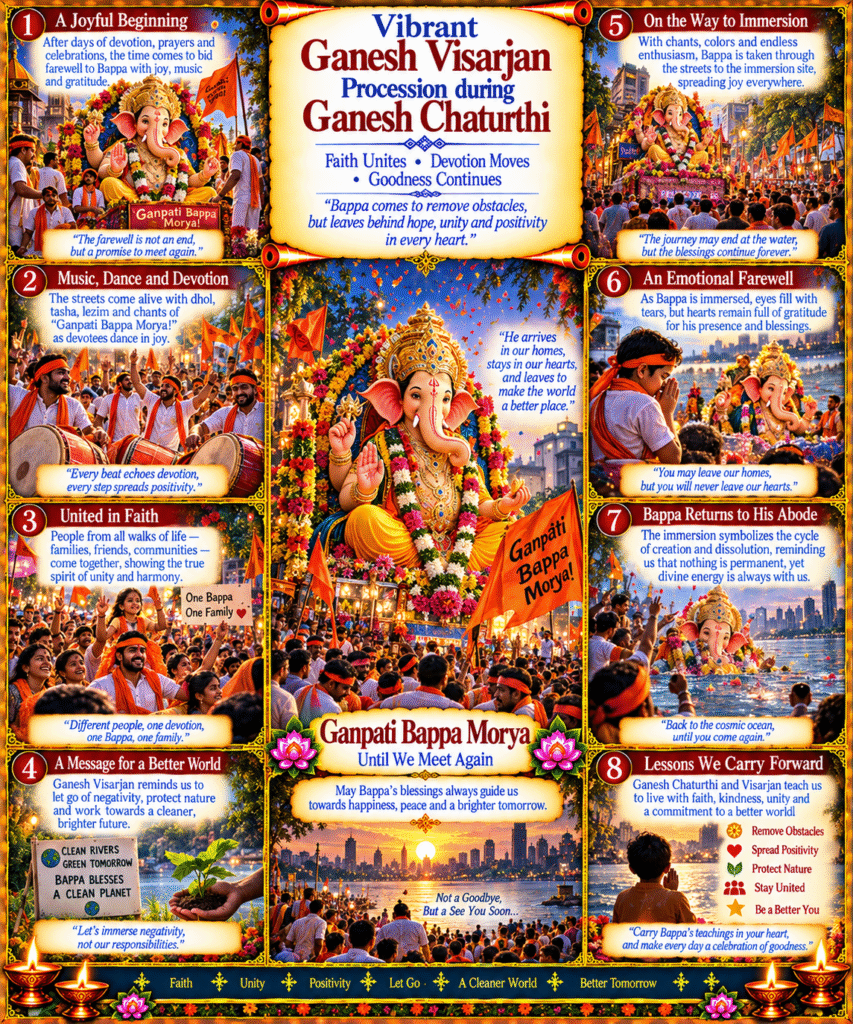
The festival concludes with Ganesh Visarjan, where devotees carry Ganesha idols in grand processions accompanied by dancing, music, and chanting:
“Ganpati Bappa Morya, Pudhachya Varshi Lavkar Ya!”
(O Lord Ganesha, come back early next year!)
Spiritual Philosophy Behind Visarjan
Why do we submerge the beloved deity after worshipping Him with so much love?
Visarjan encapsulates the core Vedantic philosophy of Sakar to Nirakar (Form to Formless). It reminds us that everything physical in the universe is transient. Ganesha comes from nature (clay/earth), stays with us to absorb negative energy and bestow wisdom, and then returns to the water element, uniting with the infinite cosmic consciousness. Visarjan teaches us detachment, renewal, and the cyclical nature of life.
Visarjan Timings
Depending on family traditions and public pandal customs, Visarjan is conducted on:
- 1.5 Days: Uttarpuja on the second day morning/evening.
- 3rd Day, 5th Day, or 7th Day.
- 11th Day (Anant Chaturdashi): The grandest day of Visarjan, marked by massive processions.
Caution Against Chandra Darshan on Ganesh Chaturthi Night
A popular tradition associated with Ganesh Chaturthi is avoiding looking directly at the moon on the night of Bhadrapada Shukla Chaturthi.
The Legend of the Moon’s Mockery and the Syamantaka Gem
Legend states that after a lavish feast on Chaturthi night, Ganesha was riding His mouse when the mouse tripped on a snake. Ganesha fell, and His belly burst open. Ganesha tied the snake around His belly to hold it together. The Moon God (Chandra Dev) witnessed this and laughed mockingly at Ganesha’s form.
Ganesha cursed the Moon that anyone who looks at the moon on Chaturthi night would face false accusations, dishonor, and loss of reputation. Lord Krishna Himself faced a false allegation of stealing the legendary Syamantaka Gem after accidentally glimpsing the moon on Chaturthi night.
Remedial Mantra for Accidental Sight
If someone accidentally looks at the moon on Ganesh Chaturthi, reciting the sacred Syamantaka Mani Mantra remedies the curse:
Simhah Prasenamavadhitsiho Jambavata Hatah |
Sukumaraka Ma Rodihstava Hyeshah Syamantakah ||
Powerful Ganesha Mantras for Ganesh Chaturthi Worship
Chanting Ganesha mantras during Ganesh Chaturthi removes obstacles, purifies intellect, and unlocks success.
1. Vakratunda Mahakaya Mantra
वक्रतुण्ड महाकाय सूर्यकोटि समप्रभ।
निर्विघ्नं कुरु मे देव सर्वकार्येषु सर्वदा॥
>
Translation: O Lord with the curved trunk, immense body, and the radiance of a million suns, please make all my endeavors free of obstacles, always.
2. Ganesh Gayatri Mantra
ॐ एकदन्ताय विद्महे वक्रतुण्डाय धीमहि तन्नो दन्तिः प्रचोदयत्॥
>
Translation: We meditate on the single-tusked Lord, we pray to the Lord with the curved trunk. May that elephant-faced deity illuminate our minds.
3. Beeja Mantra for Daily Chanting
ॐ गं गणपतये नमः॥ (Om Gam Ganapataye Namaha)
Related Sacred Topics & Cultural Heritage: For further spiritual exploration, read about Lord Rama’s ideal life story. For further spiritual exploration, read about the 14-year exile of Lord Rama.
Frequently Asked Questions (FAQs) About Ganesh Chaturthi 2026 (20 Questions & Answers)
1. When is Ganesh Chaturthi in 2026?
Ganesh Chaturthi 2026 will be celebrated on Monday, September 14, 2026 (Bhadrapada Shukla Chaturthi Tithi).
2. What is the story behind the birth of Lord Ganesha?
Goddess Parvati created Ganesha from turmeric paste and breathed life into him to guard her bath. When Lord Shiva was stopped by Ganesha, a battle ensued, leading to Shiva severing Ganesha’s head and later replacing it with an elephant head.
3. Why did Goddess Parvati create Lord Ganesha from turmeric paste?
Goddess Parvati wanted a loyal guard who would obey her commands unconditionally, creating Ganesha using divine energy and sacred turmeric paste from her own body.
4. Why did Lord Shiva sever Ganesha’s head, and how was an elephant head attached?
Lord Shiva did not recognize Ganesha as his son when Ganesha barred his entry. After the conflict, Shiva revived Ganesha by placing the head of a powerful Gaja (elephant) pointing north, granting him immortality.
5. Why is Lord Ganesha worshiped first before any other deity (Prathama Pujya)?
Lord Shiva granted Ganesha the boon of Prathama Pujya (First Worshiped Deity) after Ganesha proved his supreme wisdom by circumambulating his divine parents as his entire universe.
6. What is the best muhurat for Ganesha Sthapana on Ganesh Chaturthi 2026?
The auspicious Madhyahna Ganesha Puja time on September 14, 2026 spans between 11:03 AM and 01:34 PM.
7. How should one perform Ganesh Chaturthi Puja Vidhi at home?
Clean the puja space, install the clay idol on a decorated wooden platform (Chowki), perform Avahana, offer 21 blades of Durva grass, red flowers, turmeric, kumkum, light lamps, and offer Modaks as Naivedyam.
8. Why is Durva grass (21 blades) offered to Lord Ganesha during Puja?
Offering 21 blades of Durva grass cools the fiery divine energy of Lord Ganesha, recalling the story of Ganesha swallowing the fiery demon Analasura and cooling his body with sacred Durva.
9. Why is Modak Lord Ganesha’s favorite sweet offering?
Modak symbolizes the sweet taste of spiritual liberation (Moksha) and supreme knowledge. The outer shell represents intellect, while the inner jaggery-coconut filling represents inner divine bliss.
10. What is the significance of offering 21 Modaks during Ganesh Chaturthi?
Offering 21 Modaks honors the 5 Mahabhutas (elements), 5 Jnanendriyas (senses), 5 Karmendriyas (action organs), 5 Pranas (vital airs), and the Supreme Soul (Atman).
11. Why is looking at the Moon forbidden on Ganesh Chaturthi night (Samanthakamani story)?
Legend states that Chandra (Moon God) mocked Lord Ganesha’s form. Ganesha cursed that anyone who looks at the Moon on Bhadrapada Chaturthi would face false accusations, as experienced by Lord Krishna in the Syamantaka jewel episode.
12. What is the story of Lord Ganesha circumambulating his parents (Shiva and Parvati)?
When challenged to race around the world against Kartikeya, Ganesha walked around Shiva and Parvati three times, stating that his parents contained the entire universe, winning the divine fruit of wisdom.
13. Why is Lord Ganesha called Ekadanta (Single-Tusked)?
Ganesha broke his own tusk to write the epic Mahabharata dictated by Sage Vyasa without stopping, symbolizing supreme sacrifice for sacred knowledge.
14. What is the role of Lord Ganesha as the scribe of the epic Mahabharata?
Sage Vyasa agreed to dictate the Mahabharata on the condition that Ganesha would understand every verse before writing it, while Ganesha required Vyasa to dictate continuously without pause.
15. What is the significance of Ganesh Visarjan (Idol Immersion)?
Ganesh Visarjan symbolizes the eternal cosmic cycle of creation, existence, and dissolution (Samsara), reminding devotees that divine energy returns to formless nature (Prakriti).
16. On which days is Ganesh Visarjan performed (1.5, 3, 5, 7, or 11 days)?
Visarjan is observed based on family tradition on the 1.5th day, 3rd day, 5th day, 7th day, or Anant Chaturdashi (11th day).
17. Why is eco-friendly clay Ganesha (M मिट्टी Ganesha) recommended for Visarjan?
Clay Ganesha idols dissolve naturally in water without polluting rivers or oceans, aligning with Vedic environmental reverence.
18. How is Ganesh Chaturthi celebrated in Maharashtra and across India?
Initiated as a public festival by Lokmanya Tilak in 1893, Ganesh Chaturthi features massive public pandals, dhol-tasha drum processions, cultural performances, and vibrant street celebrations.
19. What mantras should be chanted during Ganesh Chaturthi Puja?
Chant “Om Gam Ganapataye Namaha” and “Vakratunda Mahakaya Suryakoti Samaprabha, Nirvighnam Kuru Me Deva Sarva-Karyeshu Sarvada” for removing obstacles.
20. How does Ratnam Strategy explain the spiritual symbolism of Lord Ganesha?
Ratnam Strategy decodes Lord Ganesha’s form – large ears for active listening, small eyes for sharp focus, large stomach to digest life’s experiences, and single tusk for undivided truth.