Raja Ratnam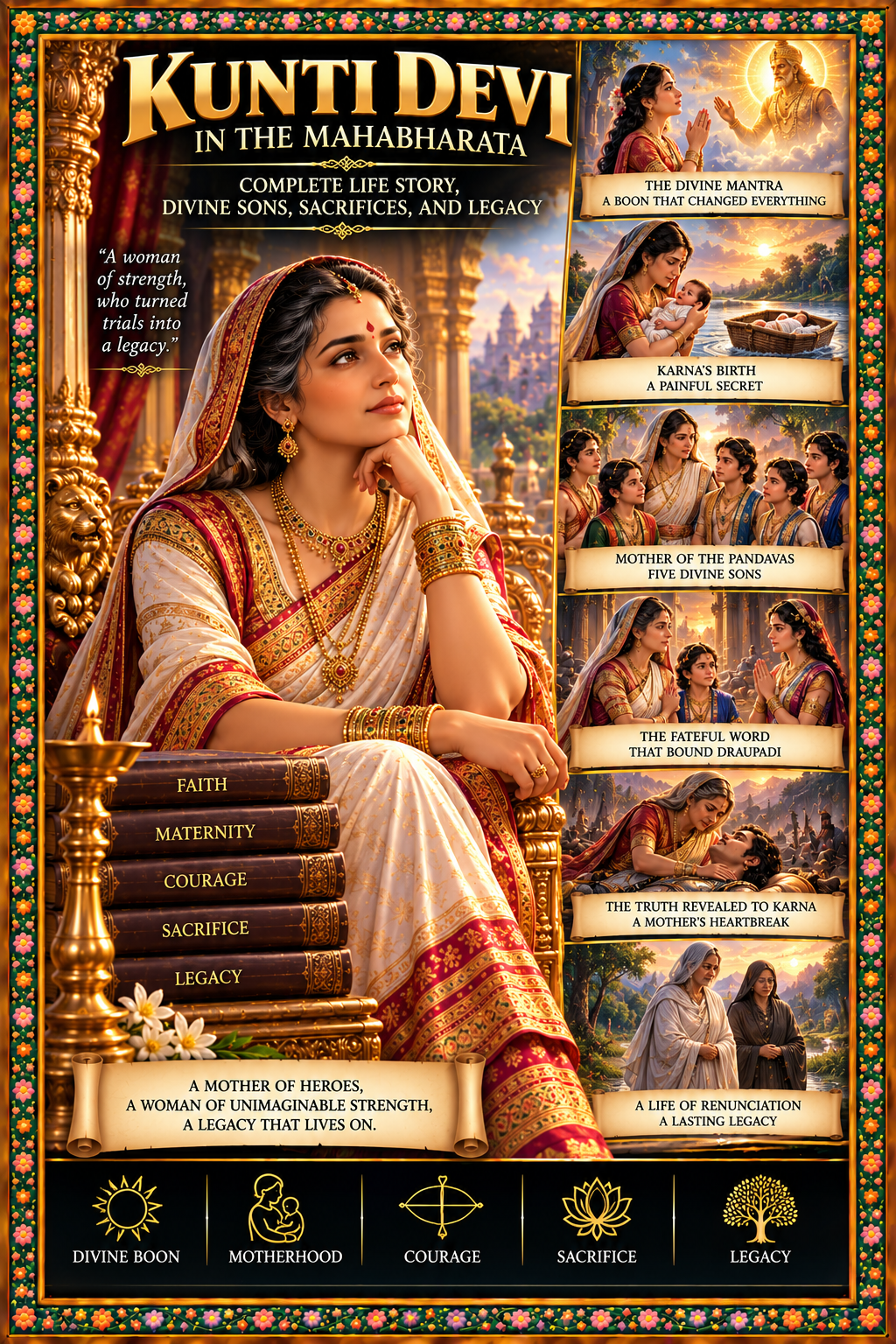
Introduction – Kunti Devi in Mahabharata
Long before she became the venerable queen mother of the Pandavas, young princess Pritha received a divine boon from the fiery sage Durvasa that could summon any god to grant her a child. When teenage curiosity led her to call upon Surya, the sun god, she was blessed with a radiant baby born with golden armor – a secret she was forced to send down the river in a floating basket with a weeping heart. Throughout a lifetime marked by widowhood, forest exile, and royal conspiracies, Queen Kunti stood as the unwavering moral anchor of the Pandava brothers, guiding them through trials with wisdom and quiet resilience.
Her life teaches us that courage, patience, and faith can overcome even the greatest challenges. From receiving a divine boon in her youth to witnessing the Kurukshetra War, Kunti’s journey remains one of the most inspiring stories in Hindu mythology.
In this comprehensive guide by Ratnam Strategy, you’ll discover Kunti Devi’s birth, childhood, marriage, divine sons, greatest sacrifices, role in the Mahabharata, and timeless lessons.
For official cultural and historical archives, visit the Ministry of Culture, Government of India.
Who Was Kunti Devi?
Pritha Kunti Devi was born into the Yadava dynasty as Kunti Devi.She was the daughter of King Shurasena and was later adopted by King Kuntibhoja, from whom she received the name Kunti.
She was known for her humility, compassion, intelligence, and devotion to sages and elders.
Her life changed forever when she served Sage Durvasa with great dedication.
Birth and Early Life of Kunti -Kunti Devi in Mahabharata
Princess Pritha
Kunti was born as Princess Pritha.
Because King Kuntibhoja had no children, Shurasena entrusted Pritha to him, and she became known as Kunti.
From childhood, she displayed:
- Respect for elders
- Compassion
- Self-discipline
- Hospitality
- Strong moral values
These qualities later helped her survive the greatest trials of her life.
Sage Durvasa’s Divine Boon – Kunti Devi in Mahabharata
The Powerful Mantra
During Sage Durvasa’s visit, Kunti served him with complete devotion.
Impressed by her dedication, Durvasa blessed her with a secret mantra.
This mantra allowed her to invoke any deity and receive a child possessing that deity’s divine qualities.
The sage warned her to use the mantra wisely.
Birth of Karna – Kunti Devi in Mahabharata
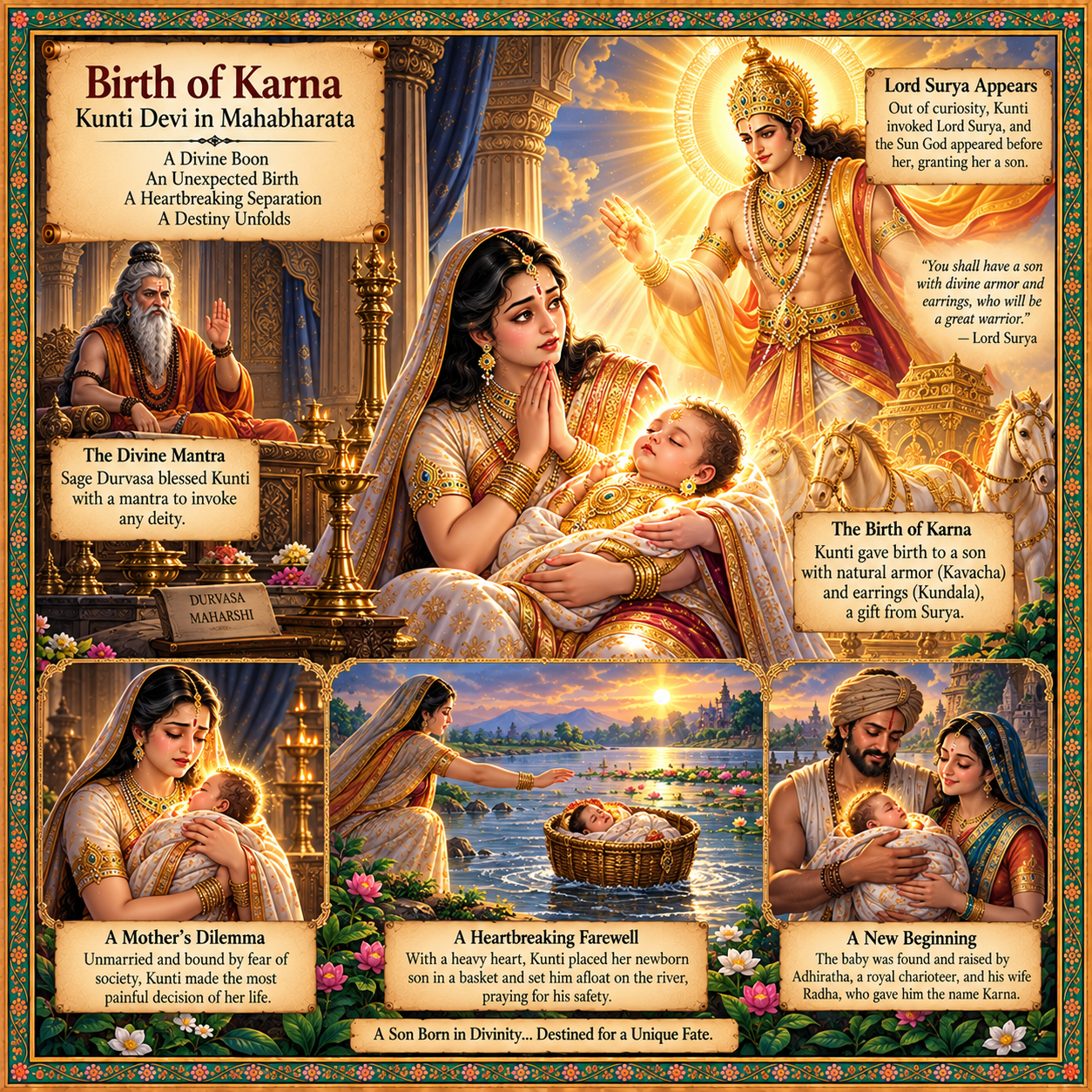
Kunti’s First Secret
Curious about the mantra’s power, the young Kunti invoked Surya, the Sun God.
Surya appeared before her and granted her a divine son.
Thus, Karna was born wearing natural celestial armor (Kavacha) and earrings (Kundala).
However, being unmarried, Kunti feared social disgrace.
With immense sorrow, she placed the infant in a basket and set him afloat in a river.
The child was later found and raised by Adhiratha and Radha.
This painful decision became the greatest regret of Kunti’s life.
Marriage to King Pandu – Kunti Devi in Mahabharata
Queen of Hastinapura
Kunti married King Pandu of Hastinapura.
Pandu later married Madri as his second wife.
The royal family initially lived happily until destiny changed everything.
Pandu’s Curse -Kunti Devi in Mahabharata
Life in the Forest
King Pandu accidentally killed Sage Kindama while hunting.
The dying sage cursed Pandu:
If he ever approached his wives with desire, he would die instantly.
Unable to father children, Pandu renounced the kingdom and went to the forest with Kunti and Madri.
Birth of the Pandavas – Kunti Devi in Mahabharata
Using the Divine Mantra
Remembering Durvasa’s boon, Kunti shared her secret with Pandu.
Following his request, she invoked different deities.
Yudhishthira
Born through Dharma (Yama), he became the embodiment of truth and justice.
Bhima
Born through Vayu, the Wind God, Bhima possessed unmatched physical strength.
Arjuna
Born through Indra, the king of the gods, Arjuna became history’s greatest archer.
Birth of Nakula and Sahadeva – Kunti Devi in Mahabharata
Sharing the Mantra
Kunti selflessly shared the mantra with Madri.
Madri invoked the Ashwini Kumaras.
She gave birth to:
- Nakula
- Sahadeva
Thus, the five Pandavas were born through divine blessings.
Pandu’s Death and Madri’s Sacrifice – Kunti Devi in Mahabharata
Kunti Becomes Mother of Five
One day, Pandu forgot the curse and embraced Madri.
The curse immediately took effect, and Pandu died.
Madri chose to perform sati, leaving Kunti to raise all five Pandavas equally.
She loved Nakula and Sahadeva as much as her own children.
This remains one of the greatest examples of motherhood in Hindu tradition.
Return to Hastinapura – Kunti Devi in Mahabharata
Raising the Pandavas
With the young princes, Kunti returned to Hastinapura.
There, the Pandavas faced:
- Jealousy
- Political conspiracies
- Attempts on their lives
- Constant rivalry with the Kauravas
Despite these dangers, Kunti taught them:
- Truth
- Compassion
- Patience
- Dharma
- Respect for elders
The Lakkagriha Incident – Kunti Devi in Mahabharata
Escape from the Palace of Lac
Duryodhana secretly planned to burn the Pandavas alive inside the Lakshagriha.
Thanks to Vidura’s warning, Kunti escaped through an underground tunnel with her sons.
This marked another turning point in her life.
Draupadi Becomes the Wife of the Pandavas – Kunti Devi in Mahabharata
Kunti’s Unintentional Command
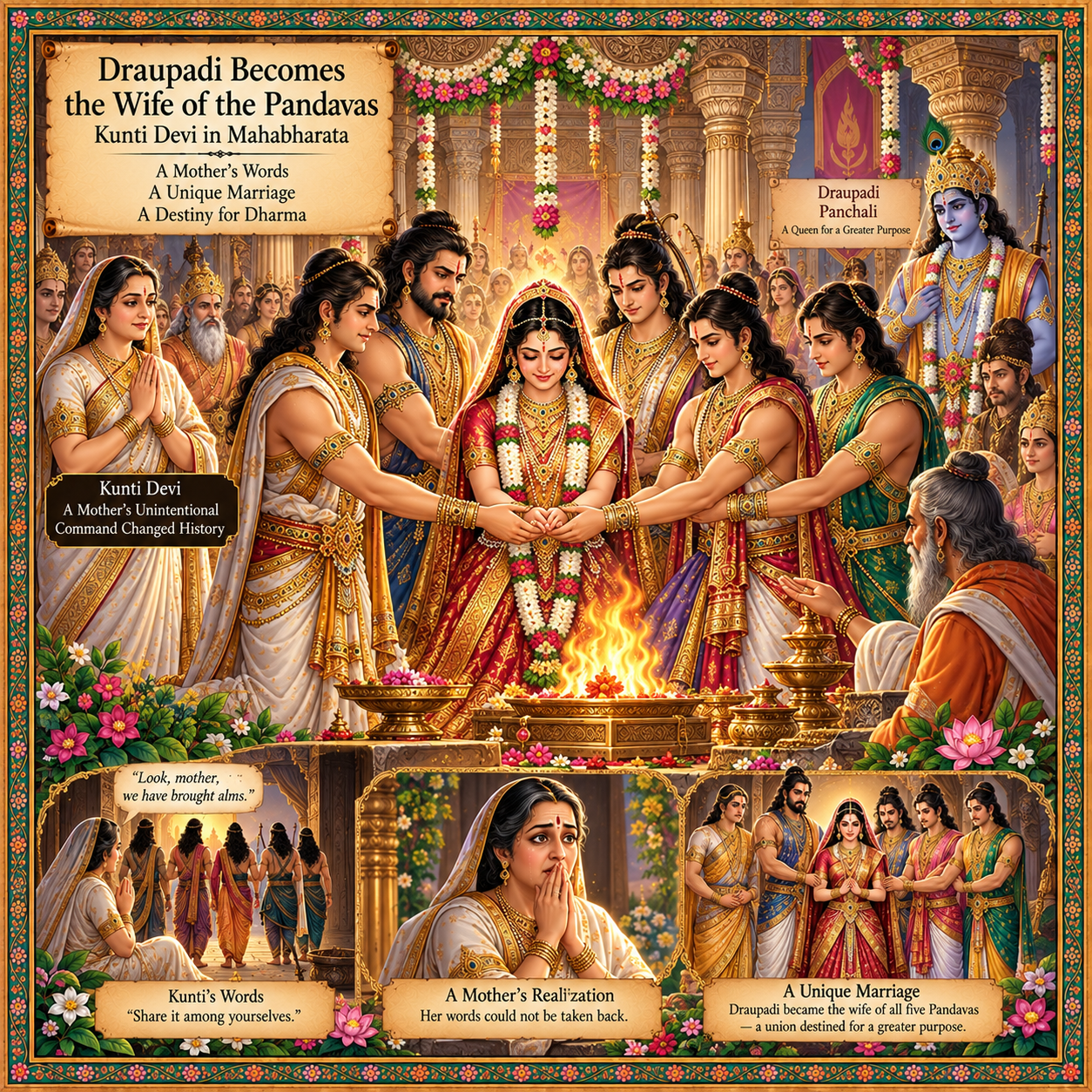
When Arjuna returned after winning Draupadi’s swayamvara, he jokingly told Kunti they had brought home something valuable.
Without seeing what it was, Kunti instructed:
“Share it equally among yourselves.”
To honor their mother’s words, Draupadi became the common wife of all five Pandavas.
This became one of the most unique events in the Mahabharata.
Kunti and Karna
The Painful Reunion
Before the Kurukshetra War, Kunti secretly met Karna.
As his biological mother, she revealed to him who she was.
She begged him to join the Pandavas.
However, Karna refused because he remained loyal to Duryodhana.
Still, he promised:
- He would not kill Yudhishthira.
- He would not kill Bhima.
- He would not kill Nakula.
- He would not kill Sahadeva.
- He would fight only Arjuna.
Kunti silently accepted her tragic fate.
Kunti During the Kurukshetra War
Silent Strength
Throughout the great war, Kunti endured unimaginable emotional pain.
She watched:
- One son fighting against five others.
- Countless warriors die.
- Families destroyed.
After Karna’s death, she finally revealed his true identity to the Pandavas.
They were devastated.
Kunti’s Final Years – Kunti Devi in Mahabharata
Renouncing Royal Life
After the war, Kunti chose a simple life.
She accompanied Dhritarashtra and Gandhari into the forest.
While meditating, all three perished in a forest fire.
Her departure reflected detachment, forgiveness, and inner peace.
Qualities of Kunti Devi
Why She Is Revered
Kunti represents:
- Unconditional motherhood
- Sacrifice
- Patience
- Faith in God
- Courage
- Humility
- Wisdom
- Forgiveness
- Leadership
- Devotion to Dharma
Lessons from Kunti Devi’s Life – Kunti Devi in Mahabharata
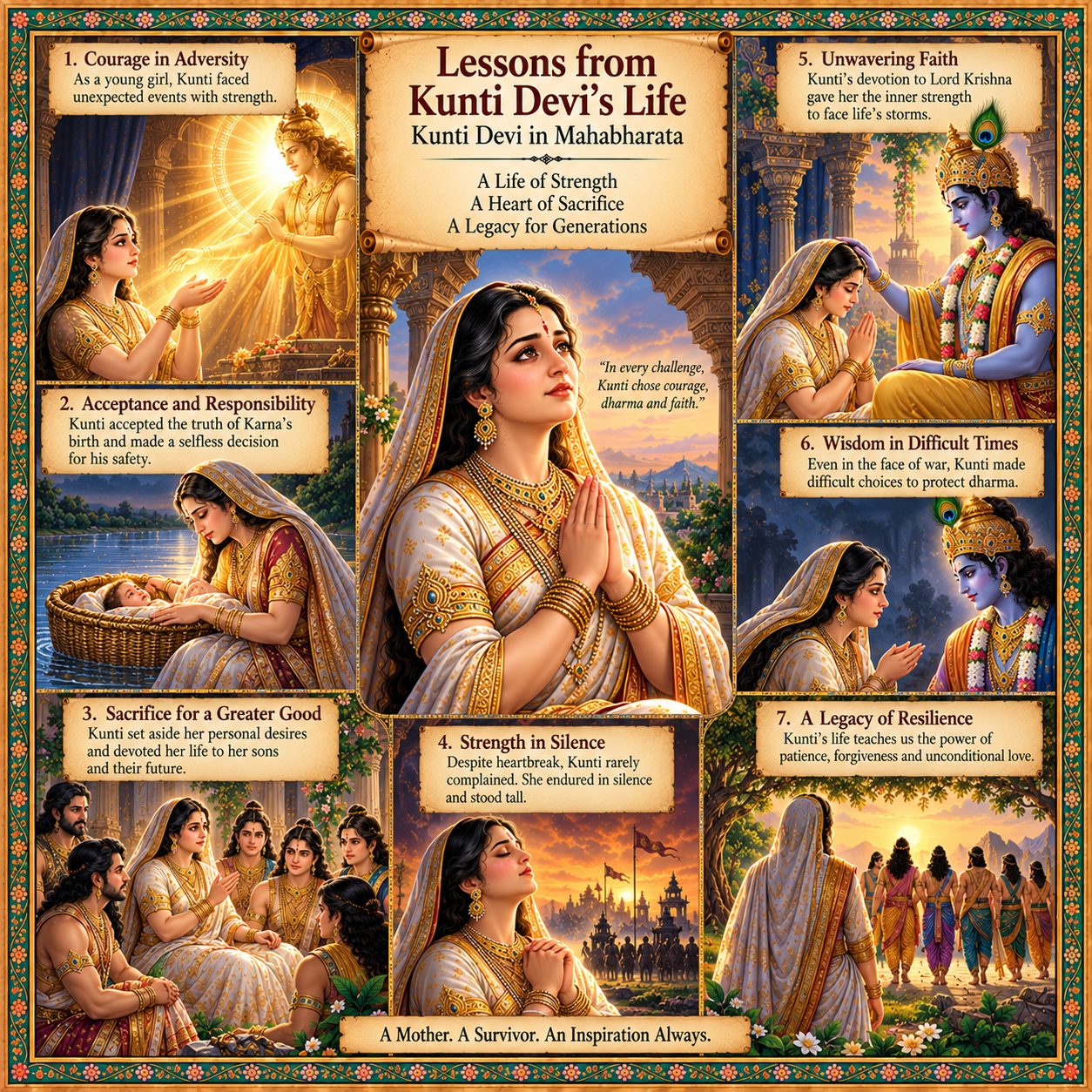
Timeless Teachings
1. Accept Responsibility
Kunti always faced the consequences of her actions with courage.
2. Faith Gives Strength
She never lost faith, even in exile.
3. Motherhood Is Beyond Birth
She raised Nakula and Sahadeva with equal love.
4. Dharma Above Everything
She taught her children righteousness over power.
5. Forgiveness Brings Peace
Despite immense suffering, Kunti chose compassion over revenge.
Kunti Devi’s Legacy – Kunti Devi in Mahabharata
Eternal Inspiration -Kunti Devi in Mahabharata
Kunti remains one of the greatest mothers in Indian history.
Her life continues to inspire millions through:
- The Mahabharata
- Spiritual discourses
- Hindu traditions
- Devotional literature
- Television adaptations
- Temple storytelling
She symbolizes resilience, maternal love, and unwavering faith.
Conclusion – Kunti Devi in Mahabharata
Kunti Devi’s life is a remarkable journey of sacrifice, resilience, and devotion. From her youthful encounter with Sage Durvasa to the heartbreaking separation from Karna, the raising of the Pandavas, and the aftermath of the Kurukshetra War, every chapter of her life reflects extraordinary courage.
She endured personal loss, political turmoil, and emotional suffering, yet remained steadfast in her commitment to dharma. Her wisdom shaped the Pandavas into noble leaders, and her legacy continues to inspire generations seeking strength in adversity.
For devotees, students of the Mahabharata, and lovers of Indian culture, Kunti Devi stands as an eternal symbol of motherhood, faith, and righteousness.
Frequently Asked Questions (FAQs) – Kunti Devi in Mahabharata
1. Who was Kunti Devi?
Kunti Devi was the mother of the Pandavas and one of the central figures in the Mahabharata.
2. What was Kunti’s original name?
Her original name was Pritha.
3. Who were Kunti’s parents?
She was born to King Shurasena and later adopted by King Kuntibhoja.
4. Why was she called Kunti?
She was adopted by King Kuntibhoja, and thereafter became known as Kunti.
5. Who gave Kunti the divine mantra?
Sage Durvasa granted her the sacred mantra.
6. Who was Kunti’s first son?
Karna was her firstborn son.
7. Why did Kunti abandon Karna?
She feared social disgrace because she was unmarried when he was born.
8. Who was Kunti’s husband?
King Pandu of Hastinapura.
9. Which gods blessed Kunti with children?
Dharma (Yama), Vayu, and Indra.
10. Who were Kunti’s three sons?
Yudhishthira, Bhima, and Arjuna.
11. Who were Madri’s sons?
Nakula and Sahadeva.
12. Why did Pandu die?
He died because of Sage Kindama’s curse after embracing Madri.
13. Why did Draupadi marry all five Pandavas?
As Kunti unknowingly instructed her sons to share their goods equally.
14. Did Kunti reveal Karna’s identity before the war?
Yes, she revealed the truth to Karna before the Kurukshetra War.
15. Why didn’t Karna join the Pandavas?
He remained loyal to Duryodhana, who had supported him throughout his life.
16. When did the Pandavas learn Karna was their brother?
After Karna’s death in the Kurukshetra War.
17. What qualities is Kunti known for?
She is remembered for courage, sacrifice, wisdom, devotion, and motherhood.
18. How did Kunti spend her final years?
She lived an ascetic life in the forest with Dhritarashtra and Gandhari.
19. How did Kunti die?
She died in a forest fire while living a life of renunciation and meditation.
20. What is Kunti Devi’s greatest legacy?
Her unwavering commitment to dharma, selfless motherhood, and resilience continue to inspire people across generations.