Admin
Admin
Dushala in the Mahabharata: The Forgotten Princess of Hastinapur
Dushala in the Mahabharata : The Mahabharata is filled with powerful kings, mighty warriors, wise sages, and remarkable women. While characters like Draupadi, Kunti, Gandhari, and Subhadra are frequently discussed, one important woman often remains overlooked—Dushala, the only daughter of Dhritarashtra and Gandhari.
Dushala’s life reflects the emotional cost of the great war. Born into the royal family of Hastinapur, she witnessed both the glory and destruction of her lineage. Her story provides a unique perspective on family, politics, duty, and the tragic consequences of conflict.
In this article, we explore Dushala’s life, marriage, role in the Mahabharata, and the lessons her story offers.
Who Was Dushala?Dushala in the Mahabharata
Birth and Family Background – Dushala in the Mahabharata
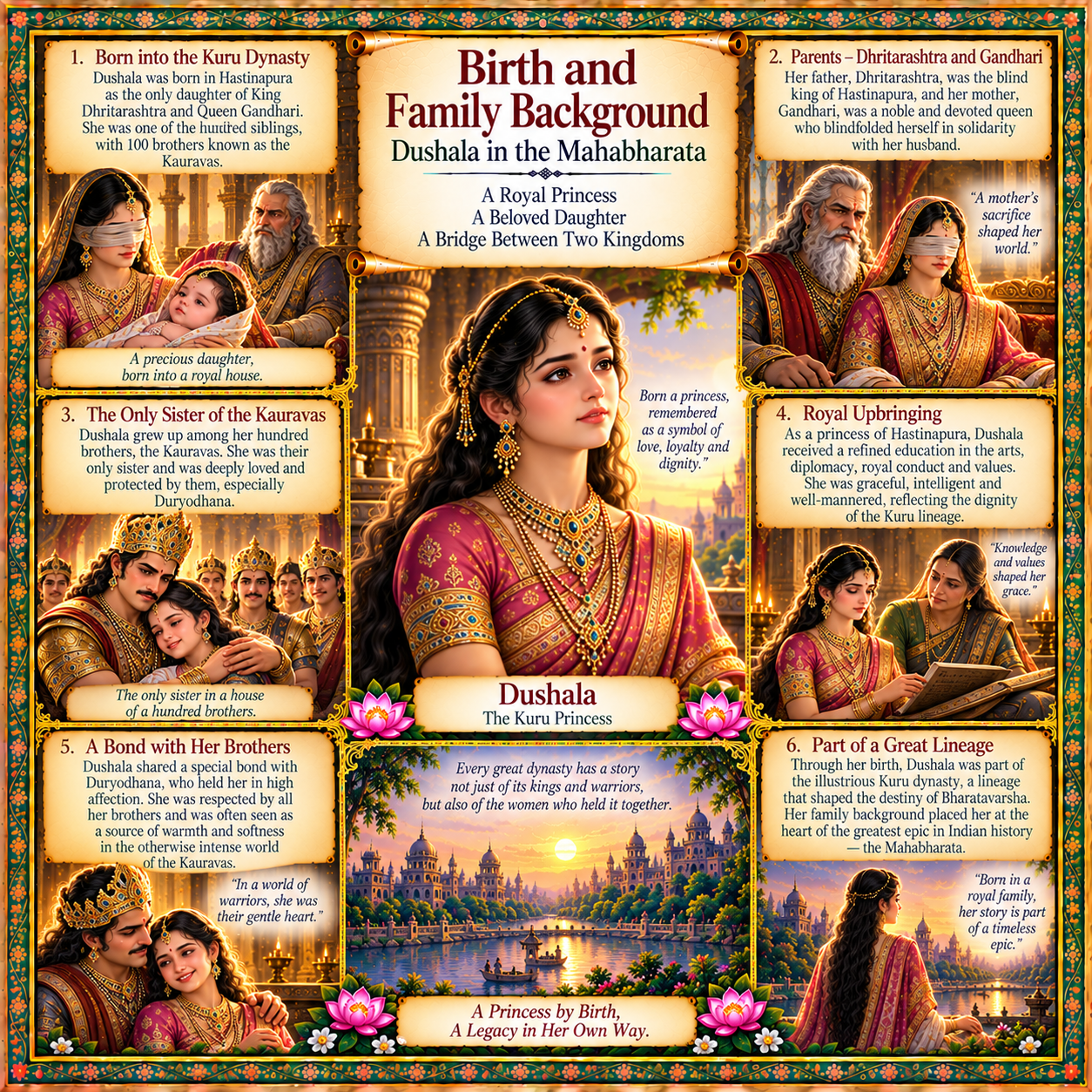
Queen Gandhari and King Dhritarashtra had one daughter, Dushala. She was the sister of the hundred Kauravas, including Duryodhana and Dushasana.
As the sole princess among one hundred brothers, Dushala was deeply loved and cherished by her family.Having grown up in Hastinapur’s royal palace, she enjoyed a rich, luxurious, and affectionate childhood.
However, her life would eventually become intertwined with the political rivalries that led to the devastating Kurukshetra War.
Dushala’s Place in the Kuru Dynasty-Dushala in the Mahabharata
The Kuru dynasty was one of the most powerful royal families in ancient India. As a member of this dynasty, Dushala held significant importance in royal alliances.
In ancient kingdoms, royal marriages often served political purposes. Dushala’s marriage was arranged not only for family reasons but also to strengthen diplomatic relationships.
Dushala’s Marriage to Jayadratha- Dushala in the Mahabharata

Who Was Jayadratha? – Dushala in the Mahabharata
Jayadratha was the king of Sindhu, a powerful kingdom located to the northwest of Hastinapur. He was known as a capable ruler and warrior.
To strengthen political ties between Hastinapur and Sindhu, Dushala was married to Jayadratha.
The marriage was considered prestigious and beneficial for both kingdoms.
Life as Queen of Sindhu – Dushala in the Mahabharata
After her marriage, Dushala moved to Sindhu and became its queen. She fulfilled her royal responsibilities and became a respected member of her husband’s kingdom.
Despite living away from Hastinapur, she maintained strong emotional ties with her parents and brothers.
The Dark Side of Jayadratha – Dushala in the Mahabharata
Jayadratha’s Attempt to Abduct Draupadi – Dushala in the Mahabharata
One of the most controversial episodes involving Dushala’s husband occurred during the Pandavas’ exile.
While the Pandavas were away, Jayadratha encountered Draupadi and became captivated by her beauty. Ignoring her protests, he attempted to abduct her and take her away.
When the Pandavas discovered this act, they pursued Jayadratha, defeated him, and brought him before Draupadi.
Why Was Jayadratha Spared? – Dushala in the Mahabharata
Bhima wanted to kill Jayadratha for his crime. However, Yudhishthira and Draupadi ultimately chose mercy.
One of the reasons for sparing Jayadratha was Dushala. The Pandavas did not want their cousin and only sister of the Kauravas to become a widow.
This incident demonstrates how Dushala’s presence indirectly influenced major events in the Mahabharata.
Dushala During the Kurukshetra War – Dushala in the Mahabharata
The War That Changed Everything – Dushala in the Mahabharata
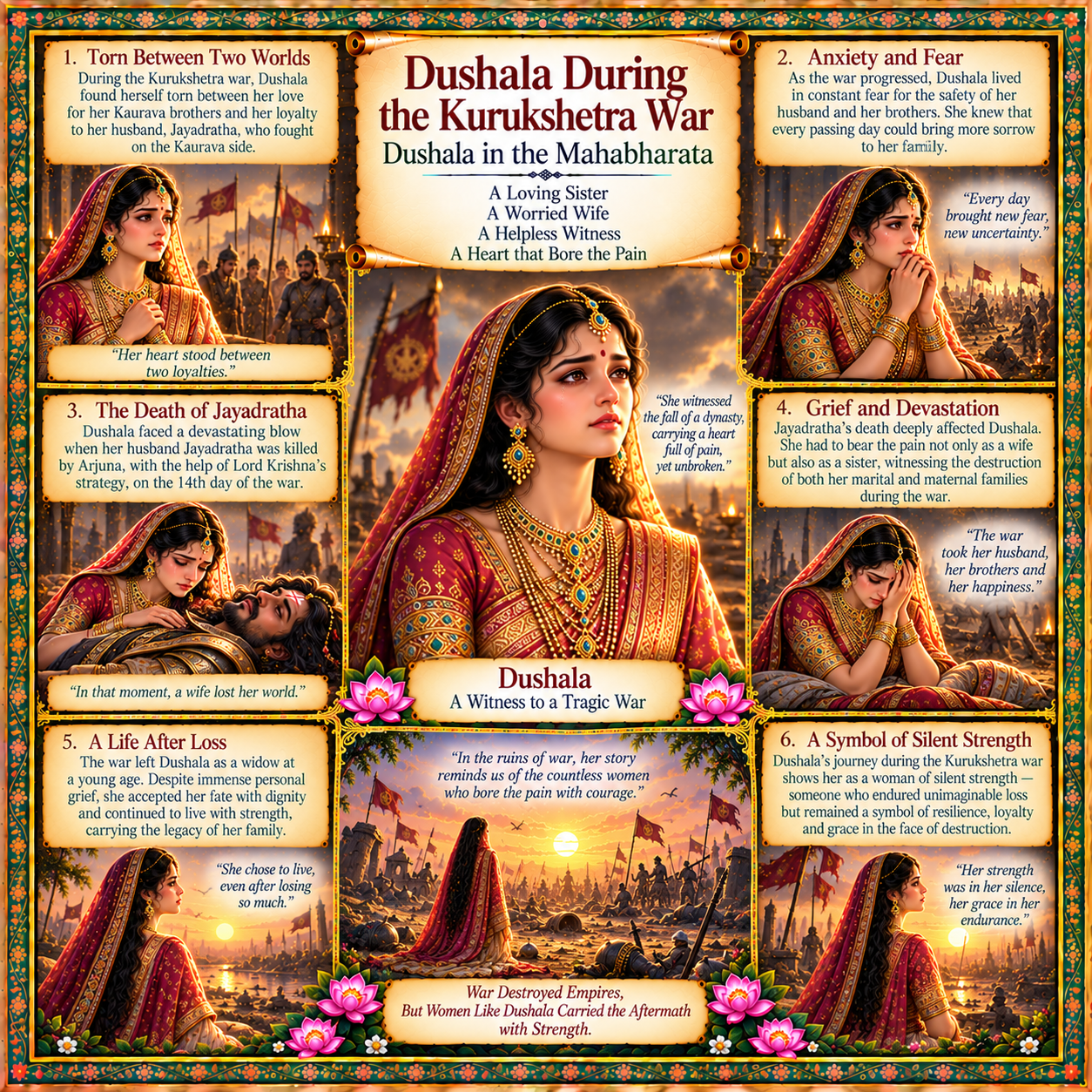
The Kurukshetra War was one of the greatest battles described in world literature. It involved the Kauravas and Pandavas fighting for control of the Kuru kingdom.
Although Dushala did not participate directly in the war, its consequences deeply affected her life.
She faced a terrible dilemma:
- Her brothers fought on one side.
- She fought alongside her husband.
- Her extended family was divided.
- The outcome threatened everyone she loved.
Jayadratha’s Important Role – Dushala in the Mahabharata
Jayadratha played a significant role in the war.
On the thirteenth day of battle, he prevented the Pandavas from entering the Chakravyuha formation. Multiple warriors eventually killed Abhimanyu because he became trapped.
This event became one of the most tragic moments of the Mahabharata.
Arjuna vowed to kill Jayadratha before sunset the next day.
The Death of Jayadratha – Dushala in the Mahabharata
Arjuna’s Terrible Vow – Dushala in the Mahabharata
After learning about Abhimanyu’s death, Arjuna was overcome with grief and anger.
He declared that he would kill Jayadratha before sunset on the following day or enter the funeral fire himself.
This vow created immense tension across both armies.
Krishna’s Strategy
With Lord Krishna’s guidance, Arjuna fought fiercely throughout the day.
As sunset approached, Krishna created an illusion that made the Kauravas believe the day had ended.
Jayadratha emerged from protection, believing he was safe.
At that moment, Arjuna released a powerful arrow and killed him.
The death of Jayadratha fulfilled Arjuna’s vow but brought immense sorrow to Dushala.
Dushala’s Tragedy – Dushala in the Mahabharata
Losing Her Husband
The death of Jayadratha transformed Dushala’s life.
She lost her husband in one of history’s most devastating wars.
Unlike warriors who gained glory on the battlefield, Dushala experienced the suffering that war leaves behind.
Losing Her Brothers
The tragedy did not end there.
As the war continued, Duryodhana, Dushasana, and nearly all her brothers were killed.
The Kaurava dynasty was virtually destroyed.
Dushala became one of the few surviving members of her family.
Dushala and Ashwamedha Parva -Dushala in the Mahabharata
Arjuna Meets Dushala Again – Dushala in the Mahabharata
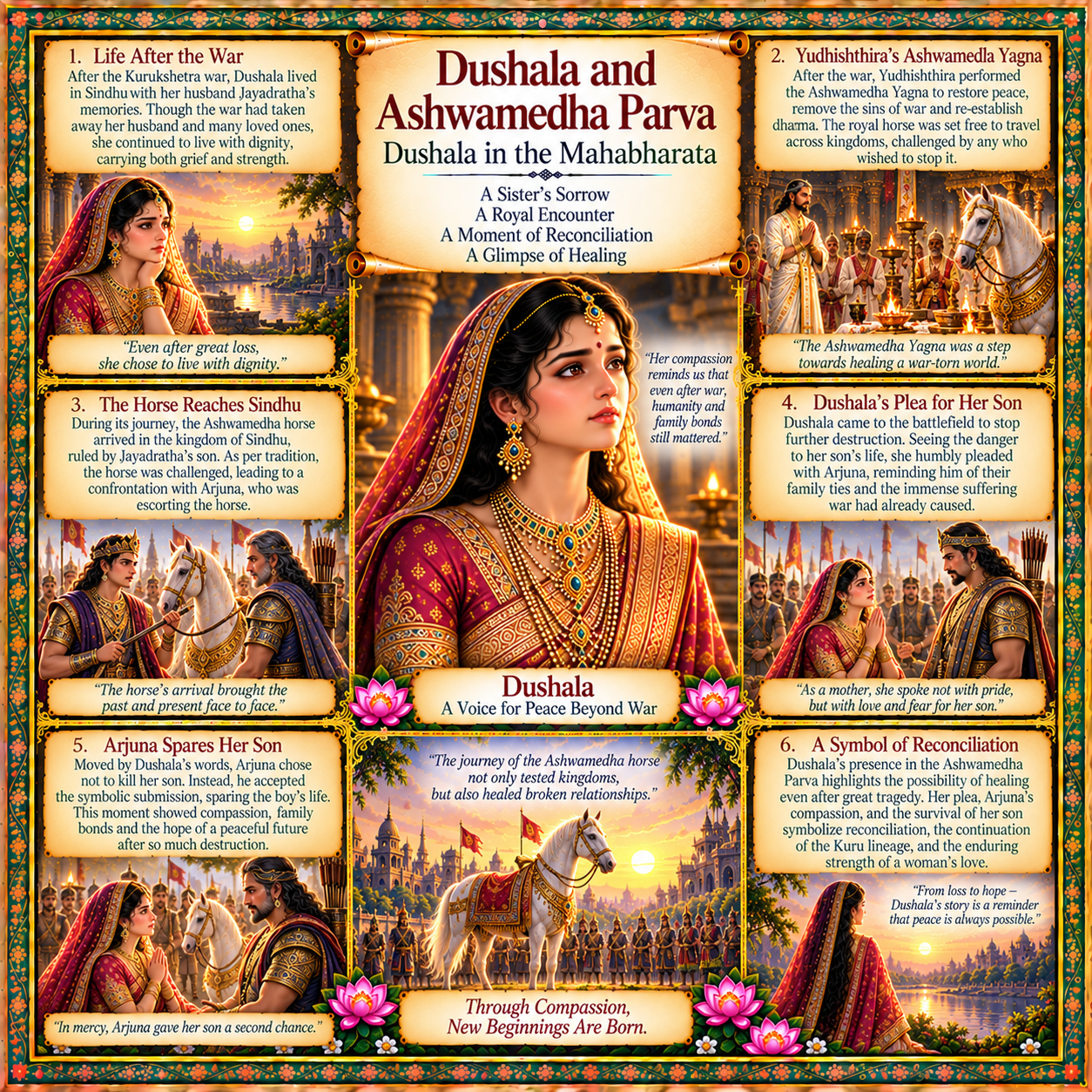
One of the most touching moments involving Dushala occurs after the war during the Ashwamedha Yajna.
As part of the ritual, Arjuna traveled with the sacrificial horse and challenged various kingdoms.
When he reached Sindhu, conflict arose between Arjuna and the local rulers.
Dushala’s Plea for Peace
Dushala came before Arjuna carrying her grandson.
She reminded him of their family relationship and pleaded for mercy.
Seeing her grief and remembering the immense losses suffered by both sides, Arjuna’s heart softened.
He agreed to spare her family and establish peace.
This emotional encounter highlights Dushala’s role as a symbol of reconciliation after years of hatred and violence.
Dushala’s Son and Descendants -Dushala in the Mahabharata
Suratha
Jayadratha and Dushala had a son named Suratha.
Following Jayadratha’s death, Suratha inherited responsibilities related to the Sindhu kingdom.
However, the aftermath of the Kurukshetra War affected him deeply.
Some versions of the Mahabharata mention that Suratha died due to shock and grief upon hearing about Arjuna’s arrival during the Ashwamedha campaign.
The Next Generation
Despite the destruction caused by the war, Dushala’s lineage continued through her descendants.
This continuity symbolizes hope and renewal after tragedy.
Character Analysis of Dushala – Dushala in the Mahabharata
A Silent Victim of War – Dushala in the Mahabharata
Unlike famous warriors and queens, Dushala had little control over the events shaping her destiny.
She neither sought conflict nor contributed to the rivalries between the Pandavas and Kauravas.
Yet she suffered greatly because of them.
Symbol of Family Bonds – Dushala in the Mahabharata
Dushala represents the emotional ties that connect families even during conflict.
Her relationship with both the Kauravas and Pandavas reminds readers that wars affect not only soldiers but also innocent relatives.
Symbol of Forgiveness – Dushala in the Mahabharata
Her encounter with Arjuna after the war demonstrates the power of forgiveness and compassion.
Instead of continuing cycles of revenge, Dushala became a bridge toward peace.
Lessons from Dushala’s Life – Dushala in the Mahabharata
1. War Hurts Everyone
The Mahabharata shows that victory often comes with immense loss. Dushala’s life illustrates how innocent family members suffer alongside warriors.
2. Family Relationships Matter
In spite of political divisions, family bonds remained important throughout the epic.
3. Compassion Is Powerful
Arjuna’s decision to spare Dushala’s family demonstrates the importance of mercy.
4. Women Bear Hidden Burdens
Dushala’s story highlights how women often endure the consequences of decisions made by others.
5. Peace Is Greater Than Revenge
Her role in the Ashwamedha Parva emphasizes reconciliation over continued hostility.
Legacy of Dushala in the Mahabharata – Dushala in the Mahabharata

Although Dushala appears less frequently than many other characters, her story carries deep emotional significance.
She was:
- The only daughter of Dhritarashtra and Gandhari.
- The beloved sister of the Kauravas.
- The queen of Sindhu.
- The wife of Jayadratha.
- A survivor of the Kurukshetra War.
- A symbol of peace and forgiveness.
Her life reminds us that behind every great war are countless untold stories of grief, resilience, and hope.
Conclusion: Dushala in the Mahabharata
Dushala may not be one of the most celebrated figures in the Mahabharata, but she is undoubtedly one of its most tragic and meaningful characters. As the only daughter of the Kaurava family, she witnessed the rise and fall of her dynasty. She lost her husband, brothers, and much of her family to the Kurukshetra War, yet she remained a symbol of dignity and compassion.
Her story teaches us that history is not shaped only by warriors and kings. Sometimes, the most profound lessons come from those who silently endure suffering and choose peace over revenge.
Frequently Asked Questions (FAQs) : Dushala in the Mahabharata
1. Who was Dushala in the Mahabharata?
Dushala was the only daughter of Dhritarashtra and Gandhari and the sister of the Kauravas.
2. How many brothers did Dushala have?
She had one hundred brothers, collectively known as the Kauravas.
3. Who was Dushala’s husband?
As the daughter of Jayadratha, the Sindhi king, Dushala married him.
4. Why was Dushala important?
She represented political alliances and later became a symbol of peace and reconciliation.
5. Did Dushala participate in the Kurukshetra War?
No, she did not fight in the war.
6. Who was Jayadratha?
Jayadratha was the king of Sindhu and Dushala’s husband.
7. Why did Arjuna kill Jayadratha?
Arjuna killed him to avenge Abhimanyu’s death.
8. Did Dushala have children?
Yes, she had a son named Suratha.
9. Was Dushala close to the Kauravas?
Yes, she shared a close bond with her brothers.
10. Why did the Pandavas spare Jayadratha earlier?
Partly because they did not want Dushala to become a widow.
11. What happened to Dushala after the war?
She survived and continued living in Sindhu.
12. What role did Dushala play in Ashwamedha Parva?
She appealed to Arjuna for peace.
13. Did Arjuna show mercy to Dushala?
Yes, he respected her plea and avoided further destruction.
14. Was Dushala a queen?
Yes, she became the queen of Sindhu.
15. What does Dushala symbolize?
She symbolizes suffering, forgiveness, and peace.
16. Did Dushala lose all her brothers?
Nearly all her brothers died in the Kurukshetra War.
17. Was Dushala related to the Pandavas?
Yes, the Pandavas were her cousins.
18. What kingdom did Dushala belong to after marriage?
She belonged to the kingdom of Sindhu.
19. Why is Dushala often overlooked?
The epic primarily focuses on major warriors and political leaders.
20. What is Dushala’s legacy today?
She remains a powerful reminder of the human cost of war and the value of compassion.