 Raja Ratnam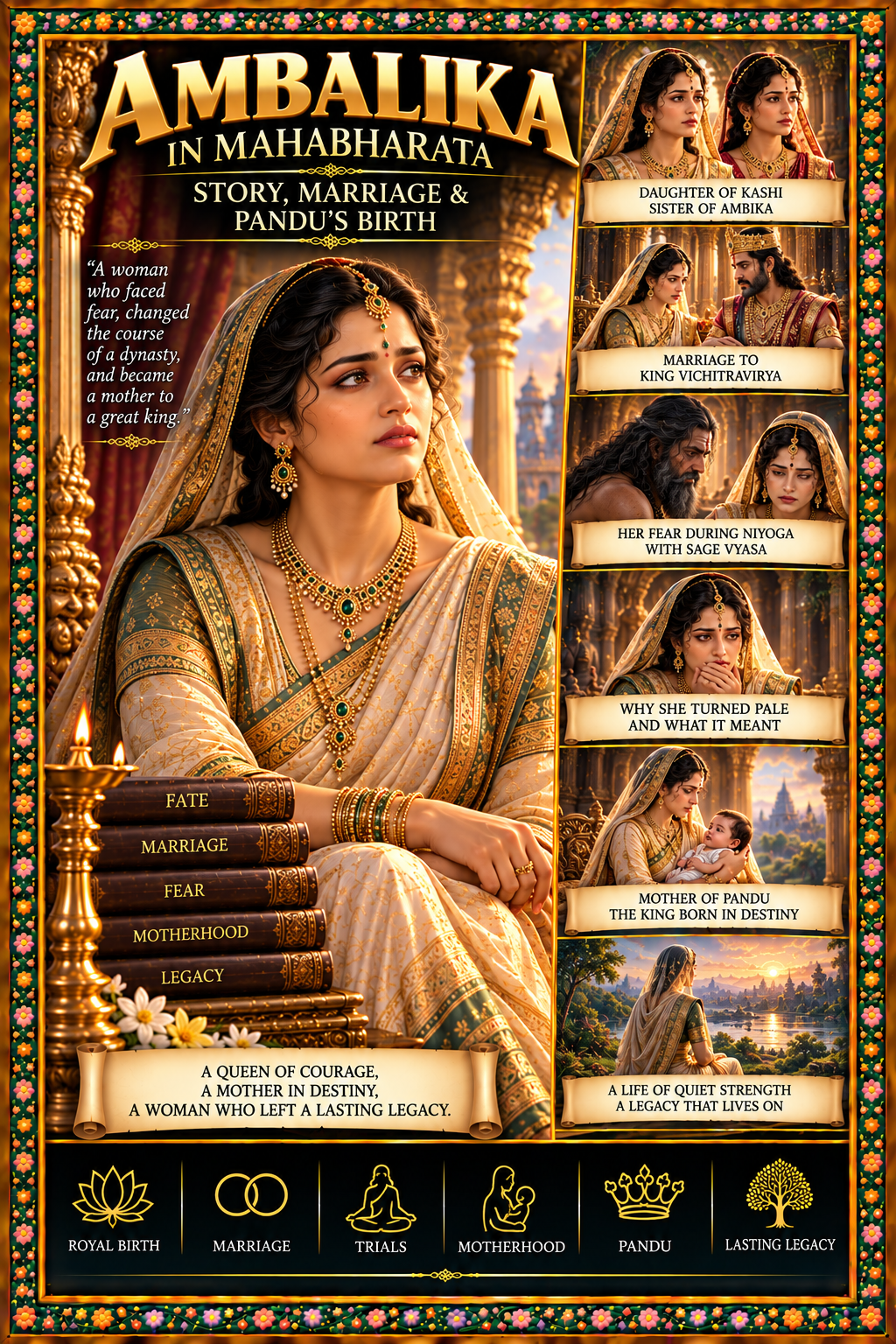
Ambalika in the Mahabharata: The Queen Who Became the Mother of Pandu
The story of Ambalika in the Mahabharata is one of sacrifice, destiny, and courage. While the Mahabharata is filled with legendary warriors like Bhishma, Arjuna, Karna, and Krishna, several women quietly shaped the destiny of the Kuru dynasty. Among them, Ambalika occupies a special place because she became the mother of King Pandu, whose sons later became the famous Pandavas.
The tale of Ambalika in the Mahabharata is deeply connected with the continuation of the Kuru lineage. Her life reflects the difficult choices royal women had to make for the welfare of their kingdom. Though she rarely appears in battle scenes or political debates, her role influenced the greatest war in Indian history.
In this article, we will explore the complete story of Ambalika in the Mahabharata, from her birth and marriage to her motherhood, spiritual life, and lasting legacy.
Who Was Ambalika? Ambalika in the Mahabharata
Ambalika was one of the three princesses of the Kingdom of Kashi. She was the younger sister of Ambika and the sister of Amba.
The three princesses were renowned for their extraordinary beauty, intelligence, and royal upbringing. Their lives changed forever when Bhishma attended their swayamvara on behalf of Hastinapura.
Unlike modern royal marriages, the customs of ancient India often required political alliances. Thus, Ambalika’s destiny became intertwined with the future of the Kuru dynasty.
The Swayamvara of the Princesses of Kashi – Ambalika in the Mahabharata
King Vichitravirya, the ruler of Hastinapura, required suitable queens.
Bhishma, bound by his lifelong vow of celibacy, attended the swayamvara of the Kashi princesses and defeated all rival kings. He then brought Amba, Ambika, and Ambalika to Hastinapura.
However, Amba revealed that she had already chosen King Salva as her husband. Bhishma respectfully allowed her to leave.
Ambika and Ambalika accepted marriage with King Vichitravirya.
This event became one of the turning points in the Mahabharata because it eventually led to the birth of Dhritarashtra, Pandu, and Vidura.
Marriage to King Vichitravirya – Ambalika in the Mahabharata
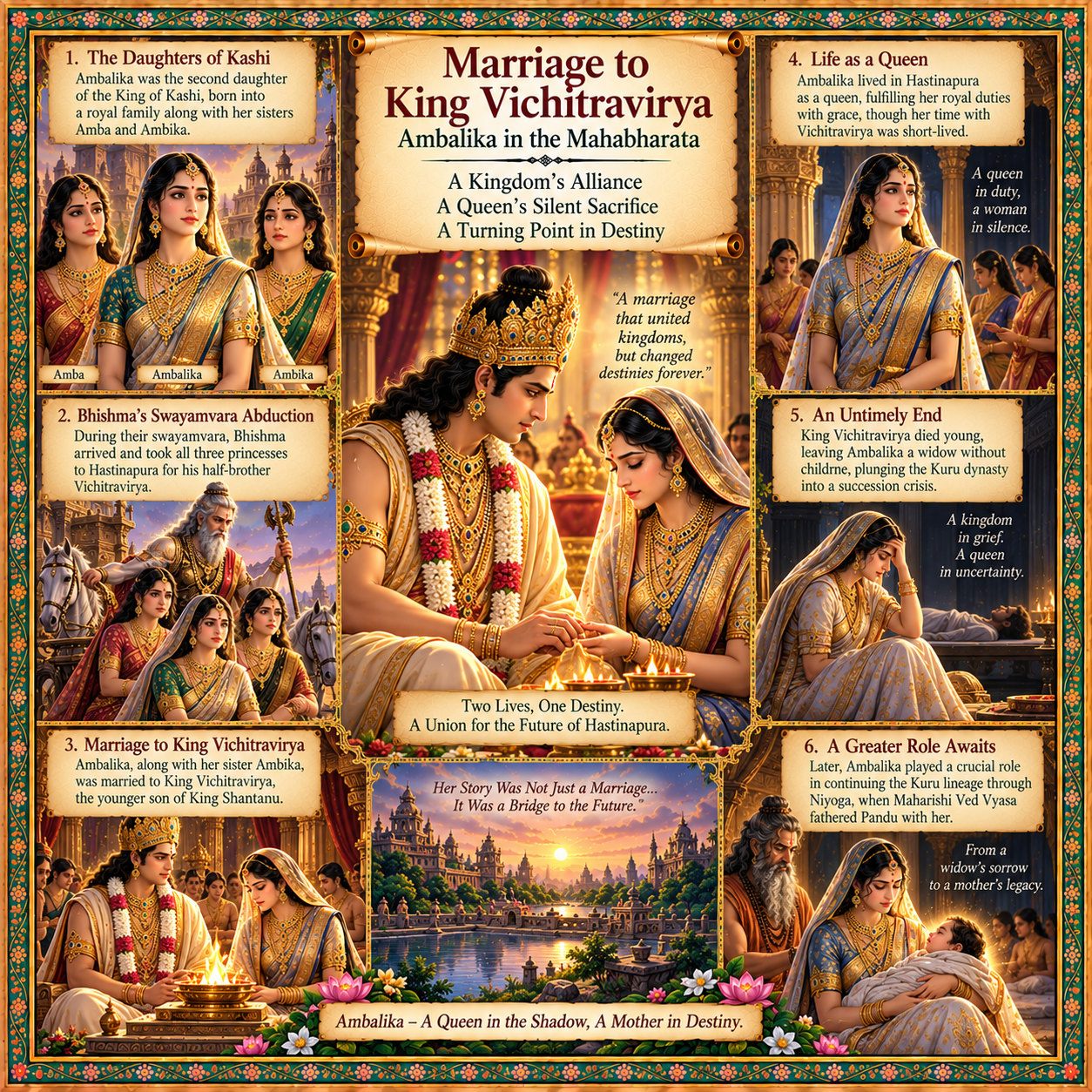
Ambalika married King Vichitravirya and became one of the queens of Hastinapura.
Unfortunately, Vichitravirya died at a young age without leaving any children.
An unexpected succession crisis was faced by the Kuru dynasty.
Without a legal heir, the future of the kingdom became uncertain.
This compelled Satyavati, the queen mother, to take an extraordinary decision.
For official cultural and historical archives, visit the Ministry of Culture, Government of India.
The Practice of Niyoga – Ambalika in the Mahabharata
Ancient Hindu society sometimes followed a tradition called Niyoga when a king died without heirs.
According to this custom, a respected sage or close relative would father children with the widow solely to continue the royal lineage.
Satyavati requested her son, Sage Vyasa, to perform this sacred duty.
Although unusual by today’s standards, Niyoga was considered a socially accepted and religiously sanctioned practice during that era.
Ambalika Meets Sage Vyasa – Ambalika in the Mahabharata
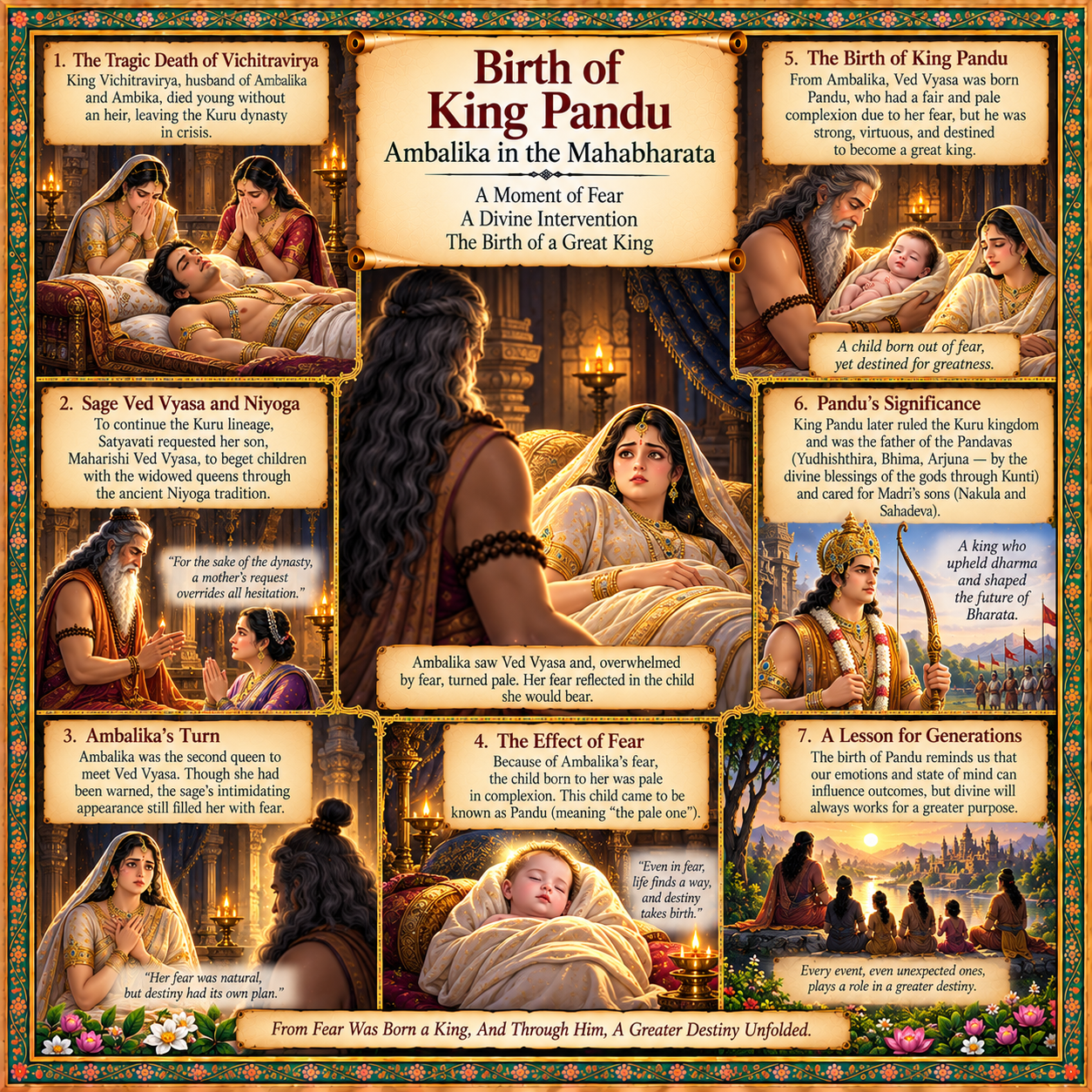
When Ambalika first saw Sage Vyasa, she became frightened.
Vyasa had spent many years performing severe penance in forests. His appearance was rugged, with matted hair, a long beard, and austere clothing.
Unable to control her fear, Ambalika’s face turned completely pale.
Vyasa noticed her reaction.
He blessed that the child born from this union would possess great strength and wisdom, but because of her fear, the child would be born with a pale complexion.
That child later became King Pandu.
Why Was Pandu Pale? – Ambalika in the Mahabharata
The Sanskrit word “Pandu” literally means “pale” or “yellowish.”
The Mahabharata explains that Pandu inherited this characteristic because Ambalika became pale during her meeting with Vyasa.
Despite this physical trait, Pandu grew into one of the greatest kings of the Kuru dynasty.
Birth of King Pandu – Ambalika in the Mahabharata
Pandu eventually became the ruler of Hastinapura.
He proved to be a brave warrior, excellent administrator, and beloved king.
Under his leadership, the kingdom expanded significantly.
Although Dhritarashtra was the elder brother, his blindness prevented him from becoming king.
Therefore, Pandu ruled the empire.
Ambalika as the Mother of Pandu – Ambalika in the Mahabharata
Ambalika devoted herself to raising Pandu with royal values, discipline, and righteousness.
Pandu inherited qualities such as:
- Courage
- Leadership
- Humility
- Respect for elders
- Military excellence
- Administrative wisdom
These qualities later made him one of the greatest kings of his generation.
Pandu’s Marriage and Family -Ambalika in the Mahabharata
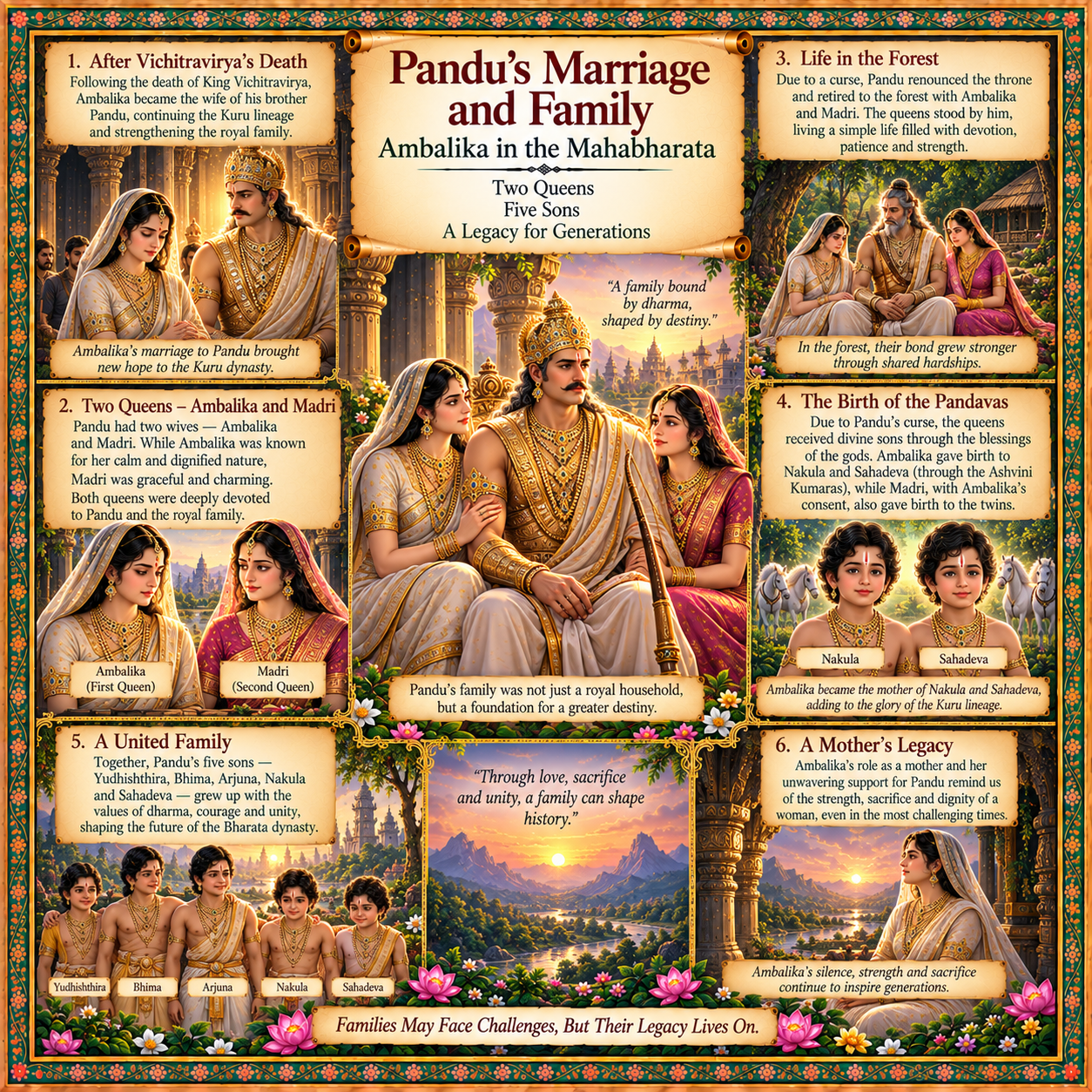
King Pandu later married:
- Kunti
- Madri
Due to Sage Kindama’s curse, Pandu could not father children naturally.
Through divine blessings, Kunti and Madri became the mothers of:
- Yudhishthira
- Bhima
- Arjuna
- Nakula
- Sahadeva
These five princes later became famous as the Pandavas.
Thus, Ambalika became the grandmother of the Pandavas.
Ambalika During the Rise of the Pandavas -Ambalika in the Mahabharata
Although Ambalika is not frequently mentioned in later sections of the Mahabharata, she witnessed many important developments:
- Rise of Pandu
- Pandu’s exile
- Birth of the Pandavas
- Death of Pandu
- Return of Kunti to Hastinapura
As an elder queen, she remained a respected figure within the royal family.
Life After Pandu’s Death – Ambalika in the Mahabharata
The death of Pandu deeply affected Ambalika.
Having already lost her husband years earlier, she now experienced the loss of her only son.
The burden of raising the Pandavas fell upon Kunti.
Ambalika gradually withdrew from palace life.
Retirement to the Forest – Ambalika in the Mahabharata
Later, Ambalika accompanied:
- Satyavati
- Ambika
The three royal women renounced worldly comforts and retired to the forest.
There they spent their remaining years performing meditation, austerities, and spiritual practices.
This peaceful retirement symbolized detachment from worldly ambitions.
Character of Ambalika – Ambalika in the Mahabharata
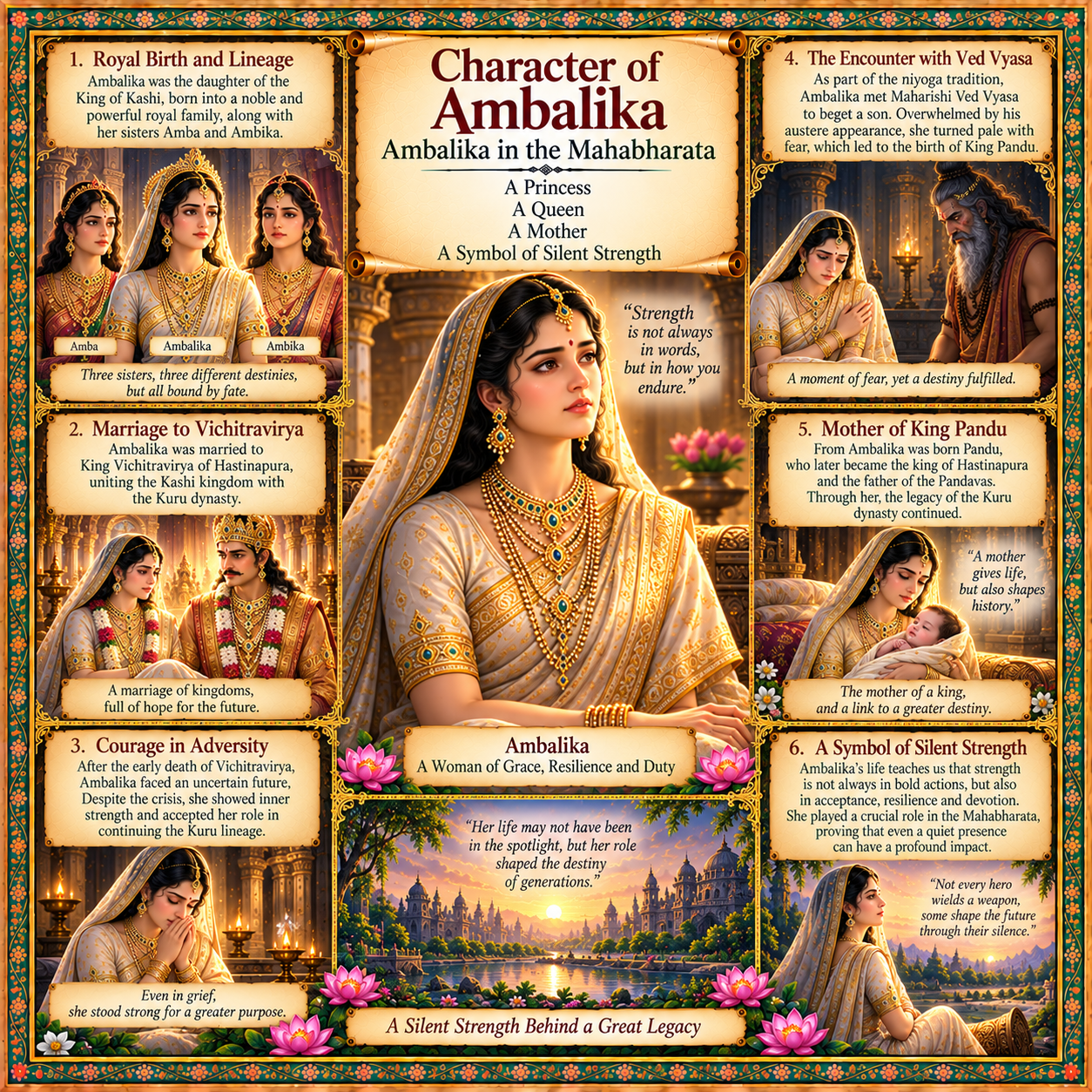
Ambalika represents several timeless virtues.
Courage
She accepted difficult responsibilities despite personal fears.
Sacrifice
She fulfilled her duty toward the Kuru dynasty.
Motherhood
She raised Pandu with noble values.
Patience
She endured personal suffering with dignity.
Devotion
She dedicated her later years to spiritual life.
Ambalika’s Importance in the Mahabharata
Without Ambalika:
- Pandu would not have been born.
- The Pandavas would never have existed.
- The Kurukshetra War might never have happened.
- Much of the Mahabharata’s central narrative would have unfolded differently.
Her role illustrates how seemingly quiet figures can shape the destiny of entire civilizations.
Lessons from Ambalika’s Life – Ambalika in the Mahabharata
Duty Above Personal Comfort
Ambalika accepted responsibilities that served the kingdom.
Fear Has Consequences
Her momentary fear influenced the destiny of her son, reminding us that emotions can shape important outcomes.
Motherhood Shapes History
Through Pandu, Ambalika became the grandmother of heroes who upheld dharma.
Spiritual Peace Comes Through Detachment
Her retirement to the forest teaches the value of renouncing worldly attachments in the later stages of life.
Silent Strength Matters
Not every hero carries a weapon. Some change history through patience and sacrifice.
Ambalika’s Legacy – Ambalika in the Mahabharata
The legacy of Ambalika in the Mahabharata continues through the Pandavas, whose lives became central to the epic.
Her story reminds readers that history is often shaped not only by kings and warriors but also by women whose quiet courage sustains entire dynasties.
Even though Ambalika appears briefly in the Mahabharata, her influence extends across generations, making her one of the most important royal women in the Kuru lineage.
Conclusion – Ambalika in the Mahabharata
The story of Ambalika in the Mahabharata is a remarkable journey of duty, motherhood, and sacrifice. From being a princess of Kashi to becoming the mother of King Pandu and grandmother of the Pandavas, Ambalika played a vital role in preserving the Kuru dynasty. Her life teaches us that true greatness often lies not in fame or power but in fulfilling one’s responsibilities with courage and dignity. Her legacy continues to inspire readers of the Mahabharata, reminding us that every individual, no matter how quietly they serve, can shape the course of history.
Frequently Asked Questions (FAQs) – Ambalika in the Mahabharata
1. Who was Ambalika in the Mahabharata?
Ambalika was the princess of Kashi, wife of King Vichitravirya, and mother of King Pandu.
2. Who were Ambalika’s siblings?
She was the sister of Amba and Ambika.
3. Why is Ambalika important?
She became the mother of Pandu and grandmother of the Pandavas.
4. Who was Ambalika’s husband?
King Vichitravirya of Hastinapura.
5. Why did Sage Vyasa visit Ambalika?
To continue the Kuru lineage through the practice of Niyoga.
6. Why did Ambalika become pale?
She was frightened by Vyasa’s austere appearance.
7. Who was Ambalika’s son?
King Pandu.
8. Why was Pandu called Pandu?
Because he was born with a pale complexion.
9. Did Ambalika have more than one child?
No. Pandu was her only son according to the epic.
10. Who were Ambalika’s grandchildren?
Yudhishthira, Bhima, Arjuna, Nakula, and Sahadeva.
11. Did Ambalika raise the Pandavas?
No. Kunti raised the Pandavas.
12. Why did Dhritarashtra not become king?
He was born blind.
13. What was Niyoga?
An ancient custom to continue a family lineage through an appointed man after a husband’s death.
14. Did Ambalika participate in the Kurukshetra War?
No. She was not involved in the war.
15. Where did Ambalika spend her final years?
In the forest with Satyavati and Ambika.
16. What virtues does Ambalika represent?
Sacrifice, patience, duty, motherhood, and spiritual devotion.
17. Was Ambalika a queen of Hastinapura?
Yes, she was one of the queens of King Vichitravirya.
18. Why is Ambalika remembered today?
Because her son Pandu became the father of the Pandavas, shaping the entire Mahabharata.
19. What can modern readers learn from Ambalika?
The importance of responsibility, resilience, and quiet strength.
20. Why should we study Ambalika in the Mahabharata?
Her life reveals how women played essential roles in preserving dynasties and influencing the destiny of one of India’s greatest epics.








Greetings,
I recently came across http://ratnamstrategy.com and wanted to get in touch. Your website has good potential, and with the right SEO strategy, it could reach more customers through Google.
Our SEO services are customized to improve rankings, increase organic traffic, and help businesses generate consistent leads.
If this is something you’d be interested in, let me know, and I’ll send our SEO strategies along with our package details.
Best regards,
Anaya
Hi Anaya,
Thank you for reaching out and for taking the time to review RatnamStrategy.com. I appreciate your feedback and your interest in helping improve our website’s SEO performance.
I’d be interested in learning more about your approach. Please send me your SEO strategies, the services you offer, case studies or past results (if available), along with your pricing and package details.
Once I’ve had a chance to review the information, I’ll get back to you if it aligns with our current requirements.
Looking forward to hearing from you.
Best regards,
Raja Ratnam
Howdy from bonusbacklinks,
Reliable seo backlinks to skyrocket ratnamstrategy.com website’s backlinks!
BonusBacklinks.com – we build daily backlinks and drive organic clicks to your site every day:
Take 85% Off
Strong daily seo backlinks
Organic website traffic
Prices start from $1
Bonus coupon codes
https://bonusbacklinks.com/offer
Kind regards,
Sarah from BonusBacklinks.com
not intersted