 Raja Ratnam
Introduction
Among the celestial beings that adorn the night sky, Chandra Deva, the Moon God, holds a special place in the hearts of devotees. His gentle radiance calms the world, nourishes life, and governs the emotional and mental balance of every being. In Hinduism, Chandra is not merely a planet (graha) but a divine deity of peace, beauty, fertility, and spiritual reflection.
This article explores Chandra’s mythological origins, his divine role in astrology, his connection to Soma and Nakshatras, and how modern science complements ancient beliefs about the Moon.
For official cultural and historical archives, visit the Ministry of Culture, Government of India.
For official cultural and historical archives, visit the Archaeological Survey of India.
Birth and Origin of Chandra Deva
According to the Vedic scriptures, Chandra was born from the Samudra Manthan (churning of the ocean of milk). When the gods and demons churned the cosmic ocean to obtain Amrita (nectar of immortality), several divine treasures emerged — including Chandra, the radiant moon. His cool light was said to soothe even the fiercest flames.
In some texts, he is also described as the son of Sage Atri and Anasuya, born from their intense penance. Chandra’s beauty and brilliance were unmatched, earning him names like Soma, Indu, and Rajanikara (one who makes the night beautiful).
Chandra Deva and His Twenty-Seven Wives – The Nakshatras
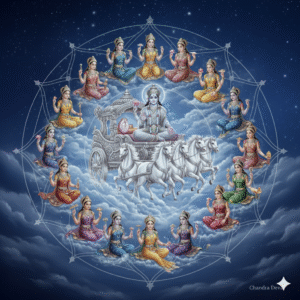
Chandra married the 27 daughters of Daksha Prajapati, who personify the 27 Nakshatras (lunar constellations) in Vedic astrology. Each night, Chandra visits one wife — representing his movement across the 27 Nakshatras in a lunar month.
However, Chandra showed excessive affection toward Rohini, his favorite wife. The other wives complained to their father Daksha, who cursed Chandra to fade away and lose his brightness.
Unable to bear the curse, Chandra performed severe penance to Lord Shiva. Moved by his devotion, Shiva partly lifted the curse, restoring Chandra’s glow in a cyclic pattern — thus explaining the waxing and waning phases of the Moon.
This myth beautifully mirrors the astronomical phenomenon of the Moon’s changing phases every fortnight.
Chandra Deva Connection to Lord Shiva
Lord Shiva, pleased by Chandra’s penance, placed the crescent moon on His matted locks, earning the name Chandrashekhara (the one who adorns the Moon).
This symbol carries deep spiritual meaning — Shiva represents the cosmic consciousness, and Chandra symbolizes the mind. The crescent moon on Shiva’s head signifies that the enlightened one controls the mind rather than being ruled by it.
Chandra as Soma – The Nectar of Life
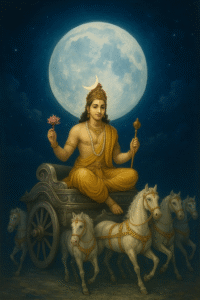
In the Vedas, Soma is both a sacred ritual drink and a deity identified with the Moon. The Moon stores Soma – the divine elixir of life, which nourishes gods, plants, and living beings.
As the Moon waxes and wanes, it is said that gods drink Soma during the bright fortnight, and the Moon is replenished during the dark fortnight. This cycle represents growth, decay, and renewal — the rhythm of nature and life itself.
Astrological Significance of Chandra
In Vedic astrology, Chandra is considered one of the most influential grahas. He governs:
- Mind and emotions (Manas)
- Mother and nurturing energy
- Imagination and intuition
- Sleep and peace of mind
Chandra rules over Monday (Somavara) and the zodiac sign Cancer (Karka Rashi).
A strong Moon in a horoscope brings mental stability, compassion, beauty, and fame, while a weak or afflicted Moon can lead to emotional distress, confusion, and mood swings.
To strengthen Chandra’s influence, devotees often chant the Chandra Beej Mantra:
“Om Shraam Shreem Shraum Sah Chandraya Namah”
Symbolism and Worship
Chandra Deva rides a chariot drawn by ten white horses, symbolizing purity and speed. He holds a lotus, a club, and sometimes a vessel of nectar — representing purity, strength, and nourishment.
Worshippers observe Somavara Vrata (Monday fasts) to please Chandra and Lord Shiva, seeking peace of mind and harmony in relationships.
Offering white flowers, milk, rice pudding, and sandalwood on Mondays is considered highly auspicious.
The Moon and Science – A Divine Parallel
Modern astronomy describes the Moon as Earth’s only natural satellite, reflecting sunlight to illuminate our nights. Its gravitational pull creates tides in the oceans, directly influencing Earth’s natural rhythms.
Interestingly, this aligns with Hindu belief — where Chandra governs the fluids and emotions of both the Earth and the human body. Just as tides rise and fall with the Moon, human emotions too ebb and flow with its cycles.
Phases of the Moon and Human Life
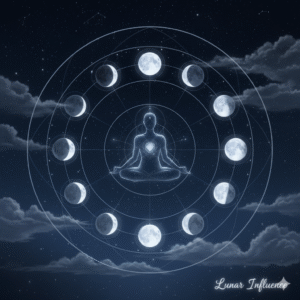
Each lunar phase — from Amavasya (New Moon) to Purnima (Full Moon) — holds spiritual meaning:
- Amavasya: Symbolizes introspection and letting go.
- Shukla Paksha (Waxing Moon): A period of growth, prosperity, and new beginnings.
- Purnima: Represents enlightenment, fullness, and divine grace.
- Krishna Paksha (Waning Moon): A phase of reflection and humility.
Devotees perform Pournami pujas and Chandra Darshan to absorb positive lunar energy for mental calmness and clarity.
Lessons from Chandra Deva
- Balance your emotions — like the Moon’s phases, life too has ups and downs.
- Reflect light — even when darkness surrounds, share your calm and kindness.
- Control the mind — follow Lord Shiva’s example of mastering the Moon (mind).
- Embrace change — every phase of life brings beauty and renewal.
Related Sacred Topics & Cultural Heritage: For further spiritual exploration, read about Lord Rama’s ideal life story. For further spiritual exploration, read about the 14-year exile of Lord Rama. For further spiritual exploration, read about Ravana’s story in the Ramayana. For further spiritual exploration, read about the Vijayadashami and Dasara festival.
Conclusion
Chandra Deva stands as a bridge between cosmic divinity and human emotion — a celestial reminder of peace, rhythm, and introspection. Whether through mythology, astrology, or science, the Moon remains a symbol of spiritual renewal and emotional wisdom.
As we gaze at the night sky, let us remember that the same light that shines in Chandra also reflects within us — calm, steady, and eternal.
20 FAQs about Chandra Deva (The Moon God)
1. Who is Chandra Deva?
Chandra Deva is the Hindu Moon God, symbolizing peace, mind, and beauty.
2. What are Chandra’s other names?
He is also called Soma, Indu, Rajanikara, Chandrama, and Nishakara.
3. Who are Chandra’s parents?
According to some texts, he was born from Sage Atri and Anasuya; in others, from Samudra Manthan.
4. Why did Chandra marry 27 wives?
He married Daksha’s 27 daughters, representing the 27 Nakshatras (lunar constellations).
5. Why was Chandra cursed by Daksha?
Because he loved Rohini more than his other wives.
6. How did Chandra regain his brightness?
By worshipping Lord Shiva, who blessed him to wax and wane in cycles.
7. What does the Moon on Lord Shiva’s head signify?
It represents control over the mind and emotions.
8. What is Soma in the Vedas?
Soma is both a divine drink and a deity identified with the Moon.
9. What day is dedicated to Chandra Deva?
Monday (Somavara).
10. What color and metal are associated with Chandra?
White color and silver metal.
11. What gemstone strengthens Chandra?
Pearl (Moti).
12. What is Chandra’s zodiac sign?
He rules Cancer (Karka Rashi).
13. Which mantra is used to worship Chandra?
“Om Shraam Shreem Shraum Sah Chandraya Namah”
14. What food is offered to Chandra?
White rice, milk, curd, and sugar.
15. What does a weak Moon cause in astrology?
Emotional instability, anxiety, and lack of confidence.
16. How to strengthen the Moon’s energy?
By chanting his mantra, wearing pearls, and fasting on Mondays.
17. What is Chandra Darshan?
The first sighting of the Moon after Amavasya — considered auspicious.
18. What does Purnima signify spiritually? 19. How does the Moon influence human life scientifically? 20. What lesson does Chandra teach us?
Completion, clarity, and divine grace.
Through its gravitational pull that affects tides and biological cycles.
To stay calm, reflective, and balanced — like the Moon itself.






Looking well projects a strong first impression.
A attire speaks loudly before a person actually speak a word.
It boosts your personal self-esteem and mood significantly.
Your polished appearance conveys professionalism in the office.
https://column.omskdaily.ru/the-unlikely-affection-10-reasons-to-love-balenciaga/
Fashionable clothing allow you to express your individual personality.
Others often judge stylish individuals as more capable and trustworthy.
Therefore, putting effort in your wardrobe is an valuable step in your personal brand.
thank you