Raja Ratnam
Introduction: Rama Rajya Explained
The idea of Rama Rajya has echoed through Indian civilization for centuries. Often referred to as the ideal form of governance, Rama Rajya represents a system where justice, morality, accountability, and compassion guide leadership.
Rooted in the Ramayana, Rama Rajya is not merely a religious or mythological concept. It is a governance philosophy—one that continues to influence political thought, public administration, and ethical leadership even today.
For students, professionals, administrators, and leaders, understanding Rama Rajya offers timeless lessons in ethical governance and responsible leadership.
What Is Rama Rajya?
Rama Rajya refers to the period of governance under Lord Rama, king of Ayodhya, where society functioned in harmony under the principles of dharma (righteousness).
Key Characteristics of Rama Rajya:
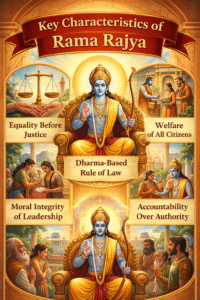
- Rule of law based on dharma
- Equality before justice
- Welfare of all citizens
- Moral integrity of leadership
- Accountability over authority
In Rama Rajya, the king was not above the law—he was its first servant.
Core Principles of Rama Rajya
Dharma as the Foundation of Governance
In Rama Rajya, dharma guided every decision. Governance was not driven by power, personal gain, or political convenience but by moral responsibility.
Lord Rama consistently chose duty over personal comfort—setting a benchmark for ethical leadership.
Modern relevance:
Ethical governance requires leaders to place constitutional values and public interest above personal or political agendas.
Equality Before Law
One of the most striking aspects of Rama Rajya was that law applied equally to everyone, including the king himself.
Rama upheld justice without favoritism, demonstrating that leadership demands personal accountability.
Modern relevance:
This principle aligns with democratic ideals where no one is above the law, a cornerstone of constitutional governance.
Welfare-Oriented Governance
Rama Rajya emphasized Sarva Jana Hitaya, Sarva Jana Sukhaya—the welfare and happiness of all.
Governance focused on:
- Poverty reduction
- Social harmony
- Protection of the vulnerable
- Public trust
There was no exploitation, corruption, or neglect of citizens.
Modern relevance:
This reflects today’s concept of welfare states, social justice policies, and inclusive governance.
Leadership by Example
Lord Rama led by personal conduct, not commands. His life demonstrated discipline, sacrifice, humility, and responsibility.
He lived simply, listened carefully, and acted decisively—earning moral authority rather than enforcing power.
Modern relevance:
Effective leaders gain legitimacy through character, not position.
Transparency and Public Trust
Rama Rajya functioned on mutual trust between ruler and citizens. Decisions were transparent, and governance was participatory in spirit.
The king remained accessible and responsive to public concerns.
Modern relevance:
Transparency, accountability, and citizen engagement are essential for sustainable governance today.
Rama Rajya and Administrative Ethics
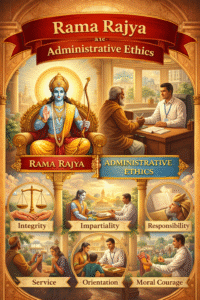
Rama Rajya serves as an early model of administrative ethics, relevant even in modern bureaucratic systems.
Ethical Values Highlighted:
- Integrity
- Impartiality
- Responsibility
- Service orientation
- Moral courage
Public servants under Rama Rajya were expected to act as custodians of public trust, not power holders.
Rama Rajya vs Modern Governance Systems
While systems differ, ethical leadership remains the common core.
Relevance of Rama Rajya for Competitive Exams
Rama Rajya is frequently referenced in:
- UPSC Ethics (GS Paper IV)
- State PSC exams
- Public administration studies
- Essay writing and ethics case studies
Key themes examiners look for:
- Ethical governance
- Moral leadership
- Citizen-centric administration
- Rule of law
Leadership Lessons from Rama Rajya
1. Authority Comes with Responsibility
Leadership is service, not privilege.
2. Ethics Strengthen Governance
Moral clarity prevents misuse of power.
3. Public Trust Is the Greatest Asset
Once lost, governance collapses.
4. Sacrifice Builds Legitimacy
Personal sacrifice enhances moral authority.
5. Long-Term Vision Matters
Short-term gains cannot replace sustainable governance.
Criticisms and Interpretations
Some scholars argue Rama Rajya is idealistic rather than practical. However, its purpose is not literal replication but ethical inspiration.
Rama Rajya acts as:
- A moral benchmark
- A guiding philosophy
- A leadership ideal
Rama Rajya in Today’s World

In the modern era of:
- Political polarization
- Governance crises
- Declining public trust
Rama Rajya reminds us that systems succeed only when values guide power.
Whether in government, corporations, or institutions, ethical leadership remains timeless.
For official cultural and historical archives, visit the Ministry of Culture, Government of India.
Related Sacred Topics & Cultural Heritage: For further spiritual exploration, read about the 14-year exile of Lord Rama. For further spiritual exploration, read about Ravana’s story in the Ramayana.
Conclusion
Rama Rajya is not a relic of mythology—it is a living philosophy of ethical governance.
By placing dharma over dominance, service over self-interest, and justice over convenience, Rama Rajya offers a powerful framework for leadership in any era.
For administrators, leaders, students, and citizens alike, Rama Rajya stands as a reminder that true governance begins with moral responsibility.
1. What is Rama Rajya?
Rama Rajya refers to the ideal system of governance under Lord Rama, characterized by justice, ethical leadership, welfare of all citizens, and rule based on dharma.
2. Why is Rama Rajya considered an ideal model of governance?
Because it emphasizes moral authority, equality before law, welfare-oriented administration, transparency, and accountability in leadership.
3. What is the role of dharma in Rama Rajya?
Dharma acts as the guiding principle for governance, ensuring decisions are ethical, just, and in the best interest of society.
4. How did Lord Rama practice ethical leadership?
Lord Rama led by example, placing duty above personal interest and holding himself accountable to the same laws as his subjects.
5. What does Rama Rajya say about equality before law?
In Rama Rajya, no one—including the king—was above the law, reflecting fairness and impartial justice.
6. How was public welfare ensured in Rama Rajya?
Governance focused on happiness, security, and prosperity of all citizens, especially the weak and vulnerable.
7. Is Rama Rajya a religious or political concept?
Rama Rajya is primarily a governance philosophy, not a religious rule, emphasizing ethical administration and leadership.
8. How is Rama Rajya relevant to modern democracy?
Its principles align with modern democratic values like rule of law, accountability, welfare state, and ethical governance.
9. What leadership qualities of Lord Rama are highlighted in Rama Rajya?
Integrity, responsibility, compassion, discipline, sacrifice, and moral courage.
10. How is Rama Rajya useful for UPSC and competitive exams?
It is often used in ethics papers, essays, and case studies to explain ethical governance and value-based leadership.
11. What is the difference between Rama Rajya and modern governance systems?
Rama Rajya is value-driven (dharma-based), while modern governance is institution-driven (constitution-based), though both aim for justice and welfare.
12. Does Rama Rajya promote authoritarian rule?
No. Rama Rajya promotes responsible leadership, not authoritarian control, with emphasis on public trust and moral restraint.
13. What administrative ethics can be learned from Rama Rajya?
Integrity, impartiality, service orientation, accountability, and commitment to public welfare.
14. Why is Rama Rajya often cited in political discourse in India?
It symbolizes good governance, corruption-free administration, and leadership rooted in moral values.
15. Can Rama Rajya be implemented in today’s world?
While not literally, its ethical principles can guide modern governance, leadership, and public administration.
16. How did Rama Rajya maintain public trust?
Through transparency, justice, accessibility of the ruler, and consistent ethical conduct.
17. What role did sacrifice play in Rama Rajya?
Personal sacrifice by leaders strengthened moral authority and public confidence in governance.
18. Is Rama Rajya mentioned directly in the Ramayana?
The concept emerges from the depiction of Lord Rama’s rule, described as a period of peace, justice, and prosperity.
19. How does Rama Rajya relate to the concept of welfare state?
Both focus on citizen welfare, social justice, and inclusive development.
20. What is the biggest lesson of Rama Rajya for leaders today?
True leadership is about service, ethics, and responsibility, not power or position.