 Raja Ratnam
Introduction : Dronacharya in Mahabharata
Dronacharya in Mahabharata : Dronacharya in the Mahabharata was one of the greatest warriors and teachers (gurus) of ancient India. He played a crucial role in shaping the destiny of both the Pandavas and the Kauravas. Known for his unmatched knowledge of warfare and archery, Dronacharya trained legendary warriors like Arjuna and Duryodhana.
His life is filled with loyalty, controversy, sacrifice, and tragedy. In this complete guide, we will explore his birth, education, role in the Kurukshetra War, and his dramatic death.
Birth and Early Life of Dronacharya
Dronacharya was the son of Sage Bharadwaja. The name “Drona” comes from the fact that he was born on a vessel (drona).
From childhood, he showed exceptional interest in warfare and scriptures. He became a close friend of Drupada, who later became the king of Panchala.
However, destiny changed their friendship forever.
Education and Mastery in Warfare
Dronacharya received advanced military training from Parashurama, who was known for his knowledge of divine weapons (Astras).
He mastered:
- Archery
- Divine weapons
- Military strategy
- Battle formations
Because of his unmatched skills, he became one of the greatest warriors in the Mahabharata.
For official cultural and historical archives, visit the Ministry of Culture, Government of India.
Dronacharya Became the Royal Guru for what reason?
After being insulted by King Drupada, Dronacharya decided to seek recognition and respect. He arrived in Hastinapura, where Bhishma appointed him as the royal teacher of the Kuru princes.
He trained:
- The five Pandavas
- The hundred Kauravas
Among all his students, Arjuna became his favorite because of his dedication and discipline.
Dronacharya and Arjuna – A Special Bond
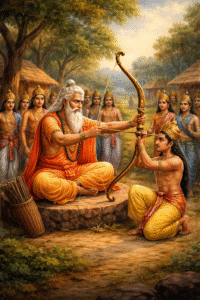
Arjuna was promised by Dronacharya that he would become the world’s greatest archer. He even demanded guru dakshina (teacher’s fee) by asking his students to capture King Drupada.
Arjuna successfully defeated Drupada, fulfilling his guru’s wish.
This incident marked the beginning of a long chain of revenge that later impacted the Kurukshetra War.
Eklavya and the Guru Dakshina
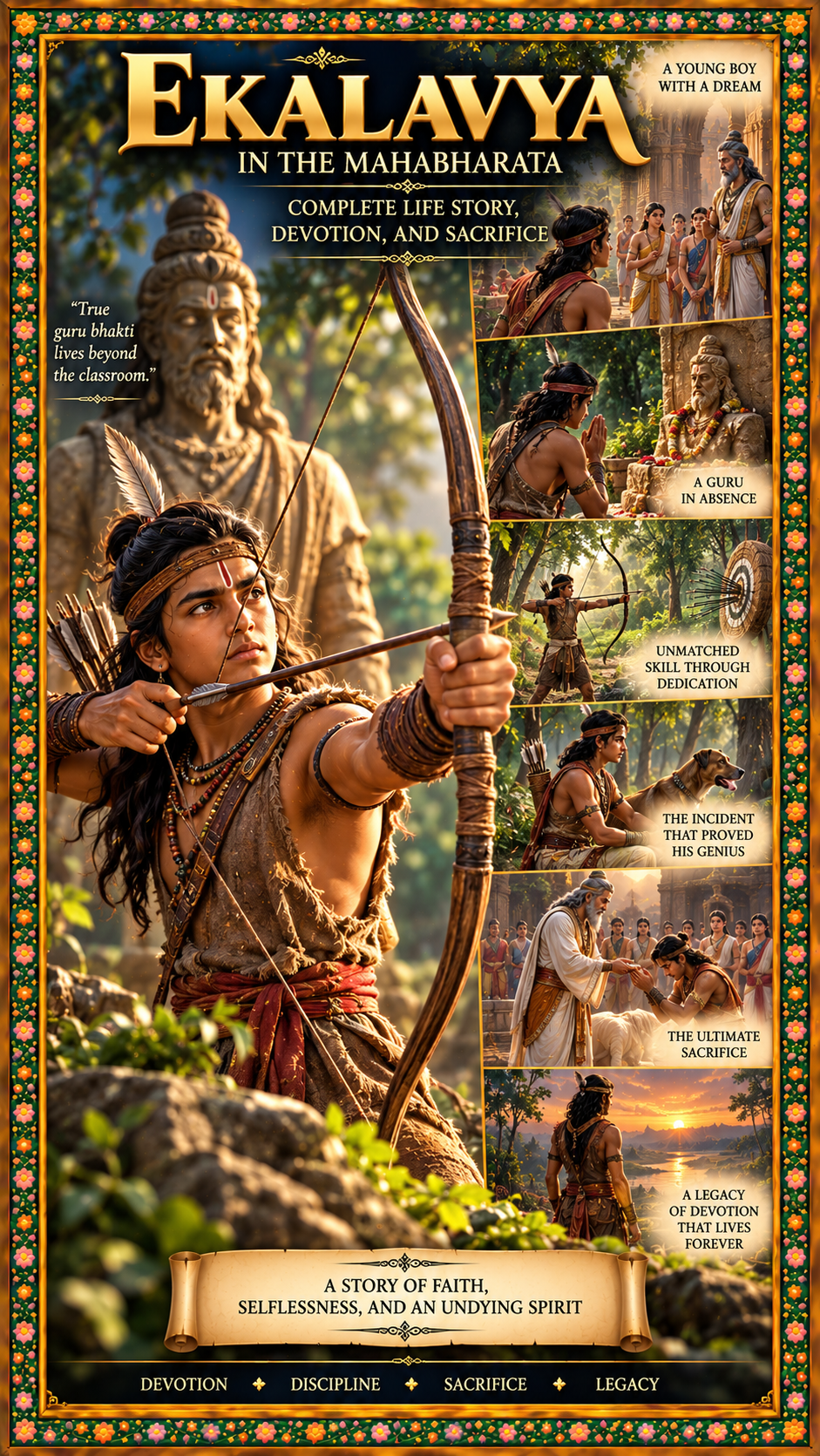
The story of Eklavya reveals the darker side of Dronacharya. When Eklavya surpassed Arjuna in archery, Drona demanded his right thumb as Guru Dakshina, crippling Eklavya’s future as an archer. This act remains one of the most debated episodes of the Mahabharata.
Role of Dronacharya( Dronacharya in Mahabharata)in Kurukshetra War
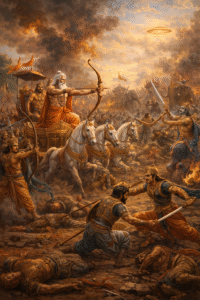
During the great battle of the Kurukshetra War, Dronacharya fought on the side of the Kauravas.
After the fall of Bhishma, Drona was appointed as the commander-in-chief of the Kaurava army.
He created powerful battle formations like:
- Chakravyuha
- Complex defensive strategies
He was nearly invincible in battle.
Chakravyuha and Abhimanyu’s Death
Dronacharya’s most controversial act was orchestrating the Chakravyuha formation, which led to the tragic death of Abhimanyu, Arjuna’s son.
The Death of Dronacharya
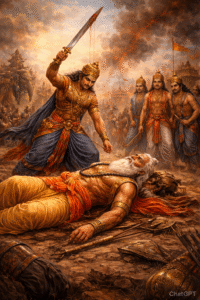
Dronacharya could not be defeated easily because of his immense power and knowledge of divine weapons.
The Pandavas, guided by Krishna, used a strategy. Drona’s son, Ashwatthama, was rumored to have died.
Hearing this, Dronacharya lost his will to fight. He laid down his weapons and was killed by Dhrishtadyumna.
His death remains one of the most emotional and controversial moments in the Mahabharata.
Character Analysis of Dronacharya
Dronacharya represents:
- The conflict between dharma and loyalty
- The dangers of pride and favoritism
- The tragedy of a teacher bound by worldly ties
He was neither purely virtuous nor evil—he was deeply human.
Was Dronacharya Right or Wrong?
Dronacharya’s character is morally complex.
✔ He was a dedicated teacher.
✔ He was loyal to Hastinapura.
✖ He supported the Kauravas despite knowing their injustice.
✖ He demanded Ekalavya’s thumb as guru dakshina (a controversial act).
His life teaches lessons about:
- Duty vs morality
- Loyalty vs righteousness
- The consequences of ego and revenge
Important Facts About Dronacharya
- Father: Sage Bharadwaja
- Son: Ashwatthama
- Best Student: Arjuna
- Teacher: Parashurama
- Killed by: Dhrishtadyumna
- Role: Royal Guru of Kuru Princes
Lessons We Learn from Dronacharya in Mahabharata
- Talent must be supported with discipline.
- Ego can destroy friendships.
- Neutrality is important in conflicts.
- Blind loyalty can lead to downfall.
Conclusion : Dronacharya in Mahabharata
Dronacharya in the Mahabharata was not just a teacher but a powerful warrior, strategist, and tragic figure. His life reflects the complex nature of dharma (duty).
Though remembered as the greatest guru of his time, his choices during the Kurukshetra War made his character one of the most debated in Indian epic history.
His story continues to inspire, teach, and provoke thought even today.
FAQs About Dronacharya in Mahabharata
1. Who was Dronacharya in Mahabharata?
Dronacharya was the royal guru of the Pandavas and Kauravas and a master of ancient warfare.
Q2. Why is Dronacharya called Acharya Drona?
He was a revered teacher (Acharya) who imparted advanced military knowledge.
Q3. Who were the main students of Dronacharya?
Arjuna, Bhima, Duryodhana, Karna, Ashwatthama, and other Kuru princes.
Q4. Why did Dronacharya favor Arjuna?
Because of Arjuna’s discipline, focus, and unmatched dedication to archery.
Q5. Who was Eklavya and why is his story important?
Eklavya was a tribal prince whose thumb sacrifice highlights injustice and favoritism.
Q6. What was Guru Dakshina demanded by Dronacharya?
Eklavya’s right thumb, ensuring Arjuna remained the greatest archer.
Q7. Who was Drupada and why did he oppose Dronacharya?
Drupada was Drona’s childhood friend who later insulted him, leading to rivalry.
Q8. Who was Dhrishtadyumna?
Drupada’s son, born to kill Dronacharya.
Q9. Why did Dronacharya fight for the Kauravas?
Out of loyalty to Hastinapura and obligation to the throne.
Q10. Was Dronacharya stronger than Bhishma?
Both were legendary; Bhishma was invincible by vow, while Drona excelled in strategy.
Q11. What role did Dronacharya play in Chakravyuha?
He led the formation that trapped Abhimanyu.
Q12. Was Dronacharya responsible for Abhimanyu’s death?
Indirectly yes, as the formation violated war ethics.
Q13. Why did Krishna trick Dronacharya?
To disarm him and end the war imbalance.
Q14. How did Dronacharya die?
He laid down weapons after hearing of Ashwatthama’s death and was killed by Dhrishtadyumna.
Q15. Did Dronacharya attain moksha?
Texts suggest he achieved liberation due to his knowledge and austerity.
Q16. Who was Ashwatthama?
Dronacharya’s son, a powerful yet tragic warrior.
Q17. What were Dronacharya’s main weaknesses?
Attachment, pride, and favoritism.
Q18. What values does Dronacharya represent?
The conflict between knowledge, power, and dharma.
Q19. Is Dronacharya a villain or hero?
He is a tragic hero shaped by moral dilemmas.
Q20. What is the main lesson from Dronacharya in Mahabharata?
Dharma must always stand above personal loyalty.

Amazing! This website is truly top-notch! The selection of shemale porn videos is insane
– loads of stunning trans girls in crystal-clear
scenes. The loading is butter-smooth and new videos
are added frequently.
If you’re looking to watch free shemale porn porn videos featuring beautiful performers
and raw action, this is definitely the best spot. Highly recommended!
Thank you for your feedback! I appreciate you taking the time to share your experience. My goal is to provide valuable and high-quality content for visitors, and your support means a lot. Thanks again for stopping by!
Woah! I’m really enjoying the template/theme of this site.
It’s simple,yet effective. A lot of times it’s challenging to get that “perfect balance” between usability
and visual appeal. I must say that you’ve done a very good job with this.
In addition,the blog loads very fast for me on Opera. Superb Blog!
Thank you so much for your amazing feedback! 😊
I’m really happy to hear that you’re enjoying the website’s theme and overall experience. Finding the right balance between clean design, usability, and fast performance is always a priority, so your appreciation truly means a lot.
It’s also great to know that the blog is loading smoothly on Opera for you. Thanks again for your kind words and support — they genuinely motivate me to keep improving the site and content!
When I originally left a comment I seem to have clicked on the -Notify
me when new comments are added- checkbox and from now on each time a comment is added I recieve
4 emails with the exact same comment. Is
there a means you can remove me from that service?
Appreciate it!
You can reply like this:
Thank you for letting me know, and I’m really sorry for the inconvenience! 😊
It seems the comment notification system may be sending duplicate emails unexpectedly. You can usually unsubscribe by clicking the “Unsubscribe” link included at the bottom of one of those notification emails.
If the issue continues, I’ll definitely look into it and try to fix the notification settings from my side as well.
Thanks again for your patience and for visiting the blog!
I like reading through an article that can make people think.
Also, many thanks for permitting me to comment!
Thank you so much for your thoughtful comment! We’re really happy to hear that the article made you think and kept you engaged. Creating meaningful and valuable content for readers like you is always our goal.
And of course, we truly appreciate you taking the time to share your thoughts here. Your comments and support help build a positive and inspiring community around the blog.
Thanks again for reading and participating — we hope to see you back again soon!
It’s amazing in favor of me to have a web site, whioch is beneficial designed
for my experience. thanks admin
Have a look aat my homepage – dope luxury Streetwear
Thank you for your kind words! 😊 We’re delighted to hear that you find the website helpful and well-designed. Your feedback is greatly appreciated and motivates us to keep creating valuable content for our readers. Thanks for stopping by, and we wish you all the best!
Great blog you have got here.. It’s hard
to find excellent writing like yours these days. I honestly
appreciate people like you! Take care!!
Thank you so much for your kind and encouraging words!
We’re truly grateful that you took the time to share your appreciation. Knowing that our writing has been helpful and enjoyable to read means a lot to us. We strive to create valuable content for our readers, and feedback like yours inspires us to keep improving.
Thank you for your support, and we hope you’ll continue visiting our blog for more insightful articles. Take care, and we wish you all the best!
Top porn sites deliver high-quality explicit content safely.
Opt for trusted sources for a discreet experience.
You can reply with:
Thank you for taking the time to comment.
We appreciate your visit to our website. Our platform is focused on providing informative and valuable content for our readers, and we encourage discussions that are relevant to the topics covered in our articles.
Thank you for your interest, and we hope you continue to enjoy our content and future updates.
This keeps the response professional and avoids engaging with unrelated promotional content.
Expliciet materiaal is beschikbaar op verschillende adult websites voor vermaak.
Kies altijd voor betrouwbare adult sites.
Feel free to visit my homepage BEST FREE PORN VIDEOS
You can reply with:
Thank you for visiting our website and sharing your thoughts.
We appreciate your engagement with our content. Our website is dedicated to providing informative and valuable resources for our readers, and we encourage discussions that are relevant to the topics covered here.
Thank you for stopping by, and we hope you continue to enjoy our articles and updates.
This keeps the response polite and professional without endorsing unrelated promotional links.
Hiya! I know this is kinda off topic nevertheless I’d figured I’d ask.
Would you be interested in exchanging links or maybe
guest authoring a blog post or vice-versa? My website discusses a lot of
the same topics as yours and I believe we could greatly benefit from each other.
If you are interested feel free to shoot me an email.
I look forward to hearing from you! Wonderful blog by
the way!
You can reply with:
Hi! Thank you for your thoughtful message and kind words about our blog.
We appreciate your interest in link exchanges and guest posting opportunities. Since our websites cover similar topics, there may be a great opportunity for collaboration that benefits both of our audiences.
Please feel free to send us more details about your website, including your preferred topics and any guest post ideas you have in mind. We’ll be happy to review them and discuss potential collaboration.
Looking forward to hearing from you. Thanks again for reaching out, and we wish you continued success with your blog!
This response is professional, friendly, and encourages further discussion.
I was suggested this website by my cousin. I am
not sure whether this post is written by him as no one else know such
detailed about my trouble. You’re incredible!
Thanks!
Thank you so much for your kind words! We’re delighted that you found the post helpful and detailed. While your cousin may have recommended our website, the article was written by our team with the goal of providing accurate and useful information to readers facing similar challenges. Your appreciation means a lot to us and motivates us to continue creating valuable content. We hope you’ll keep visiting and sharing your feedback. Thank you for your support!