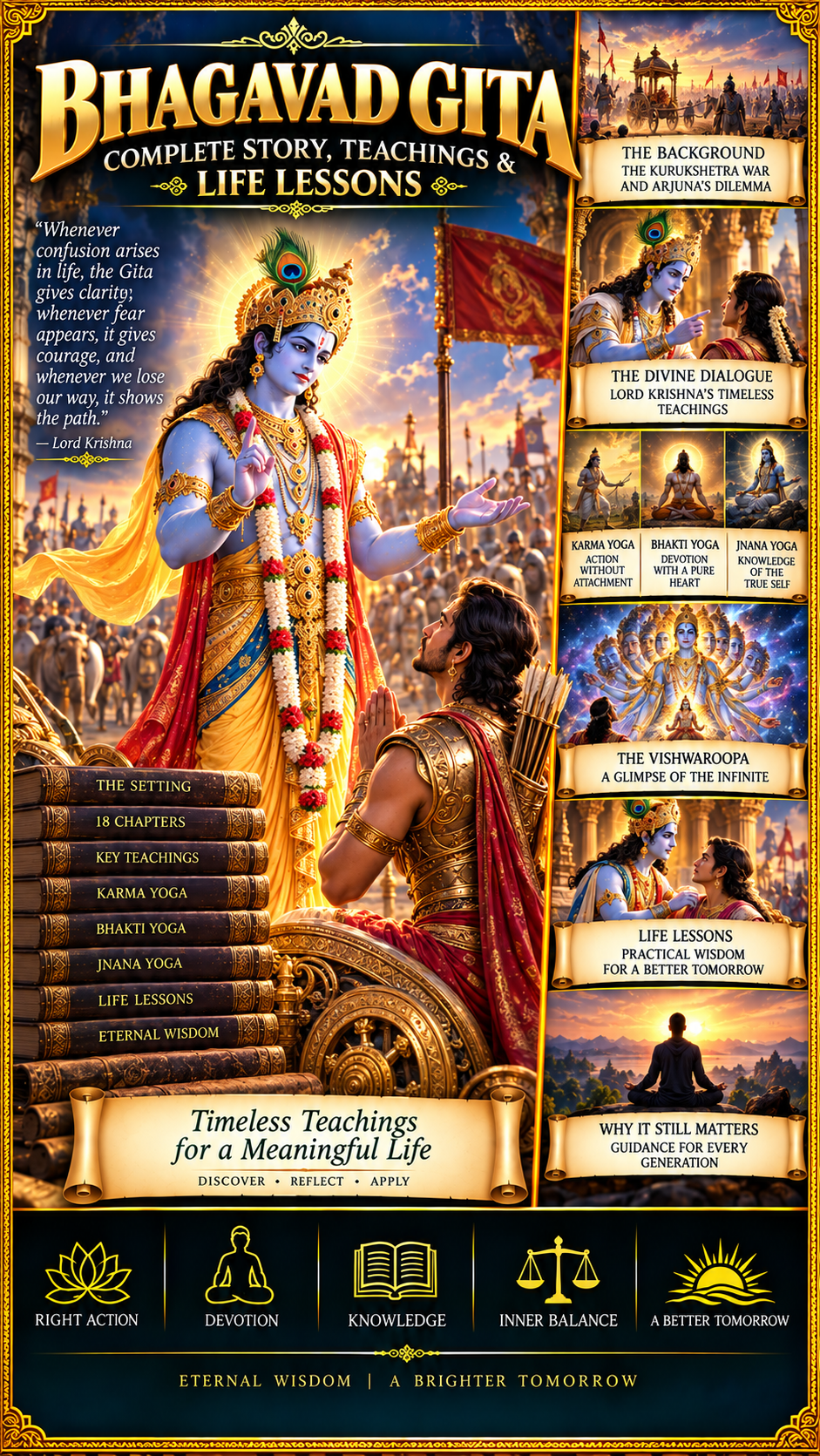
Bhagavad Gita: Complete Story, Teachings & Timeless Life Lessons

About the Author

Raja Ratnam is a passionate researcher and writer specialising in Indian mythology and epic stories.
With years of experience studying texts like Ramayana, Mahabharata, Bhagavad Gita: Complete Story, Teachings & Timeless Life Lessons, Festivals, Ratha Saptami 2026, Navagrahas, Ketu Deva and other cultural scriptures,
he brings insightful interpretations and practical lessons from these timeless stories.

Raja Ratnam believes in making mythology accessible and meaningful for modern readers,
helping them understand the moral, ethical, and cultural significance behind characters like Rama, Laxman, Shani Deva, and many more.

Connect with the author: info@ratnamstrategy.com

Introduction to Bhagavad Gita

Mahabharata’s Bhishma Parva contains 700 verses of the Bhagavad Gita, which means “The Song of the Lord”.It addresses fundamental human dilemmas such as fear, confusion, duty, attachment, and purpose of life.

At its core, the Bhagavad Gita teaches how to live a balanced life while performing one’s responsibilities with devotion and wisdom.

Origin and Background of the Bhagavad Gita
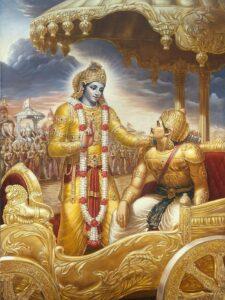
Arjuna receiving Bhagavad Gita teachings

Battlefield of Kurukshetra

The Bhagavad Gita was spoken on the battlefield of Kurukshetra, just before the great war between the Pandavas and the Kauravas. Arjuna, overwhelmed by sorrow and moral conflict, drops his bow and refuses to fight.

At this crucial moment, Lord Krishna reveals divine wisdom to guide Arjuna out of despair.

Lord Krishna’s instructions to Arjuna about the Bhagavad Gita
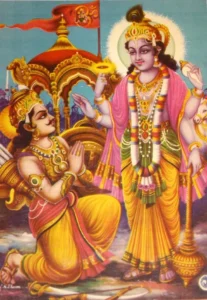
Lord Krishna's instructions to Arjuna about the Bhagavad Gita

Arjuna’s Moral Dilemma

Arjuna saw his own relatives, teachers, and friends on both sides of the war. His compassion turned into confusion, fear, and attachment.

Krishna chose Arjuna because he represented every human being who struggles between emotions and duty.

Core Teachings of the Bhagavad Gita

Dharma – The Path of Duty

The Bhagavad Gita emphasizes dharma, meaning righteous duty. Krishna teaches that one must perform their duty without selfish desires.

Karma Yoga – Action Without Attachment

Krishna explains that action is unavoidable, but attachment to results causes suffering. Perform work sincerely and leave the outcome to the divine.

Bhakti Yoga – The Path of Devotion

Devotion to God with love and surrender leads to inner peace and liberation.

Jnana Yoga – The Path of Knowledge

True knowledge is understanding the difference between the eternal soul and temporary body.

The Immortality of the Soul in The Bhagavad Gita

One of the most famous teachings of the Gita is that the soul is eternal. The body indeed dies, but the soul does not. This teaching removes fear of death and encourages courage and clarity.

Bhagavad Gita and Leadership Lessons

The Bhagavad Gita offers timeless leadership and management lessons:

  • Take responsibility without ego
  • Make decisions based on wisdom, not fear
  • Stay calm in success and failure
  • Lead with compassion and discipline

These teachings are widely applied in modern business and personal development.

Role of Bhagavad Gita in the Mahabharata

The Bhagavad Gita is the spiritual heart of the Mahabharata. Without it, the epic would be only a story of war. With it, the Mahabharata becomes a guide to life and ethics.

Krishna’s teachings transformed Arjuna into a confident warrior ready to fulfill his destiny.

Relevance of Bhagavad Gita in Modern Life

Even today, the Bhagavad Gita helps people deal with:

  • Stress and anxiety
  • Career confusion
  • Relationship challenges
  • Moral dilemmas
  • Fear of failure

Its universal wisdom applies beyond religion, culture, and time.

Bhagavad Gita and Arjuna’s Transformation

Vishwaroopa darshan in the Bhagavad Gita

Before the Gita, Arjuna was confused and broken. After receiving Krishna’s teachings, he regained clarity, strength, and determination.

This transformation shows the power of right guidance at the right time.

Importance of Bhagavad Gita for Spiritual Growth

The Bhagavad Gita teaches balance between worldly life and spiritual growth. It does not ask people to renounce life, but to live wisely within it.

FAQs – Bhagavad Gita

1. What is the Bhagavad Gita?
The Bhagavad Gita is a sacred Hindu scripture containing Lord Krishna’s teachings to Arjuna.

2. Where does the Bhagavad Gita appear in the Mahabharata?
It appears in the Bhishma Parva of the Mahabharata.

3. Who spoke the Bhagavad Gita?
Lord Krishna spoke the Bhagavad Gita.

4. To whom was the Bhagavad Gita spoken?
The Bhagavad Gita was spoken to Arjuna.

5. Where was the Bhagavad Gita spoken?
On the battlefield of Kurukshetra.

6. What is the number of verses in the Bhagavad Gita?
There are 700 verses in the Bhagavad Gita.

7. How many chapters are in the Bhagavad Gita?
The Bhagavad Gita has 18 chapters.

8. What is the main message of the Bhagavad Gita?
To perform one’s duty without attachment to results.

9. What is Karma Yoga in Bhagavad Gita?
Karma Yoga is the path of selfless action.

10. What is Bhakti Yoga according to Bhagavad Gita?
God is worshipped through Bhakti yoga.

11. What is Jnana Yoga in Bhagavad Gita?
Jnana Yoga is the path of spiritual knowledge and wisdom.

12. Why did Arjuna hesitate to fight the war?
He was emotionally disturbed seeing his relatives on the battlefield.

13. What does Bhagavad Gita say about the soul?
The soul is eternal and never dies.

14. What is Vishwaroopa in Bhagavad Gita?
It is Krishna’s universal cosmic form revealed to Arjuna.

15. Is Bhagavad Gita only for Hindus?
No, it is a universal guide for all humanity.

16. How is Bhagavad Gita relevant today?
It helps manage stress, fear, duty, and life decisions.

17. What does Bhagavad Gita teach about success and failure?
Remain balanced in both success and failure.

18. Can Bhagavad Gita be applied in daily life?
Yes, its teachings guide everyday actions and decisions.

19. What role does Bhagavad Gita play in Mahabharata?
It provides the spiritual foundation of the epic.

20. What is the greatest lesson from Bhagavad Gita?
Live a righteous life with devotion, wisdom, and detachment.

  • Admin

    Hi, I’m Raja Ratnam. Based in Hydrabad, Telangana, I’m a content creator and strategist with a passion for Indian history, Hindu festivals and WordPress website design. Over the past X years I’ve developed high-impact GK quiz content in Telugu, written devotional blog posts in both English and Telugu (covering puja vidhanams, vrat kathas and festival traditions), and built easy-to-use Elementor/WordPress templates for service-oriented businesses. I started this blog, Ratnam Strategy, because as a student I often struggled to find quality study material in my preferred language. At the same time, I felt there was a gap in how festival guides were shared online — so I decided to document detailed gaudy-free posts anyone can follow. With a background in website development, I also wanted to share templates and tips for small businesses who need a professional online presence without the hassle. On this site you’ll find: Full-length GK quiz packs in Telugu — especially focused on Indian history and competitive exam prep. Devotional blogs in English (and sometimes Telugu) about major Hindu festivals, complete with puja steps, vrat stories and celebration ideas. Ready-to-use Elementor/WordPress templates for service websites — including my own trailering service niche. If you’re prepping for exams, exploring festival rituals or building a website for your service business — you’re in the right place. Feel free to browse my latest posts and templates, or get in touch at ratnampasalapudi@gmail.com / 7892211516 for custom help. When I’m not writing quizzes or building templates, I love visiting historic sites around Secunderabad and experimenting with new design tools. Let’s make strategy simple, meaningful and fun!

    Related Posts

    Krishna in Mahabharata: The Divine Role of the Supreme Guide

    About the Author Raja Ratnam is a passionate researcher and writer specialising in Indian mythology and epic stories.With years of experience studying texts like Ramayana, Mahabharata, Krishna in Mahabharata: The Divine Role of the Supreme Guide, Festivals, Ratha Saptami 2026, Navagrahas, Ketu Deva and other cultural scriptures,he brings insightful interpretations and practical lessons from these timeless stories. Raja Ratnam believes in making mythology accessible and meaningful for modern readers,helping them understand the moral, ethical, and cultural significance behind characters like Rama, Laxman, Shani Deva, and many more. Connect with the author: info@ratnamstrategy.com Krishna in Mahabharata: The Divine Role of the Supreme Guide Krishna in Mahabharata is not merely a character but the soul of the epic. As the eighth avatar of Lord Vishnu, Krishna guides humanity through wisdom, strategy, compassion, and divine justice. Without Krishna, the Mahabharata would be a tale of war; with Krishna, it becomes a timeless guide to dharma and life. Introduction to Krishna in Mahabharata Lord Krishna appears in the Mahabharata as a king, friend, diplomat, philosopher, and divine guide. Though he does not directly fight in the Kurukshetra war, his influence shapes every major event. Krishna represents divine consciousness guiding human actions toward righteousness. Birth and Early…

    Arjuna in Mahabharata The Greatest Archer and Hero of Dharma

    About the Author Raja Ratnam is a passionate researcher and writer specialising in Indian mythology and epic stories.With years of experience studying texts like Ramayana, Mahabharata, Arjuna in Mahabharata, The Greatest Archer and Hero of Dharma, Festivals, Ratha Saptami 2026, Navagrahas, Ketu Deva and other cultural scriptures,he brings insightful interpretations and practical lessons from these timeless stories. Raja Ratnam believes in making mythology accessible and meaningful for modern readers,helping them understand the moral, ethical, and cultural significance behind characters like Rama, Laxman, Shani Deva, and many more. Connect with the author: info@ratnamstrategy.com Arjuna in Mahabharata: The Greatest Archer and Hero of Dharma Arjuna in Mahabharata is one of the most celebrated warriors in Indian history and Hindu mythology. Known for his unmatched archery skills, deep devotion to Lord Krishna, and strong commitment to dharma (righteousness), Arjuna’s life is filled with inspiration, struggle, devotion, and victory. This full-length SEO-optimized blog is specially crafted for Ratnam Strategy in the same format as Uttara and Abhimanyu content. Introduction to Arjuna in Mahabharata Arjuna is the third of the five Pandava brothers and the son of King Pandu and Queen Kunti. He was born through the blessings of Lord Indra, the king of gods, which is…

    Leave a Reply

    Your email address will not be published. Required fields are marked *

    You Missed

    Meaning and Significance of Maha Shivaratri – Lord Shiva, the Auspicious One

    • By Admin
    • February 3, 2026
    • 89 views
    Meaning and Significance of Maha Shivaratri – Lord Shiva, the Auspicious One

    Krishna in Mahabharata: The Divine Role of the Supreme Guide

    • By Admin
    • February 1, 2026
    • 223 views
    Krishna in Mahabharata: The Divine Role of the Supreme Guide

    Bhagavad Gita: Complete Story, Teachings & Timeless Life Lessons

    • By Admin
    • February 1, 2026
    • 204 views
    Bhagavad Gita: Complete Story, Teachings & Timeless Life Lessons

    Arjuna in Mahabharata The Greatest Archer and Hero of Dharma

    • By Admin
    • January 30, 2026
    • 185 views
    Arjuna in Mahabharata The Greatest Archer and Hero of Dharma

    Story of Abhimanyu in the Mahabharata

    • By Admin
    • January 29, 2026
    • 297 views
    Story of Abhimanyu in the Mahabharata

    Uttara in Mahabharata: The Graceful Princess Who Became Mother of the Pandava Legacy

    • By Admin
    • January 27, 2026
    • 378 views
    Uttara in Mahabharata: The Graceful Princess Who Became Mother of the Pandava Legacy
    Translate »