Admin
Admin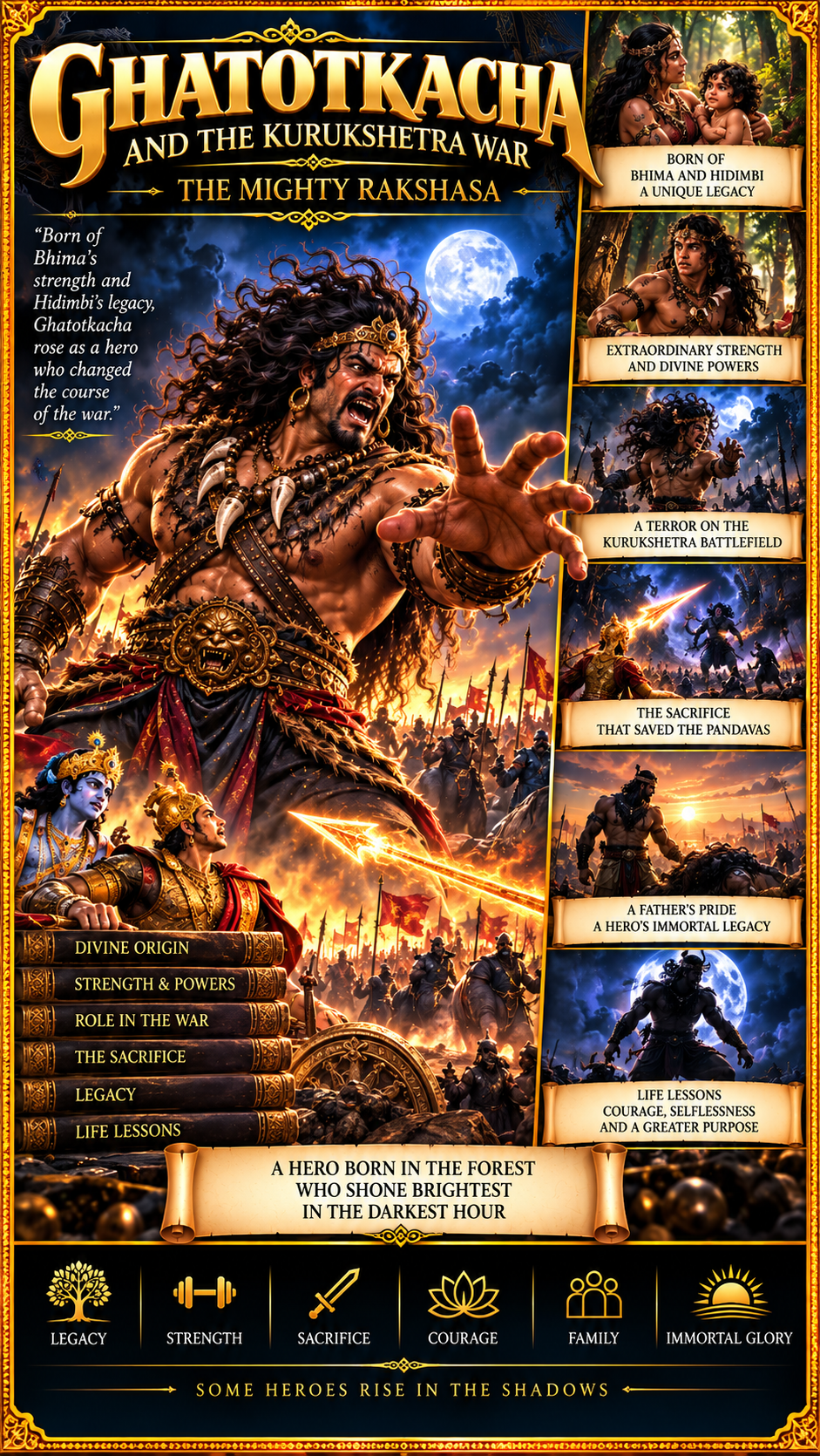
Introduction
Among the many powerful warriors of the Mahabharata, few left an impact as dramatic and decisive as Ghatotkacha. Though he appears mainly in the later part of the epic, his role becomes one of the most critical turning points of the Kurukshetra war.
Born as the son of Bhima and the Rakshasi Hidimba, Ghatotkacha possessed extraordinary strength, magical powers, and unmatched night-war abilities. His heroic sacrifice not only changed the fate of the war but also saved Arjuna’s life indirectly.
Ghatotkacha stands as a symbol of selfless sacrifice, destiny, and divine strategy in the Mahabharata.
Birth of Ghatotkacha
After the Pandavas escaped from the House of Lac (Lakshagriha), they traveled through dense forests. During this time, Bhima encountered Hidimba, a Rakshasi who fell in love with him.
With Kunti’s permission, Bhima married Hidimba under Gandharva tradition. From this union was born Ghatotkacha.
Meaning of the Name “Ghatotkacha”
- Ghata – pot-like head
- Utkacha – bald or unusual hair
According to legend, he was born with a powerful body and fearsome appearance, typical of Rakshasas.
Yet beneath his terrifying form lived a heart filled with loyalty, righteousness, and devotion to the Pandavas.
Childhood and Extraordinary Powers
From birth itself, Ghatotkacha displayed supernatural strength. Hidimba raised him among Rakshasas, where he learned:
- Magical warfare (Maya Yuddha)
- Illusion techniques
- Shape-shifting abilities
- Control over darkness and night combat
Unlike human warriors, Ghatotkacha could multiply himself, create terrifying illusions, and summon weapons magically.
Bhima blessed his son, saying:
“When the Pandavas need you most, you shall come without being summoned.”
This blessing would later shape the destiny of the Kurukshetra war.
Ghatotkacha’s Loyalty to the Pandavas
Though raised among Rakshasas, Ghatotkacha’s loyalty always remained with his father Bhima and the Pandavas.
He considered:
- Yudhishthira as his king
- Bhima as his guiding force
- Arjuna as the protector of dharma
He appeared whenever the Pandavas were in danger and disappeared once his duty was fulfilled — almost like a divine weapon guided by fate.
Role of Ghatotkacha in the Kurukshetra War
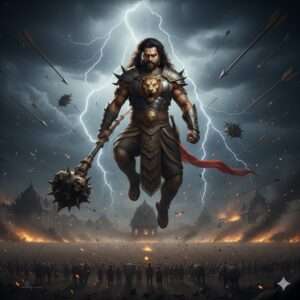
Ghatotkacha fought on the Pandava side during the Kurukshetra war. Initially, his participation was limited, as Rakshasas were forbidden from daytime warfare.
However, night battles changed everything.
Master of Night Warfare
At night:
- His powers multiplied many times
- His illusions confused entire armies
- Horses, elephants, and soldiers fled in fear
- Kaurava formations collapsed
The Kaurava army suffered massive destruction due to him.
Even great warriors like Drona, Kripa, and Ashwatthama struggled against his illusions.
Terror in the Kaurava Camp
Ghatotkacha used Maya (illusion) warfare:
- Creating hundreds of replicas of himself
- Making darkness thicker
- Turning the battlefield into chaos
Kaurava soldiers believed thousands of demons had arrived.
Duryodhana panicked.
For the first time in the war, the Kaurava side felt complete helplessness.
Karna vs Ghatotkacha
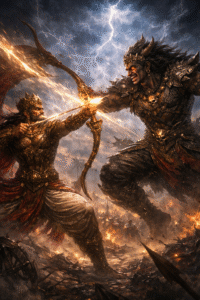
Seeing the destruction, Duryodhana begged Karna to stop Ghatotkacha.
Karna fought valiantly but soon realized:
- Normal weapons were useless
- Illusions neutralized his attacks
- The battlefield was beyond human control
At this moment, Karna remembered his most powerful divine weapon — Vasavi Shakti.
The Divine Weapon: Vasavi Shakti
Vasavi Shakti was gifted to Karna by Lord Indra.
Its power:
- Could kill any enemy without fail
- Could be used only once
- Was originally meant to kill Arjuna
Krishna had long known this secret.
Ghatotkacha’s role was destined — not accidental.
The Supreme Sacrifice of Ghatotkacha
As Ghatotkacha’s destruction intensified, Karna had no choice.
He invoked Vasavi Shakti and hurled it toward Ghatotkacha.
Understanding destiny, Ghatotkacha:
- Expanded his body to a gigantic size
- Ensured the weapon would be completely exhausted
- Fell dead after shaking the battlefield
His final act ensured the divine weapon could never be used against Arjuna.
Krishna’s Smile — The Hidden Strategy
When Ghatotkacha fell, the Pandava army mourned.
But Lord Krishna smiled.
Why?
Because:
- Karna had lost his ultimate weapon
- Arjuna’s life was now protected
- The balance of war shifted permanently
Krishna declared:
“Ghatotkacha’s death is worth more than the fall of a thousand warriors.”
This moment became one of the greatest turning points of the Mahabharata war.
Why Ghatotkacha’s Death Changed the War
His sacrifice resulted in:
- Karna becoming vulnerable
- Arjuna surviving future duels
- Pandavas gaining strategic advantage
- Dharma moving closer to victory
Without Ghatotkacha’s sacrifice, Karna could have killed Arjuna later.
Thus, though he died early, his contribution decided the final outcome of the war.
Symbolic Meaning of Ghatotkacha
Ghatotkacha represents:
- Selfless sacrifice
- Duty beyond birth or race
- Power guided by righteousness
- Unsung heroes of history
Though born a Rakshasa, he stood firmly on the side of dharma — proving that character matters more than origin.
Ghatotkacha and Bhima – Father and Son
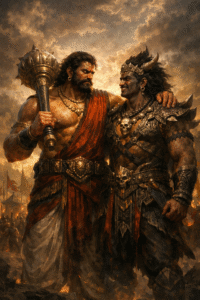
Bhima’s grief was immense.
Yet he understood his son’s destiny.
Ghatotkacha died not for fame, not for reward, but for:
- Protecting his father’s brothers
- Preserving dharma
- Ensuring justice prevailed
Few warriors in the Mahabharata achieved such spiritual greatness through sacrifice.
Lessons from Ghatotkacha’s Life
- True heroism lies in sacrifice
- Dharma is greater than personal survival
- Destiny works through unexpected instruments
- Even short lives can create eternal impact
- Victory often comes through silent sacrifices
Conclusion: Ghatotkacha — The Warrior Who Saved Arjuna
Though his life was brief and his appearance fearsome, Ghatotkacha’s sacrifice shaped the destiny of the Mahabharata.
He did not kill the most enemies.
He did not fight till the final day.
Yet his death ensured the victory of dharma.
Ghatotkacha stands immortal —
the warrior who died so that righteousness could live.
20 FAQs on Ghatotkacha (Mahabharata)
1. Who was Ghatotkacha?
Ghatotkacha was a powerful warrior in the Mahabharata, the son of Bhima and the Rakshasi Hidimba.
2. Who were the parents of Ghatotkacha?
His father was Bhima (one of the Pandavas) and his mother was Hidimba.
3. Was Ghatotkacha a Rakshasa?
Yes, he was half-Rakshasa and half-human, possessing supernatural powers.
4. What does the name Ghatotkacha mean?
In other words, it means “one with a unique head shape and hairstyle.”
5. Why is Ghatotkacha famous in the Mahabharata?
He is famous for his heroic sacrifice that forced Karna to use the divine Vasavi Shakti.
6. Which side did Ghatotkacha fight for?
During the Kurukshetra war, he fought for the Pandavas
7. What special powers did Ghatotkacha have?
He had illusion magic, night-war strength, shape-shifting, and supernatural weapons.
8. Why was Ghatotkacha powerful at night?
Rakshasas gain maximum strength after sunset, making him nearly unstoppable at night.
9. Who could defeat Ghatotkacha?
Only Karna, using the divine Vasavi Shakti, could defeat him.
10. What is Vasavi Shakti?
It was a divine weapon given to Karna by Lord Indra, usable only once.
11. Why did Karna use Vasavi Shakti on Ghatotkacha?
Because no other weapon could stop Ghatotkacha’s destruction of the Kaurava army.
12. Was Vasavi Shakti meant for Arjuna?
Yes, Karna had saved it to kill Arjuna.
13. How did Ghatotkacha’s death help the Pandavas?
His death ensured Karna lost his strongest weapon, saving Arjuna later.
14. Why did Lord Krishna smile after Ghatotkacha’s death?
Because Krishna knew Arjuna’s life was now protected.
15. On which day of the war did Ghatotkacha die?
He was killed on the 14th night of the Kurukshetra war.
16. Did Bhima mourn Ghatotkacha’s death?
Yes, Bhima was deeply grieved but accepted his son’s destiny.
17. Was Ghatotkacha a villain or hero?
He was a heroic warrior who fought for dharma despite being born a Rakshasa.
18. What lesson does Ghatotkacha teach?
That selfless sacrifice can change the destiny of the world.
19. Is Ghatotkacha worshipped?
In some regions, especially in folklore, he is honored as a protector warrior.
20. Why is Ghatotkacha considered immortal in history?
Because his sacrifice altered the entire course of the Mahabharata war.