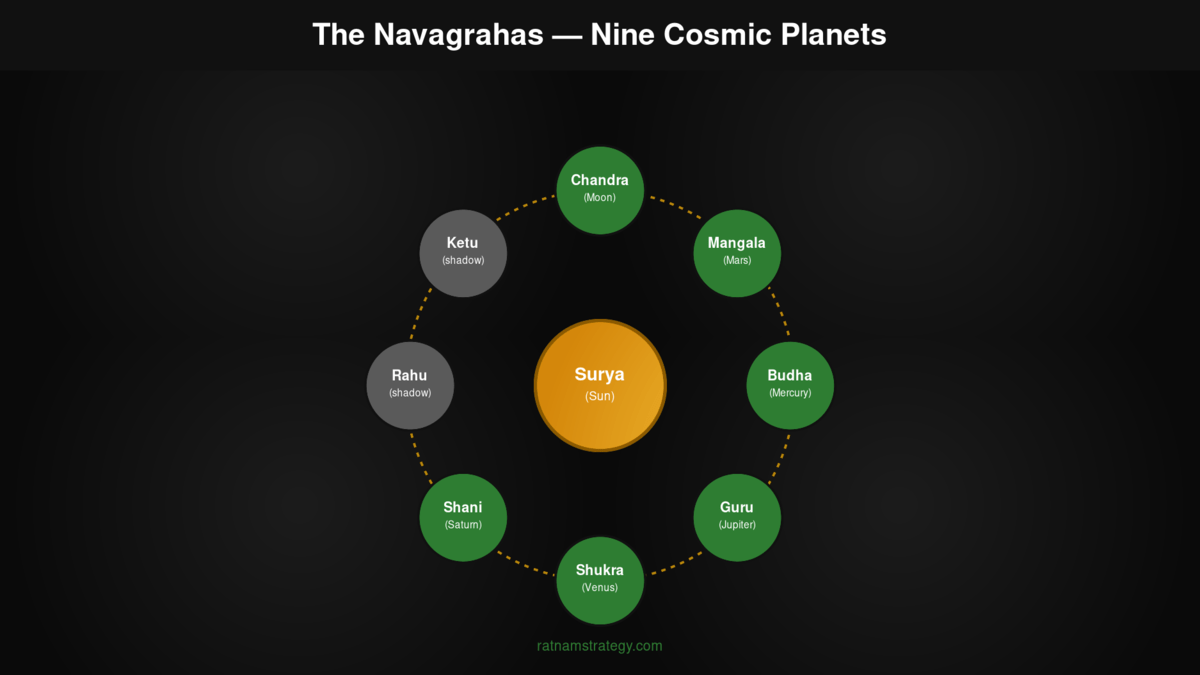
Navagrahas — Soul’s Journey is guided by the Cosmic Teacher

About the Author

Raja Ratnam is a passionate researcher and writer specializing in Indian mythology and epic stories.
With years of experience studying texts like Ramayana, Mahabharata,Navagrahas, Ketu Deva and other cultural scriptures,
he brings insightful interpretations and practical lessons from these timeless stories.

Raja Ratnam believes in making mythology accessible and meaningful for modern readers,
helping them understand the moral, ethical, and cultural significance behind characters like
Rama, Laxman, Shani Deva, and many more.

Connect with the author: info@ratnamstrategy.com

Introduction — More Than Planets, Eternal Teachers

The Navagrahas are often misunderstood as mere planets that influence fate.
In truth, they are cosmic teachers — divine forces that guide the soul through karma, experience, growth, and liberation.

The purpose of each Graha is not to punish, but to teach.
Transits are not accidents, but lessons timed by the universe.

Together, the Navagrahas form a complete spiritual syllabus for human life —
from birth and identity to desire, duty, wisdom, and finally moksha.

Surya — Awakening the Soul (Atman)

The source of life and consciousness is Surya Deva.
He teaches:

  • Self-respect
  • Discipline
  • Truth
  • Leadership
  • Inner radiance

Surya awakens the Atman, reminding us to stand in our truth and shine without fear.

Without Surya, there is no life.
Without self-awareness, there is no growth.

Chandra — Mastering the Mind

Chandra governs the mind, emotions, and inner world.
He teaches:

  • Emotional balance
  • Compassion
  • Intuition
  • Adaptability

The Moon reminds us that inner peace is more important than outer success.
A calm mind reflects the divine clearly.

Mangala — Right Action and Courage

Mangala Deva represents energy, discipline, and righteous action.
He teaches:

  • Courage without aggression
  • Discipline without cruelty
  • Strength guided by dharma

Mangala is the inner warrior —
fighting ignorance, laziness, and fear.

Guru (Brihaspati) — Wisdom and Dharma

Guru is the light of wisdom.
He teaches:

  • Moral clarity
  • Faith
  • Learning
  • Guidance
  • Grace

Without Guru, power becomes arrogance.
With Guru, life becomes meaningful.

Shukra — The Art of Living in Harmony

Shukra represents love, beauty, relationships, and grace.
He teaches:

  • Balance between pleasure and purity
  • Refinement of desires
  • Respect for relationships
  • Appreciation of beauty

Shukra reminds us that spirituality does not reject life — it refines it.

Rahu — Breaking Illusion Through Experience

Rahu is the karmic amplifier.
He teaches:

  • Awareness through confusion
  • Growth through obsession
  • Awakening through chaos

Rahu exposes false identities so that truth can emerge.
It is only ignorance that he is harsh with – not awareness.

Ketu — Liberation Through Detachment

Ketu is the final teacher.
He teaches:

  • Letting go
  • Silence
  • Inner truth
  • Moksha

To free the soul, Ketu removes attachments, not to punish.

Where Rahu pulls outward,
Ketu pulls inward.

Rahu and Ketu are the karmic axis

Rahu and Ketu together form the axis of destiny:

  • Rahu = what you must experience
  • Ketu = what you have already mastered

Life flows between these two poles —
from desire to detachment, from ignorance to realization.

Navagrahas and Free Will

The Navagrahas do not control us
they reveal our tendencies.

Astrology is not fate; it is self-knowledge.

When we understand the Grahas:

  • Fear reduces
  • Awareness increases
  • Choices become wiser
  • Karma becomes lighter

Astrology is a map, not a prison, for the enlightened.

Worship, Awareness, and Balance

True Graha Shanti is not only rituals and mantras —
it is inner alignment.

When:

  • Surya shines within
  • Chandra rests calmly
  • Mangala acts rightly
  • Guru guides wisely
  • Shukra loves purely
  • Rahu is observed
  • Ketu is surrendered to

Life flows in harmony.

Final Reflection — From Cosmos to Consciousness

The Navagrahas are not outside us —
they are within us.

They move in the sky
as they move in the psyche.

To study the Navagrahas
is to study life itself.

Closing Blessing

May Surya light your path
May Chandra calm your mind
May Mangala give you courage
May Guru bless you with wisdom
May Shukra fill your life with love
May Rahu awaken awareness
May Ketu guide you to moksha

🙏 Om Navagrahaya Namah 🙏

  • Admin

    Hi, I’m Raja Ratnam. Based in Hydrabad, Telangana, I’m a content creator and strategist with a passion for Indian history, Hindu festivals and WordPress website design. Over the past X years I’ve developed high-impact GK quiz content in Telugu, written devotional blog posts in both English and Telugu (covering puja vidhanams, vrat kathas and festival traditions), and built easy-to-use Elementor/WordPress templates for service-oriented businesses. I started this blog, Ratnam Strategy, because as a student I often struggled to find quality study material in my preferred language. At the same time, I felt there was a gap in how festival guides were shared online — so I decided to document detailed gaudy-free posts anyone can follow. With a background in website development, I also wanted to share templates and tips for small businesses who need a professional online presence without the hassle. On this site you’ll find: Full-length GK quiz packs in Telugu — especially focused on Indian history and competitive exam prep. Devotional blogs in English (and sometimes Telugu) about major Hindu festivals, complete with puja steps, vrat stories and celebration ideas. Ready-to-use Elementor/WordPress templates for service websites — including my own trailering service niche. If you’re prepping for exams, exploring festival rituals or building a website for your service business — you’re in the right place. Feel free to browse my latest posts and templates, or get in touch at ratnampasalapudi@gmail.com / 7892211516 for custom help. When I’m not writing quizzes or building templates, I love visiting historic sites around Secunderabad and experimenting with new design tools. Let’s make strategy simple, meaningful and fun!

    Related Posts

    Ketu Deva — The Planet of Moksha, Detachment, and Spiritual Awakening

    About the Author Raja Ratnam is a passionate researcher and writer specializing in Indian mythology and epic stories.With years of experience studying texts like Ramayana, Mahabharata, Navagraha’s Ketu Deva and other cultural scriptures,he brings insightful interpretations and practical lessons from these timeless stories. Raja Ratnam believes in making mythology accessible and meaningful for modern readers,helping them understand the moral, ethical, and cultural significance behind characters likeRama, Laxman, Shani Deva, and many more. Connect with the author: info@ratnamstrategy.com Introduction — The Silent Force of Liberation Among the Navagrahas, Ketu is the most silent, mysterious, and spiritually potent graha.He does not create noise, fame, or desire — instead, he cuts attachments, dissolves ego, and pushes the soul toward liberation (Moksha). If Rahu binds the soul to illusion and desire,Ketu frees the soul through detachment and realization. Ketu represents: Ketu does not give pleasure —he gives truth. Mythological Origin of Ketu Deva The origin of Ketu is inseparable from Rahu and the great event of Samudra Manthan. When the Asura Svarbhanu disguised himself and drank Amrita,Lord Vishnu severed his body with the Sudarshana Chakra. Unlike Rahu, who retained desire and hunger,Ketu was left without a head — symbolizing ego-less existence. Thus, Ketu became: Scriptures describe…

    Rahu Deva — The Shadow Planet of Illusion, Obsession, and Transformation

    About the Author Raja Ratnam is a passionate researcher and writer specializing in Indian mythology and epic stories.With years of experience studying texts like Ramayana, Mahabharata, Navagraha’s Rahu Deva and other cultural scriptures,he brings insightful interpretations and practical lessons from these timeless stories. Raja Ratnam believes in making mythology accessible and meaningful for modern readers,helping them understand the moral, ethical, and cultural significance behind characters likeRama, Laxman, Shani Deva, and many more. Connect with the author: info@ratnamstrategy.com Introduction — Rahu Deva It is the invisible force that shapes destiny Among the Navagrahas, Rahu Deva is the most mysterious, feared, and misunderstood force.He has no physical body, no light of his own — yet his influence is powerful enough to alter destinies, create kings, destroy empires, and awaken souls. Rahu represents: If Surya gives clarity and Mangala gives action,Rahu tests the soul by blurring truth — forcing growth through confusion. Rahu is not evil.He is the teacher of hidden karma. Mythological Origin of Rahu Deva The origin of Rahu comes from the legendary Samudra Manthan (Churning of the Ocean of Milk). When the Devas and Asuras churned the ocean for Amrita (nectar of immortality), Lord Vishnu appeared as Mohini to distribute…

    Leave a Reply

    Your email address will not be published. Required fields are marked *

    You Missed

    A Model of Ethical Governance: Rama Rajya Explained

    • By Admin
    • January 13, 2026
    • 72 views
    A Model of Ethical Governance: Rama Rajya Explained

    Makar Sankranti: Significance, Traditions, Rituals, and Celebrations Across India

    • By Admin
    • January 9, 2026
    • 148 views
    Makar Sankranti: Significance, Traditions, Rituals, and Celebrations Across India

    In the Mahabharata, Vidura is seen as the wisest man and the voice of Dharma for all time

    • By Admin
    • January 8, 2026
    • 148 views
    In the Mahabharata, Vidura is seen as the wisest man and the voice of Dharma for all time

    Satyavati in Mahabharatam – The Woman Who Shaped Destiny

    • By Admin
    • January 6, 2026
    • 172 views
    Satyavati  in Mahabharatam – The Woman Who Shaped Destiny

    Goddess Ganga in Mahabharatam: Divine Mother, Sacred River & Symbol of Liberation

    • By Admin
    • January 5, 2026
    • 165 views
    Goddess Ganga in Mahabharatam: Divine Mother, Sacred River & Symbol of Liberation

    King Shantanu in the Mahabharata: Life, Love, Dharma, and Legacy

    • By Admin
    • January 4, 2026
    • 115 views
    King Shantanu in the Mahabharata: Life, Love, Dharma, and Legacy
    Translate »